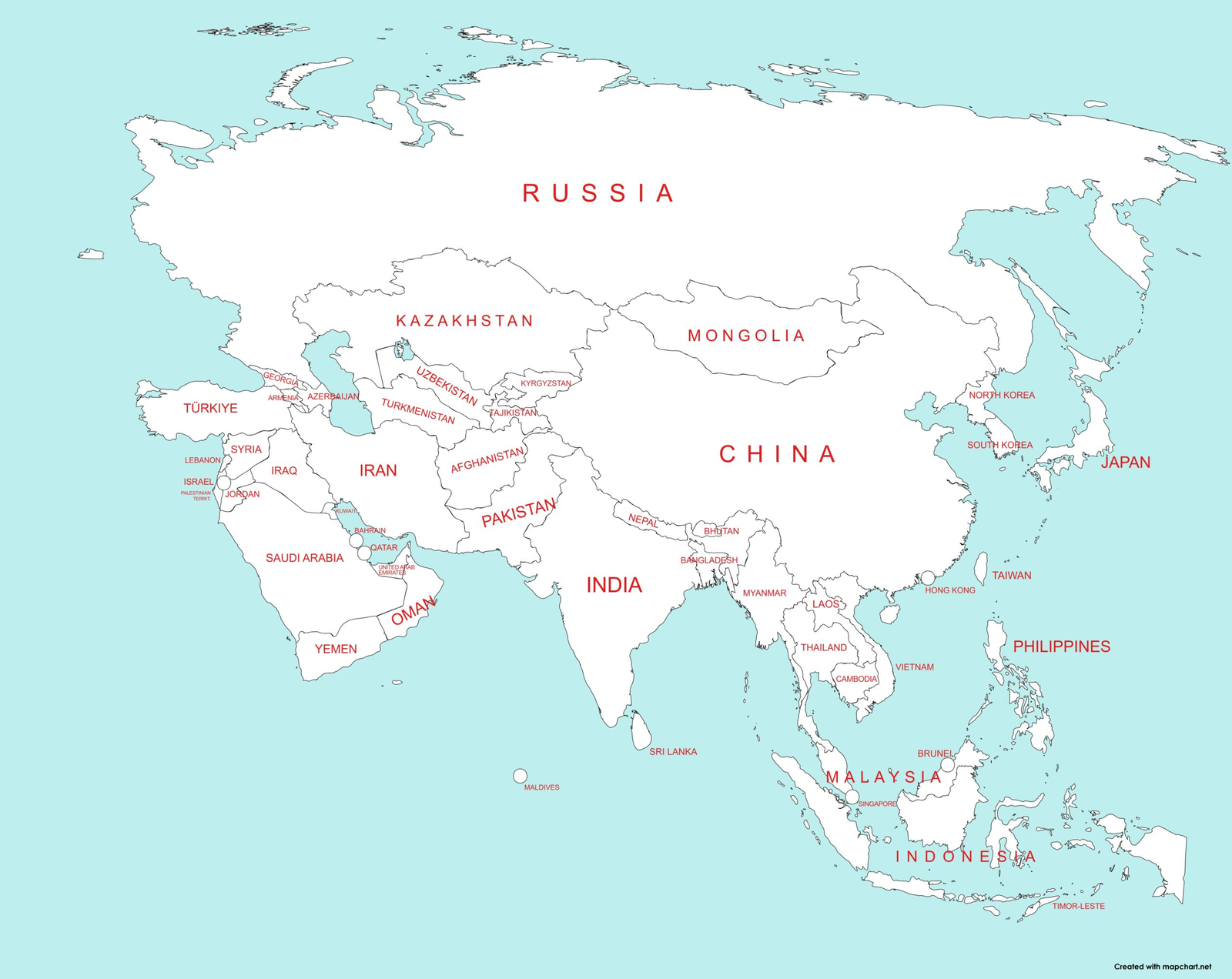
ASIA
Contents
ASIA:
1. EXTENT OF ASIA
Asia is the world’s largest continent, covering approximately 44,444,100 square kilometers (17,212,048 square miles), representing roughly 30% of Earth’s total land area and about 8.7% of the Earth’s total surface area. The continent accounts for approximately 60% of the world’s total population, with over 4.5 billion people.
Boundaries of Asia:
North: Arctic Ocean
East: Pacific Ocean
South: Indian Ocean and Red Sea
West: Ural Mountains (boundary with Europe), Caucasus Mountains, and Mediterranean Sea
The total land area includes approximately 1,240,000 square kilometers (3,210,000 square miles) of island territories, representing about 7% of Asia’s total area. These islands include Taiwan, Japan, Indonesia, Sakhalin, Sri Lanka, Cyprus, and numerous smaller island formations.
2. REGIONAL DIVISIONS OF ASIA WITH COUNTRY NAMES
Asia is traditionally divided into six major physiographic regions:
A. East Asia
Countries: China, Hong Kong, Japan, North Korea, South Korea, Macau, Mongolia, Taiwan
Population: Approximately 1.69 billion people
Land Area: 7,356,459 sq km
Characteristics: Includes the world’s most densely populated regions, particularly along the Pacific coast. Major economic centers including Beijing and Tokyo.
B. North Asia (Siberia)
Countries: Russia (Asian portion including Siberia and Russian Far East)
Characteristics: Vast expanse covering approximately 77% of Russian territory. Dominated by tundra, taiga, and permafrost regions. Contains Lake Baikal, the world’s deepest freshwater lake.
C. Central Asia
Countries: Kazakhstan, Kyrgyzstan, Tajikistan, Turkmenistan, Uzbekistan, Afghanistan
Population: Approximately 77 million people
Land Area: 2,487,629 sq km
Characteristics: Landlocked region west of China, south of Russia, and north of Afghanistan. Located along the historic Silk Road. High elevation plateaus and mountain ranges dominate.
D. South Asia (Indian Subcontinent)
Countries: India, Pakistan, Nepal, Sri Lanka, Bhutan, Bangladesh, Maldives
Population: Approximately 1.99 billion people
Land Area: 3,218,688 sq km
Characteristics: Diverse topography ranging from the Himalayas to the Deccan Plateau. Home to the world’s largest monsoon region. Highly fertile river plains.
E. Southeast Asia
Mainland: Myanmar, Cambodia, Laos, Thailand, Vietnam, Malaysia, Singapore
Maritime: Brunei, Indonesia, East Timor (Timor-Leste), Philippines
Population: Approximately 684 million people
Land Area: 2,792,406 sq km
Characteristics: Divided into mainland and island zones. Rich in tropical vegetation and biodiversity. Strategic location between Indian and Pacific Oceans.
F. West Asia (Middle East)
Countries: Afghanistan, Armenia, Azerbaijan, Bahrain, Cyprus, Georgia, Iran, Iraq, Israel, Jordan, Kuwait, Lebanon, Oman, Palestine, Qatar, Saudi Arabia, Syria, Turkey, United Arab Emirates, Yemen
Population: Approximately 290 million people
Land Area: 3,886,565 sq km
Characteristics: Bridge between Europe and Asia. Rich in oil and natural gas reserves. Ancient civilizational cradle with significant geopolitical importance.
3. MAJOR PHYSICAL DIVISIONS OF ASIA
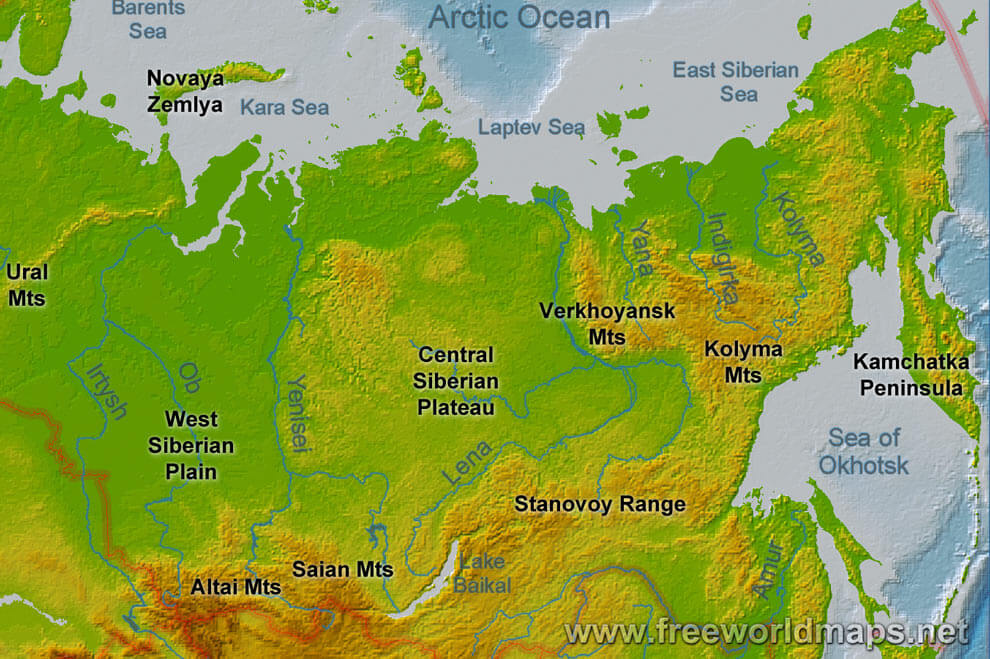
A. NORTHERN LOWLANDS (The Great Siberian Plain)
The Northern Lowlands represent the largest lowland region in the world, extending across northern Asia.
Key Features:
Extent: Stretches from the Urals in the west to the Pacific Ocean in the east, covering millions of square kilometers
Formation: Developed from Cenozoic alluvial deposits and glacial deposits from the Quaternary Period
Shape: Triangular configuration, widest in the west and tapering toward the east
Elevation: Relatively low and flat, with gentle slopes
Drainage Systems:
Three major river systems drain the Northern Lowlands:
Ob River: Flows northward into the Arctic Ocean; supports development of swamps and floodplains
Yenisei River: Second major drainage system of northern Asia
Lena River: Easternmost major river of the northern lowlands
Hydrological Characteristics:
Rivers remain frozen at their mouths during winter, causing water from upper courses (in warmer latitudes) to spread across the plains
Results in extensive marshy and swampy terrain
Contains Lake Baikal (world’s oldest and deepest lake), located in the south-central portion
Presence of extensive permafrost zones, with some areas showing depths exceeding 300-400 meters
Geological Significance:
Contains enormous areas of permafrost (~4.25 million square miles), the largest concentration anywhere on Earth
Permafrost restricts vegetation growth and affects land stability
The region experiences minimal snowfall despite cold temperatures due to arid conditions
Ancient glaciation traces still visible in landscape features
Plains in Asia
| Region/Plain | Rivers | Area | Boundaries | Countries |
|---|---|---|---|---|
| Indo-Gangetic Plain (North Indian River Plain) | Indus, Ganga, Brahmaputra and tributaries (Beas, Yamuna, Gomti, Ravi, Chambal, Sutlej, Chenab, Dibang, Lohit, Siang, Tista, Dhansari) | 700,000 km² (270,000 sq mi) | North: Shiwalik Range; South: Peninsular Plateau; West: Desert (Thar); East: Puruvachal Hills | India, Pakistan, Nepal, Bangladesh, Bhutan |
| West Siberian Plain | Ob, Irtysh, Yentsey and tributaries | ~1,200,000 sq mi (3,000,000 km²) | North: Kara Sea; South: Torghay Plateau, Kazakh Uplands, Altai Mountains; West: Ural Mountains; East: Yenisey River valley | Russia, Kazakhstan |
| Great Siberian Plain (Northern Lowlands) | Lena River (eastern portion); various northern rivers | ~1,200,000 sq mi total Siberian region; ~5.2 million sq mi broader region | North: Arctic Ocean; South: Kazakhstan, Mongolia, China; West: Ural Mountains; East: Pacific Ocean | Russia |
| Mesopotamian Plain (Tigris-Euphrates) | Tigris, Euphrates | ~880,000 km² (340,000 sq mi) basin area; lower alluvial plain is the main plain | Between the two rivers in lower course; central Iraq region extends to Persian Gulf | Iraq, Turkey, Syria, Iran, Kuwait |
| Turan Plain | Amu Darya, Syr Darya, Zeravshan, Tejen, Murghab, Tedzhen, Karakum Desert region | Extensive; encompasses much of Central Asian interior | Bounded by Pamir Mountains (north/east), Hindu Kush (south), Caspian Sea region (west) | Kazakhstan, Uzbekistan, Turkmenistan, Afghanistan, Kyrgyzstan |
| Great Plains of China | Huang Ho (Yellow River), Yangtze (Chang Jiang), Sikiang | ~158,000 sq mi approx. (Great Plains portion) | Flows to Pacific Ocean; bounded by mountain ranges | China |
| Manchurian Plain (Northeast Plain) | Amur River and tributaries, Sungari, Liao rivers | ~135,000 sq mi | North: Russia; East: Pacific/Sea of Japan; West: Da Hinggan Range; South: Korea | China, Russia |
| Irrawaddy Plain (Myanmar Central Basin) | Irrawaddy, Chindwin (tributary) | ~404,000 km² drainage basin (61% of Myanmar’s land area) | North: Upper highlands; South: Irrawaddy Delta to Andaman Sea; East: Pegu Mountains; West: Arakan Mountains | Myanmar (Burma) |
| Mekong Plain (Southeast Asia) | Mekong River, Tonle Sap | ~795,000 km² basin area | Runs through multiple countries; forms Laos-Thailand border for ~850 km; Mekong Delta in Vietnam | China (Yunnan), Myanmar, Laos, Thailand, Cambodia, Vietnam |
B. CENTRAL MOUNTAINS
The Central Mountains constitute the world’s most extensive and complex mountain system, representing the backbone of Asian topography.
Mountain Ranges and Systems:
1. The Himalayan System:
Extent: Approximately 2,400 km long and 200-240 km wide
Formation: Result of collision between Indo-Australian and Eurasian tectonic plates (over 50 million years ago)
Ongoing Process: The Himalayas continue to grow approximately 2 inches (5 cm) annually due to ongoing tectonic collision
Highest Peak: Mount Everest (8,849 meters), the world’s highest mountain
Surrounding Peaks: Contains numerous peaks exceeding 7,000 meters
Geographic Spread: Extends across China, Nepal, Bhutan, and India
Significance: Acts as a climatic barrier, influencing monsoon patterns and precipitation distribution
2. The Hindu Kush Range:
Length: Approximately 800 kilometers
Geographic Location: Central and South Asia, west of the Himalayas
Extent: Stretches from central Afghanistan through northwestern Pakistan to southeastern Tajikistan
Highest Peak: Tirich Mir/Terichmir (7,708 meters/25,289 feet) in Chitral, Pakistan
Character: Numerous high snow-capped peaks; average heights 4,500 meters
Divisions: Three main sections—Eastern, Central, and Western Hindu Kush; sometimes includes Hindu Raj
Significance: Divides the Amu Darya valley (north) from the Indus River valley (south)
3. The Karakoram Range:
Location: North of the Himalayas, between Himalayas and Hindu Kush
Key Features: Mountain and plateau regions to the east and northeast
Second Highest Peak: Godwin Austen (K2) at 8,611 meters
Notable Feature: Ladakh Plateau lies between Karakoram and Himalayas
4. Other Major Mountain Ranges:
Tien Shan: Complex mountain system of Central Asia with significant elevation
Altai Mountains: Located in southern Siberia and Mongolia; contain contemporary glaciers
Sayan Mountains: Alpine ranges showing evidence of ancient glaciation
Pamirs: Massive highland region with extensive mountain systems
Kunlun Mountains: Major range south of the Taklamakan Desert
Mountain Knots:
Mountain knots represent junctions where two or more mountain ranges converge
Create extremely complex topography with deep gorges and valleys
Examples include regions where Himalayas, Hindu Kush, and Karakoram meet
Geological Features:
Formation primarily through folding and faulting processes
Presence of deep superimposed gorges and canyons carved by major rivers
Example: Yarlung Tsangpo Grand Canyon in Tibet exceeds 5,300 meters in depth (deeper than Grand Canyon)
Karst topography present in limestone terrain regions
Extensive eolian (wind-produced) relief features due to high altitudes and exposure
C. CENTRAL AND SOUTHERN PLATEAUS
The plateau regions constitute vast elevated landforms with distinctive characteristics and significant geographic importance.
1. Tibetan Plateau (The Roof of the World): (Click here for map)
Status: Highest and largest plateau in the world
Elevation: Average elevation exceeding 4,600 meters, with some areas reaching 5,000+ meters
Area: Approximately 2 million square kilometers
Geographic Coverage: Spans Tibet (China), Qinghai Province, and portions of Ladakh (Jammu and Kashmir, India)
Formation: Result of collision between Indo-Australian and Eurasian tectonic plates
Surrounding Mountains:
South: Himalayan Range
Northeast: Tibetan mountain systems
North and West: Kunlun and Pamir ranges
Climate Significance:
Sufficiently elevated to reverse Hadley cell convection cycles
Directly drives monsoon circulation affecting Indian subcontinent’s climate
Acts as “Third Pole” with significant climate implications
Water Tower Function: Serves as source for major Asian rivers including Indus, Yangtze, Brahmaputra, and Mekong
Topography: Mix of flat areas, moderate relief, and enclosed basins
Sub-regions: Contains intermontane basins like Kashgaria, Junggar, Qaidam, and Fergana
2. Deccan Plateau:
Location: Forms most of southern peninsular India
Area: Covers approximately 500,000 square kilometers
Elevation: Raised table land with average elevation of 600-900 meters
Boundaries:
Western boundary: Western Ghats mountain range
Eastern boundary: Eastern Ghats mountain range
Composition: Primarily basaltic lava flows forming the Deccan Traps
Formation: Result of massive volcanic eruptions 60-65 million years ago
Geological Age: Represents one of the largest volcanic features on Earth
Mineral Resources: Rich in minerals including mica, iron ore, diamonds, and gold
Fertility: Productive region supporting significant agricultural activities
Characteristics: Black soil (regur soil) particularly fertile for cotton and cereals
3. Other Significant Plateaus:
Central Siberian Plateau: Complex system of plateaus and stratified plains uplifted during Cenozoic era
Gobi Plateau: Semi-arid plateau in Mongolia and China; extensive grasslands and desert regions
Ustyurt Plateau: Located in Central Asia
Iranian Plateau: Extensive high plateau in West Asia
Anatolian Plateau: In Asia Minor (Turkey region)
Plateau Characteristics:
Elevated areas with flat or gently rolling surfaces
Often surrounded by mountain ranges
Elevations typically 2,600-4,900 feet (800-1,500 meters) for lower plateaus
Higher intermontane plateaus reach 12,000+ feet (3,700+ meters)
Subject to erosional dissection creating mountainous terrain in some areas
Many contain valuable mineral deposits and support specialized vegetation
D. PENINSULAS
Peninsulas represent significant landforms projecting into oceans and seas, influencing climate, trade, and settlement patterns.
1. Indian Peninsula (Deccan Peninsula):
Status: Second-largest peninsula in the world
Area: Covers most of southern India
Boundaries:
West: Arabian Sea
East: Bay of Bengal
South: Indian Ocean
States Included: Approximately eight Indian states
Economic Activities: Predominantly agricultural with rice, cotton, and spices
Geographic Features: Plateau region bounded by Western and Eastern Ghats
2. Indochinese Peninsula (Mainland Southeast Asia):
Extent: Projects southward from Asian continent
Geographic Scope: Extends from South China Sea to Bay of Bengal
Countries Included: Myanmar, Thailand, Laos, Cambodia, Vietnam, and Peninsular Malaysia
Dimensions: Broad expanses with significant north-south extension
Topography:
Northern portion: Mountainous terrain from Tibetan Plateau extension
Southern portion: Hilly landscapes but lower elevations
Broad plains separating highland regions
Boundaries:
West: Indian Ocean
East: Pacific Ocean
Major Mountain Ranges: Several mountain systems including Shan Hills, Annamite Range, and Cardamom Mountains
Drainage Systems: Three major river systems:
Irrawaddy (Myanmar)
Chao Phraya (Thailand)
Mekong (flowing through multiple countries)
3. Malay Peninsula:
Characteristics: Narrower than Indochinese Peninsula; extends southward from Indochina
Terminus: Southern point at Singapore island
Regional Portion: Extends through southern Thailand and peninsular Malaysia
Strategic Location: Controls access between Indian and Pacific Oceans
4. Arabian Peninsula:
Geopolitical Significance: Holds vast oil and natural gas reserves despite largely unsuitable terrain for agriculture
Boundaries: Red Sea, Persian Gulf, Arabian Sea
Dominant Landscape: Desert terrain with limited arable land
E. DESERTS
Asian deserts represent vast arid regions with minimal precipitation, distinctive flora and fauna, and significant geographic challenges.
1. Gobi Desert:
Location: Central Asia, primarily in Mongolia and China
Area: Approximately 1,300,000 square kilometers
Character: Semi-arid plateau with grasslands interspersed with desert regions
Terrain: Rocky plains with occasional sand dunes
Significance: Large but not as vast as Sahara; extends across international borders
2. Arabian Desert:
Location: Arabian Peninsula
Area: Approximately 850,000 square kilometers
Character: Extensive sandy desert region
Sub-regions: Includes Rub al Khali (Empty Quarter), one of world’s largest sand deserts—larger than Sahara in sand content
Climate: Extremely arid with rare precipitation
3. Kara Kum Desert:
Location: Central Asia (Turkmenistan)
Area: Approximately 310,000 square kilometers
Character: Sandy desert with limited vegetation
4. Taklamakan Desert:
Location: Western China (Xinjiang region)
Character: Enclosed desert basin
Significance: Part of major precipitation minimum belt
5. Thar Desert:
Location: Border region between India and Pakistan (Rajasthan, Kutch)
Characteristics: Hot, arid desert with seasonal precipitation variations
Rainfall: Less than 200 mm annually with hazardous precipitation patterns
Temperature: Cool winters; mean temperature of coldest month below 15°C
Associated Feature: Rann of Kutch—salt marsh region to the south
6. Other Desert Regions:
Kyzyl Kum: Central Asian desert
Karakul: Desert region in Afghanistan/Tajikistan border
Atacama: Arid regions of northwestern China
Various smaller desert pockets throughout arid belts
Precipitation Patterns:
A major “rainfall minimum” belt stretches from Gobi Desert (Mongolia) through Taklamakan (Western China), Thar Desert (Western India), Iranian Plateau, to Arabian Desert (Arabian Peninsula). This continuous arid zone represents one of Earth’s most substantial precipitation deficiency regions.
F. ISLAND GROUPS
Asia contains the world’s largest and most numerous island systems, spanning multiple climatic and geographic zones.
1. Indonesian Archipelago (Malay Archipelago – Largest Island Group):
Total Islands: More than 17,000 islands (world’s largest archipelago)
Land Area: 1,919,440 square kilometers
Status: Independent republic
Capital: Jakarta (on Java island)
Largest Island: Sumatra (443,044 sq km)
Most Populated Island: Java—world’s most populated island with approximately 138 million people
Major Island Groups:
Greater Sundas: Sumatra, Java, Borneo, Celebes
Lesser Sundas: Multiple islands east of Java
Moluccas: Eastern archipelago region
Western New Guinea: Shared with Papua New Guinea
Extent: Stretches along equator for more than 3,800 miles; extends 2,200 miles north-south
Surrounding Seas: Sulu, Celebes, Banda, Molucca, Java, Flores, Savu seas
Characteristics: Primarily volcanic origin; subject to earthquake and volcanic activity
Biodiversity: Extreme diversity due to tropical location and island isolation
2. Philippine Archipelago:
Total Islands: Approximately 7,107 islands
Land Area: 299,764 square kilometers
Status: Independent republic
Major Islands:
Luzon (northern)
Mindanao (southern)
Visayas (central group)
Characteristics: Primarily volcanic; mountainous terrain dominates major islands
Strategic Location: Between South China Sea and Pacific Ocean
3. Japanese Archipelago:
Total Islands: Thousands of islands (four major islands)
Major Islands: Honshu, Hokkaido, Kyushu, Shikoku
Characteristics: Highly mountainous, volcanic arc; prone to earthquakes and tsunamis
Population Concentration: Predominantly urban; major cities include Tokyo, Osaka, Kyoto
Climate: Ranges from subtropical to temperate
4. Malaysian Island Groups:
Total Islands: Approximately 30,000 islands
Land Area: 329,847 square kilometers
Major Regions: Peninsular Malaysia and Malaysian Borneo (Sabah and Sarawak)
Island Groups: Distributed across major archipelago systems
5. Asian Russian Islands:
Sakhalin: Large island off Russian Far East
Kamchatka Peninsula: Contains numerous volcanic features
New Siberian Islands: Northern Arctic islands
Kuril Islands: Volcanic island chain
6. Taiwan (Formosa):
Area: Approximately 36,000 square kilometers
Characteristics: Mountainous island; subtropical to tropical climate
Strategic Location: Separates South China Sea from Pacific
7. Sri Lanka:
Location: South of Indian peninsula
Area: Approximately 65,610 square kilometers
Characteristics: Island nation; tropical climate; significant agricultural production
Significance: Historical trade hub on major ocean routes
8. Other Island Groups:
Andaman and Nicobar Islands: Indian territories in Bay of Bengal
Maldives: Atoll islands in Indian Ocean; world’s smallest Asian country (120 sq km)
Brunei: Small island nation in Southeast Asia
Singapore: Island city-state at southern tip of Malay Peninsula
Cypr: Mediterranean island (divided)
Island Formation Mechanisms:
Volcanic Origin: Indonesia and Philippines formed by collision of Indo-Australian and Philippine tectonic plates
Seismic Activity: Extensive earthquake and volcanic zones
Natural Disasters: Over 100,000 Indonesians killed in recent decades by earthquakes, volcanoes, and tsunamis
Coral Formations: Atoll islands in tropical regions
G. THE GREAT RIVER PLAINS
Asia’s river plains represent among Earth’s most fertile and densely populated regions, supporting billions of people.
1. The Ganges-Brahmaputra Plain:
Rivers: Ganges (Ganga) and Brahmaputra river systems
Geographic Scope: Primarily in northern India and Bangladesh; also extends into Nepal
Combined Drainage Basin: 668,000 square kilometers (largest in Asia)
Countries: China, India, Bangladesh
Length of Ganges: Approximately 1,560 miles (2,511 km)
Length of Brahmaputra: Approximately 1,765 miles (2,840 km)
Source: Both originate in Tibetan Plateau region
Formation: Alluvial deposits from glacial meltwater and seasonal flooding
Soil Characteristics: Extremely fertile alluvial and silty soils
Agricultural Significance: World’s most productive agricultural region; supports rice, wheat, pulses, and other cereals
Population: Supports over 400 million people
Features: Broad floodplains, extensive deltaic regions, seasonal flooding patterns
Ganga Delta: World’s largest delta region (Sundarbans in Bangladesh)
2. The Yangtze River Plain:
River: Yangtze (Chang Jiang)—longest river in Asia and third-longest in world
Length: 6,300 kilometers (3,915 miles)
Drainage Basin: 454,000 square kilometers
Countries: China (entire river system within China)
Geographic Spread: Flows through central and eastern China into Pacific Ocean
Terrain:
Upper course: Deep gorges and canyons through high plateaus
Middle course: Broad plains and agricultural regions
Lower course: Fertile deltaic regions
Notable Feature: Yarlung Tsangpo Grand Canyon (upstream) exceeds 5,300 meters in depth
Agricultural Importance: Major rice-producing region
Industrial Significance: Industrial and commercial backbone of China
Major Cities: Shanghai, Wuhan, Chongqing
Biodiversity: Hotspot for endemic species; home to endangered Yangtze sturgeon
3. The Indus River Plain:
River: Indus River (Sindhu)
Length: 3,610 kilometers (2,243 miles)
Drainage Basin: 1,165,000 square kilometers
Countries: China, India, Pakistan
Geographic Scope: Originates in Tibetan Plateau, flows through Kashmir, Pakistan
Terrain:
Upper course: Dramatic gorges as it exits Tibetan Plateau
Middle course: Alluvial plains in Pakistan
Lower course: Deltaic regions
Navigation: Critical for water supply and irrigation
Historical Importance: Cradle of Indus Valley Civilization
Agricultural Role: Major irrigation-dependent agricultural region
4. The Mekong River Plain:
River: Mekong (Mother of Waters)
Length: 4,909 kilometers (3,050 miles)
Drainage Basin: Approximately 795,000 square kilometers
Countries: China, Myanmar, Laos, Thailand, Cambodia, Vietnam
Source: Tibetan Plateau
Course: Flows southward through mainland Southeast Asia
Features: Deep canyons in upper course; extensive deltaic plains in lower Mekong
Delta: Mekong Delta in Vietnam—world’s second-largest delta; extremely fertile
Agricultural Significance: Rice bowl of Southeast Asia
Population: Supports over 70 million people in delta region alone
Seasonal Flooding: Predictable annual flooding supports agriculture
5. The Yellow River (Huang He) Plain:
River: Yellow River (Huang He)
Length: 5,464 kilometers (3,395 miles)
Drainage Basin: 378,000 square kilometers
Countries: China
Characteristics: Second-longest river in China; carries high sediment load (source of yellow color)
Historical Role: “Cradle of Chinese civilization”
Plain Development: Alluvial plains in lower course
6. Other Significant River Plains:
Chao Phraya Plain (Thailand): Major rice-producing region
Pearl River Delta (China): Major economic center
Irrawaddy Plain (Myanmar): Primary agricultural region
Red River Delta (Vietnam): Densely populated region
Salween River Valley: Flows through Myanmar and Thailand
River Characteristics:
Source Regions: Majority originate in Tibetan Plateau (Asia’s Water Tower)
River Systems: Support approximately 3 billion people downstream
Drainage Patterns: Three major ocean outlets (Pacific, Indian, Arctic) plus endorheic basins (Amu Darya, Syr Darya, Tarim)
Glacial Feed: Meltwater from glaciers and snowfields sustains rivers through dry seasons
Mythological Importance: Many rivers hold religious and cultural significance (Ganges, Indus, Yellow River)
4. CLIMATE AND NATURAL VEGETATION OF ASIA
CLIMATE CLASSIFICATION
Asia exhibits the world’s most diverse climate systems due to its vast size, varied topography, and different latitudinal positions.
Major Climate Types:
Equatorial Climate
Location: Parts of Indonesia and maritime Southeast Asia
Characteristics: Year-round warmth, high precipitation, no distinct seasons
Vegetation: Tropical rainforests
Tropical Monsoon Climate
Location: South and Southeast Asia
Characteristics: Warm, wet summers; dry winters; significant seasonal variation
Precipitation: Concentrated during summer monsoon season (June-September)
Affected Regions: Indian subcontinent, Indochinese Peninsula
Tropical or Hot Desert Climate
Location: Arabia, parts of western India (Thar Desert), northwestern China
Characteristics: Hot throughout year; extremely low precipitation (often less than 200mm annually)
Temperature: Average temperatures exceed 20°C year-round
Vegetation: Sparse desert vegetation; scanty grass and shrubs
Warm Temperate Eastern Margin Climate (China-type)
Location: East China, Korea, Japan southern regions
Characteristics: Hot summers, mild winters; moderate precipitation
Season: Influenced by East Asian monsoon
Vegetation: Deciduous and mixed forests
Temperate or Mid-latitude Desert Climate
Location: Central Asia, interior western China
Characteristics: Continental; extreme temperature ranges; low precipitation
Winters: Cold with occasional snow
Summers: Very hot and dry
Mediterranean Climate
Location: Eastern Mediterranean coast (Cyprus, Lebanon, parts of Turkey)
Characteristics: Hot, dry summers; mild, wet winters
Vegetation: Scrubland and drought-resistant species
Cool Temperate Eastern Margin Climate
Location: Japan (northern), Korea (northern), southern Russia
Characteristics: Distinct seasons; cold winters; moderate summers
Precipitation: Throughout year; concentrated in summer
Temperate Grassland or Steppe Climate
Location: Mongolia, portions of Siberia, Central Asia
Characteristics: Continental; moderate precipitation; grassy vegetation
Temperature Variation: Extreme between seasons
Vegetation: Grasslands and shrub steppe
Cold Temperate or Taiga Climate
Location: Central and Northern Siberia
Characteristics: Very cold winters; short summers; limited precipitation
Permafrost: Extensive areas of permanently frozen ground
Vegetation: Coniferous forests
Arctic or Tundra Climate
Location: Far northern Siberia and Arctic regions
Characteristics: Extremely cold; minimal precipitation; long dark winters
Vegetation: Low-growing tundra vegetation
MONSOON SYSTEMS
Monsoons dominate Asian climate patterns, particularly in southern and eastern regions.
Asian Monsoon Sub-systems:
1. South Asian Monsoon (Indian Monsoon):
Mechanism: Results from differential heating of Indian subcontinent and Indian Ocean
Period: June to September (southwest/summer monsoon)
Process: Heating of northern/central Indian subcontinent creates low-pressure area; winds blow from Indian Ocean toward landmass
Characteristics: Warm, rainy summers; concentrated rainfall in belt running east-west across subcontinent
Dry Season: December to early March (northeastern monsoon); high-pressure system generates northeasterly winds
Impact: Most significant climate driver for South and Southeast Asia
Affected Regions: Indian subcontinent, Indochinese Peninsula, Malay Peninsula
2. East Asian Monsoon:
Extent: Affects southern China, Korea, parts of Japan
Character: Warm, rainy summer monsoon; cold, dry winter monsoon
Pattern: Rain occurs in concentrated belt stretching east-west (except east China where tilted east-northeast over Korea/Japan)
Progression: From May-August, monsoon shifts through dry and rainy phases
May: Rain over Indochina and South China Sea
June: Yangtze River Basin and Japan
July: North China and Korea
August: Monsoon ends, rain belt shifts back southward
Duration: Affected by subtropical jet stream behavior
3. Western Disturbances:
Location: West and Central Asia
Characteristics: Winter precipitation system bringing snow to northern regions
Duration: November to March
PRECIPITATION PATTERNS
High Precipitation Regions:
Western coasts of Indian Peninsula (interrupted by Western Ghats)
Eastern Himalayas and mountain ranges of Myanmar, Cambodia
Coastal Southeast Asia
Eastern China
Japan
Rainfall Minimum Belt:
Stretches from Gobi Desert (Mongolia) through Taklamakan (Western China), Thar Desert (India), Iranian Plateau, to Arabian Desert—continuous arid zone representing Earth’s most substantial precipitation deficiency
Extreme Precipitation Records:
Mawsynram (Meghalaya, India): 11,872 cm annually (one of world’s wettest places)
Cherrapunji (India): Also extremely high annual rainfall
NATURAL VEGETATION ZONES
1. Tropical Rainforests (Equatorial Vegetation):
Location: Maritime Southeast Asia, parts of Indonesia, Philippines, coastal regions
Characteristics: Dense, evergreen, multi-layered vegetation; year-round growth
Biodiversity: Extremely high species diversity
Climate Requirement: High year-round temperature and precipitation
Soil: Laterite soils under high moisture
Species: Hardwood trees, vines, orchids, diverse fauna
2. Tropical Deciduous and Moist Deciduous Forests:
Location: Parts of peninsular India, Southeast Asia
Climate Requirement: 4-8 dry months per year (seasonal monsoon climate)
Characteristics: Trees shed leaves during dry season to conserve moisture
Valuable Species: Teak, sal, sandalwood—highly exploited commercially
Biodiversity: Significant but less than rainforests
3. Tropical Savanna and Thorny Vegetation:
Location: Northwest India, interior Deccan Plateau, “dry zone” of Myanmar
Characteristics: Prolonged dry season; low precipitation
Dominant Species: Acacia and euphorbia species; thorny thickets; scattered trees
Soil: Often poor and degraded
4. Desert and Semi-desert Vegetation:
Location: Thar Desert, Arabian Desert, Gobi Desert, Central Asian deserts
Characteristics: Sparse vegetation adapted to extreme aridity
Adaptation: Deep root systems, water storage, reduced leaf surface
Species: Hardy shrubs, succulents, grasses in semi-arid transitions
5. Steppe and Grassland Vegetation:
Location: Mongolia, Central Asia, portions of Siberia
Character: Grasslands with minimal trees and shrubs
Grass Species: Native grasses adapted to dry climate
Soil: Chernozem and similar dark soils
Use: Traditional grazing lands for nomadic peoples
6. Taiga (Boreal Forest):
Location: Central and Northern Siberia, subarctic regions
Dominant Vegetation: Coniferous forests (larch, spruce, fir, pine)
Additional Species: Hardy deciduous trees (aspen, birch); shrub steppe in drier zones
Characteristics:
Single-layered canopy structure
Limited understory development
Moss and lichen groundcover
Periodically cleared by wildfires
Soils: Young, poor in nutrients; turbels and spodosols
Growing Season: 50-180 days depending on location and oceanic influence
Biodiversity: Low compared to temperate forests but important ecosystem services
Types of Taiga:
Closed Canopy Forest: Densely packed trees with mossy groundcover; clearings contain shrubs and wildflowers
Lichen Woodland/Sparse Taiga: Wider tree spacing; lichen groundcover; characteristic of northernmost taiga
Fire Ecology: Periodic stand-replacing wildfires (20-200 year cycles) clear tree canopies, allowing new growth. Some species (e.g., jack pine) require fire for seed dispersal.
7. Tundra Vegetation:
Location: Arctic regions of Siberia and northern margins
Characteristics: Low-growing vegetation adapted to extreme cold
Dominant Species: Mosses, lichens, dwarf shrubs, grasses
Growth Period: Very short summer season
Soil: Permafrost restricts root penetration; only active layer allows vegetation
8. Alpine/Mountain Vegetation:
Location: Himalayan and other mountain regions
Variation: Changes with elevation; resembles latitudinal vegetation zones
Characteristics: Sparse vegetation; adapted to cold, wind, thin soils
Examples: Alpine meadows, dwarf vegetation, bare rock
9. Mangrove Vegetation:
Location: Coastal regions, particularly Southeast Asia
Characteristics: Salt-tolerant forest vegetation adapted to brackish water
Ecological Role: Critical nursery for fish and crustaceans
Geographic Distribution: Sundarbans (India-Bangladesh border), Southeast Asian coasts
Vegetation-Climate Relationships:
Wet Tropical Regions: Support dense, diverse tropical rainforests with high biodiversity
Monsoonal Regions: Support deciduous and moist deciduous forests; seasonal water availability limits evergreen vegetation
Arid Regions: Sparse vegetation adapted to moisture scarcity; stunted growth forms
Cold Regions: Limited vegetation; short growing seasons restrict tree growth to cold-tolerant species
Mountain Regions: Vertical zonation from tropical at base to alpine at peaks
5. HUMAN GEOGRAPHY OF ASIA
POPULATION OVERVIEW
Total Population: Over 4.5 billion people (approximately 60% of world’s population)
Population Distribution: Extremely uneven; concentrated in:
East Asia (China, Japan): 1.69 billion
South Asia (India, Pakistan, Bangladesh): 1.99 billion
Southeast Asia: 684 million
Remaining regions: Relatively sparse
Population Giants (100+ million each):
China
India
Indonesia
Pakistan
Bangladesh
Japan
Philippines
Vietnam
Iran
Turkey
Demographic Characteristics:
Peak of population momentum occurring in South Asia
Declining population trends in China and developed East Asian nations
High proportion of youth population in developing regions
Urbanization rates varying by region (36.6% in South Asia; 72.3% in West Asia as of 2020)
SETTLEMENT PATTERNS AND URBANIZATION
Factors Influencing Population Distribution:
1. Physical Geography:
River valleys and deltas: Highest population concentrations (Ganges, Yangtze, Mekong plains)
Coastal areas: Major population centers due to trade and maritime access
Mountain regions: Lower population densities; difficult terrain
Deserts and extreme environments: Minimal population
2. Climate and Resources:
Monsoon-influenced regions: Favorable for agriculture; high population
Arid regions: Limited population except along rivers
Temperate zones: Moderate to high population concentration
Access to water: Critical determinant of settlement
3. Urbanization Patterns:
Urban Population (2020): 2.4 billion people
Projected (2050): 3.5 billion people
Regional Variation:
East Asia (Japan, South Korea): >80% urban
West Asia: 72.3% urban
East Asia (excluding Japan/Korea): 64.8% urban
Central Asia: ~60% urban by 2050 projection
South Asia: 36.6% urban (least urbanized); expected to reach 53.8% by 2050
Major Megacities and Urban Centers:
Tokyo, Japan
Shanghai, China
Beijing, China
Delhi, India
Mumbai, India
Dhaka, Bangladesh
Bangkok, Thailand
Seoul, South Korea
Hong Kong
Urban Challenges:
Rapid rural-to-urban migration
Infrastructure strain; inadequate housing; slum development
Environmental degradation and pollution
Sewage and waste management issues
Transportation congestion
Water supply challenges
Rural Development:
Agricultural base remains important; majority of rural population engaged in farming
Infrastructure gaps compared to urban areas
Migration of youth to urban centers
ETHNIC GROUPS AND CULTURAL DIVERSITY
Major Ethnic Groups by Region:
East Asia:
Han Chinese (largest ethnic group globally; ~1.2 billion)
Japanese
Koreans
Tibetans
Mongols
Vietnamese
Central Asia:
Kazakh
Uzbek
Tajik
Kyrgyz
Turkmen
Uyghur
South Asia:
Indo-Aryans (predominantly in north)
Dravidians (south India)
Bengalis
Punjabis
Pashtun
Baloch
Sinhalese
Tamil
Southeast Asia:
Burman
Thai
Vietnamese
Filipino
Indonesian (Javanese, Sundanese, etc.)
Khmer
Lao
West Asia:
Arab (~150 million)
Turkish (~60 million)
Persian (~50 million)
Kurdish (~35 million)
Other minorities: Assyrian, Armenian, Jewish, Mandaean, Yazidi
North Asia (Siberia):
Russians and East Slavs
Turkic peoples (Tatar, Sakha, Bashkir)
Mongolic peoples
Tungusic peoples (Evenki, Buryat)
Indigenous peoples with nomadic heritage
LANGUAGES
Language Families:
Sino-Tibetan Family:
Mandarin Chinese (largest number of speakers; ~1 billion)
Cantonese, Wu, Min, Hakka dialects
Tibetic languages
Burmese
Thai
Khmer
Indo-European Family:
Hindi (300+ million speakers)
Bengali (265+ million)
Punjabi
Marathi
Gujarati
Urdu
Persian
Turkish
Armenian
Kurdish
Austronesian Family:
Indonesian (Bahasa Indonesia)
Tagalog (Filipino)
Javanese
Malay
Various Pacific languages
Japonic Family:
Japanese (~125 million)
Koreanic Family:
Korean (~75 million)
Dravidian Family:
Tamil
Telugu
Kannada
Malayalam
Other Language Families:
Altaic (Mongolic, Tungusic, Korean, Japanese—classification debated)
Mon-Khmer (Khmer, Vietnamese influences)
Tai-Kadai
Arabic
Multilingualism: Common across much of Asia due to regional diversity; English increasingly used as lingua franca in business and education.
RELIGIONS
Major Religious Traditions:
1. Hinduism:
Followers: ~1 billion worldwide; primarily South Asia
Sacred Texts: Vedas, Upanishads, Bhagavad Gita
Practice: Polytheistic; emphasis on dharma (duty), karma, and reincarnation
Geographic Concentration: India, Nepal, parts of Southeast Asia
2. Buddhism:
Followers: ~500 million worldwide
Branches:
Theravada: Southeast Asia (Thailand, Myanmar, Cambodia, Laos, Sri Lanka)
Mahayana: East Asia (China, Japan, Korea, Vietnam)
Vajrayana/Tibetan Buddhism: Himalayan regions (Tibet, Bhutan)
Historical Development: Spread from India throughout Asia; declined in India but dominant elsewhere
3. Islam:
Followers: ~1.8 billion globally; significant presence across Asia
Geographic Distribution:
West Asia and Middle East (primary heartland)
Indonesia and Malaysia (largest Muslim-majority countries)
Pakistan, Bangladesh, Central Asia
Growing populations in China (Uyghurs), Philippines
Character: Five pillars central to practice; Quran as holy text
4. Christianity:
Followers: Present throughout Asia but minority except in Philippines
Distribution: Philippines (predominantly Catholic); parts of Southeast Asia; growing presence in China
5. Sikhism:
Followers: ~30 million; primarily Punjab region (India)
Characteristics: Monotheistic; emphasizes social equality
6. Jainism:
Followers: ~6 million; primarily India
Philosophy: Non-violence (ahimsa) fundamental principle
7. Traditional/Indigenous Religions:
Shintoism (Japan)
Taoism and Confucianism (East Asia)
Animism and ancestor worship (various regions)
Folk religions blended with major traditions
Religious Pluralism:
Asia demonstrates significant religious diversity; many regions exhibit peaceful coexistence of multiple faiths alongside sectarian tensions in some areas.
ECONOMIC GEOGRAPHY
Economic Development Stages:
Developed/Highly Industrialized:
Japan
Singapore
South Korea
Taiwan
Hong Kong
Middle-Income/Developing:
China
India
Indonesia
Thailand
Malaysia
Vietnam
Philippines
Lower-Income/Emerging:
Bangladesh
Myanmar
Cambodia
Laos
Afghanistan
Various Central Asian nations
Economic Sectors:
1. Agriculture:
Remains largest employer in developing Asian countries
Green Revolution dramatically increased yields since 1960s
Shift from traditional to high-value products
Major crops: Rice, wheat, cotton, tea, spices
Challenges: Climate change, water scarcity, soil degradation
Percentage employment: Still >20% for most Asian countries despite rapid industrialization
2. Industry and Manufacturing:
Rapid growth in East Asia and Southeast Asia
Special Economic Zones attract manufacturing (e.g., Shenzhen, China)
Textile, electronics, automotive, pharmaceuticals industries
Industrial development led to rapid urbanization and rural-urban migration
Labor-intensive growth characteristic of many Asian economies
3. Services and Technology:
Growing IT and software sectors (India, Philippines)
Business process outsourcing
Tourism and hospitality (significant in Southeast Asia)
Financial services (Hong Kong, Singapore)
E-commerce and digital economy rapidly expanding
4. Natural Resource Extraction:
Oil and natural gas (Middle East, Indonesia, Malaysia)
Mineral resources (coal, iron ore, rare earth elements)
Forest products (though sustainability concerns)
Fishing (major protein source for many countries)
Trade and Global Integration:
Asia central to global supply chains
ASEAN (Southeast Asian economic community)
Rapid growth in intra-Asian trade
Export-oriented development strategies in East and Southeast Asia
Growing consumer markets, especially in China and India
Development Challenges:
Poverty: Still significant in South Asia and parts of Southeast Asia
Income inequality: Widening in many countries despite growth
Environmental degradation: Pollution, deforestation, water scarcity
Food security: Concerns in some regions despite Asian agricultural dominance
Climate change vulnerability: Rising sea levels threaten island nations and deltas
Agricultural Development Pathways:
Green Revolution Impact:
Dramatically increased yields of traditional crops (wheat, rice)
Modern inputs (fertilizers, pesticides, irrigation) adoption
Higher productivity: Asia’s labor and land productivity growth surpasses other developing regions
Structural transformation within agriculture toward high-value products
Future Agricultural Trends:
Continued productivity growth essential for food security
Climate change adaptation necessary
Integration into global value chains
Development of agribusiness enterprises
Sustainable intensification required
KEY GEOGRAPHIC RELATIONSHIPS
Climate-Vegetation Interactions: Monsoon patterns directly determine vegetation distribution and agricultural productivity.
Topography-Settlement Patterns: River valleys and coastal plains support highest population densities; mountains and deserts relatively unpopulated.
Monsoon Systems-Hydrology: Seasonal monsoons drive major river patterns and flooding cycles critical to agriculture.
Urbanization-Development: Rapid urban growth follows industrialization and economic development, particularly in East and Southeast Asia.
Physical Geography-Cultural Development: Mountain ranges, deserts, and river systems historically influenced cultural development, language distribution, and economic specialization.
Population Pressure-Environmental Impact: High population densities, particularly in South and East Asia, create significant environmental challenges including water scarcity, deforestation, and pollution.


Discover more from Simplified UPSC
Subscribe to get the latest posts sent to your email.