The French Revolution (1789-1799)
Contents
The French Revolution (1789-1799):
Introduction
The French Revolution (1789-1799) stands as one of the most transformative and consequential events in world history, fundamentally reshaping the political, social, and ideological landscape of Europe and beyond. Spanning a critical decade, this revolutionary movement dismantled centuries of absolute monarchy, feudal social structures, and hierarchical privilege that had defined pre-modern France. The Revolution’s rallying cry—”Liberty, Equality, Fraternity”—became not merely a slogan but a blueprint for modern governance that would inspire nationalist movements, democratic reforms, and anti-colonial struggles across the globe for generations to come. For UPSC aspirants, understanding the French Revolution is essential, as it represents the watershed moment between the premodern and modern eras, embedding itself permanently in the examination’s world history segments across both prelims and mains examinations.
Part 1: Reasons Behind the French Revolution
1.1 The Three Estates: A Rigid Social Hierarchy in Crisis
Pre-revolutionary France operated under a system of social organization known as the ancien régime (old regime), which divided society into three formal estates, each with distinct legal status, privileges, and obligations.
The First Estate comprised the clergy—bishops, priests, monks, and other religious officials. Despite constituting only about 2 percent of the population, the Church held vast territorial possessions, enjoying exemption from most taxes while collecting its own tithe from the common people. This concentration of wealth and power created visible inequality and resentment among the masses.
The Second Estate consisted of the nobility—aristocratic families who traced their lineage through hereditary privilege. Comprising approximately 2 percent of the population, nobles monopolized high administrative, military, and ecclesiastical positions. Like the clergy, they enjoyed significant tax exemptions and held feudal rights over peasant lands, extracting feudal dues for land use. These privileges were not merely economic; they were deeply embedded in law and custom, making social mobility virtually impossible for those born outside noble status.
The Third Estate encompassed the remaining 96 percent of the population—peasants, artisans, merchants, lawyers, doctors, and the nascent industrial bourgeoisie (middle class). Despite their numerical majority and increasing economic importance, the Third Estate bore the entire tax burden of the state. Peasants, comprising about 85 percent of the population, suffered under feudal obligations, paying both feudal dues to nobles and heavy taxes to the crown. Urban workers faced rising bread prices and unemployment due to economic stagnation. The bourgeoisie, though wealthy through commerce and finance, were excluded from political power and the highest social positions reserved for the nobility.
This rigid tripartite system became increasingly untenable in the late eighteenth century. The bourgeoisie, having accumulated significant wealth through commerce and finance during the mercantilist era, demanded political representation commensurate with their economic power. Meanwhile, Enlightenment thinking had begun permeating educated circles, questioning the divine right of kings and the naturalness of hereditary privilege. The psychological distance between wealth and political power became unbearable for the rising middle class, creating an explosive pressure for systemic transformation.
1.2 Monarchy and Financial Troubles: The Fiscal Crisis and Administrative Incompetence
France’s financial collapse formed the immediate trigger for revolutionary upheaval, forcing Louis XVI to convene the Estates-General in 1789—an assembly that would prove the revolution’s opening act.
The Fiscal Crisis stemmed from multiple sources. The reign of Louis XIV (1643-1715) had established an extravagant court culture at Versailles, institutionalizing lavish spending as a marker of royal magnificence. Though subsequent monarchs attempted some fiscal restraint, the structural deficit persisted. Military expenditures compounded the problem: France’s involvement in the American War of Independence (1775-1783), though politically successful, cost an estimated 1.3 billion livres—approximately 50 percent of annual revenue. Naval wars against Britain had similarly drained the treasury. Additionally, the tax system itself was fundamentally broken. Tax farmers (wealthy individuals who purchased the right to collect taxes) enriched themselves through corrupt collection practices, with substantial portions never reaching the royal coffers. The nobility and clergy, whose cooperation was theoretically required to impose new taxes, consistently blocked fiscal reforms that would threaten their exemptions.
Louis XVI’s Incompetence exacerbated the crisis. Ascending to the throne in 1774, the twenty-year-old king lacked his great-grandfather’s political acumen and personal authority. He appointed capable finance ministers like Jacques Necker, whose reform proposals—including elimination of tax exemptions for privileged estates—provoked such fierce aristocratic resistance that the king repeatedly dismissed him. Necker’s publication of the Compte rendu (Financial Statement) in 1781 shocked the public by revealing the true state of royal finances, destroying the myth of royal invulnerability and signaling that the monarchy had lost control of its finances. By 1786, with annual expenditures exceeding revenues by 112 million livres and debt servicing consuming 50 percent of budget, the state faced imminent bankruptcy. The royal government possessed neither the authority to impose new taxes nor sufficient reserves to borrow, creating a governance crisis that no amount of administrative tinkering could resolve.
The demand to convene the Estates-General, first raised in 1787, represented both a desperate gamble by the monarchy to find new revenue sources and, ironically, the mechanism by which the Third Estate would seize political initiative. The fiscal crisis thus transformed what might have been managed reform into revolutionary transformation.
1.3 The Role of Enlightenment Thinkers: Intellectual Foundations of Revolutionary Ideology
While philosophers did not cause the revolution, as some historians argue, their ideas provided the intellectual ammunition and moral justification that transformed legitimate grievances into a revolutionary consciousness. The Enlightenment, that eighteenth-century intellectual movement emphasizing reason, science, and individual rights over tradition and faith, had penetrated educated circles throughout France via salons, printed works, and informal discussion groups.
Montesquieu (1689-1755), in his masterwork The Spirit of the Laws (1748), articulated the doctrine of separation of powers—the notion that governmental authority should be divided among legislative, executive, and judicial branches to prevent tyranny. Though monarchical in his political conclusions, Montesquieu’s structural critique of absolute authority provided intellectual scaffolding for constitutional reform. His work demonstrated that political systems could be scientifically analyzed and deliberately redesigned, undermining claims that existing arrangements reflected natural or divine order.
Voltaire (1694-1778), perhaps the eighteenth century’s most influential polemicist, championed religious toleration and freedom of speech through relentless criticism of religious fanaticism and ecclesiastical pretension. His celebrated case of Jean Calas—a Protestant merchant wrongly executed for murder—mobilized public opinion against judicial injustice and religious intolerance. Though Voltaire was no radical democrat, his skepticism toward established authority, his mockery of aristocratic absurdity, and his articulation of individual rights against institutional oppression created intellectual space for revolutionary thinking. His works circulated in French salons and were smuggled into France from the Dutch Republic where they were published.
Jean-Jacques Rousseau (1712-1778) proved most directly influential on revolutionary ideology, particularly through his masterwork The Social Contract (1762). Opening with the immortal declaration “Man is born free, and everywhere he is in chains,” Rousseau challenged the legitimacy of existing social orders. He argued that legitimate political authority derives not from divine right, hereditary succession, or conquest, but solely from the “general will”—the collective expression of the people’s desires. Sovereignty resides inalienably in the people themselves; no monarch or aristocracy can claim legitimate authority without representing the people’s will. This concept directly contradicted Louis XVI’s claims to rule by divine right and provided revolutionary leaders with philosophical justification for deposing the monarchy. Robespierre and the Jacobins explicitly invoked Rousseau’s theory of the general will when defending the Terror as expression of popular sovereignty.
Denis Diderot (1713-1784), editor of the monumental Encyclopédie (1751-1772), worked systematically to disseminate Enlightenment knowledge and rationalism to a broad educated public. The Encyclopédie, comprising 28 volumes and over 70,000 entries, presented a comprehensive rationalist worldview, subtly undermining religious orthodoxy and traditional hierarchies through juxtaposition of skeptical inquiry with dogmatic claims. The work’s very existence—a democratization of knowledge previously monopolized by clergy and aristocrats—challenged elite monopolies on learning and intellectual authority.
These thinkers did not advocate revolution; most were monarchists or constitutional moderates. Yet their systematic questioning of tradition, their articulation of individual rights, their critique of organized religion, and especially Rousseau’s theory of popular sovereignty provided intellectual frameworks enabling ordinary people to conceptualize their grievances as violations of natural rights rather than mere misfortunes. Without the Enlightenment’s intellectual apparatus, the revolutionary challenge might have remained limited to factional nobility and reform-minded bourgeoisie. With it, the revolution acquired utopian dimensions and universal pretensions.
Part 2: Major Events of the French Revolution
2.1 The Estates-General and the Formation of the National Assembly (May-June 1789)
Desperate to solve the financial crisis, Louis XVI convened the Estates-General on May 5, 1789—an assembly of representatives from all three estates. This body had not convened since 1614, making its revival extraordinary. Each estate elected delegates; the Third Estate, comprising mostly lawyers, merchants, and educated professionals rather than peasants, elected 577 representatives to match the combined 577 delegates from clergy and nobility.
Immediately, tensions erupted over voting procedure. Under traditional practice, each estate voted as a bloc, meaning the First and Second Estates could always outvote the Third. Third Estate delegates demanded individual voting (“voting by head”) to reflect their numerical majority. When the king vacillated, Third Estate delegates, joined by sympathetic clergy, declared themselves the National Assembly on June 17, 1789, asserting the sovereign right to draft a constitution.
2.2 The Tennis Court Oath (June 20, 1789)
When the king locked the Third Estate out of their usual meeting hall, delegates reconvened at an indoor tennis court in Versailles. There, on June 20, they collectively swore the Tennis Court Oath, vowing not to disperse until they had produced a written constitution for France. This moment marked the symbolic transfer of sovereignty from the monarch to the people’s representatives—a revolutionary act that directly challenged royal authority.
2.3 The Storming of the Bastille (July 14, 1789)
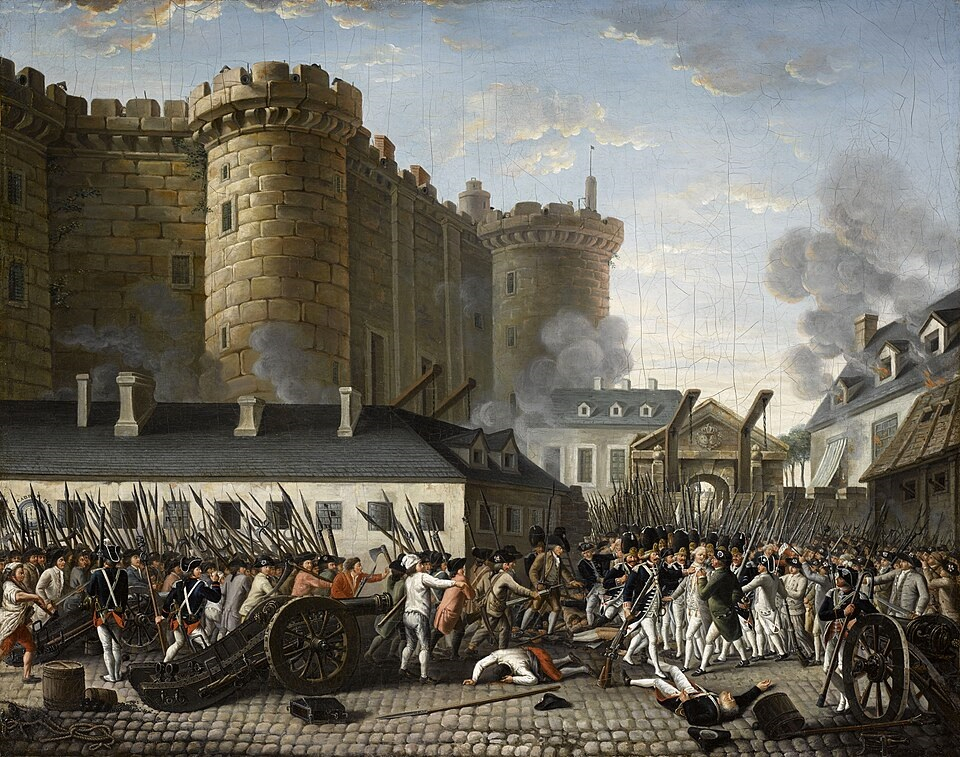
As the National Assembly worked toward a constitution, tensions escalated in Paris. Bread prices had soared, unemployment was rising, and rumors spread of royal troops massing to suppress the revolution. On July 14, an estimated 7,000-8,000 Parisian men and women stormed the Bastille, a medieval fortress-prison symbolizing royal tyranny. Though containing only seven prisoners, the Bastille’s symbolic importance was immense; its capture demonstrated that popular power could challenge royal authority successfully. The storming killed approximately 98 attackers and 28 defenders, establishing a pattern of revolutionary violence that would intensify throughout the decade.
2.4 The Declaration of the Rights of Man and Citizen (August 26, 1789)
The National Assembly, reinvigorated by the Bastille’s fall, accelerated constitutional work. On August 4, in a dramatic night session, feudal privileges were abolished—nobles renounced feudal rights, the clergy surrendered tax exemptions, and the principle of legal equality advanced substantially. On August 26, the assembly adopted the Declaration of the Rights of Man and Citizen, a document of profound ideological significance.
The Declaration proclaimed seventeen principles: natural rights to liberty, property, and security; equality before law; popular sovereignty; separation of powers; freedom of speech and religion; and the right to participate in governance. These principles, derived partly from American precedents and partly from Enlightenment philosophy, represented a fundamental reconceptualization of political authority. No longer would rights depend on birth status or royal grace; henceforth they would be universal, inalienable, and anterior to government. The Declaration transformed the French Revolution from a movement addressing fiscal crisis into one proclaiming universal human principles.
2.5 The Civil Constitution of the Clergy (1790)
Between 1789-1791, the National Assembly systematized its reforms through constitutional provisions. The Civil Constitution of the Clergy (1790) subordinated the Church to state authority, eliminating papal jurisdiction over French bishops and transforming clergy into state officials elected by voters. While eliminating clerical tax exemptions and confiscating Church lands to finance state debt, the measure generated fierce Catholic opposition, particularly in rural areas. Priests refusing to swear allegiance to the new arrangement became “non-juring clergy,” creating religious schism that poisoned revolutionary unity and provoked counter-revolutionary sentiment among devout Catholics.
2.6 The Royal Family’s Flight to Varennes (June 20-21, 1791)
The constitutional settlement of 1791 created a constitutional monarchy with limited royal authority. However, Louis XVI deeply resented the constraints imposed upon him, viewing constitutional limitations as violations of divine right. On June 20-21, 1791, Louis and Marie Antoinette, disguised as servants, attempted to flee France with their children, planning to reach the Austrian Netherlands and join émigré armies gathering to invade and restore absolute monarchy. They were intercepted at Varennes, a small town near the border, and forced to return to Paris. This flight destroyed remaining public confidence in the king’s commitment to constitutional settlement, radicalizing opinion and making abdication or deposition increasingly discussed.
2.7 The Deterioration into Radical Revolution (1791-1792)
The period from late 1791 through 1792 witnessed a radicalization of revolutionary politics. Multiple factors drove this shift: continued economic crisis and bread shortages, counter-revolutionary activity by émigré nobles and foreign powers threatening invasion, the king’s evident bad faith, and the emergence of popular political societies—particularly the Jacobin Club, which advocated increasingly radical measures.
War became a crucial turning point. In April 1792, the National Assembly, under Girondin influence, declared war against Austria and Prussia, believing military victory would solidify the revolution and eliminate counter-revolutionary threats. However, initial defeats created panic in Paris, fueling suspicion that the king and court were sabotaging the war effort. Popular radicals, organized by the sans-culottes (literally “without breeches,” referring to urban workers and artisans who wore trousers rather than the knee-breeches of the wealthy), demanded action against counter-revolutionaries.
On September 10-12, 1792, in events known as the September Massacres, Parisian mobs, believing counter-revolutionaries planned to break through prison walls and massacre patriots, attacked prisons, executing approximately 1,000-1,400 inmates—aristocrats, non-juring priests, and political prisoners. This atrocity shocked moderates and demonstrated the revolution’s descent into violence.
2.8 The Abolition of Monarchy and Establishment of the First Republic (September 21, 1792)
On September 20, 1792, the French army halted the Prussian invasion at the Battle of Valmy, proving that revolutionary forces could defeat professional armies. Emboldened by this success, the newly convened National Convention (elected through broader male suffrage) abolished the monarchy on September 21, declaring France a republic. This transformation was no longer constitutional reform; it was revolution in its fullest sense.
2.9 The Trial and Execution of King Louis XVI (January 1793)
The convention’s next momentous act was trying the deposed king. Conservatives, particularly the Girondins (moderate republicans who favored federalism and limited war), advocated clemency. Radicals, led by Maximilien Robespierre and the Jacobins (centralist republicans advocating vigorous prosecution of war and social revolution), demanded death, arguing that a legitimate republic could not tolerate a rival focus of loyalty in the form of a living king. On January 21, 1793, Louis XVI was executed by guillotine—the first major European monarch to face democratic judgment and death. The execution shocked European royalty, galvanizing conservative powers and émigré forces into more determined counter-revolutionary efforts.
2.10 The Reign of Terror (1793-1794)
The period from September 1793 through July 1794 became known as the Reign of Terror, an episode of state-sponsored violence targeting perceived counter-revolutionaries, aristocrats, non-cooperating clergy, and eventually, political opponents of Robespierre’s Jacobin faction.
The Committee of Public Safety, established in 1792 and increasingly dominated by Robespierre, orchestrated the Terror through the Law of Suspects (September 1793), which defined broadly as suspect anyone accused of counter-revolutionary sympathies or failure to demonstrate republican commitment. Approximately 300,000 people were arrested; some 16,000 were officially sentenced to death by military tribunals, with estimates suggesting 30,000-40,000 total deaths, including extra-judicial killings. The guillotine, the revolution’s signature instrument of execution, became the dominant symbol of revolutionary justice and terror.
The Terror also extended to the Vendée region and Lyon, where counter-revolutionary uprisings provoked brutal suppression costing tens of thousands of lives. Revolutionary forces destroyed religious objects, suppressed Catholic worship, and imposed a new calendar (with months named after natural phenomena) and a rationalist “Cult of the Supreme Being” under Robespierre’s spiritual direction.
The Terror reflected genuine counter-revolutionary threats—royalist armies, foreign invasion, economic collapse, and religious opposition. Yet it also revealed revolutionary utopianism’s darker implications: the belief that society could be remade through force according to rationalist principles, that political enemies could be definitively eliminated, and that virtue could be imposed through terror. Robespierre’s own execution on July 28, 1794 (the Thermidorian Reaction), marked the Terror’s conclusion and signaled exhaustion with revolutionary violence.
Part 3: French Revolutionary Wars (1792-1815)
3.1 Origins and Early Campaigns (1792-1797)
The French Revolutionary Wars began as a defensive conflict, became an instrument of revolutionary expansion, and evolved into Napoleonic imperial wars. Initiated in April 1792 against Austria, the wars quickly expanded to include Prussia, Britain, Spain, and eventually most of continental Europe. The wars served multiple purposes: eliminating foreign threats to the revolution, spreading revolutionary ideology, acquiring territory, and redirecting popular militancy outward rather than against the revolutionary government.
Early campaigns succeeded dramatically. General Napoleon Bonaparte, a young Corsican artillery officer, achieved stunning victories in Italy (1796-1797), defeating Austrian and Piedmontese armies and forcing peace. These military successes elevated Napoleon to national prominence, establishing him as the revolution’s savior from counter-revolutionary and foreign threats.
3.2 The Wars’ Scale and Human Cost
The Revolutionary and Napoleonic Wars (1792-1815) created unprecedented carnage. Conservative estimates place French military deaths at 600,000-1,300,000 across this entire period, with approximately 700,000-1,200,000 total French casualties including wounded. Austrian losses reached approximately 500,000 men; Russian losses approximately 500,000; British losses approximately 300,000; and Spanish and Portuguese combined losses approximately 700,000. Overall, historians estimate between 2-3 million total European military deaths across these twenty-three years.
These wars, initiated to defend revolutionary gains, created human suffering on an unprecedented scale. The wars’ enormous expense necessitated continuous military expansion, perpetual mobilization of manpower, and the maintenance of internal surveillance and repression to enforce conscription. The wars’ logic—each victory creating new enemies and requiring further conquest to eliminate threats—contributed to the dynamic whereby revolutionary ideals of liberty and fraternity coexisted with imperial conquest and military dictatorship.
Part 4: Impact of the French Revolution
4.1 Political and Constitutional Impact
The French Revolution fundamentally transformed political possibilities. It established that legitimate political authority derives from popular sovereignty rather than divine right, that constitutions rather than royal prerogative should structure government, and that rights are universal and inalienable rather than contingent on status. These principles, embodied in the Declaration of Rights and subsequent constitutional documents, became the template for modern liberal democracy.
The principle of separation of powers—legislative, executive, and judicial branches functioning independently—became institutionalized during the revolution and spread globally, shaping constitutional design from the United States to contemporary republics. The revolution proved that hereditary monarchy could be overthrown and replaced with republicanism, legitimizing subsequent republican movements.
4.2 Social Transformation: Abolition of Feudalism
The August 4, 1789 decree abolishing feudal privileges represented a revolutionary moment of extraordinary significance. Feudal dues—the economic foundation of noble power for centuries—were eliminated. Peasants gained absolute property rights to land, eliminating feudal obligations. This transformation occurred without compensation (unlike abolition in other European countries), making it thorough and complete.
The abolition of feudalism meant that Europe’s fundamental social organization—the feudal hierarchy linking peasants to nobles through mutual obligation—ceased to exist in France. Peasants transformed from feudal subjects to property-owning citizens, acquiring stakes in the revolutionary social order. This transformation spread to territories conquered by revolutionary and Napoleonic armies, permanently altering European social structures.
4.3 Religious Transformation
The revolution subordinated religious authority to state power and eliminated clerical privileges. Church lands were confiscated and sold, the tithe was abolished, and clergy became state officials. While the revolution did not technically eliminate religion, the Civil Constitution of the Clergy and subsequent anti-religious measures—particularly during the Terror—broke the Catholic Church’s institutional power in France. The principle that religious authority must defer to secular state authority, now articulated explicitly, influenced religious settlements throughout Europe.
4.4 Nationalism and the Nation-State
The French Revolution created modern nationalism—the identification of political community with a nation defined by common language, culture, and territory rather than dynastic loyalty. Revolutionary government replaced local customs and jurisdictions with uniform national legal codes and administrative structures. A new national identity—expressed through the tricolor flag, the Marseillaise national anthem, revolutionary festivals, and patriotic rhetoric—bound citizens to the nation-state rather than to locality or monarchy.
This revolutionary nationalism, spread by Napoleonic conquest, proved infectious. Subject peoples in Spain, Italy, Germany, and Poland, initially viewing French occupation as liberation from reactionary dynasties, eventually turned nationalist sentiment against French rule, demanding national independence. Nineteenth-century nationalism, culminating in Italian and German unification, descended directly from this French Revolutionary precedent.
4.5 Global Impact on Anti-Colonial Movements
The revolutionary principle that legitimate authority derives from popular consent and that hereditary hierarchies can be overthrown proved profoundly influential on anti-colonial movements. The Haitian Revolution (1791-1804), initiated by enslaved Africans inspired by the French Declaration of Rights, created the first Black republic and first successful slave revolution. Latin American independence movements (1810-1830) invoked revolutionary principles against Spanish and Portuguese colonial rule. In the nineteenth and twentieth centuries, nationalist movements throughout Asia and Africa explicitly referenced the French Revolution as precedent for throwing off colonial domination.
4.6 Economic and Property Rights
The revolution eliminated ecclesiastical and noble monopolies on landholding, confiscated Church properties, and established legal equality in property transactions. These changes facilitated capitalist development by removing feudal restrictions on land sale and market transactions. The Napoleonic Code (1804), established by Napoleon to consolidate revolutionary legal principles, created uniform civil law across French territory and influenced legal systems throughout Europe.
Part 5: Criticisms of the French Revolution
5.1 Violence and the Reign of Terror
The most sustained criticism of the French Revolution concerns its descent into systematic violence, particularly during the Reign of Terror (1793-1794). Conservative thinkers, from Edmund Burke (whose Reflections on the Revolution in France appeared in 1790 and presciently predicted the revolution’s violent trajectory) through nineteenth-century reactionaries, condemned the revolution as having unleashed mob violence and destroyed social order.
The Reign of Terror, though creating only 16,000-40,000 official executions, represented state-orchestrated political killing unprecedented in European experience. The psychological impact exceeded the numerical scale; the spectacle of the guillotine, the atmosphere of denunciation and suspicion, and the targeting of perceived enemies created terror as both method and reality. Political prisoners, aristocrats, clergy, and eventually, Jacobin leaders themselves fell victim to the revolutionary logic of purification through elimination of enemies.
The Vendée Wars (1793-1796), counter-revolutionary uprisings in western France, provoked particularly brutal repression, with historians debating whether government actions constituted proto-genocidal measures against a civilian population. Recent scholarship estimates 170,000-250,000 deaths in this regional conflict, demonstrating the revolution’s capacity for mass violence when facing organized opposition.
5.2 Religious Repression and Dechristianization
Though the revolution proclaimed religious toleration in the Declaration of Rights, practice diverged sharply from principle. The Civil Constitution of the Clergy (1790) attacked ecclesiastical independence. During the Terror, churches were desecrated, priests executed, and Christian worship suppressed in favor of deist and atheistic state ideologies. Robespierre’s “Cult of the Supreme Being” attempted to create a rationalist religion compatible with his vision of republican virtue, representing revolutionary utopianism’s capacity to deny reality—the deep Catholicism of French society—and impose ideological visions through force.
Religious repression, particularly severe in rural areas, created enduring alienation between French Catholicism and republicanism, shaping French politics well into the twentieth century.
5.3 Gender Exclusion and Women’s Marginalization
Despite revolutionary rhetoric of universal rights, the revolution systematically excluded women from political participation. The Declaration of Rights addressed “all men,” not women. Women could not vote, could not hold office, and were legal minors under the Code Napoleon (1804), subordinate to fathers or husbands. The revolution mobilized women effectively—female riots over bread prices initiated the October 1789 march to Versailles that brought the royal family to Paris; women’s political societies agitated for revolutionary measures—yet denied them political recognition.
While figures like Olympe de Gouges articulated feminist critiques of the revolution’s universalism and inconsistency, their voices remained marginal. The revolution did establish equal inheritance rights for daughters and permitted some female intellectual participation through salon culture and publications, yet the fundamental exclusion of women from political citizenship contradicted universalist rhetoric.
5.4 Economic Costs and Perpetual Warfare
The revolutionary and Napoleonic Wars, initiated to defend revolutionary gains, imposed enormous economic costs and created perpetual military mobilization. The wars’ expense exceeded any economic benefit the revolution produced through feudal abolition or Church property confiscation. Military conscription, unprecedented in scale, drained manpower from agriculture and industry. The Wars’ duration—twenty-three years of nearly continuous warfare (1792-1815)—disrupted trade, created chronic inflation, and necessitated authoritarian measures to enforce conscription.
The wars’ logic represented a tragic paradox: wars undertaken to spread revolutionary principles of liberty paradoxically required militarization, centralization, and destruction of the very liberation they claimed to advance. By 1815, France was exhausted, militarily defeated, territorially reduced, and demoralized—conditions that enabled monarchical restoration and counterrevolutionary reaction.
5.5 Historiographical Debates
Modern historians continue contentious debates regarding the revolution’s balance of achievement and destruction. Conservative revisionist historians (Alfred Cobban, François Furet) argue that the revolution’s violence was disproportionate to its achievements, that feudalism was already disappearing, and that the revolutionary and Napoleonic Wars’ human cost exceeded any social benefit. They emphasize contingency—arguing that the revolution’s violent radicalization was not inevitable but resulted from specific political decisions by Robespierre and radical Jacobins.
Socialist and leftist historians (Albert Mathiez, Georges Lefebvre, Albert Soboul) defend the Terror as necessary response to genuine counter-revolutionary threats and foreign invasion, emphasizing the revolution’s achievements in abolishing feudalism, establishing legal equality, and creating nationalism. They view the Jacobins as defenders of popular sovereignty against aristocratic conspiracies.
Modern cultural historians (François Furet, Lynn Hunt) emphasize the revolution’s political culture—its symbols, language, and social practices—examining how revolutionary discourse both inspired and justified violence. They suggest that the terror flowed from the revolution’s political logic rather than from social conditions.
No historical consensus exists. The revolution remains what it has always been: an event simultaneously celebrated as the birth of modernity and democracy, and condemned as a blueprint for totalitarianism—its meaning contested by those defending universal rights and those warning against revolutionary utopianism’s dangers.
UPSC Previous Years Questions and Model Answers
Prelims-Style MCQs
1. Consider the following statements about the Estates-General of 1789:
Each estate voted as a bloc under traditional procedure
The Third Estate represented 96% of France’s population
The National Assembly was formed when the Third Estate declared itself sovereign
Which of the above statements are correct?
A) 1 and 2 only
B) 2 and 3 only
C) 1 and 3 only
D) All of the above
Answer: D) All of the above
2. The Tennis Court Oath was significant because it:
A) Established the equality of all three estates
B) Asserted the National Assembly’s sovereign right to create a constitution
C) Ended feudal privileges
D) Abolished the monarchy
Answer: B) Asserted the National Assembly’s sovereign right to create a constitution
3. Which of the following was NOT a cause of the French Revolution?
A) Fiscal crisis and financial collapse
B) Rigid three-estate social hierarchy
C) Rapid industrialization and factory system development
D) Enlightenment critique of absolute authority
Answer: C) Rapid industrialization and factory system development (France was not significantly industrialized in 1789; the Industrial Revolution was primarily a British phenomenon)
4. The Declaration of the Rights of Man and Citizen proclaimed all of the following EXCEPT:
A) Natural rights to liberty, property, and security
B) Legal equality and equal citizenship
C) Gender equality and universal suffrage
D) Separation of governmental powers
Answer: C) Gender equality and universal suffrage (The Declaration applied only to men; women were excluded from political rights)
Mains-Style Questions (with brief answer guidelines)
Question 1: “If monarchical misrule ignited the French Revolution, lofty ideas both inspired and sustained it.” Comment. (2002, 15 marks)
Approach: Present a balanced argument acknowledging both structural causes and ideological dimensions.
Key Points:
Monarchy’s fiscal incompetence created the immediate crisis (Louis XVI’s inability to resolve financial collapse despite Necker’s proposals)
Three-estate hierarchy and absolute privilege created structural grievances
However, these grievances alone would not have produced revolution; many peasant societies endured feudalism for centuries
Enlightenment philosophy provided language and concepts to transform grievances into revolutionary consciousness (Rousseau’s sovereignty, Montesquieu’s separation of powers)
The Declaration of Rights, Declaration of the Rights of Man, and constitutional frameworks embodied philosophical ideals that sustained revolutionary commitment
Yet, the terror and violence that followed suggest ideological utopianism’s limitations in practice
Conclusion: Both causes were necessary; structural crisis created opportunity, while philosophical ideals provided vision and legitimation. Neither alone would have produced the specific trajectory of revolution.
Question 2: “The connection between the philosophers’ ideas and the outbreak of the French Revolution (1789) is somewhat remote and indirect.” Critically examine. (2012, 15 marks)
Approach: Acknowledge the complexity while arguing for significant (though not deterministic) philosophical influence.
Key Points:
Philosophers did not call for revolution; most were monarchists or constitutional moderates
The fiscal crisis would have necessitated some reform regardless of philosophical trends
However, the specific form of revolution—its universalist pretensions, its commitment to popular sovereignty, its rationalist restructuring of society—reflected Enlightenment influence
Without Rousseau’s theory of popular sovereignty, the Third Estate might not have claimed sovereign power
Without Montesquieu’s separation of powers doctrine, constitutional frameworks would have differed substantially
The Declaration’s universal language—applicable to all humanity, not just French—embodied Enlightenment universalism
Yet philosophers’ ideas achieved influence because they resonated with material grievances; ideas alone in different circumstances might have remained academic
Conclusion: The connection is neither remote nor direct, but dialectical—structural conditions created receptivity to philosophical ideas; philosophical ideas shaped how actors conceptualized and acted upon structural conditions.
Question 3: “The French Revolution attacked privileges and not property.” Comment. (2003, 15 marks)
Approach: Clarify what this statement means and assess its accuracy.
Key Points:
The August 4 decree abolished feudal privileges (noble rights over peasant lands, clerical tax exemptions) without attacking property itself
Indeed, the revolution expanded property rights by eliminating feudal restrictions; peasants gained absolute property in land previously held under feudal obligation
Church property was confiscated and sold, benefiting bourgeoisie and wealthy peasants who purchased it
The Napoleonic Code (1804) protected property and facilitated capitalist markets
Yet during the Terror, aristocratic property was confiscated, and some Jacobins discussed land redistribution
Critical analysis: The statement captures the revolution’s fundamental achievement—eliminating hereditary privilege and establishing legal equality—while missing its ambiguity regarding property. The revolution eliminated feudal privilege while simultaneously consolidating capitalist property relations, creating paradoxes that would characterize nineteenth-century development.

Discover more from Simplified UPSC
Subscribe to get the latest posts sent to your email.