NORTH AMERICA
Contents
NORTH AMERICA:
INTRODUCTION AND LOCATION
North America is the third-largest continent in the world, after Asia and Africa, covering an area of approximately 24.7 million square kilometers (including Greenland and Caribbean islands). It is a continent entirely situated within the Northern Hemisphere and almost entirely within the Western Hemisphere.
Latitude: 7°N to 84°N (approximately 7°N to 83°38’N)
Longitude: 20°W to 179°W (approximately 12°08’W to 172°30’W)
Boundaries:
North: Arctic Ocean
East: Atlantic Ocean
West: Pacific Ocean
South: Gulf of Mexico, Caribbean Sea, and Central America (bordering South America)
Northwest: Separated from Asia (Siberia) by the Bering Strait (~85 km)
Southeast: Connected to South America by the Isthmus of Panama
Physical Size: The continent extends approximately 3,000 km from east to west and over 7,000 km from north to south, making it the third-largest continent after Asia and Africa.
Time Zones: North America spans five time zones, reflecting its vast east-west expanse.
Key Geographic Lines:
The Tropic of Cancer passes through the continent (entering through Mexico)
The Arctic Circle passes through northern Canada and Alaska
The 49°N parallel forms the boundary between Canada and the United States
The 100°W longitude divides the continent into two roughly equal parts
Political Status: North America comprises 23 countries (though often referred to by its three largest: Canada, United States, and Mexico), multiple territories, and numerous Caribbean island nations.
POLITICAL DIVISIONS
Three Major Countries
1. Canada

Status: Second-largest country in the world by land area
Capital: Ottawa
Type of Government: Parliamentary democracy and constitutional monarchy
Population: Approximately 40 million
Key Features: Bilingual nation (English and French), highly urbanized with vast wilderness areas
2. United States of America (USA)
Status: Third-largest country by land area; world’s leading economic and military power
Capital: Washington, D.C.
Type of Government: Federal republic
Composition: 50 states, a federal district (Washington, D.C.), and overseas territories
Population: Approximately 330 million

3. Mexico
Status: Largest Spanish-speaking country in the world
Capital: Mexico City
Type of Government: Federal republic
Population: Approximately 125 million
Key Features: Rich indigenous heritage, ancient civilizations (Aztec, Maya)
Central American Countries (7)

Situated between Mexico and Colombia (South America):
Belize
Costa Rica
El Salvador
Guatemala
Honduras
Nicaragua
Panama
Caribbean Islands and Territories
Major Island Groups:
Greater Antilles: Cuba, Hispaniola (Haiti, Dominican Republic), Jamaica, Puerto Rico
Lesser Antilles: Chain of islands extending from Virgin Islands to Trinidad and Tobago
Notable Countries: Bahamas, Barbados, Dominica, Grenada, St. Lucia, St. Vincent and the Grenadines
Other Important Territories
Greenland: Autonomous territory within the Kingdom of Denmark; world’s largest island
Alaska: Part of USA, located in northwestern North America
Aleutian Islands: Extension of the Rockies, part of USA
PHYSICAL FEATURES
Major Mountain Systems
1. The Western Cordilleras
The western mountain system is geologically young and tectonically active, comprising several distinct ranges:
a) Alaska and Aleutian Ranges
Located in northern Alaska
Extend in an east-west direction
Continuation of the Rockies
Mount McKinley (Denali): 6,194 m – highest peak in North America
Terminate in the Aleutian Islands (part of Pacific Mountain Systems)
b) Cascade Range
Located east of the Coast Mountains
Extends from northern California to Washington
Mount Whitney (4,418 m): highest peak in the continental USA
Characterized by volcanic peaks
c) Sierra Nevada
Located south of the Cascade Range to southern California
Runs along the Pacific coast
Contains Mount Whitney in its southern section
d) Rocky Mountains
North America’s largest mountain chain
Extends from British Columbia (Canada) to New Mexico (USA)
Length: Over 4,800 km
Height: Peaks over 4,000 m
Significance: Forms the Continental Divide; separates Pacific and Atlantic drainage basins
Highest peak: Mount Robson (3,954 m) in the Canadian Rockies
Created during the Laramide Orogeny (geological mountain-building period)
Rich in mineral resources: coal, uranium, metals
Influences climate with weather phenomena like Chinook winds on eastern slopes
Western Lowlands Between Ranges:
Region of tablelands, basins, canyons, and deserts exists between the Cascade Range/Sierra Nevada (east) and the Rockies
Includes the Colorado Plateau, a prominent uplifted feature deeply eroded with canyons
2. The Canadian Shield (Laurentian Plateau)
Location: Eastern, central, and northwestern Canada
Characteristics:
Raised but relatively flat plateau
Made of Precambrian metamorphic and igneous rocks (ancient basement rocks)
Rocky landscape pocked by an astounding number of lakes
Region of significant mineral wealth
Extent:
Includes the Laurentian Plateau
Extends from Quebec (Canada) through central and northern regions
Importance:
Major source of minerals and metallic ores
Hydroelectric potential due to river systems
Strategic waterways and transportation routes
3. The Eastern Highlands (Appalachian System)
Location: Extends from Quebec (Canada) southward to central Alabama (USA)
Characteristics:
Ancient, eroded mountain range
Much older than the Rockies (formed during the Caledonian Orogeny)
Lower elevations compared to western mountains
Highest peak: Mount Mitchell on Blue Ridge (North Carolina) – approximately 2,037 m
Component Ranges (from north to south):
Adirondack Mountains: Joined to Canadian Shield, located between Lake Ontario and Gulf of St. Lawrence
Green Mountains: Part of the northern Appalachian system
Allegheny Mountains: Part of the southern system
Blue Ridge Mountains: Contain Mount Mitchell
Great Smoky Mountains: Southeastern component
Cumberland Plateau: Located west of the Appalachians in Kentucky; an uplifted peneplain comprising Cumberland Plateau and Allegheny Plateau
Significance:
Been mined for rich deposits of coal and other minerals for centuries
Coal is a major economic resource
Supports historical industrial development
Major Plateaus and Plains
1. Central Lowlands (Interior Plains)
Composition: Structural plains formed by the Mississippi and Missouri river systems
Characteristics:
Stretch from around the Arctic shores and Hudson Bay to the Gulf of Mexico
Hemmed in by the Cordilleras in the west and highlands in the east
Divided into two distinct regions:
High Plains (western section): Greater altitudes, semi-arid grasslands
Canadian Shield (northern section): Relatively flat with rocky landscapes
2. Great Plains
Location: East of the Rocky Mountains, extending across the USA and Canada
Characteristics:
Vast high plateau of semi-arid grassland
Extends approximately 3,000 miles from Rio Grande (south) to Arctic Ocean (north)
Covers parts of the United States and Canada
Deep, rich soil blankets large areas
Landscape varies from flat areas (Texas’s Llano Estacado) to low hills and incised valleys
Significance:
“Breadbasket of North America” – region of wheat cultivation (winter and summer)
Fertile soils support major agricultural production feeding a large part of the world
Rich deposits of oil and natural gas
Major rivers (Missouri and Red River) drain this region
Vegetation: Prairies – expansive grasslands with fertile soil, grasses, and wild herbs
3. Gulf Coastal Plain
Formation: Plain formed by the Mississippi-Missouri river system
Characteristics:
Coastal lowlands along the Gulf of Mexico
Much narrower than the eastern coastal plain
Transitional zone between interior plains and ocean
Important Features:
Mississippi River Delta: Major sediment deposition area
Strategic location for ports and economic development
Home to important cities like New Orleans
4. Colorado Plateau
Location: Southwestern USA
Characteristics:
Uplifted plateau
Deeply eroded by river systems
Contains spectacular canyon systems, most notably the Grand Canyon
Formation:
Carved out by the Colorado River through vertical erosion of sedimentary strata over millions of years
Example of water erosion in desert environments
5. Atlantic and Pacific Coastal Plains
Atlantic Coastal Plain:
Wider than the Pacific coastal plain
Extends along the eastern coast
Includes important harbors and industrial centers
Contains fertile soils
Pacific Coastal Plain:
Much narrower than the eastern coastal plain
Located in California, Oregon, and Washington
Valuable for agriculture and urban development
Major Deserts
North America contains four major desert regions, primarily located in the southwestern USA and northern Mexico:
1. Great Basin Desert
Location: Nevada (primarily), also Utah, Oregon, California
Type: Cold desert
Climate: Cold winters, hot summers; 6-12 inches annual rainfall
Vegetation: Sagebrush, junipers, grasses
Cause: Rain shadow of Sierra Nevada mountains
Significance: Largest desert in USA; mineral-rich for mining activities
2. Mojave Desert
Location: Southern California
Climate: Hot, arid
Vegetation: Desert shrubs and specialized plants
Cause: Double rain shadow (Sierra Nevada and coastal ranges)
Significance: Tourism hub (Death Valley National Park); solar energy production
3. Sonoran Desert
Location: Southwestern Arizona, southeastern California, northwestern Mexico
Climate: Bimodal rainfall (winter and summer monsoons); 3-15 inches annually
Vegetation: Saguaro cactus, palo verde, ocotillo – richest biodiversity among North American deserts
Cause: Subtropical high-pressure systems and rain shadows
Significance: Supports agriculture via irrigation; ecotourism and research; cultural significance to indigenous populations
4. Chihuahuan Desert
Location: Southeastern Arizona, southern New Mexico, western Texas, northern Mexico
Type: Largest desert in North America by area (~200,000 square miles)
Climate: Hot summers, cold winters; 6-20 inches rainfall annually
Vegetation: Agave, yucca, creosote bush
Cause: Rain shadow of Sierra Madre Occidental
Significance: Grazing lands; desert agriculture with irrigation; cave systems (Carlsbad Caverns)
Important Peninsulas
Ungava Peninsula
Located in northern Canada
Surrounded by Hudson Bay and Hudson Strait
Baja California Peninsula
Located on the west coast of Mexico
Extends into the Pacific Ocean
Boothia Peninsula
Northern Canada
Surrounded by Arctic waters
Yucatán Peninsula
Located in southeastern Mexico
Important for archaeological sites and tourism
MAJOR SEAS, BAYS, AND GULFS
Arctic Ocean Bodies
| Water Body | Location | Ocean | Significance |
|---|---|---|---|
| Beaufort Sea | North of Canada | Arctic Ocean | Shipping routes, oil exploration |
| Gulf of Boothia | Between Boothia Peninsula and Baffin Island | Arctic Ocean | Remote, ice-covered region |
| Hudson Bay | Central Canada | Arctic Ocean | Important historical fur trade route |
| Hudson Strait | Connecting Hudson Bay to Atlantic | Arctic Ocean | Navigation route |
| Baffin Bay | Between Greenland and Baffin Island | Atlantic Ocean | Strategic location |
Atlantic Ocean Bodies
| Water Body | Location | Ocean | Significance |
|---|---|---|---|
| Bay of Fundy | Between New Brunswick and Nova Scotia | Atlantic Ocean | Site of world’s highest tides (up to 15 meters) |
| Chesapeake Bay | Between Virginia and Maryland | Atlantic Ocean | Longest offshore bar in the world; important estuary |
| Gulf of St. Lawrence | Eastern Canada | Atlantic Ocean | Important for fishing and navigation |
Gulf of Mexico and Caribbean
| Water Body | Location | Ocean | Significance |
|---|---|---|---|
| Gulf of Mexico | East of Central America | Atlantic Ocean | Mississippi River drains into it; important economic zone; area of hurricane generation |
| Gulf of Campeche | East of Mexico | Gulf of Mexico/Atlantic Ocean | Oil and gas resources |
| Gulf of Darién | Between Panama and South America | Caribbean Sea/Atlantic Ocean | – |
| Caribbean Sea | East of Central America | Atlantic Ocean | Known for hurricane generation; tropical island ecosystems |
Pacific Ocean Bodies
| Water Body | Location | Ocean | Significance |
|---|---|---|---|
| Gulf of Alaska | Northwestern North America | Pacific Ocean | Where cold and warm water currents meet; distinctive coloring |
| Gulf of California (Sea of Cortez) | Between Baja California and Mexico | Pacific Ocean | Terminal point of Colorado River; rich marine life |
| Gulf of Panama | Central America | Pacific Ocean | Strategic location |
MAJOR RIVERS AND RIVER SYSTEMS
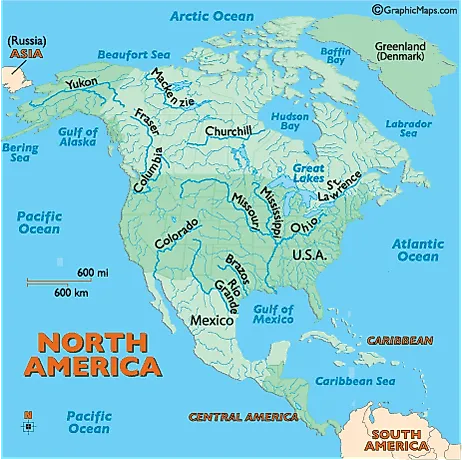
1. Mississippi River System
The Mississippi-Missouri-Jefferson System: World’s fourth-longest river system (approximately 5,971 km when including Missouri and Jefferson)
Mississippi River (Main Branch):
Length: ~3,766 km (alone)
Source: Lake Itasca, northern Minnesota
Mouth: Mississippi River Delta, Louisiana (flows into Gulf of Mexico)
Direction: Generally flows north to south
Drainage: Drains 31 US states and 2 Canadian provinces
Significance:
Central to US agriculture, transportation, and economy
Supports one of the largest freshwater ecosystems
Major commercial waterway with significant port cities
Major Tributaries (use mnemonic “MORA Rocks”):
Missouri River (longest tributary, ~4,090 km)
Ohio River (eastern tributary)
Red River
Arkansas River
Rock River
Important Cities on Mississippi:
Minneapolis (Minnesota)
St. Louis (Missouri)
New Orleans (Louisiana)
Major Dams:
Upper St. Anthony Falls Lock
Keokuk Dam (Iowa-Illinois border)
2. Missouri River
Length: ~4,090 km
Source: Confluence of three rivers in Rocky Mountains of Montana (Jefferson, Madison, Gallatin rivers)
Mouth: Joins Mississippi River near St. Louis, Missouri
States: Flows through Montana, North Dakota, South Dakota, Nebraska, Iowa, Kansas, Missouri
Tributaries: Kansas River, Niobrara River, Yellowstone River
Major Cities: Great Falls (Montana), Bismarck (North Dakota), Kansas City (Missouri), St. Louis (Missouri)
3. Colorado River
Length: ~2,330 km
Source: Continental Divide in Rocky Mountain National Park, Colorado
Mouth: Gulf of California (Sea of Cortez), Mexico
Significance: Major river of arid southwestern USA
Key Features: Carves the Grand Canyon through vertical erosion of sedimentary strata
Current Issue: Now often dries up before reaching the sea due to overuse for irrigation and urban water supply
Drainage Basin: Shared between USA and Mexico
Major Dams: Hoover Dam (forming Lake Mead), Glen Canyon Dam (forming Lake Powell)
4. Yukon River
Length: ~3,190 km
Source: Atlin and Tagish Lakes (Canada)
Mouth: Norton Sound, Bering Sea (Alaska)
Significance: Major river in northwestern North America
Tributaries: Teslin, White, Stewart rivers
Countries: Flows through Canada and USA (Alaska)
5. Rio Grande
Length: ~3,034 km
Source: San Juan Mountains, Colorado
Significance: Forms the international boundary between USA and Mexico
Mouth: Gulf of Mexico, Texas
Region: Southwestern North America
Note: Does not originate in Rocky Mountains (unlike Missouri, Colorado, Columbia)
6. Columbia River
Length: ~2,250 km
Source: Canadian Rockies (British Columbia)
Mouth: Pacific Ocean, Oregon-Washington border
Significance: Important for hydroelectric power generation
Tributaries: Snake River (major tributary)
Major Feature: Originates in Rocky Mountains
7. Mackenzie River System
Location: Northwest Canada
Significance: Part of major North American river systems
Drain: Into Arctic Ocean
THE GREAT LAKES
The Great Lakes are a series of large interconnected freshwater lakes located on the border between the United States and Canada, holding approximately 21% of the world’s freshwater.
The Five Great Lakes
| Lake | Area | Countries | Significance |
|---|---|---|---|
| Superior | Largest by surface area | USA, Canada | Deepest; coldest; source of water to other lakes |
| Michigan | Second largest | USA only | Completely within USA |
| Huron | Third largest | USA, Canada | Connected to Superior via straits |
| Erie | Fourth largest; shallowest | USA, Canada | Most populated; affected by pollution historically |
| Ontario | Smallest | USA, Canada | Connected to Atlantic via St. Lawrence River |
Key Features
Formation: Glacial depression during the Pleistocene epoch; carved by glacial erosion
Freshwater Volume: Contain approximately 21% of the world’s surface freshwater
Geographic Significance:
Connected to each other through straits and channels
St. Lawrence River: Links Great Lakes to Atlantic Ocean via St. Lawrence Seaway
Form a natural international boundary between USA and Canada
Connected to Hudson Bay system
Economic and Ecological Importance
Transportation:
Great Lakes-St. Lawrence Seaway is an important trade route
Connects industrial heartland of North America to foreign markets
Strategic for international commerce
Water Supply:
Vital for municipal and industrial water supply
Support millions of people
Fishing Industry:
Important commercial and recreational fishing
Support significant fish populations
Climate Moderation:
Significantly impact surrounding climate
Moderately control temperature and influence local weather patterns
Lake-effect snowfall phenomenon in winter
Moderate summer temperatures
Recreation:
Important for tourism and recreation
Beaches and water sports
Historical and cultural significance
CLIMATE ZONES
North America exhibits remarkable climatic diversity due to its vast size, varying latitudes, and complex topography. Climate zones vary from arctic to tropical.
Major Climate Types
1. Arctic/Tundra Climate
Location: Northern Canada, Greenland, northern Alaska
Characteristics:
Extremely cold mean annual temperature
Mid-winter temperatures: 40-50°C below freezing
Summers relatively warmer but still cool
Permafrost (permanently frozen ground)
Continuous darkness for weeks in mid-winter
Very low precipitation, mostly snow
Vegetation: Mosses, lichens, sparse grasses; permanently frozen landscape
Wildlife: Reindeer, arctic foxes, polar bears, musk oxen
2. Boreal/Taiga Climate
Location: Northern Canada, parts of Alaska
Characteristics:
Cold winters, cool summers
Moderate annual precipitation
Short growing season
Permafrost in many areas
Vegetation: Coniferous forests (spruce, fir, pine)
Economic Importance: Soft wood timber production
3. Cool Temperate Eastern Margin (Laurentian) Climate
Location: Eastern Canada, Northeastern USA (New England states)
Characteristics:
Four distinct seasons
Rainfall throughout the year (75-150 cm annually)
Cold winters with snow
Warm to hot summers
Continental with maritime influences
Vegetation: Mixed deciduous and coniferous forests
4. Cool Temperate Western Margin Climate
Location: Western Canada (Vancouver provinces), Pacific Northwest USA
Characteristics:
Influence of westerlies throughout the year
Mild winters, cool summers
High annual precipitation
Moderated by Pacific Ocean
Vegetation: Temperate rainforests with tall evergreens (Douglas fir), mosses, lichens
Features: Vulnerable to logging; important carbon sinks
5. Warm Temperate/Gulf Type Climate
Location: Southeastern USA, Gulf of Mexico region
Characteristics:
Subtropical to warm temperate
Maximum rainfall in summer
Hot, humid summers
Mild winters
Experience temperate cyclones in winter; tropical cyclones (hurricanes) in late summers
Vegetation: Mixed deciduous and subtropical forests
Hazards: Hurricane generation in late summer/early fall
6. Temperate Continental Grasslands/Prairie Climate
Location: Central North America (Great Plains, Prairies between Rocky Foothills and Great Lakes)
Characteristics:
Semi-arid to sub-humid grasslands
Temperature extremes between winter and summer
Low to moderate precipitation
Strong seasonal variation
Vegetation: Prairies – grasses, wild herbs, open grasslands
Agricultural Significance: “Breadbasket of North America”; major wheat production region
7. Desert/Arid Climate
Location: Southwestern USA and northern Mexico
Characteristics:
Very low annual precipitation (varies by desert)
High daytime temperatures, cold nights
Strong diurnal temperature variation
Rain shadow deserts
Vegetation: Sparse; adapted xerophytic plants (cacti, shrubs, agave)
Four Major Deserts: Great Basin, Mojave, Sonoran, Chihuahuan
8. Tropical Climate
Location: Southern Mexico, Central America, Caribbean islands
Characteristics:
Warm to hot throughout the year
High humidity
Monsoonal influences
Hurricane-prone season
Vegetation: Tropical rainforests, tropical deciduous forests
Features: Seasonal variation driven by monsoon circulation; typhoon/hurricane generation
VEGETATION AND NATURAL BIOMES
Major Vegetation Zones
1. Tundra Vegetation
Location: Arctic Canada, Greenland, northern Alaska
Characteristics:
Treeless landscape
Low-growing vegetation: mosses, lichens, sparse grasses
Plant life adapted to permafrost conditions
Extremely short growing season
Low biodiversity but unique adaptations
Wildlife: Arctic foxes, polar bears, musk oxen, reindeer, migratory birds
2. Boreal/Taiga Forests
Location: Northern Canada, Alaska interior
Characteristics:
Dense coniferous forests
Dominated by spruce, fir, and pine
Understory of moss and lichens
Limited deciduous trees
Wildlife: Moose, bears, wolves, migratory birds, beavers
Economic Importance: Soft wood production (lumber and paper)
3. Temperate Deciduous Forests
Location: Eastern North America (Appalachian region, Great Lakes region)
Characteristics:
Dominated by deciduous trees (oak, maple, beech, birch)
Four distinct seasons
High biodiversity
Rich soil due to leaf litter decomposition
Wildlife: Deer, bears, raccoons, squirrels, songbirds
4. Temperate Rainforests
Location: Pacific Northwest (Washington, Oregon, British Columbia), parts of Chile
Characteristics:
Tall evergreens (Douglas fir, Sitka spruce, western hemlock)
High precipitation (200-400 cm annually)
Moss and lichen-covered forest floor
Dense undergrowth
High biodiversity
Wildlife: Grizzly bears, eagles, salmon, mountain lions, deer, salamanders
Significance: Carbon sinks; vulnerable to logging; important for watershed protection
5. Grasslands/Prairies
Location: Central North America (Great Plains, between Rocky Foothills and Great Lakes)
Characteristics:
Expansive grasslands with fertile soil
Grasses, wild herbs, and flowering plants
Relatively flat terrain
Semi-arid conditions
Clear skies and open landscape
Wildlife: Buffalo/bison, prairie dogs, ground squirrels, coyotes, grasshoppers, migratory birds
Agricultural Importance: Wheat production; grazing lands; “Breadbasket of North America”
6. Desert Vegetation
Location: Southwestern USA and northern Mexico
Characteristics:
Specialized xerophytic (drought-adapted) plants
Low plant density
Deep root systems
Succulent plants (cacti)
Seasonal flowering
Vegetation by Desert:
Great Basin: Sagebrush, junipers, grasses
Mojave: Desert shrubs, Joshua trees
Sonoran: Saguaro cactus, palo verde, ocotillo
Chihuahuan: Agave, yucca, creosote bush
Wildlife: Lizards, scorpions, roadrunners, rattlesnakes, coyotes, javelinas
7. Tropical Forests and Vegetation
Location: Southern Mexico, Central America, Caribbean islands
Characteristics:
High biodiversity
Evergreen and deciduous tropical forests
High precipitation
Warm throughout the year
Dense canopy structure
Vegetation Types:
Tropical rainforests (high precipitation areas)
Tropical deciduous forests (seasonal areas)
Mangrove forests (coastal areas)
Wildlife: Jaguars, sloths, macaws, tropical amphibians, insects, reptiles
NATURAL RESOURCES AND MINERALS
Metallic Minerals
Copper:
Major Producers: USA (Arizona – Bingham Canyon Mine, Utah, Montana, Nevada, New Mexico)
Significance: Major world producer; important for electrical and construction industries
Nickel:
Major Producers: Canada (world’s largest producer); Ontario (Sudbury District), Manitoba, Quebec, Saskatchewan
Zinc:
Major Producer: Canada (second largest producer)
Platinum:
Major Producer: Canada (significant producer)
Asbestos:
Major Producer: Canada (largest producer)
Iron Ore:
Location: Widespread deposits in Canadian Shield and Great Lakes region
Cobalt:
Producer: Canada (second largest)
Uranium and Radium:
Producer: Canada (uranium), USA (uranium – world’s largest producer)
Sulfur:
Producer: USA (world’s largest producer)
Gold and Silver:
Location: Scattered deposits in western mountains
Energy Resources
Coal:
Major Reserves: USA (Appalachian region, Western USA)
Significance: Important historical fuel source; declining use due to climate concerns
Oil and Natural Gas:
Major Regions: Great Plains, Alaska, Gulf of Mexico, parts of Canada
Importance: Foundation of modern economy and energy supply
Hydroelectric Power:
Location: Great Lakes region (St. Lawrence), Rocky Mountains, Pacific Northwest
Significance: Important renewable energy source; powers industries and cities
Non-Metallic Minerals and Resources
Phosphate:
Location: Florida, other southeastern regions
Salt:
Location: Great Salt Lake (Utah), salt mines in various regions
Gypsum:
Location: Scattered deposits, especially in deserts
Biological Resources
Forests:
Soft Wood Forests: Coniferous forests in northern Canada, western Cordilleras, Appalachians
Hard Wood Forests: Deciduous forests in eastern North America
Significance: Timber and paper production; carbon sequestration; habitat preservation
Fisheries:
Marine Fisheries: Atlantic and Pacific coasts; Gulf of Mexico
Freshwater Fisheries: Great Lakes; major rivers
Significance: Important food source; commercial industry
Soil Resources:
Most Productive Soils: Great Plains, around Great Lakes, along Mississippi River
Significance: Support major agricultural production; fertile for grain cultivation
Water Resources:
Freshwater Sources: Mississippi River, Great Lakes, Missouri River, Colorado River
Importance: Municipal and industrial supply; irrigation; navigation; hydroelectric power
Renewable Energy
Solar Energy:
Potential: Southwestern deserts (Arizona, New Mexico, California)
Development: Increasing solar farms in high insolation areas
Wind Energy:
Location: Great Plains, coastal regions
Potential: Growing wind farm development
ECONOMIC REGIONS AND MAJOR CITIES
Major Metropolitan Areas
North America’s Largest Cities:
| City | Country | Region | Population (Millions) | Economic Significance |
|---|---|---|---|---|
| Mexico City | Mexico | South | 20+ | Capital; cultural center; financial hub |
| New York City | USA | Northeast | 8.3+ | Financial center; global importance; major port |
| Los Angeles | USA | Southwest | 3.9+ | Entertainment; technology; port; aerospace |
| Chicago | USA | Midwest | 2.7+ | Great Lakes region; transportation hub; industry |
| Toronto | Canada | Eastern | 2.9+ | Financial capital of Canada; Great Lakes region |
| San Francisco | USA | Southwest | 0.8+ | Technology hub; financial center; port |
| Boston | USA | Northeast | 0.7+ | Education; research; financial services |
| Washington, D.C. | USA | Northeast | 0.6+ | Political capital |
| Miami | USA | Southeast | 0.4+ | Gateway to Caribbean; tourism; finance |
| Denver | USA | Mountain | 0.7+ | Rocky Mountain hub; energy sector |
Major Industrial Regions
Great Lakes Region:
States: Illinois, Indiana, Michigan, Minnesota, New York, Ohio, Pennsylvania, and others
Industry: Automobiles, steel production, heavy machinery, chemicals
Access to: Great Lakes shipping, mineral resources, agricultural products
Rust Belt:
Location: Northeastern and Midwestern USA
Industries: Steel production, automobiles, machinery
Current Status: Transition from manufacturing to service industries; renewal efforts
Oil and Gas Regions:
Gulf Coast: Texas, Louisiana – petrochemicals, refineries
Alberta, Canada: Oil sands; major energy producer
Alaska: Oil exploration and extraction
Agricultural Regions:
Great Plains: Wheat, corn, soybeans, livestock
Central Valley (California): Fruits, vegetables, nuts
Midwest: Corn, soybeans, dairy
Technology and Service Centers:
Silicon Valley (California): Information technology, software, semiconductors
Seattle area (Washington): Technology, aerospace, software
Boston area (Massachusetts): Technology, research, education
Austin (Texas): Technology, software development
Tourism Centers:
Las Vegas, Nevada: Entertainment, gambling, tourism
Orlando, Florida: Theme parks, tourism
Caribbean islands: Beach tourism, winter destinations
Banff and Lake Louise (Canada): Mountain tourism
Niagara Falls: Tourism, hydroelectric power
HUMAN-ENVIRONMENTAL INTERACTIONS
Geopolitical Significance
Strategic Location:
Gateway between Arctic, Atlantic, and Pacific
Bering Strait separates North America from Asia
Isthmus of Panama connects to South America
Control of major shipping lanes
Economic Interdependence:
USMCA (United States-Mexico-Canada Agreement) trade bloc
Major flows of goods, services, and labor
Integrated supply chains across the continent
Environmental Challenges
Climate Change:
Arctic warming affecting Greenland ice sheet
Permafrost melting in northern regions
Sea level rise threatening coastal areas
Water Resources:
Over-allocation of Colorado River
Great Lakes pollution and conservation issues
Freshwater depletion in some regions
Desertification:
Dust Bowl effects in Great Plains history
Ongoing drought in southwestern USA and Mexico
Deforestation:
Logging pressure on temperate rainforests
Tropical forest loss in Central America and southern Mexico
Biodiversity Loss:
Habitat fragmentation
Species decline (bison, wolves, eagles historically hunted to near extinction)
Conservation efforts and wildlife recovery programs
Urban Development:
Rapid urbanization and megacity growth
Sprawl affecting agricultural and natural lands
Infrastructure strain on water and energy systems
KEY POINTS
Critical Geography:
The 49°N parallel divides Canada and USA
The 100°W longitude divides North America into equal parts
Five time zones across the continent
Arctic Circle and Tropic of Cancer pass through the region
Physical Geography Essentials:
Rocky Mountains: Largest range; forms Continental Divide
Great Lakes: Hold 21% of world’s freshwater
Mississippi-Missouri system: 4th longest in world
Colorado River: Carves Grand Canyon
Climate Diversity:
From Arctic tundra (north) to tropical (south)
Temperate zones in central regions
Desert zones in southwest
Coastal moderation effects on Pacific and Atlantic shores
Economic Resources:
North America’s mineral wealth: Copper (USA), Nickel (Canada), diverse metals
Agricultural supremacy: Wheat, corn, soybeans in Great Plains and Midwest
Energy resources: Oil, natural gas, coal, hydroelectric, emerging renewables
Technology and service sectors in major metropolitan areas
Strategic Importance:
Bering Strait: International border with Asia
Panama Canal region: Important global shipping route
Great Lakes-St. Lawrence Seaway: Major trade corridor
Arctic resources and climate change implications


Discover more from Simplified UPSC
Subscribe to get the latest posts sent to your email.