Operation Sagar Bandhu
Contents
Operation Sagar Bandhu: India’s Swift Response to Cyclone Ditwah in Sri Lanka
Operation Sagar Bandhu is India’s humanitarian assistance and disaster relief mission launched in November 2025 to support Sri Lanka following the devastating impact of Cyclone Ditwah. The operation exemplifies India’s commitment to its “Neighbourhood First” policy and reinforces its role as a dependable first responder to regional crises. The name “Sagar Bandhu” refers to maritime friendship and cooperation, reflecting India’s approach to assisting its closest maritime neighbor during times of unprecedented disaster.
Background and Scale of the Disaster
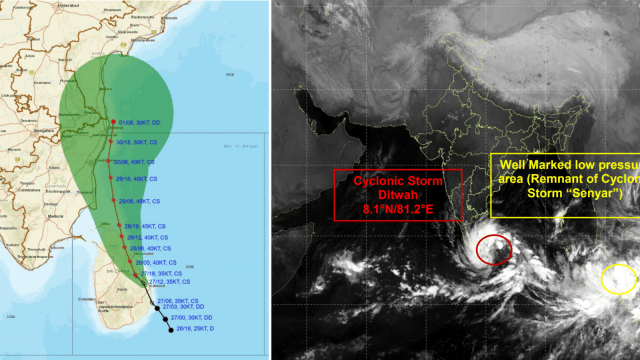
Cyclone Ditwah made landfall on Sri Lanka on November 27, 2025, bringing severe destruction to the island nation. The cyclone triggered widespread flooding and devastating landslides, claiming at least 123 lives with 130 more reported missing, and affecting nearly 44,000 people across the country. More than 300 mm of rainfall inundated the eastern and central regions, with the Western Province facing warnings of an “unprecedented disaster situation” due to rising water levels in the Kelani and Attanagalu rivers. The disaster disrupted critical infrastructure, including airport operations, road connectivity, and essential services.
Operation Sagar Bandhu: Multi-Agency Response
Recognizing the urgency and scale of the crisis, Prime Minister Narendra Modi directed swift mobilization of relief and rescue assets under Operation Sagar Bandhu. External Affairs Minister S. Jaishankar announced the launch of the operation, emphasizing India’s commitment to supporting its close maritime neighbor. The operation represents a whole-of-government approach involving the Indian Armed Forces, the Indian Air Force (IAF), the Indian Navy, and the National Disaster Response Force (NDRF).
Initial Response and Asset Deployment: The Indian Navy took immediate action, with the aircraft carrier INS Vikrant and the frontline warship INS Udaigiri reaching Colombo on November 27, 2025, just hours after the cyclone’s impact. These vessels handed over initial relief supplies to Sri Lankan authorities in a swift show of solidarity. The Indian Air Force demonstrated exceptional operational readiness by deploying two aircraft from Hindan Air Base on the night of November 28-29, 2025. One C-130J Hercules and one IL-76 transport aircraft carried a combined 21 tonnes of critical relief material along with over 80 specially trained NDRF personnel and 8 tonnes of specialized rescue equipment.
Relief Materials and Supplies: The humanitarian assistance provided through Operation Sagar Bandhu includes essential items tailored to address immediate needs in disaster-affected areas. Relief materials dispatched include tents, tarpaulins, blankets, hygiene kits, ready-to-eat food packets, medicines, water purification systems, and medical equipment. The NDRF teams accompanying the shipments bring advanced search and rescue capabilities, including specialized equipment for urban search and rescue operations, trained personnel, and canine units.
Coordination and Execution: India’s High Commission in Sri Lanka coordinated closely with local authorities to ensure efficient distribution of aid and identification of priority areas. Prime Minister Modi, in his official statement, conveyed condolences to the affected people and affirmed India’s readiness to provide additional assistance as the situation evolved. The operation underscores India’s capacity to mobilize military and civilian resources rapidly, coordinate across agencies, and execute large-scale humanitarian missions within hours of disaster declaration.
Strategic Significance and Regional Diplomacy
Operation Sagar Bandhu reinforces India’s leadership role in regional humanitarian response and demonstrates the depth of India-Sri Lanka relations. As stated by the Ministry of External Affairs, the support is guided by India’s “Neighbourhood First” policy and the Vision MAHASAGAR (Maritime Approach to foster Growth in South Asian Region), highlighting India’s commitment to ensuring stability, prosperity, and cooperation in the Indian Ocean region. The rapid response also reflects India’s evolution from reactive relief to proactive disaster preparedness and regional responsibility.
India’s HADR Legacy: Last 5 Years of Operations
India’s Operation Sagar Bandhu is part of a broader pattern of humanitarian leadership demonstrated across multiple operations in the last five years. India has established itself as a reliable and rapid-response first responder to regional and international disasters, deploying military assets, medical expertise, and specialized rescue personnel.
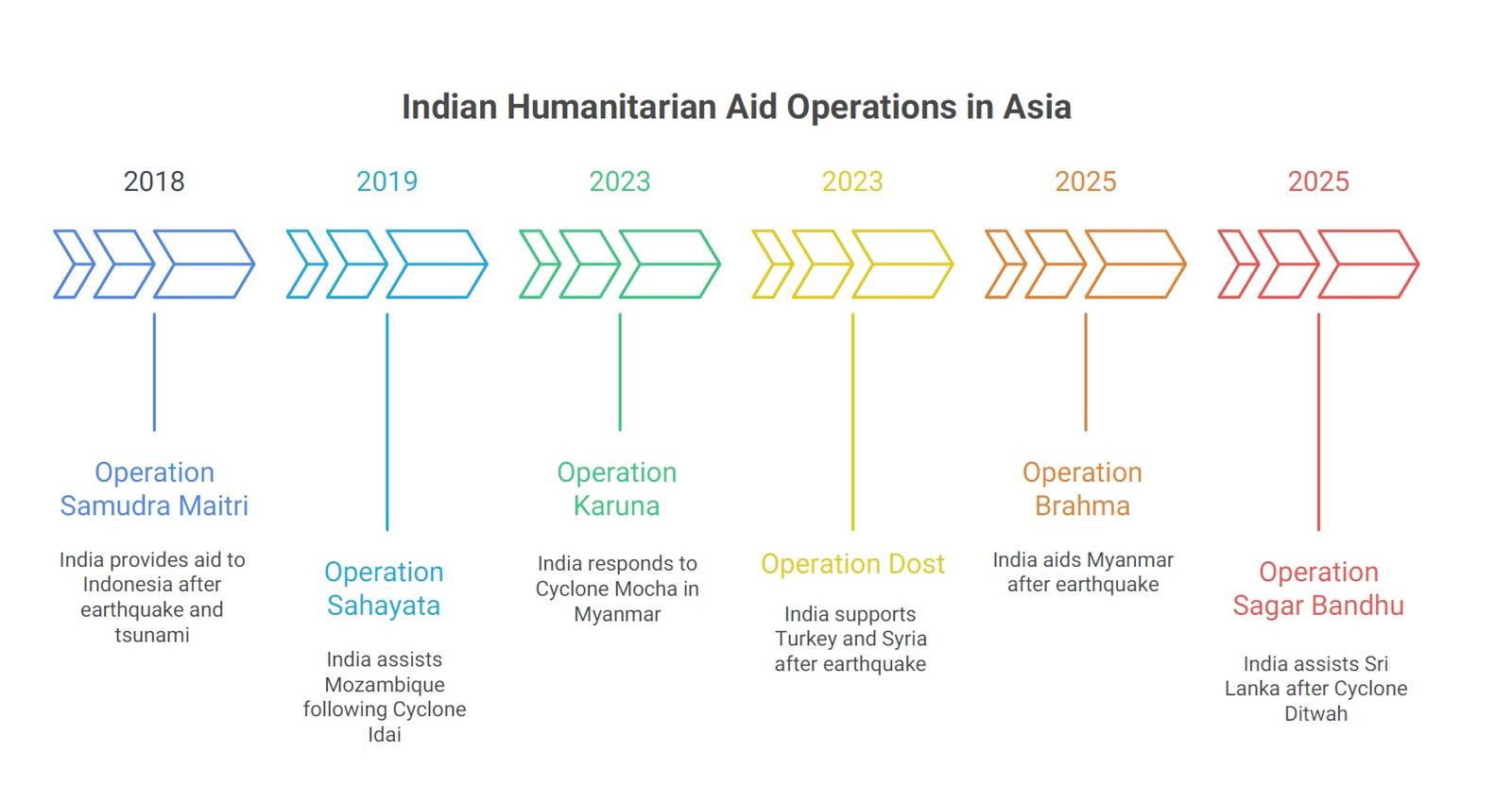
India’s Humanitarian Assistance and Disaster Relief (HADR) Operations for Other Countries (Last 5 Years)
Detailed Overview of Recent Operations:
Operation Samudra Maitri (2018) – Indonesia Earthquake and Tsunami:
On September 28, 2018, a devastating 7.5-magnitude earthquake struck Central Sulawesi, Indonesia, followed by a localized tsunami that reached heights of 4-7 meters. The combined impact resulted in at least 1,407 deaths and 632 injuries. India launched Operation Samudra Maitri in response, dispatching two IAF aircraft (C-130J and C-17) with medical teams and relief materials, along with three naval ships (INS Tir, INS Sujata, and INS Shardul) carrying humanitarian aid. The operation established a field hospital in the affected region and provided comprehensive disaster relief support, reinforcing India’s role as a trusted partner in the Indian Ocean region.
On September 28, 2018, a devastating 7.5-magnitude earthquake struck Central Sulawesi, Indonesia, followed by a localized tsunami that reached heights of 4-7 meters. The combined impact resulted in at least 1,407 deaths and 632 injuries. India launched Operation Samudra Maitri in response, dispatching two IAF aircraft (C-130J and C-17) with medical teams and relief materials, along with three naval ships (INS Tir, INS Sujata, and INS Shardul) carrying humanitarian aid. The operation established a field hospital in the affected region and provided comprehensive disaster relief support, reinforcing India’s role as a trusted partner in the Indian Ocean region.
Operation Sahayata (2019) – Mozambique Cyclone Idai:
Cyclone Idai made landfall in Mozambique on March 15, 2019, causing widespread destruction across the country and also affecting Zimbabwe and Malawi. India was the first responder to the humanitarian crisis, immediately diverting three naval ships (INS Sujata, ICGS Sarathi, and INS Shardul) to Port Beira. The Indian Navy rescue teams and medical personnel conducted search and rescue operations, rescuing over 192 people, providing medical assistance to 1,381 persons in medical camps, and supplying fresh water and food to affected communities. Additional supplies were dispatched on INS Magar, loaded with medicines, dry provisions, ready-to-eat meals, and essential items to support approximately 1,000 persons for seven days, along with 400 tonnes of rice and 500 kg of epidemic-related medicines.
Cyclone Idai made landfall in Mozambique on March 15, 2019, causing widespread destruction across the country and also affecting Zimbabwe and Malawi. India was the first responder to the humanitarian crisis, immediately diverting three naval ships (INS Sujata, ICGS Sarathi, and INS Shardul) to Port Beira. The Indian Navy rescue teams and medical personnel conducted search and rescue operations, rescuing over 192 people, providing medical assistance to 1,381 persons in medical camps, and supplying fresh water and food to affected communities. Additional supplies were dispatched on INS Magar, loaded with medicines, dry provisions, ready-to-eat meals, and essential items to support approximately 1,000 persons for seven days, along with 400 tonnes of rice and 500 kg of epidemic-related medicines.
Operation Karuna (2023) – Myanmar Cyclone Mocha:
Cyclone Mocha, classified as an extremely severe cyclonic storm with wind speeds of 277 kmph, struck Myanmar in May 2023, causing catastrophic destruction. The cyclone also devastated Cox’s Bazar in Bangladesh, destroying shelters in refugee camps and affecting vulnerable populations. India swiftly launched Operation Karuna, with three Indian Navy ships (INS Shivalik, Kamorta, and Savitri) arriving in Yangon on May 18, 2023, carrying emergency food items, tents, medicines, water pumps, portable generators, clothing, and hygiene supplies. The operation demonstrated India’s commitment to regional stability and humanitarian values despite political complexities.
Cyclone Mocha, classified as an extremely severe cyclonic storm with wind speeds of 277 kmph, struck Myanmar in May 2023, causing catastrophic destruction. The cyclone also devastated Cox’s Bazar in Bangladesh, destroying shelters in refugee camps and affecting vulnerable populations. India swiftly launched Operation Karuna, with three Indian Navy ships (INS Shivalik, Kamorta, and Savitri) arriving in Yangon on May 18, 2023, carrying emergency food items, tents, medicines, water pumps, portable generators, clothing, and hygiene supplies. The operation demonstrated India’s commitment to regional stability and humanitarian values despite political complexities.
Operation Dost (2023) – Turkey and Syria Earthquakes:
The devastating 7.8-magnitude earthquakes that struck Turkey and Syria on February 6, 2023, represented one of the deadliest seismic events in modern history, with confirmed deaths exceeding 53,537 in Turkey and estimates of 5,951-8,476 in Syria. India launched Operation Dost within hours of the disaster, deploying five IAF C-17 aircraft carrying specialized search and rescue teams, medical personnel, and relief materials totaling over 135 tonnes. Three teams from the NDRF, comprising more than 150 specially trained personnel with dog squads and specialized equipment, were deployed to conduct search and rescue operations in collapsed structures. The Indian Army established a 30-bed self-sustained field hospital with a fully functional operation theatre, X-ray facilities, ventilators, and a team of 99 specially trained medical personnel equipped with essential medicines and emergency supplies. The operation showcased India’s capability to execute large-scale humanitarian missions in coordination with international relief efforts.
The devastating 7.8-magnitude earthquakes that struck Turkey and Syria on February 6, 2023, represented one of the deadliest seismic events in modern history, with confirmed deaths exceeding 53,537 in Turkey and estimates of 5,951-8,476 in Syria. India launched Operation Dost within hours of the disaster, deploying five IAF C-17 aircraft carrying specialized search and rescue teams, medical personnel, and relief materials totaling over 135 tonnes. Three teams from the NDRF, comprising more than 150 specially trained personnel with dog squads and specialized equipment, were deployed to conduct search and rescue operations in collapsed structures. The Indian Army established a 30-bed self-sustained field hospital with a fully functional operation theatre, X-ray facilities, ventilators, and a team of 99 specially trained medical personnel equipped with essential medicines and emergency supplies. The operation showcased India’s capability to execute large-scale humanitarian missions in coordination with international relief efforts.
Operation Brahma (2025) – Myanmar Earthquake:
On March 28, 2025, a devastating 7.7-magnitude earthquake struck Myanmar, causing widespread destruction and claiming over 1,600 lives with thousands injured and missing. India immediately launched Operation Brahma, a whole-of-government response involving search and rescue efforts, medical assistance, and comprehensive disaster relief. By April 1, 2025, the operation had delivered 625 metric tonnes of humanitarian aid through six aircraft and five Indian Naval ships. An NDRF team of 80 skilled rescuers equipped with advanced search and rescue equipment and trained canines was airlifted from Hindon Air Base to Nay Pyi Taw. The Indian Army’s medical teams established field hospitals treating over 2,500 patients, performing 65 major surgeries, and delivering essential relief supplies to affected populations. This operation reinforced India’s regional leadership and demonstrated enhanced disaster response capabilities.
On March 28, 2025, a devastating 7.7-magnitude earthquake struck Myanmar, causing widespread destruction and claiming over 1,600 lives with thousands injured and missing. India immediately launched Operation Brahma, a whole-of-government response involving search and rescue efforts, medical assistance, and comprehensive disaster relief. By April 1, 2025, the operation had delivered 625 metric tonnes of humanitarian aid through six aircraft and five Indian Naval ships. An NDRF team of 80 skilled rescuers equipped with advanced search and rescue equipment and trained canines was airlifted from Hindon Air Base to Nay Pyi Taw. The Indian Army’s medical teams established field hospitals treating over 2,500 patients, performing 65 major surgeries, and delivering essential relief supplies to affected populations. This operation reinforced India’s regional leadership and demonstrated enhanced disaster response capabilities.
India’s Humanitarian Diplomacy and Soft Power
India’s constellation of disaster relief operations over the past five years reflects a sophisticated understanding of humanitarian diplomacy as a tool of statecraft. These operations achieve multiple objectives simultaneously: they provide lifesaving assistance to affected populations, strengthen bilateral relations with neighboring and partner nations, establish India as a dependable and capable regional leader, and enhance India’s global humanitarian standing. The consistency and speed of India’s response across diverse geographic regions and disaster types demonstrates institutional capacity and political commitment to the principle of “Vasudhaiva Kutumbakam” (the world is one family).The operations conducted under successive governments have established operational protocols, pre-positioned resources, and institutional frameworks that enable rapid deployment. India’s NDRF, with 16 operational battalions, has become a world-class disaster response force, capable of complex rescue operations, medical intervention, and logistical support. Similarly, the Indian Armed Forces have demonstrated flexibility in converting military assets for humanitarian purposes while maintaining core security capabilities.
Check : ENVIRONMENT NOTES


Discover more from Simplified UPSC
Subscribe to get the latest posts sent to your email.