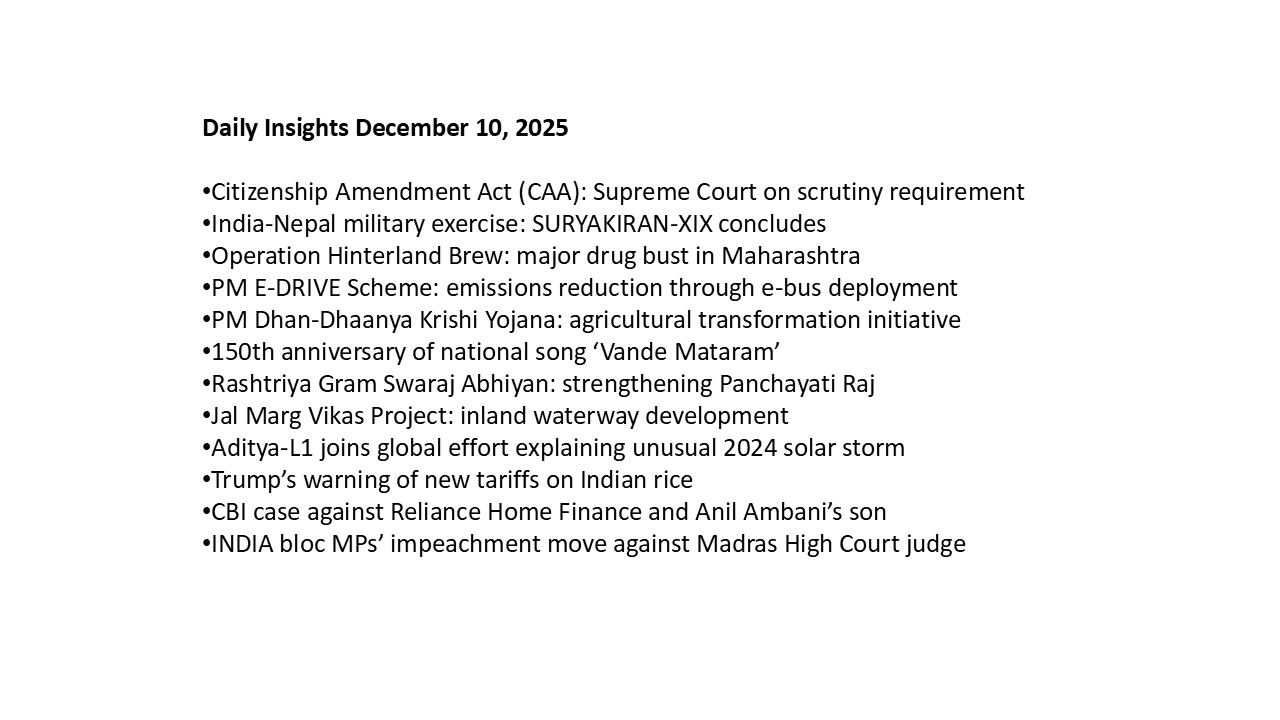
Daily Insights December 10, 2025
Contents
Daily Insights December 10, 2025
1. CITIZENSHIP AMENDMENT ACT (CAA): SUPREME COURT ON SCRUTINY REQUIREMENT
Source: The Hindu (Editorial Page)
Summary:
The Supreme Court, led by Chief Justice Surya Kant, held that conferment of citizenship to religious minorities from Pakistan, Afghanistan, and Bangladesh under the Citizenship Amendment Act (2019) will be wholly dependent on verifying their claims through proper scrutiny. The court emphasized that the CAA has merely provided “enforceable rights” to apply for citizenship, not automatic citizenship grants.
Key Points:
CAA grants enforceable rights to persecuted minorities but does not guarantee automatic citizenship
Each application must undergo statutory verification and scrutiny at district, state, and central levels
Special Intensive Revision (SIR) of electoral rolls has created panic among CAA applicants about statelessness
Applicants claiming minority status must prove: (a) their identity, (b) membership in persecuted minority, (c) previous residency in originating country, (d) legal entry into India
The court rejected the notion of automatic citizenship upon CAA eligibility
Proper implementation mechanism through government protocols required before citizenship grant
Naturalized citizens can apply for voter list inclusion through statutory scheme
NGO Aatmadeep filed petition alleging delays in citizenship certificate issuance
Court issued notice to Election Commission and Government seeking responses
Case posted for hearing next week with focus on constitutional crisis concerns
Enforcement of rights subject to fulfillment of specific conditions by applicants
Court emphasized government’s responsibility in determining citizenship claims
2. INDIA-NEPAL MILITARY EXERCISE: SURYAKIRAN-XIX CONCLUDES
Source: The Hindu (News)
Summary:
The 19th edition of India-Nepal joint military exercise SURYAKIRAN-XIX concluded in Pithoragarh, Uttarakhand, after demonstrating high operational synergy in counter-terrorism operations and peacekeeping scenarios. The exercise involved 334 personnel from both armies and emphasized interoperability in complex mountainous terrain.
Key Points:
Exercise conducted from November 25 to December 8, 2025 in Pithoragarh, Uttarakhand
19th edition of institutionalized bilateral military exercise between India and Nepal
334 personnel participated from Indian Army (Assam Regiment) and Nepal Army (Devi Datta Regiment)
Focus on UN Chapter VII peacekeeping operations and sub-conventional warfare
Training areas included jungle warfare, counter-terrorism, HADR (Humanitarian Assistance and Disaster Relief)
Demonstrated battalion-level interoperability and tactical coordination
DGMOs of both nations observed two-day validation exercise validating joint operations
Intelligence-based surgical operations conducted across complex terrain using aerial insertion
Training covered medical response, environmental conservation, and integrated ground-aviation operations
Directors General of Military Operations jointly observed culminating battalion-level validation exercise
Exercise reinforced strategic cooperation pillar of India-Nepal partnership
DGMO Lieutenant General Manish Luthra and DGMO Major General Anup Jung Thapa jointly planted Tree of Friendship
3. OPERATION HINTERLAND BREW: MAJOR DRUG BUST IN MAHARASHTRA
Source: ANI/DD News
Summary:
The Directorate of Revenue Intelligence (DRI) dismantled a clandestine Mephedrone manufacturing facility in Wardha district, Maharashtra, seizing 128 kg of the synthetic drug worth ₹192 crore. Three persons, including the mastermind chemist-financier, were arrested under NDPS Act, 1985.
Key Points:
Operation code-named “Operation Hinterland Brew” conducted on December 7-8, 2025
Location: Remote shrub-covered area in Karanja (Ghadge), Wardha district, approximately 60 km from Wardha
Seizure: 128 kg of finished Mephedrone valued at ₹192 crore
Additional seizure: 245 kg of precursor chemicals and raw materials essential for drug synthesis
Manufacturing setup included makeshift reactors, vessels, and complete processing equipment
Three arrested: mastermind (chemist-financier) and two associates involved in manufacturing and distribution
Facility deliberately set up in rural landscape to evade detection
Temporary, modular, nondescript structure concealed in shrubland
Fifth clandestine drug manufacturing facility dismantled by DRI in 2025
Demonstrates DRI’s commitment to “Nasha Mukt Bharat Abhiyaan” (drug-free India campaign)
Operation based on specific intelligence and surveillance
Reflects India’s sustained efforts against synthetic drug trafficking network
4. PM E-DRIVE SCHEME: EMISSIONS REDUCTION THROUGH E-BUS DEPLOYMENT
Source: PIB/DD News
Summary:
The PM E-DRIVE scheme, notified on September 29, 2024, aims to reduce public transport emissions through large-scale deployment of 14,028 electric buses in nine major Indian cities. With an outlay of ₹4,391 crore, the scheme represents India’s commitment to sustainable urban mobility and climate action.
Key Points:
Total allocation: ₹4,391 crore for deployment of 14,028 e-buses
Target cities: Mumbai, Delhi, Bengaluru, Hyderabad, Ahmedabad, Chennai, Kolkata, Surat, Pune (population above 40 lakh)
Objective: Reduce greenhouse gas emissions from public transport sector significantly
Bengaluru allocated 4,500 e-buses with procurement through Convergence Energy Services Limited (CESL)
Support provided through operational expenditure or gross cost contract model
Ministry of Heavy Industries and CESL coordinating timely deployment across cities
Parallel focus on charging infrastructure expansion nationwide
₹2,000 crore earmarked for establishing EV Public Charging Stations
Charging stations on national highways and in metropolitan regions (unlicensed activity for private operators)
Operational guidelines for charging infrastructure issued on September 26, 2025
Supports India’s NDC (Nationally Determined Contribution) climate commitments
Addresses urban air quality degradation and sustainable development goals
5. PM DHAN-DHAANYA KRISHI YOJANA: AGRICULTURAL TRANSFORMATION INITIATIVE
Source: PIB/Cabinet Approval
Link: https://www.pib.gov.in/PressNoteDetails.aspx?NoteId=154909
Summary:
The Union Cabinet approved the Prime Minister Dhan-Dhaanya Krishi Yojana targeting 100 under-performing agricultural districts through saturation-based convergence of 36 Central schemes across 11 Ministries with an annual outlay of ₹24,000 crore for six years (FY 2025-26 to 2030-31).
Key Points:
Launched in Union Budget 2025-26 and approved by Cabinet on July 16, 2025
Duration: Six years starting FY 2025-26 with annual outlay of ₹24,000 crore
Targets 100 districts with low productivity, moderate crop density, below-average credit parameters
Convergence of 36 Central schemes across 11 Ministries (unprecedented scope)
Inspired by NITI Aayog’s Aspirational District Programme model
Focus areas: Higher productivity, value addition, local livelihood creation
Expected to drive Atmanirbhar Bharat (self-reliant agriculture) objective
Includes institutional credit expansion and Kisan Credit Card (KCC) growth
Support from NITI Aayog, agricultural universities, and multiple ministries
Addresses structural challenges in Indian agricultural sector
Real-time monitoring and decentralized planning mechanism
Will create resilient rural livelihoods and improve national agricultural indicators
6. VANDE MATARAM 150TH ANNIVERSARY: NATIONAL COMMEMORATION LAUNCH
Source: PIB/Ministry of Culture
Summary:
India officially launched year-long commemoration (November 7, 2025 to November 7, 2026) of 150 years of the national song “Vande Mataram,” composed by Bankimchandra Chatterji. Prime Minister inaugurated the ceremony at Indira Gandhi Indoor Stadium, New Delhi, releasing commemorative stamp and coin.
Key Points:
Vande Mataram written on Akshaya Navami, November 7, 1875 by Bankimchandra Chatterji
First appeared in literary journal “Bangadarshan” as part of novel “Anandamath” (serialized), later as standalone book in 1882
Became enduring symbol of India’s freedom movement and national pride
Inaugural ceremony held on November 7, 2025 at Indira Gandhi Indoor Stadium, New Delhi
Prime Minister Narendra Modi as Chief Guest released Commemorative Stamp and Coin
Year-long commemoration approved by Union Cabinet and National Implementation Committee (October 24, 2025)
Four-phase celebration structure: Phase 1 (Nov 7-14, 2025), Phase 2 (Jan 19-26, 2026), Phase 3 (Aug 7-15, 2026), Phase 4 (Nov 1-7, 2026)
VIP events with widespread public participation held across country till tehsil level
Song invokes Motherland as embodiment of strength, prosperity, and divinity
Represents India’s awakening spirit of unity and self-respect
Part of government initiative to strengthen national consciousness and pride
Connects contemporary India with freedom movement heritage and values
7. RASHTRIYA GRAM SWARAJ ABHIYAN: PANCHAYATI RAJ STRENGTHENING
Source: PIB/Ministry of Panchayati Raj
Summary:
The revamped Rashtriya Gram Swaraj Abhiyan (2022-23 to 2025-26) focuses on strengthening Panchayati Raj Institutions (PRIs) through capacity building, training, and convergence with sustainable development goals. Total financial outlay: ₹5,911 crore (Central: ₹3,700 crore, State: ₹2,211 crore).
Key Points:
Revamped scheme operational from FY 2022-23 to 2025-26 (15th Finance Commission period)
Total financial outlay: ₹5,911 crore (Central share: ₹3,700 crore, State share: ₹2,211 crore)
Succeeds previous RGSA (2018-19 to 2021-22) which had ₹7,255.50 crore allocation
Primary aim: Strengthen PRIs for achieving Sustainable Development Goals (SDGs)
Focus on convergence with Mission Antyodaya and aspirational district development
Emphasizes capacity building and training (CB&T) of PRIs as continuous process
Funds released: FY 2021-22: ₹614.25 crore; FY 2022-23: ₹672.97 crore; FY 2023-24: ₹800.17 crore; FY 2024-25: ₹670.40 crore
As of November 25, 2025: ₹697.00 crore released for FY 2025-26
Total released (5 years): ₹3,854.79 crore
Objective: Enable PRIs to function as effective instruments of decentralized governance
Supports rural development and local empowerment initiatives
Aligns with “Gram Swaraj” (village self-governance) constitutional principles
8. JAL MARG VIKAS PROJECT: WATERWAY DEVELOPMENT MILESTONE
Source: IWAI/World Bank
Summary:
The Jal Marg Vikas Project, targeting development of 1,380 km navigation route between Varanasi and Haldia with 3-meter depth, has achieved 63.10% financial and 63.50% physical progress. Expected completion: December 2025 (extended timeline). Estimated cost: ₹4,633.81 crore.
Key Points:
Project initiated to develop National Waterway-1 (Varanasi-Haldia stretch)
Total distance: 1,380 km with target depth of 3 meters
Original estimated cost: ₹5,369.18 crore; Revised cost: ₹4,633.81 crore (savings of ₹735.51 crore)
Funding pattern: IBRD Loan: ₹2,512 crore; GoI Counterpart: ₹2,556 crore; PPP: ₹301 crore
World Bank loan agreement signed: February 2, 2018
Implemented by Inland Waterways Authority of India (IWAI) under Ministry of Shipping
Completed: Multi-modal terminals at Varanasi (₹169.59 crore), Haldia (₹517.36 crore), Sahibganj (₹280.90 crore)
Navigation Lock at Farakka: 99.49% physical progress
IMT-Terminal at Kalughat: 95.5% physical progress
Fairway development ongoing with dredging and maintenance works
Supports inland water transport, reducing logistics costs and emissions
Part of National Waterways Development Program contributing to multimodal connectivity
9. ADITYA-L1 SOLAR OBSERVATORY: MAJOR SCIENTIFIC BREAKTHROUGH
Source: ISRO/The Hindu
Link: https://www.isro.gov.in/Aditya_L1_Landmark_solar_storm_study.html
Summary:
India’s Aditya-L1 solar observatory played a key role in international collaboration studying the May 2024 solar storm (“Gannon’s storm”), the strongest in over two decades. Indian scientists published breakthrough research in Astrophysical Journal Letters explaining unprecedented magnetic reconnection phenomenon.
Key Points:
May 2024 solar storm (“Gannon’s storm”) was strongest in over 20 years
Aditya-L1 collaborated with 6 US satellites (NASA’s Wind, ACE, THEMIS-C, STEREO-A, MMS, DSCOVR)
Research published in Astrophysical Journal Letters (September 2025)
Discovery: Two coronal mass ejections (CMEs) collided causing unprecedented magnetic reconnection
Magnetic field lines inside CMEs snapped and rejoined in new ways (magnetic reconnection process)
Reconnection region: Approximately 1.3 million km across (nearly 100 times Earth’s size)
First time such giant magnetic breakup within CME observed
Particles accelerated rapidly, significantly increasing storm’s impact on Earth
Aditya-L1’s precise magnetic field measurements mapped reconnection region
Demonstrates India’s growing leadership in global space science
Enhances understanding of solar storm evolution from Sun to Earth
Improves India’s preparedness for predicting and understanding powerful solar events
10. INDIA-USA TRADE TENSIONS: TRUMP’S RICE TARIFF WARNING
Source: The Hindu/NDTV
Summary:
US President Donald Trump warned of imposing tariffs on Indian rice and Canadian fertilizers, alleging “dumping” in American markets. Analysis shows India’s rice exports to US represent only 3% of India’s total rice exports, while Indian rice comprises over 25% of US rice imports—indicating greater US dependence.
Key Points:
Trump announced ₹$12 billion farm support package for American farmers on December 8, 2025
Alleged Indian rice “dumping” in US market affecting domestic rice prices
American farmers complaint: falling rice prices due to cheap imports from India, Thailand, Vietnam
Trump stated: “They shouldn’t be dumping. You can’t do that.”
Trade analysis: Only 3% of India’s rice exports go to US market
Paradox: Indian rice makes up over 25% of US rice imports (high US dependence)
US is not major export market for India; India is major import source for US
US negotiation team visited India on December 7 for trade talks
Earlier context: Trump imposed 50% tariffs on Indian goods (citing trade barriers, Russia oil purchases)
Allison Hooker (US Under Secretary of State) on 5-day visit to boost bilateral ties
Demonstrates Trump administration’s protectionist trade stance
Ongoing US-India tariff negotiations expected to continue
11. INDIA BLOC IMPEACHMENT MOTION: MADRAS HIGH COURT JUDGE
Source: Indian Express/The Hindu
Summary:
Over 120 Opposition MPs from INDIA bloc submitted impeachment notice against Madras High Court Justice G.R. Swaminathan, alleging misconduct, bias toward particular communities, and ideologically-driven judgments. Motion covers Articles 217 and 124 of the Constitution regarding high court judge removal.
Key Points:
Impeachment motion filed: December 9, 2025 with 120+ Opposition MP signatures
107 Lok Sabha MPs signed (DMK, Congress, Trinamool Congress)
Submitted to Lok Sabha Speaker Om Birla
Copies sent to President of India and Chief Justice of India
Grounds alleged: Impartiality questions, undue favoritism shown to Senior Advocate M. Sricharan Ranganathan
Favoritism claims toward advocates from particular community
Allegations: Decisions influenced by “particular political ideology,” violating secular constitutional principles
Trigger incident: Judge’s December 1, 2025 order allowing lamp-lighting at Thiruparankundram Karthigai Deepam ritual site
Judicial impartiality and transparency concerns central to motion
Removal requires 2/3 majority in both Houses present and voting (>50% of total membership)
BJP responded: Called motion “anti-Hindu bigotry”
Judge appointed to Madras High Court in 2017
12. AI AND COPYRIGHT: GOVERNMENT BLANKET LICENSE PROPOSAL
Source: Onmanorama/The Hindu Business Line
Summary:
Government-appointed committee recommended mandatory blanket license for AI developers to use copyrighted works in training systems, with statutory remuneration rights for copyright owners. Department for Promotion of Industry and Internal Trade (DPIIT) released working paper for 30-day public consultation (December 8, 2025).
Key Points:
Committee formed: April 28, 2025 (8-member panel headed by Additional Secretary Himani Pande)
Committee includes legal experts, industry, and academia representatives
Working Paper Part 1 released: December 8, 2025 for public feedback (30-day window)
Majority recommendation: Mandatory blanket license for AI developers
License covers: All lawfully accessed copyright-protected works for AI training
Copyright owner protection: Statutory remuneration right (non-negotiable)
Rights holders cannot withhold works from AI training system use
Single umbrella organization: Administered by designated rights holders’ body for royalty collection
Model objective: Simplify licensing, reduce transaction costs, ensure fair compensation
Balancing innovation: Regulatory architecture preserves creative ecosystem while enabling AI development
Single-window access: AI developers to gain copyright work access without complex negotiations
Recognizes generative AI’s transformative potential while protecting human-created intellectual property
13. INDIA NAVAL CHIEF’S BRAZIL VISIT
Source: PIB/Greater Kashmir
Summary:
Admiral Dinesh K. Tripathi, Chief of Naval Staff, commenced 4-day official visit to Brazil (December 9-12, 2025) to strengthen maritime partnership between Indian and Brazilian navies. Engagements include meetings with Brazil’s Defence Minister, joint staff chief, and Brazilian Navy commander.
Key Points:
Visit duration: December 9-12, 2025 (4 days)
Brazilian counterparts: Defence Minister Jose Mucio, Admiral Renato Rodrigues de Aguiar Freire (Joint Staff Chief), Admiral Marcos Sampaio Olsen (Navy Commander)
Focus areas: Maritime security, naval interoperability, capacity building, professional exchanges
Engagements: Operational commands, naval bases, shipyards visits
India-Brazil Strategic Partnership: Maritime cooperation as key pillar
Collaboration framework: South-South cooperation within multilateral context
Shared maritime priorities: Regional and global maritime stability
Capacity development: Training, technology exchange, capability enhancement
Operational linkages: Deepening professional and tactical coordination
Demonstrates India’s maritime diplomacy and global naval partnerships
Contributes to global maritime commons stability
Reaffirms Indian Navy’s commitment to expanding international partnerships
Discover more from Simplified UPSC
Subscribe to get the latest posts sent to your email.