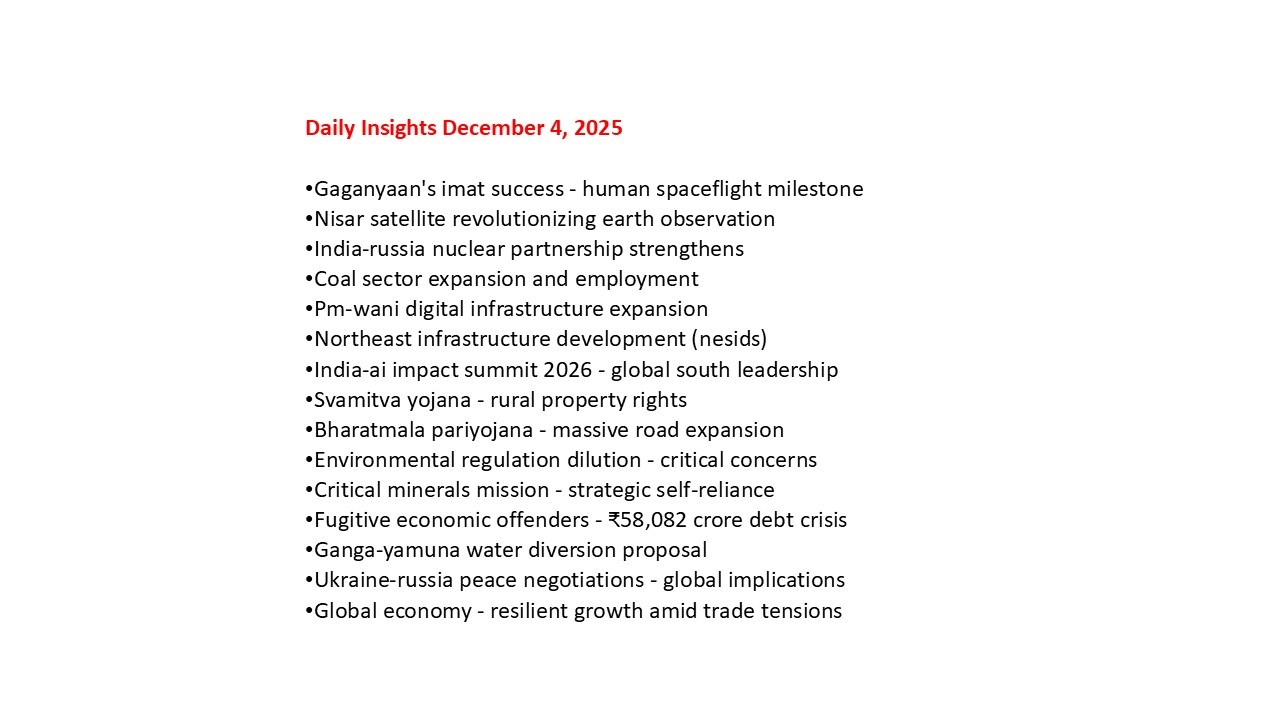
Daily Insights December 4, 2025
Contents
Daily Insights December 4, 2025
1. INTEGRATED MAIN PARACHUTE AIRDROP TEST (IMAT) – GAGANYAAN MISSION
Source: https://www.pib.gov.in/PressReleseDetail.aspx?PRID=2198289
Key Points:
ISRO successfully conducted IMAT for India’s first human spaceflight programme (Gaganyaan)
Test validated parachute system under extreme descent conditions with deliberate disreefing delay
Assessed structural integrity and load-bearing performance under asymmetric forces
Third-party validation through Design Review Team, Independent Assessment Committee, and National Advisory Panel
Supports Government target of first crewed Gaganyaan mission by Q1 2027
Demonstrates India’s indigenous capability for human space missions and safety protocols
Crew training and ground recovery preparations continuously improved
Risk assessment framework aligned with global standards for human spaceflight
UPSC Relevance: Science & Technology, Space Exploration, India’s Scientific Achievements
2. NISAR SATELLITE – NASA-ISRO JOINT MISSION
Source: https://www.pib.gov.in/PressReleseDetail.aspx?PRID=2198276
Key Points:
NASA-ISRO Synthetic Aperture Radar (NISAR) successfully launched July 30, 2025 from Sriharikota
Joint development with investment exceeding $1.5 billion; weight 2,392 kg
Features dual radar: L-Band SAR (NASA) and S-Band SAR (ISRO) on 12-meter unfurlable antenna
Mission life: 5 years; revisits entire Earth’s land and ice surfaces every 12 days
Open-data policy: All data freely available within 1-2 days, near real-time during emergencies
ISRO expenditure: ₹504.78 crores for satellite development, ₹340 crores for launch
Applications: Disaster management, agriculture, climate monitoring for Global South nations
Symbolises India-US cooperation in space exploration under Vishwa Bandhu vision
UPSC Relevance: India-US Relations, Space Technology, International Cooperation, Environmental Monitoring
3. INDIA-RUSSIA CIVIL NUCLEAR COOPERATION
Source: https://www.pib.gov.in/PressReleseDetail.aspx?PRID=2198342
Key Points:
MoU to be signed during Putin’s visit (December 4-5) for 23rd India-Russia Annual Summit
Focus on small modular reactors (SMRs) of Russian design for deployment in India
Rosatom authorized to negotiate on localization of equipment production in India
Budget 2025-26: ₹20,000 crore outlay for developing 5 indigenous SMRs by 2033
BARC initiated design work on indigenous SMRs for technology demonstration at DAE site
Bharat Small Reactors (BSR) for captive industrial use: RFP deadline extended to March 31, 2026
Draft Atomic Energy Bill 2025 in advanced processing stage for comprehensive nuclear framework
Strategic bilateral cooperation for energy security and nuclear technology advancement
UPSC Relevance: India-Russia Relations, Nuclear Energy Policy, Energy Security, Infrastructure Development
4. COAL MINES AND LOCAL DEVELOPMENT
Source: https://www.pib.gov.in/PressReleseDetail.aspx?PRID=2198220
Key Points:
FY 2025-26 coal production target: 1,157 Million Tonnes (1,157 MT)
Coal India Ltd (CIL): 875 MT; SCCL: 72 MT; Captive/Commercial: 210 MT
Long-term target: ~1.5 Billion Tonnes by FY 2029-30
133 coal mines auctioned with Peak Rated Capacity of 276.04 MTPA
Expected annual revenue: ₹38,710 crore; Capital investment: ₹41,407 crore
Employment generation: 3,73,199 persons once operationalised
Coal gasification scheme: ₹8,500 crore approved; 7 projects selected
Abandoned mines under Revenue Sharing model: 28 with LoA; coal production started in 2 mines (FY 2025-26)
Reduces import dependency; supports Atmanirbhar Bharat initiative
UPSC Relevance: Economic Development, Resource Management, Employment Generation, Industrial Policy
5. PM-WANI WI-FI ACCESS NETWORK INTERFACE SCHEME
Source: https://www.pib.gov.in/PressReleseDetail.aspx?PRID=2198211
Key Points:
3,91,599 Wi-Fi hotspots operational across country (as of November 26, 2025)
Delhi leads with 1,98,275 hotspots; followed by Uttar Pradesh (47,549), Gujarat (11,857)
Public Data Offices (PDOs) expanded to 3,91,599 agents of PDOAs
Scheme approved December 9, 2020 to accelerate broadband proliferation
Aligns with National Digital Communications Policy (NDCP) 2018 objectives
Key reforms (September 16, 2024): regulatory oversight minimization for local entrepreneurs
TRAI tariff order (June 16, 2025): FTTH plans up to 200 Mbps offered to PDOs at ≤ twice consumer price
Supports financial inclusion and digital transformation in rural areas
Encourages local entrepreneurship in digital ecosystem
- Read More about PM-WANI
UPSC Relevance: Digital Infrastructure, Financial Inclusion, Grassroots Entrepreneurship, Technology Access
6. NESIDS PROJECTS IN ASSAM
Source: https://www.pib.gov.in/PressReleseDetail.aspx?PRID=2198115
Key Points:
North East Special Infrastructure Development Scheme (NESIDS) approved 2017-18; restructured 2022-23
Two components: NESIDS-Roads and NESIDS-Other Than Roads Infrastructure
Assam: 20 road projects sanctioned since 2017; 14 completed
No projects pending due to land or clearance issues in Assam
Impact study (IIM Shillong) shows long-term socio-economic benefits
Enhances trade connectivity, tourism, and regional mobility
Aligns with SDG 9 (Industry, Innovation, Infrastructure) and SDG 11 (Sustainable Cities)
Road infrastructure improves multi-sectoral support and implementing mechanisms
Part of comprehensive Northeast development strategy under regional growth focus
UPSC Relevance: Regional Development, Infrastructure Planning, Northeast India, Sustainable Development Goals
7. INDIA-AI IMPACT SUMMIT 2026
Source: https://www.pib.gov.in/PressReleseDetail.aspx?PRID=2198216
Key Points:
Summit scheduled February 19-20, 2026 at Bharat Mandapam, New Delhi
First global AI summit hosted by Global South nation; includes heads of state and global leaders
3 Sutras (guiding principles): People, Planet, Progress
7 Chakras (thematic priorities): Human Capital, Inclusion, Safe & Trusted AI, Resilience, Science, Democratizing AI Resources, AI for Economic Development & Social Good
8 new foundational models launched from 506 proposals (Avatar AI, Bharat Gen, BrahmAI, Yukti, etc.)
30 IndiaAI Data & AI Labs launched in first wave (27 with NIELIT, 3 with Intel)
AI Pitch Fest (UDAAN) to showcase global startups and Tier 2&3 Indian ventures
Global innovation challenges and research symposium planned
₹38,000 GPUs deployed (target: 570 Data Labs across country by 2030)
UPSC Relevance: Technology Governance, Global Leadership, Innovation Ecosystem, Future Skills Development
8. SVAMITVA YOJANA – PROPERTY RIGHTS AND RURAL EMPOWERMENT
Source: https://www.pib.gov.in/PressReleseDetail.aspx?PRID=2198174
Key Points:
Nearly 3.44 lakh villages targeted for coverage
Drone survey and property card distribution ongoing
Ministry of Panchayati Raj target: All targeted villages covered by March 2026
Property cards provide legal documentation of ownership in villages
Empowers rural populations with land rights and collateral for credit access
States/UTs incorporating postcard issuance procedures in respective Acts
Supports financial inclusion and land dispute resolution
Aligns with rural development and women empowerment objectives
Digital mapping via drone technology for accurate property demarcation
- Read More
UPSC Relevance: Rural Development, Property Rights, Digital India, Financial Inclusion, Women Empowerment
9. BHARATMALA PARIYOJANA – INFRASTRUCTURE CONNECTIVITY
Source: https://www.pib.gov.in/PressReleseDetail.aspx?PRID=2198346
Key Points:
Total expenditure under Bharatmala: ₹4,92,562 crore
Phase-I: 796 projects awarded (26,425 km length); 21,248 km constructed (till September 2025)
High-speed greenfield corridors: 6,669 km awarded; 4,610 km completed
National Highway network expanded from 1,32,499 km (March 2019) to 1,46,560 km
4-lane and above NH: increased 1.4 times (31,066 km to 43,512 km)
Less than 2-lane highways reduced from 27% to 9% of total network
Access-controlled expressways: 3,052 km operationalized
Average freight speed on expressways: improved from 30-35 km/h to ~50 km/h
Road safety measures implemented at design, construction, and operation stages
Enhances regional connectivity, reduces logistics costs, supports Make in India
UPSC Relevance: Infrastructure Development, Economic Growth, Regional Connectivity, Transportation Policy
10. ENVIRONMENTAL REGULATION FRAMEWORK CHALLENGES
Key Points:
India confronting deepening environmental emergency from decade-long policy dilution
Forest Conservation Act amendments sidelined essential safeguards
Chronic underfunding and growing post-facto clearances undermined accountability
Aravalli range erosion due to relaxed mining norms; uranium-tainted groundwater reports
Supreme Court recalls judgment on retrospective environmental clearances (2-1 majority)
Green Credit Programme amended (August 2025): 40% canopy density mandate after 5 years
Ramsar wetland sites: India reached 94 sites (highest in South Asia)
PM Surya Ghar scheme: 4,946 MW rooftop solar by July 2025
Green vs. Green conflict: renewable energy expansion fragmenting wildlife habitats
Great Indian Bustard: numbers dropped below 150 due to power line collisions
Urgency for policy reset restoring protections, empowering communities, strengthening institutions
UPSC Relevance: Environmental Law, Regulatory Framework, Sustainable Development, Climate Action
11. INDIA’S CRITICAL MINERALS MISSION
Source: https://www.pib.gov.in/PressReleseDetail.aspx?PRID=2198342 & Multiple Sources
Key Points:
National Critical Mineral Mission (NCMM) launched 2025 (spans 2024-25 to 2030-31)
Budget allocation: ₹16,300 crore; anticipated ₹18,000 crore PSU/stakeholder investments
30 critical minerals identified; 24 included under MMDR Act for exclusive government auction
Exploration: 1,200+ projects by GSI; ~100 blocks targeted for auction
China dominance: 90% global processing; 70% production (despite only 30% reserves)
Rare Earth Permanent Magnets scheme: ₹7,280 crore for domestic manufacturing
Recycling capacity: ₹1,500 crore scheme targeting 270 kiloton per annum recovery
7 Centres of Excellence in premier institutions (IITs, CSIR)
Target: 1,000 patents by 2030-31 across exploration-extraction value chain
Overseas mineral acquisition through KABIL; strategic stockpile establishment
Missing link: inadequate processing, refining capacity; long gestation periods (10-15 years)
UPSC Relevance: Mineral Policy, Self-Reliance, Strategic Resources, Technology Development, Geopolitical Competition
12. FUGITIVE ECONOMIC OFFENDERS – ₹58,082 CRORE DEBT
Key Points:
15 Fugitive Economic Offenders (FEOs) owe ₹58,082 crore to public sector banks
Principal amount: ₹26,645 crore; Interest accrued: ₹31,437 crore (as of October 31, 2025)
Key offenders: Vijay Mallya, Nirav Modi, Sandesara Brothers (Sterling Biotech)
Vijay Mallya: ₹6,848.28 crore principal (SBI); ₹11,960.05 crore with interest
Sandesara Brothers: ₹18,694.32 crore (₹7,875.40 principal; ₹10,818.92 interest)
Recovery achieved: ₹19,187 crore (~33% recovery rate)
Outstanding: ₹38,895 crore balance unpaid
9 of 15 FEOs linked to major financial frauds involving PSBs
Only 2 in one-time settlement negotiations
Declared under Fugitive Economic Offenders Act, 2018 (applies for ₹100+ crore frauds)
Challenges: weak compliance culture, enforcement gaps, criminal deterrence issues
UPSC Relevance: Financial Crime, Banking Regulation, Economic Offenders, Public Sector Management, Governance
13. GANGA-YAMUNA WATER DIVERSION PROPOSAL
Key Points:
Delhi government exploring proposal to divert ~500 cusecs of Ganga water to Yamuna
Diversion via Eastern Yamuna Canal
Objective: Improve Yamuna river flow during non-monsoon season
Addresses water quality and availability concerns in Yamuna during dry months
Farmer concerns: Roadblock due to agricultural irrigation impact
Intergovernmental coordination needed: Involves Himachal Pradesh, Uttarakhand, Haryana, UP states
Historical context: 1994 Yamuna River Basin States agreement on water sharing
Environmental implications: Ecological flow maintenance, ecosystem preservation
Urban water security vs. agricultural water needs tension
Part of broader Yamuna Master Plan for river rejuvenation (2027 deadline for cleaning)
UPSC Relevance: Water Resource Management, River Basin Disputes, Inter-State Water Sharing, Environmental Conservation
14. UKRAINE-RUSSIA PEACE TALKS AND GEOPOLITICAL DEVELOPMENTS
Source: https://www.aljazeera.com/news/2025/12/4/russia-ukraine-war-list-of-key-events-day-1379
Key Points:
US special envoys Steve Witkoff and Jared Kushner met Putin in Moscow (December 3)
Putin stated partial acceptance of US peace proposals; many proposals deemed unacceptable
Ukrainian President Zelensky preparing for US talks in Miami (December 4)
91 UN nations voted for resolution on Ukrainian deportees’ return; Russia voted against (11 others abstained: 57)
EU proposed €90 billion support package for Ukraine (2026-2027 coverage)
EU agreed phased phaseout of Russian gas imports by September 2027
NATO commitment: 2/3 of NATO members pledged $4 billion weapons through PURL initiative
Australia and New Zealand supporting PURL initiative
Russia claims territorial gains (Chervone village, Zaporizhia); Ukraine reports strikes on Russian oil facilities
Diplomacy ongoing; no major breakthrough; expert-level negotiations continuing
Implications: Global security architecture, energy security (Europe), humanitarian crisis
UPSC Relevance: International Relations, Geopolitics, United Nations, Regional Conflicts, Global Security
15. GLOBAL ECONOMIC GROWTH AND TRADE DYNAMICS
Source: https://www.oecd.org & https://unctad.org
Key Points:
OECD upgrades 2025 global growth forecast to 3.2% (from 3.3% in 2024)
Global trade rose ~4% early 2025 despite tariff concerns and policy uncertainty
Trade resilience driven by AI investments and structural shifts (services expanding)
UNCTAD reports global growth will slow to 2.6% due to financial volatility
Developing economies forecast 4.3% growth (significantly outpacing advanced economies)
India: Growing at 6.7% (fastest major economy; upgraded from 6.5%)
China: Expected 5% growth (same as 2024; slower than historical rates)
Eurozone: 1.3% growth (improved from 0.8% in 2024)
Dollar dominance in global finance: SWIFT payment share risen from 39% to ~50% in 5 years
Developing economies face: higher financing costs, capital flow volatility, climate-related risks
Supply chain diversification occurring: South-South trade growing above average
Financial shocks increasingly affecting real economy; policy uncertainty persisting
UPSC Relevance: Global Economy, Trade Policy, India’s Economic Position, Financial Markets, Development Challenges
Discover more from Simplified UPSC
Subscribe to get the latest posts sent to your email.