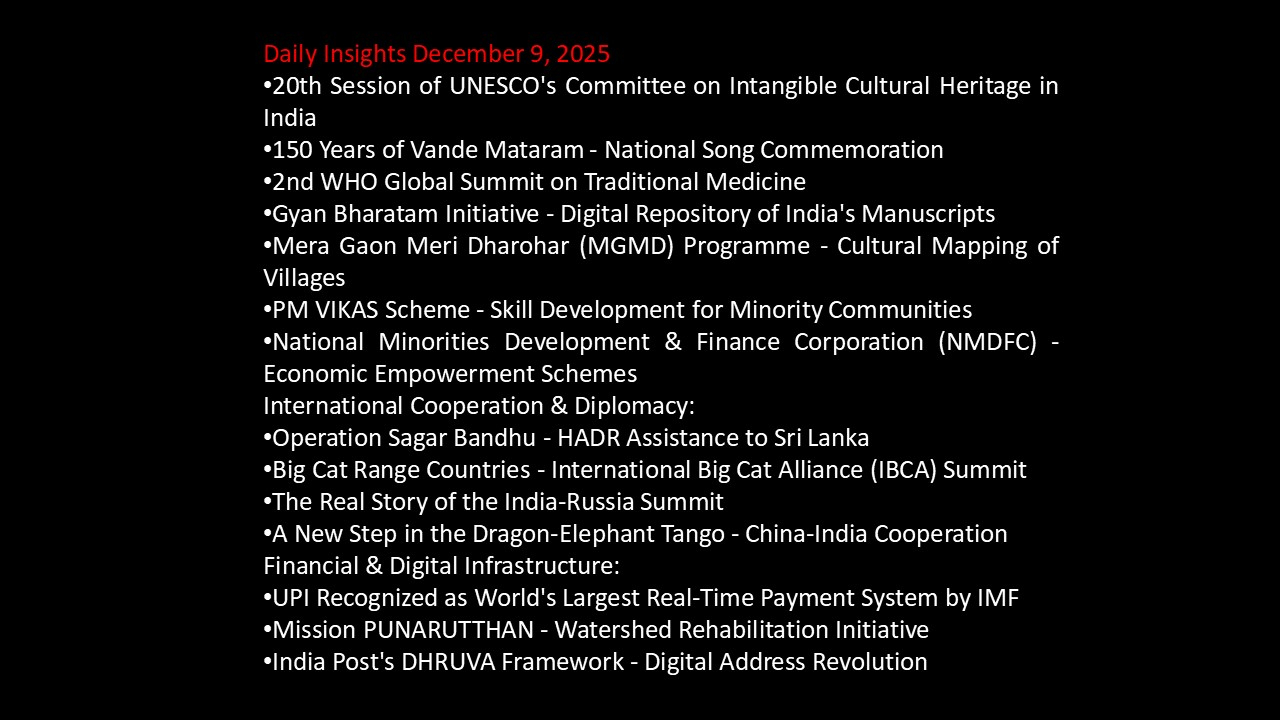
Daily Insights December 9, 2025
Contents
Daily Insights December 9, 2025
1. 20th Session of UNESCO’s Committee on Intangible Cultural Heritage in India
Source: PIB
Key Points:
The 20th Session of UNESCO’s Intergovernmental Committee for Safeguarding Intangible Cultural Heritage (20 COM) commenced on December 8, 2025, at the Red Fort, New Delhi, running till December 13, 2025.
Nearly 1,000 delegates from Member States, cultural institutions, experts, NGOs, and observers are participating in this week-long session, emphasizing global cooperation on living heritage.
India currently has 15 elements inscribed on UNESCO’s Representative List of Intangible Cultural Heritage, including Vedic Chanting, Kutiyattam, Yoga, Kumbh Mela, Durga Puja, and Garba, representing a kaleidoscope of India’s cultural identity.
Globally, UNESCO’s ICH lists include 788 elements from 150 countries, highlighting the scale and urgency of strengthening safeguarding measures.
The session emphasizes a community-centered approach to safeguarding traditions, with India leading ongoing expansion of the National Inventory of Intangible Cultural Heritage.
Capacity-building initiatives for practitioners and efforts to integrate living heritage into national development programmes are being showcased at the summit.
The forum addresses challenges facing intangible heritage worldwide, including commercial pressures, shifting community dynamics, and evolving digital ecosystems.
The hosting of this session at the UNESCO World Heritage Site of the Red Fort reflects India’s unique blend of tangible and intangible cultural heritage.
India’s initiatives in craft revival, community archiving, master-apprentice training models, and market-linked livelihood support for artisans are being highlighted as best practices.
Greater involvement of youth through school curricula, vocational training, cultural fellowships, and digital platforms is emphasized to ensure continuity of traditions for future generations.
Communities are recognized as true custodians of cultural heritage, with discussions focusing on strengthening global cooperation and practical, community-led safeguarding measures.
The event reflects India’s commitment to harnessing the power of culture to connect societies and generations, advancing the vision of a culturally vibrant nation.
2. 150 Years of Vande Mataram – National Song Commemoration
Source: PIB
Key Points:
India is commemorating 150 years of Vande Mataram with a year-long celebration from November 7, 2025, to November 7, 2026, formally launched by Prime Minister Narendra Modi on November 7, 2025.
The national song, written by Bankim Chandra Chatterjee on November 7, 1875, was first published in the literary journal Bangadarshan as part of his novel Anandamath.
Mass singing of the full version of Vande Mataram occurred at 10 AM on November 7, 2025, across the nation in public places with broad participation.
The song invokes the Motherland as the embodiment of strength, prosperity, and divinity, giving poetic expression to India’s awakening spirit of unity and self-respect.
Commemorative Stamp and Coin were released by the Prime Minister on November 7, 2025, marking the historic occasion of 150 years of this timeless composition.
The commemoration is structured in four phases: Phase 1 (November 7-14, 2025), Phase 2 (January 26, 2026), Phase 3 (August 7-15, 2026), and Phase 4 (November 1-7, 2026).
The song became an enduring symbol of devotion to the nation and inspired India’s freedom movement, uniting millions in the struggle against colonial rule.
Programs include Vande Mataram concerts featuring patriotic songs and different renditions, short movies on its 150-year history, and exhibitions titled “Witness to History.”
State governments and union territories are organizing aligned programs from district to tehsil levels, with schools and colleges participating in celebrating the national song’s legacy.
Live broadcasts of the Prime Minister’s program are being disseminated across the nation, ensuring widespread media and social media coverage of all activities.
The commemoration reflects India’s commitment to acknowledging the song’s role in the freedom struggle and its continuing resonance as a symbol of national pride and unity.
The year-long campaign demonstrates India’s dedication to preserving and promoting its cultural heritage while reinforcing the values of nationalism and collective identity.
3. 2nd WHO Global Summit on Traditional Medicine
Source: WHO Official
Key Points:
The 2nd WHO Global Summit on Traditional Medicine is scheduled for December 17-19, 2025, at Bharat Mandapam, New Delhi, bringing together up to 500 in-person and 5,000 online participants.
The theme “Restoring Balance: The Science and Practice of Health and Well-being” aligns with India’s role in promoting traditional medicine on the global stage.
The summit will advance implementation of the WHO Global Strategy for Traditional Medicine (2025-2034), adopted by the World Health Assembly in May 2025.
Focus areas include implementing the WHO Global Strategy, advancing evidence-based dialogue leading to action, and integrating traditional knowledge with scientific innovations.
The summit will address critical issues such as biodiversity protection, intellectual property rights, and the transformative potential of AI in traditional medicine research.
Four main objectives of the WHO Global Strategy are emphasized: strengthening evidence base for traditional, complementary, and integrative medicine (TCIM); supporting safe and effective TCIM through regulatory mechanisms; integrating TCIM into health systems; and optimizing cross-sector value.
Participants include policymakers, peoples and practitioners, health professionals, governments, youth groups, NGOs, academia, and the private sector for inclusive collaboration.
A ministerial round table dialogue on December 17 will discuss galvanizing commitment and progress for traditional medicine aligned with the new Global Strategy objectives.
The summit will facilitate exchange of country experiences, lessons, and successes in traditional medicine, strengthening multilateral cooperation on TCIM.
Announcements of new innovations, investments, and commitments toward WHO indicators for traditional medicine advancement are expected during the summit.
The interactive virtual platform will ensure global participation and accessibility for researchers, practitioners, and policymakers unable to attend in-person.
The summit represents a continuation of the WHO’s commitment to organizing a Global Traditional Medicine Summit every two years, building on the success of the inaugural 2023 summit.
4. Gyan Bharatam Initiative – Digital Repository of India’s Manuscripts
Source: PIB
Key Points:
Gyan Bharatam is the flagship initiative of the Ministry of Culture announced in the Union Budget 2025, aimed at surveying, documenting, conserving, digitizing, and disseminating India’s manuscript heritage.
The initiative targets surveying over one crore manuscripts scattered across academic institutions, museums, libraries, and private collections across India.
The Standing Finance Committee (SFC) has sanctioned Rs. 491.66 crore for the period 2025-2031 to support this ambitious national initiative.
Approximately 3.5 lakh manuscripts have already been digitized under Gyan Bharatam as of the latest report, demonstrating rapid progress in preservation efforts.
Memoranda of Understanding (MoUs) have been signed with 31 institutions, comprising 19 Cluster Centres and 12 Independent Centres working across five core verticals.
The five core verticals are: Survey & Cataloguing, Conservation & Capacity Building, Technology & Digitization, Linguistics & Translation, and Research, Publication & Outreach.
Technology partners have been finalized to support Cluster and Independent Centres across the country, ensuring quality digitization and preservation standards.
The Gyan Bharatam Digital Web Portal has been launched by the Prime Minister, enabling unified access to digitized manuscripts and related metadata.
The initiative employs AI-assisted Handwritten Text Recognition (HTR), microfilming, and cloud-based metadata systems for efficient digitization.
A National Digital Repository is being created to be globally accessible, making India’s vast knowledge heritage available to researchers worldwide.
Manuscript Conservation Centres (MCCs) are being strengthened using preventive and curative conservation methods respecting traditional preservation practices.
The mission aligns with PM Modi’s vision of “Virasat aur Vikas” (Heritage and Development), ensuring India’s civilizational wisdom is preserved and celebrated as it moves toward Viksit Bharat @2047.
5. Mera Gaon Meri Dharohar (MGMD) Programme – Cultural Mapping of Villages
Source: PIB
Key Points:
Under the Mera Gaon Meri Dharohar (MGMD) Programme, 6,38,365 villages have been identified for cultural mapping across India, representing an unprecedented documentation effort.
As of the latest update, details of 6,23,449 villages have been successfully uploaded on the MGMD Portal, achieving a substantial coverage rate.
The MGMD Programme documents a wide range of cultural elements, both tangible and intangible, including oral traditions, beliefs, customs, and historical significance.
Cultural documentation covers art forms, heritage sites, traditional food, prominent artists, fairs and festivals, traditional dress, ornaments, and local landmarks.
The program strengthens rural identity by creating authentic, village-level cultural profiles that recognize local traditions, practices, and heritage assets.
Community participation is promoted by enabling community-led documentation and crowd-sourced validation through the MGMD Portal, ensuring grassroots involvement.
In Odisha, 47,209 villages have been mapped, with all 998 villages in Bhadrak district and all 2,798 villages in Balasore district fully documented and uploaded on the portal.
In Bihar’s West Champaran district, details of all 1,237 villages have been mapped and uploaded on the MGMD Portal, demonstrating state-level success.
Structured cultural data on the national portal supports planning for cultural cluster development, heritage tourism, and promotion of traditional skills.
The program contributes to sustainable livelihood generation and rural economic development through heritage tourism and traditional skill promotion.
The initiative is part of India’s broader commitment to preserve and celebrate cultural diversity while empowering rural communities economically.
Digital archiving through the MGMD Portal ensures that village-level cultural heritage is preserved for future generations and accessible for research and development.
6. Operation Sagar Bandhu – HADR Assistance to Sri Lanka
Source: MEA
Key Points:
India launched Operation Sagar Bandhu on November 28, 2025, providing urgent Search & Rescue and Humanitarian Assistance & Disaster Relief (HADR) support to Sri Lanka following Cyclone Ditwah.
A total of 53 tons of relief material has been handed over to Sri Lankan authorities, including emergency rations, tents, tarpaulins, blankets, hygiene kits, and medicines.
Indian Navy Ships stationed in Colombo immediately handed over 9.5 tons of emergency rations as the first phase of assistance.
Three Indian Air Force aircraft airlifted 31.5 tons of additional relief materials, including ready-to-eat food items, medicines, surgical equipment, and two BHISHM cubes.
80 specialized Urban Search and Rescue (USAR) teams from the National Disaster Response Force (NDRF) were deployed to assist in rescue operations on the ground.
A 5-person medical team was deployed for on-site training and medical support to affected Sri Lankan communities.
Another 12 tons of relief supplies were despatched via Indian Navy Ship Sukanya to ensure comprehensive coverage of affected areas.
Chetak and MI-17 helicopters conducted extensive rescue operations, airlifting stranded people including pregnant women, infants, and critically injured persons.
Over 2,000 Indian nationals stranded due to the cyclone were evacuated through special Indian Air Force flights and commercial flights.
Over 150 persons have been rescued and assisted in combined operations that are continuing, including nationals of multiple countries (Germany, Slovenia, UK, South Africa, Poland, Belarus, Iran, Australia, Pakistan, and Bangladesh).
NDRF teams continue search-and-rescue operations in severely affected and isolated regions, assisting flood-hit families and ensuring immediate safety.
The operation demonstrates India’s commitment as a reliable maritime neighbor and its leadership in regional humanitarian response under the Mahasagar vision.
7. Big Cat Range Countries – International Big Cat Alliance (IBCA) Summit
Source: DD News
Key Points:
Union Minister for Environment, Forest and Climate Change Bhupender Yadav chaired a high-level interaction on the Collaborative Initiative for Big Cat Conservation under the International Big Cat Alliance (IBCA) on December 4, 2025.
India will host the Global Big Cats Summit in New Delhi in 2026, providing a major international platform for big cat conservation and biodiversity protection.
Ambassadors and High Commissioners of big cat range countries and senior officials participated in the meeting, emphasizing global diplomatic commitment to conservation.
Currently, 18 countries have formally joined the IBCA, with three nations holding Observer Status and multiple international organizations contributing to the initiative.
The IBCA Secretariat has been established in New Delhi, signifying India’s leadership in global big cat conservation efforts.
The Minister invited all big cat range nations to collaborate, exchange conservation strategies, and share best practices for protecting big cats and their habitats.
The global initiative focuses on protecting seven major big cat species: tiger, lion, leopard, snow leopard, jaguar, cheetah, and puma.
The IBCA was launched in 2023 by PM Narendra Modi during the 50-year celebration of Project Tiger, demonstrating India’s historical commitment to big cat conservation.
The initiative aims to halt the decline of big cat populations through strengthened cooperation among range countries and promotion of climate resilience.
Knowledge-sharing, capacity building, and coordinated action among big cat range nations are emphasized as key outcomes of the summit.
Countries with big cat populations are urged to join IBCA and contribute to worldwide efforts protecting habitats and strengthening climate resilience.
The meeting concluded with a shared resolve to deepen conservation efforts, with India reaffirming its commitment to work with global partners for a sustainable future.
8. UPI Recognized as World’s Largest Real-Time Payment System by IMF
Source: NDTV
Key Points:
The International Monetary Fund (IMF), in its June 2025 report titled “Growing Retail Digital Payments (The Value of Interoperability),” recognized UPI as the world’s largest retail fast-payment system by transaction volume.
As of October 31, 2025, approximately 5.45 crore digital touchpoints have been created through the Public Interface for Digital Finance (PIDF) initiative.
According to the ACI Worldwide report titled “Prime Time for Real-Time” 2024, UPI accounts for 49% of global real-time payment transactions, with a transaction volume of 129.3 billion.
Brazil ranks second with a 14% market share and 37.4 billion transactions, followed by Thailand with 8% market share and 20.4 billion transactions.
UPI has revolutionized financial transactions in India by enabling interoperability across different banks and apps, offering instant 24x7x365 fund transfers.
Peer-to-peer and merchant payments through UPI operate with zero merchant discount rate (MDR), reducing transaction costs for businesses and consumers.
Launched in 2016, UPI has become the backbone of India’s digital payments infrastructure, supporting the broader Digital India mission.
The BHIM-UPI Incentive Scheme promotes low-value UPI transactions and encourages small-ticket digital payments, making digital payments accessible to all economic segments.
As of FY 2024-25, approximately 56.86 crore QR codes have been deployed to 6.5 crore merchants, significantly boosting grassroots-level digital adoption.
Expansion of RuPay and UPI integration covers public utilities, e-commerce, and transport services across India, broadening the payment ecosystem.
UPI’s growth reflects the success of India’s Digital Public Infrastructure (DPI) approach, offering a blueprint for other nations aiming for fintech transformation.
UPI’s dominance in global real-time payments demonstrates India’s emergence as a fintech leader, with implications for international financial systems and developing economies worldwide.
9. Jal Jeevan Mission (JJM) – Water Access Achievement Update
Source: PIB
Key Points:
As of December 3, 2025, out of 19.36 crore rural households in India, more than 15.75 crore (81.37%) now have functional household tap water connections under the Jal Jeevan Mission.
Since the mission’s inception, approximately 12.52 crore additional rural households have been provided with tap water connections, transforming rural water access.
At the mission’s start, only 3.23 crore (16.7%) rural households had tap water connections, demonstrating an extraordinary expansion of water infrastructure.
The total outlay for the mission was estimated at Rs. 3.60 lakh crore, of which the central share was Rs. 2.08 lakh crore, representing a major national investment.
The approved central outlay has been nearly fully utilized till 2024-25, with sanctioned funds being efficiently deployed across states and union territories.
The Finance Minister announced in Budget 2025-26 an extension of Jal Jeevan Mission till December 2028 with enhanced outlay focusing on infrastructure quality and operation & maintenance.
The program targets ensuring long-term sustainability and citizen-centric water service delivery through improved infrastructure management.
Various states have achieved different completion rates, with states like Goa, Puducherry, Arunachal Pradesh, and Punjab achieving over 70% additional connections since mission launch.
Water availability per capita in India stands at 1,486 cubic meters in 2021, projected to fall to 1,367 cubic meters by 2031, making the mission critical for water security.
The mission’s success contributes to public health improvements, agricultural productivity gains, and enhanced quality of life for rural communities.
Operations & Maintenance is prioritized to ensure continued functionality of water supply systems and prevent infrastructure degradation over time.
The extension and enhancement of JJM reflects India’s commitment to achieving universal water access and water security as a national priority for sustainable development.
10. PM VIKAS Scheme – Skill Development for Minority Communities
Source: DD News
Key Points:
The Pradhan Mantri Virasat Ka Samvardhan (PM VIKAS) scheme, launched under the Ministry of Minority Affairs, focuses on socio-economic empowerment of six notified minority communities.
The scheme provides skill development, leadership training, and entrepreneurship support to minorities and artisan communities across India.
PM VIKAS is divided into four components targeting different developmental needs of minority youth and artisans.
The scheme is expected to benefit approximately 9 lakh candidates during the 15th Finance Commission Cycle (2025-26).
The six notified minority communities covered are Muslims, Sikhs, Christians, Buddhists, Jains, and Zoroastrians (Parsis).
The scheme integrates with the Skill India Mission and Skill India Portal (SIP) for unified implementation across ministries.
Convergence is planned with multiple ministries including Tourism, Women & Child Development, Panchayati Raj, Education, and Skill Development & Entrepreneurship.
The scheme aims to strengthen capacity of minority youth through need-based skill training in various sectors.
A significant focus is on empowering women entrepreneurs through training and support mechanisms, with “Biz Sakhis” serving as Business Mentors.
The scheme includes education support for school dropouts from minority and artisan communities through bridge programs.
Selected women entrepreneurs are promoted for establishing individual or group enterprises, fostering entrepreneurship in minority communities.
PM VIKAS represents a comprehensive approach to minority community development, addressing skill gaps, entrepreneurial aspirations, and educational needs simultaneously.
11. National Minorities Development & Finance Corporation (NMDFC) – Economic Empowerment Schemes
Source: PIB
Key Points:
The National Minorities Development & Finance Corporation (NMDFC) implements various schemes for socio-economic development of backward sections among six notified minority communities.
NMDFC provides concessional loans for self-employment income generation ventures, with schemes implemented through State Channelizing Agencies (SCAs) and banking partners.
Since inception in 1994, NMDFC has disbursed Rs. 10,225.83 crore covering over 27.35 lakh families under its various schemes.
In FY 2024-25, NMDFC disbursed Rs. 860.43 crore, demonstrating continued growth in financial support to minority communities.
The Term Loan Scheme extends credit up to Rs. 20 lacs under Credit Line-1 and Rs. 30 lacs under Credit Line-2 at favorable interest rates.
The Micro-Finance Scheme specifically targets Self Help Groups (SHGs), particularly women from minority communities in remote villages and urban slums.
Under Micro-Finance, maximum loan of Rs. 1 lac per SHG member is available under Credit Line-1 at 7% interest, and Rs. 1.50 lacs under Credit Line-2 at variable rates.
Female beneficiaries receive preferential interest rates, with 2% concessions on certain credit lines to promote women’s economic participation.
The schemes feature 6-month moratorium periods for beneficiaries and 5-year repayment periods, ensuring manageable financial obligations.
NMDFC implements promotional schemes specifically aimed at marketing opportunities for minority artisans and craft persons across the country.
Banking partners include Punjab Gramin Bank, Canara Bank, and Union Bank, ensuring wider reach and accessibility to minority entrepreneurs.
The corporation’s comprehensive approach supports various income generation ventures, contributing significantly to poverty alleviation and economic development in minority communities.
12. Mission PUNARUTTHAN – Watershed Rehabilitation Initiative
Source: Free Press Journal
Key Points:
The government launched Mission Watershed PUNARUTTHAN in December 2025 at Naga Solidarity Park, Kohima, Nagaland, to revive traditional water bodies and restore degraded lands.
The mission aims to strengthen water-harvesting systems and transform water-stressed regions into water-secure, climate-resilient landscapes.
Mission PUNARUTTHAN focuses on repair and maintenance of assets created under earlier watershed development projects, particularly from WDC-PMKSY 1.0 scheme.
The initiative marks a new chapter in the North East’s water and land revival, showcasing India’s commitment to environmental sustainability in vulnerable regions.
Union Minister of State for Rural Development and Communications Dr. Pemmasani Chandra Sekhar emphasized that “water security is national security.”
Key achievements under PM Krishi Sinchayee Yojana (PMKSY) in Nagaland include 14 approved watershed projects with Rs. 140 crore sanctioned, of which Rs. 80 crore has been released.
To date, 555 water-harvesting structures have been renovated, benefitting over 6,500 farmers and restoring 120 springs in Nagaland.
The Watershed Mahotsav is being celebrated across the country at State and individual watershed project levels to promote public participation and community engagement.
Activities under Watershed Mahotsav include awarding winners of Watershed Jan Bhagidari Cup 2025, launching completed works, conducting plantation drives, and community shramdan.
Sustainable livelihood generation is ensured through community participation and convergence with schemes such as MGNREGA for comprehensive rural development.
North Eastern States receive 90% central assistance compared to the usual 60:40 Centre-State ratio, reflecting priority given to regional development.
The program demonstrates the government’s commitment to transforming rainfed and drought-prone areas into climate-resilient, water-secure regions through systematic watershed management.
13. National Mission on Edible Oils (NMEO) – Self-Sufficiency Initiative
Source: PM India
Key Points:
The Union Cabinet approved the National Mission on Edible Oils – Oilseeds (NMEO-Oilseeds), a landmark initiative for boosting domestic oilseed production and achieving Atmanirbhar Bharat.
The mission will be implemented over seven years from 2024-25 to 2030-31 with a financial outlay of Rs. 10,103 crore.
The mission aims to increase primary oilseed production from 39 million tonnes (2022-23) to 69.7 million tonnes by 2030-31.
Together with NMEO-Oil Palm, the mission targets increasing domestic edible oil production to 25.45 million tonnes by 2030-31, meeting approximately 72% of projected domestic requirements.
Currently, India relies on imports for 57% of its domestic demand for edible oils, making self-sufficiency a critical objective.
The NMEO-Oil Palm component, launched in 2021, has been allocated Rs. 11,040 crore to boost oil palm cultivation in targeted regions.
The mission will enhance domestic oilseed production, reducing import dependency and conserving valuable foreign exchange for other priority sectors.
Environmental benefits include promoting low water usage, improving soil health, and making productive use of crop fallow areas.
Significant benefits are expected in the form of increased farmers’ incomes through higher productivity and market linkages for oilseed crops.
An Information, Education, and Communication (IEC) campaign will promote awareness of recommended dietary guidelines for edible oils across India.
The initiative represents a comprehensive strategy to address India’s edible oil security while supporting agricultural development and farmer prosperity.
Success of the NMEO will advance India’s goal of economic self-reliance and reduce vulnerability to global oil price fluctuations and supply chain disruptions.
14. Democracy’s Paradox: The Chosen People of the State
Source: The Hindu – Editorial
Key Points:
The paradox of modern democracy is that the state, created by the people, paradoxically determines who constitutes “the people” through citizenship determination.
There exists a fundamental conflict between the principle that people are sovereign and the administrative state’s authority to define who qualifies as a citizen.
The Special Intensive Revision (SIR) of electoral rolls by the Election Commission raises questions about citizenship determination and its procedural fairness.
The burden of proving citizenship falls on the individual rather than the state, creating challenges for citizens, particularly vulnerable populations.
The Citizenship Act, 1955, as amended in 2004, places stringent requirements on proving citizenship eligibility, with complex documentation obligations.
India’s territorial concept of citizenship (Jus Soli) has evolved to include elements of blood lineage and ethnicity (Jus Sanguinis) over decades.
The Assam National Register of Citizens (NRC) exercise demonstrated how citizenship determination can result in marking millions as “doubtful” despite decades of residence.
A draft NRC in Assam marked 19 lakh residents out of 3.29 crore as “D” for Doubtful citizenship, raising serious concerns about due process.
Citizens marked “D” face suspension of voting rights, potential determination as non-citizens by Foreigners’ Tribunals, and risk of deportation.
The process relies heavily on legacy records and historical documentation of parentage and residency, which many citizens struggle to produce.
Questions of citizenship, treason, and sedition are determined at the lowest bureaucratic and police levels, creating inconsistency and potential for abuse.
The editorial emphasizes that resolving this paradox requires clarifying the balance between state authority and individual rights in citizenship determination processes.
15. The Real Story of the India-Russia Summit
Source: The Hindu – Analysis by Pankaj Saran
Key Points:
The 23rd India-Russia Summit demonstrated India’s skilled navigation of complex geopolitical terrain amid global polarization and the Ukraine conflict.
The red carpet treatment given to Russian President Vladimir Putin, his first visit to India since the Ukraine war began, signaled Russia’s enduring importance to India.
A large, high-powered Russian delegation, including peace effort representatives and economic specialists, highlighted the multi-dimensional nature of the bilateral relationship.
The summit’s timing—as Russia’s position on the Ukraine battlefield tightened—underscored India’s independence in maintaining strategic relationships.
The adoption of the Programme for Development of Strategic Areas of India-Russia Economic Cooperation till 2030 established a framework for bilateral economic collaboration.
New arrangements for bilateral settlements and trade in national currencies reduce dependency on dollars, strengthening bilateral economic autonomy.
Non-tariff barriers are being removed to facilitate trade diversification and investment in non-energy sectors, addressing traditional dependencies.
Strategic focus areas include fertilizers, railways, pharmaceuticals, mineral resources, and critical raw materials essential for India’s economic growth.
Russia’s vast untapped potential in resources and energy supplies are critical for India’s economic security amid global competition.
India’s challenge remains preserving gains with Europe while supporting peace efforts globally, requiring careful diplomatic balancing.
India and the US align on supporting Trump administration’s Ukraine peace initiatives, positioning India as a constructive voice in global negotiations.
The summit reflects India’s mature foreign policy approach of maintaining strategic autonomy while engaging constructively with all major powers.
16. A New Step in the Dragon-Elephant Tango – China-India Cooperation
Source: The Hindu – Article by Xu Wei, Chinese Consul General
Key Points:
China and India, as fellow emerging economies and major developing nations, possess broad prospects for cooperation across various fields and sectors.
Both countries share a history of friendly exchanges spanning thousands years, with India’s diverse culture deeply appealing to Chinese people.
Yoga, Bollywood movies, and Darjeeling tea enjoy great popularity in China, reflecting deep cultural affinities between the two civilizations.
This year marks the 75th anniversary of the establishment of diplomatic relations between China and India, celebrated through enhanced cultural and people-to-people exchanges.
China resumed Indian pilgrimages to sacred mountains and holy lakes in the Xizang Autonomous Region, facilitating religious and cultural exchange.
India reinstated tourist visas for Chinese citizens, with several direct flights between the two countries restored to strengthen connectivity.
Future plans include more two-way visits by tourists, artists, scholars, and youth, deepening mutual understanding and cultural appreciation.
As important members of multilateral mechanisms such as BRICS, SCO, and G20, China and India should enhance communication and coordination on global issues.
Joint efforts are needed to address challenges such as climate change, food security, and public health in a coordinated manner.
Sound relations between China and India are conducive to regional and global peace and stability, benefiting not only both nations but the world.
The “dragon-elephant dance” advancing in step brings stability and progress to Asia while serving as a pivotal anchor for the world economy.
The article emphasizes the foundational relationship between these two major civilizations and their potential to shape a multipolar, equitable world order.
17. AI Could Widen Inequalities in Asia Pacific
Source: The Hindu – Analysis on AI Preparedness
Key Points:
A UN report argues that the Asia-Pacific region begins AI transition from widely unequal starting points, risking exacerbation of existing disparities.
The AI Preparedness Index in the region varies drastically, ranging from over 70 in advanced economies to under 20 in fragile states.
The IMF Assessment Index evaluates countries’ digital infrastructure, human capital and labor market policies, innovation, economic integration, and regulation/ethics.
Several economies such as Singapore, South Korea, and China have equipped themselves better for AI adoption through investment in infrastructure and talent.
Many other countries lack access to electricity, data systems, and connectivity needed to participate fully in the AI transition.
Regional divides in AI preparedness sit atop deep inequalities within countries themselves, with income and wealth heavily concentrated in the top 10%.
Inclusive AI adoption requires strengthening both hard infrastructure (internet, electricity) and soft foundations (education, governance, digital literacy).
Without deliberate policy interventions, AI advancement could exacerbate economic inequalities between and within nations in the Asia-Pacific region.
Developing nations risk being excluded from AI benefits while facing labor market disruptions from automation without adequate transition support.
Capacity building in developing economies is essential for equitable AI adoption and ensuring benefits reach broader populations.
International cooperation and technology transfer mechanisms are needed to bridge the AI preparedness gap across the region.
Policymakers must prioritize inclusive, equitable AI development to prevent widening of existing economic disparities in Asia-Pacific nations.
18. How Can India Benefit from Neurotechnology?
Source: The Hindu – Science Analysis
Key Points:
Neurotechnology—devices and applications using neural signals—offers transformative potential for India’s healthcare, education, and economic development sectors.
Applications include brain-computer interfaces for paralyzed individuals, neurofeedback for mental health management, and cognitive enhancement technologies.
India’s large population with various neurological disorders presents both a challenge and opportunity for neurotechnology innovation and application.
Investment in neurotechnology research can position India as a leader in next-generation healthcare technology for developing nations.
Neurotechnology offers solutions for addressing stroke, spinal cord injuries, Parkinson’s, Alzheimer’s, and other neurodegenerative diseases prevalent in aging populations.
Mental health applications through neurofeedback and brain-computer interfaces could address India’s significant mental health crisis and treatment gap.
Educational applications of neurotechnology could optimize learning efficiency and enable personalized education at scale.
Ethical considerations around cognitive privacy, consent, and equitable access must be addressed during technology development and deployment.
Regulatory frameworks must be developed to ensure safety, efficacy, and responsible use of neurotechnology in clinical and consumer settings.
India’s IT expertise and biomedical research capacity position it well to develop affordable neurotechnology solutions for developing countries.
International collaboration and research funding are essential for advancing neurotechnology innovation and clinical translation in India.
India should prioritize neurotechnology research aligned with national health priorities, ensuring accessible and affordable solutions for its population.
19. India Post’s DHRUVA Framework – Digital Address Revolution
Source: Current Affairs Adda247
Key Points:
India Post has launched DHRUVA (Digital Hub for Reference and Unique Virtual Address), a revolutionary digital address framework for the modern era.
DHRUVA proposes “Address as a Service” (AaaS), enabling secure, verified, and interoperable use of address data for public and private services.
The framework is proposed under the Ministry of Communications’ Department of Posts and will be legislated through amendments to the Post Office Act, 2023.
Draft amendments aim to provide statutory backing for digital address creation, usage, and governance across all sectors.
DHRUVA will establish a National Network Administrator to maintain standards, ensure interoperability, and oversee the digital address ecosystem.
Independent Address Validation Agencies (AVAs) will be authorized to validate and authenticate address data for reliability and accuracy.
A national framework will ensure all digital address systems work seamlessly across sectors, reducing fragmentation and improving service integration.
Consent-based address generation and usage ensures individuals and entities control their digital address information sharing.
Mechanisms for grievance redress, adjudication, and penalties for violations are built into the governance architecture.
Public consultation period runs till December 31, 2025, with citizens, businesses, NGOs, and experts invited to provide feedback.
DHRUVA aligns with India’s broader digital public infrastructure vision, complementing initiatives like Aadhaar and UPI.
The framework aims to address challenges in address verification and validation across government, banking, insurance, e-commerce, and logistics sectors.
20. National Inventory of Intangible Cultural Heritage – Safeguarding Living Traditions
Source: PIB
Key Points:
The Ministry of Culture, through Sangeet Natak Akademi, maintains and regularly updates the National Inventory of Intangible Cultural Heritage (ICH).
The Sangeet Natak Akademi serves as the nodal agency for safeguarding intangible cultural heritage under the Ministry of Culture.
India currently has 15 elements inscribed on UNESCO’s Representative List of Intangible Cultural Heritage of Humanity, including prestigious traditions.
The Academy undertakes comprehensive initiatives for training, awareness generation, documentation, and promotion of ICH across India.
Capacity-building workshops involve local communities, cultural practitioners, stakeholders, and students in safeguarding living heritage.
A significant increase in requests from various regions for inclusion of elements in the National Inventory of ICH has been observed.
The inventory covers diverse cultural expressions including music, dance, rituals, crafts, oral traditions, and customary practices.
Documentation of ICH elements ensures preservation of knowledge and practices that might otherwise be lost to future generations.
The scheme for safeguarding intangible heritage supports various ICH forms through financial assistance and capacity building.
Ministry of Tourism provides financial assistance to State Governments for development of Buddhist Tourism under central sector schemes.
The Archaeological Survey of India undertakes conservation of Buddhist sites and protected monuments as part of cultural preservation efforts.
The comprehensive approach to ICH preservation reflects India’s commitment to protecting cultural diversity and ensuring living heritage thrives through community participation and intergenerational transmission.
Discover more from Simplified UPSC
Subscribe to get the latest posts sent to your email.