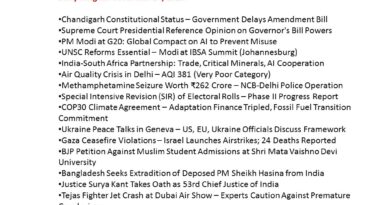
Daily Insights January 7, 2026
Contents
Daily Insights January 7, 2026
1. INDIA BECOMES WORLD’S LARGEST RICE PRODUCER
Context:
India has overtaken China to become the world’s largest rice producer in 2025, marking a transformative achievement in agricultural development and food security.
About:
Production Volume: 150.18 million tonnes (2024-25) versus China’s 145.28 million tonnes
Global Export Share: 40% of world rice exports (20+ million metric tonnes annually)
Ministry: Ministry of Agriculture & Farmers Welfare; Indian Council of Agricultural Research (ICAR)
Key Announcement: Union Agriculture Minister Shivraj Singh Chouhan
Top Producing States: Uttar Pradesh (13.8%), Telangana (11.6%), West Bengal (10.6%), Punjab (9.5%), Chhattisgarh (7%)
New Initiatives: 184 high-yielding, climate-resilient seed varieties released for 25 crops
Key Points:
Success reflects science-driven farming innovations and improved agricultural policies
Climate-resilient varieties designed to withstand temperature stress and erratic rainfall
Government stressed speedy delivery of improved seeds to maximize farmer benefits
Strong foodgrain stocks strengthen India’s international market position
Transition from food-deficient to major global food-exporting nation
2. SUSTAINABILITY CRISIS IN RICE CULTIVATION
Context:
India’s position as world’s largest rice producer masks urgent environmental concerns regarding water depletion, emissions, and long-term agricultural viability, particularly in Punjab and Haryana.
About:
Water Intensity: Producing 1 kg rice consumes 3,000-4,000 litres (20-60% above global average)
Groundwater Depletion: In Punjab/Haryana, water table fallen from ~30 feet to 80-200 feet; most aquifers classified as over-exploited
Greenhouse Gas Impact: Flooded rice paddies contribute 10-20% of India’s agricultural GHG emissions (methane); post-harvest residue burning exacerbates air pollution
Climate Vulnerability: Climate change threatens 6-10%+ yield reduction, particularly in rainfed systems of northern/eastern India
Policy Response: Government promoting Direct Seeded Rice (DSR), micro-irrigation, crop diversification under PMKSY; focus on Alternate Wetting and Drying (AWD) techniques
Key Points:
Over-exploitation cycle: Aquifers extracting 35-57% more than recharged annually
Arsenic contamination in groundwater: 11 hotspot districts in Bihar showing elevated arsenic in rice, wheat, potatoes
Subsidy-driven unsustainable practices: Subsidised electricity promotes groundwater over-extraction, raises carbon emissions from pumping
Soil micronutrient imbalances (zinc, iron deficiency) from prolonged rice monoculture requiring increased fertiliser use
Global food security implications: Any significant production reduction would affect global rice prices and food security
3. INDIA’S IPO BOOM CONTINUES IN 2026
Context:
Indian capital markets poised for record IPO activity with diverse sectors mobilizing unprecedented levels of capital.
About:
Total Fundraising Target: Rs 2.65 lakh crore estimated
Participating Sectors: Financial services, manufacturing, consumer goods, technology, infrastructure
Ministry/Authority: Ministry of Finance; Securities and Exchange Board of India (SEBI)
Market Sentiment: Large, diverse set of companies reflecting strong investor confidence
Economic Significance: Strengthens capital formation and infrastructure investment pipeline
Key Points:
Record IPO pipeline reflects sustained economic growth and investor appetite
Broad-based sectoral participation indicates balanced development across economy
Expected to generate employment opportunities and boost economic growth
Attracts both domestic and foreign institutional investment
4. ELECTORAL ROLL REVISION (SIR 2.0): UTTAR PRADESH DRAFT PUBLISHED
Context:
Election Commission released draft electoral roll for Uttar Pradesh following Special Intensive Revision (SIR), revealing unprecedented voter deletions and raising citizenship verification issues.
About:
Voter Deletions: 2.89 crore voters removed from 15.44 crore (18.70% reduction)
Final Draft Count: 12.55 crore electors retained
Deletion Breakdown:
14.06% marked absent/shifted
1.65% enrolled at multiple places
2.99% deceased
1.4 crore pending mapping verification (receiving notices)
National Context: 6.56 crore (13%) deleted across 9 states and 3 UTs in SIR 2.0 nationally
Legal Framework: Conducted under Article 326 (Constitutional citizenship requirement)
Timelines: Claims/objections deadline February 6, 2026; Final roll publication March 6, 2026
Key Points:
UP recorded highest deletions nationally; Tamil Nadu (15%) and Gujarat (14.5%) also significant
First intensive revision in 20 years; justified by rapid urbanisation, migration, multiple entries
Booth-level officer enumeration conducted November 2025-December 2025
Recognized political parties deployed 5,76,611 booth-level agents
Electoral mapping exercise ongoing; systematic verification of eligibility
Opposition parties alleging discriminatory implementation; SC petitions ongoing
5. RABIES DECLARED NOTIFIABLE DISEASE IN DELHI
Context:
Delhi government declared human rabies a notifiable disease under the Epidemic Diseases Act, 1897, aiming to achieve zero human deaths from dog-mediated rabies through systematic surveillance and reporting.
About:
Government Authority: Delhi Health Department; aligned with National Centre for Disease Control (NCDC)
Legal Framework: Epidemic Diseases Act, 1897
Surveillance Mechanism: Integrated Disease Surveillance Programme (IDSP)
Objective: Achieve zero human deaths from dog-mediated rabies
Notification Requirement: Mandatory reporting by all healthcare providers (public and private) of suspected, probable, and confirmed cases
Related Notified Diseases: Tuberculosis, Dengue, Malaria, Cholera, Hepatitis, Measles, Leptospirosis, Polio
Key Points:
First major rabies surveillance declaration in Delhi
Decentralized system: No uniform national list; states independently declare diseases notifiable
Recent notifications: Snakebite (2024); Rabies (2025)
Aligns with WHO’s International Health Regulations (2005) requirements
Ensures comprehensive data collection for public health planning and response
Strengthens India’s surveillance infrastructure for emerging and re-emerging zoonotic diseases
6. UTTAR PRADESH CABINET APPROVES SEMICONDUCTOR SECTOR INCENTIVES
Context:
UP Cabinet approved tailored incentive package to attract semiconductor manufacturers with investments of Rs 3,000 crore or more, positioning the state as semiconductor hub under India Semiconductor Mission.
About:
Policy Framework: Semiconductor Policy 2024 (approved January 2024)
Minimum Investment Threshold: Rs 3,000 crore for case-by-case incentives
Incentive Package:
Interest subsidy on project financing
Employee cost reimbursement
Net SGST 100% exemption for 10 years
EPF reimbursement for UP domiciles (100% capped at Rs 2,000/month)
Electricity tariff relief: Rs 2 per unit for 10 years
Water charge concessions
Chief Minister: Yogi Adityanath; Finance Minister: Suresh Kumar Khanna
National Alignment: India Semiconductor Mission (ISM) provides 50% project cost support
Current Pipeline: Over Rs 32,000 crore in proposals (Tarq Semiconductors, Kaynes Semicon)
Key Points:
Positions UP as preferred destination amid US, Europe, Japan, Taiwan dominance
Recent central project: Rs 3,700-crore HCL-Foxconn unit near Jewar International Airport (sixth ISM project)
Sixth approved proposal under ISM framework
Expected to generate high-tech manufacturing employment
Parallel approval: 500-bed multi-super speciality hospital in Varanasi (Rs 315 crore; 60% Centre, 40% State funding)
7. ICGS SAMUDRA PRATAP COMMISSIONED
Context:
Defence Minister Rajnath Singh commissioned India’s first indigenously designed pollution control vessel on January 5, 2026, advancing maritime self-reliance and environmental protection capabilities.
About:
Commissioned: January 5, 2026
Minister: Defence Minister Rajnath Singh
Builder: Goa Shipyard Limited (GSL), Vasco
Vessel Classification: Multi-role Pollution Control Vessel (PCV)
Indigenous Content: 60% (target: 90%); largest ICG fleet vessel to date
Attendance: Goa CM Pramod Sawant, Defence Secretary Rajesh Kumar Singh, ICG DG Paramesh Sivamani
Gender Inclusion: Two women officers appointed onboard (first for ICG frontline vessel)
Key Points:
Designed for oil spills, marine pollution control, firefighting, maritime emergencies
Conducts coastal patrols, long-duration surveillance, extended EEZ operations
Advanced automation, aviation facilities, rapid detection, precise station-keeping systems
Efficient recovery systems for pollution response; prevents coral reef, mangrove, fishery damage
Addresses non-traditional maritime threats (illegal fishing, pollution incidents)
Complements Samudra Prahari class for robust EEZ surveillance network
Reflects Atmanirbhar Bharat vision in defence industrial ecosystem maturity
8. MARITIME CAPABILITY STRENGTHENING & BLUE ECONOMY
Context:
ICGS Samudra Pratap’s commissioning enhances India’s operational readiness for maritime safety, environmental protection, and sustainable coastal management across vast maritime zones.
About:
Prime Minister’s Statement: Strengthens self-reliance vision, boosts security apparatus, reflects sustainability commitment
Operational Mandate: Marine pollution response, maritime law enforcement, search & rescue, EEZ protection
Blue Economy Alignment: Sustains fisheries, coastal communities, marine biodiversity through prompt pollution response
Gender-Inclusive Force: Women officers serving in critical ICG roles (pilots, observers, air traffic controllers, logistics)
Regional Context: Addresses rising Indian Ocean Region maritime tensions
Key Points:
Promptly addresses pollution incidents preventing ecological damage
Supports sustainable coastal community livelihoods
Strengthens India’s “responsible maritime power” credentials
Transitions ICG from platform-centric to intelligence-driven, integration-centric maritime security
Embedded in Grand Maritime Vision for ocean governance and resource stewardship
9. INDUSFOOD MANUFACTURING 2026 & FOODTECH 4.0 PLATFORM LAUNCH
Context:
India launched Indusfood Manufacturing 2026, a dedicated industry platform for advancing food processing, packaging, automation, and manufacturing technologies across the value chain.
About:
Location: Yashobhoomi, IICC, New Delhi
Launch Date: January 6, 2026
Organizing Ministry: Ministry of Food Processing Industries (MoFPI)
Organizer: Trade Promotion Council of India (TPCI)
Inaugurated By: Avinash Joshi, Secretary, MoFPI
Stakeholders: Technology providers, manufacturers, policymakers, global partners, industry associations
Duration: Multi-day event featuring showcases, conferences, business interactions
Key Points:
Addresses India’s surplus agricultural production and skilled workforce
Emphasis on value addition, quality enhancement, technology adoption
Creates employment opportunities along food supply chain
Increases farmer incomes through value-chain enhancement
Expands agricultural export competitiveness
Supports vision of Viksit Bharat 2047 through sustainable, export-oriented food ecosystem
10. US-VENEZUELA MILITARY OPERATION & MONROE DOCTRINE REVIVAL
Context:
US conducted military operation in Venezuela codenamed Operation Absolute Resolve, capturing President Nicolás Maduro in January 2026, signaling revival of Monroe Doctrine interventionism in Western Hemisphere.
About:
Operation: Operation Absolute Resolve; January 2026
Authorized By: President Donald Trump
Result: Capture of President Nicolás Maduro and wife Cilia Flores; senior Venezuelan officials
Justification: “Trump Corollary” to Monroe Doctrine (1823)
Official Charges: Narco-terrorism, drug trafficking conspiracy (previously charged 2020)
Military Actions: Rare late-night operations; air and ground strikes; civilian/military locations attacked
Key Points:
Monroe Doctrine revival for contemporary geopolitical control
Strategic objectives: Securing energy resources (world’s largest proven oil reserves: 300+ billion barrels)
Counter-terrorism/narco-terrorism framing for legitimacy under domestic law
Counters extra-regional powers (China, Russia, Iran) influence in Western Hemisphere
Raises sovereignty erosion concerns across Global South (Mexico, Colombia, Cuba cautious reactions)
Challenges UN Charter Article 2(4) prohibition on military force against territorial integrity
Venezuela termed US action as “imperialist attack”; called for public resistance
Triggers global debate on great power intervention, sovereignty, and multipolar order stability
11. JNU STUDENT PROTEST & CONTROVERSIAL SLOGANS INCIDENT
Context:
Jawaharlal Nehru University witnessed political controversy over controversial slogans raised during student protest commemorating 2020 campus violence, triggering national debate on freedom of expression and sedition.
About:
Incident Date: January 5, 2026 (Sixth anniversary of January 5, 2020 violence)
Event Name: “Night of Resistance with Guerrilla Dhaba” protest
Location: Sabarmati Hostel premise, JNU
Participants: ~35 initially; JNUSU President Aditi Mishra, VP Gopika Babu among attendees
Trigger: Supreme Court’s denial of bail to Umar Khalid and Sharjeel Imam in 2020 Delhi riots case
Administrative Response: JNU sought FIR; threatened suspension, expulsion, permanent debarment
Controversy: Alleged anti-PM Modi, anti-Home Minister Amit Shah slogans in videos
Key Points:
Students defended slogans as ideological expression relating to alleged 2020 inaction and minority protection
JNU administration: Slogans “objectionable, provocative, inflammatory”; violate JNU Code of Conduct
Political reactions: BJP termed protesters “urban Naxals”; demands for strict action
Freedom of speech vs. sedition/contempt of court debate
Related to Supreme Court bail decision; pattern of inaction allegations
JNUSU defended gatherings as peaceful, democratic agitation against violence
12. TRADE WATCH QUARTERLY RELEASED BY NITI AAYOG
Context:
NITI Aayog released fifth edition of Trade Watch Quarterly focusing on India’s automotive export competitiveness amid evolving global trade dynamics.
About:
Edition: Fifth edition covering Q1 FY 2025-26 (April-June 2025)
Release Date: January 6, 2026; New Delhi
Released By: Dr. Arvind Virmani, Hon’ble Member, NITI Aayog
Organizing Ministry: NITI Aayog (National Institution for Transforming India)
Thematic Focus: India’s automotive exports and global competitiveness positioning
Key Points:
Comprehensive, data-driven assessment amid evolving global conditions
Emerging trends: Rising technology-intensive exports; services-led growth strength; import composition shifts reflecting GVC integration
Automotive sector analysis: Global demand patterns, export footprint, tariff structures, intra-industry trade, GVC participation
India’s strengths: Notable gains in auto components, motorcycles, tractors; broad export footprint across advanced and emerging markets
Global market context: $2.2 trillion total automotive export market (growing); significant expansion opportunity
Policy recommendations: Strengthen quality standards, certification systems, technology adoption, market diversification, forward GVC linkages
Audience: Policymakers, industry stakeholders, researchers, academia; evidence-based policy formulation
Discover more from Simplified UPSC
Subscribe to get the latest posts sent to your email.