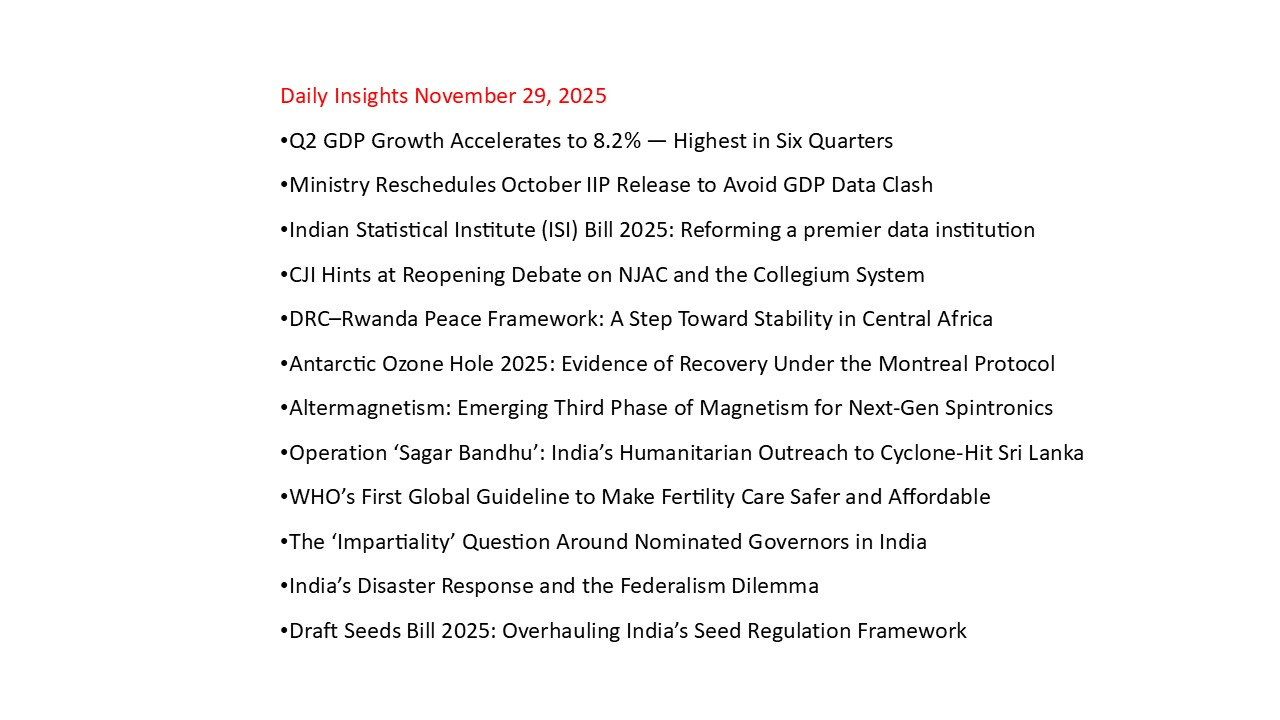
Daily Insights November 29, 2025
Contents
Daily Insights November 29, 2025
1. Q2 GDP Growth Accelerates to 8.2% — Highest in Six Quarters
Category: Economics | GS Paper: 3 | Relevance: Economic Growth, Macroeconomic Policy
Key Points:
India’s real GDP grew 8.2% in Q2 FY 2025-26 (Jul-Sep), exceeding forecasts and beating Q1’s 7.8% growth
Nominal GDP expanded 8.7%, reaching ₹85.25 lakh crore
Secondary Sector (manufacturing, construction) drove growth: Manufacturing expanded 9.1%, Construction 7.2%
Tertiary Sector (services) remained strongest with 9.2% growth, led by financial, real estate and professional services at 10.2%
Private consumption grew 7.9% vs 6.4% in Q2 FY24, signaling strong urban and rural demand
Agriculture lagged at 3.5% due to uneven monsoon; utilities grew 4.4%
India reaffirmed as world’s fastest-growing major economy despite US tariffs
UPSC Insight: Demonstrates resilience of India’s economy amid global headwinds; highlights the importance of secondary and tertiary sector diversification for sustained growth.
2. Ministry of Statistics Reschedules October IIP Release Due to GDP Data Clash
Category: Economics | GS Paper: 3 | Relevance: Economic Data Management, Industrial Production
Key Points:
Ministry of Statistics and Programme Implementation (MoSPI) postponed the All-India Index of Industrial Production (IIP) release for October 2025 from November 28 to December 1, 2025 at 4:00 PM
Postponement aimed to avoid coinciding with Q2 GDP release
September’s IIP recorded 4% growth, with Manufacturing at 4.8% YoY
August’s IIP was 3.5%, showing acceleration in industrial momentum
Rescheduling prevents market volatility from dual major releases
UPSC Insight: Reflects governance efficiency and administrative coordination in macroeconomic data dissemination; important for understanding India’s industrial health trajectory.
3. ISI Bill 2025: Strengthening India’s Premier Statistical Institute
Category: Governance | GS Paper: 2 | Relevance: Constitutional Bodies, Institutional Reforms
Key Points:
Ministry of Statistics & Programme Implementation released Draft Indian Statistical Institute (ISI) Bill 2025 for public consultation (extended to November 3, 2025)
Founded in 1931 by P.C. Mahalanobis; declared Institution of National Importance in 1959
Currently serves ~1,200 students across centers offering programs in Statistics, Mathematics, Economics, Computer Science, Cryptology, Quality Management, and Operations Research
Mashelkar Committee (2020) recommended major reforms to make ISI globally competitive and relevant as it approaches its centenary in 2031
Bill proposes leaner, more empowered Board of Governance with enhanced autonomy in decision-making and accountability
Aims to strengthen governance structure aligning with other Institutions of National Importance (INIs) like IITs and AIIMS
UPSC Insight: Part of India’s broader strategy to position premier institutions as knowledge hubs for data-driven policymaking; aligned with National Education Policy 2020 and Digital India vision.
4. CJI Surya Kant Signals Reconsideration of Collegium System — NJAC Revival Possible
Category: Polity | GS Paper: 2 | Relevance: Judicial Appointments, Constitutional Governance
Key Points:
Recently sworn 53rd Chief Justice Surya Kant (Nov 24, 2025) signaled the Supreme Court will “consider” a petition to revive the NJAC and replace the collegium system
Advocate Mathews Nedumpara filed the plea, citing collegium as a “hotbed of nepotism and favoritism” overriding Parliament’s democratic will
Supreme Court struck down NJAC (99th Constitutional Amendment) in 2015 (4:1 majority), deeming it “unconstitutional and void”
NJAC was designed with 6-member composition: CJI, 2 senior SC judges, Union Law Minister, and 2 eminent persons
Collegium system (judges appointing judges) criticized for opacity, lack of accountability, and underrepresentation of women and marginalized communities
CJI Kant acknowledged that the Court will “see” the plea on Constitution Day proceedings
UPSC Insight: Landmark signal for potential constitutional reform; raises fundamental questions about judicial independence vs transparency; directly relevant to governance and separation of powers discourse.
5. DRC-Rwanda Peace Framework: Significant Step Toward Central African Stability
Category: International Relations | GS Paper: 2 | Relevance: Regional Conflict Resolution, UN Diplomacy
Key Points:
Washington Accord signed June 27, 2025 between DRC and Rwanda following US-Qatar mediation; overseen by US Secretary of State Marco Rubio
M23 Framework Agreement signed November 15, 2025 in Doha; commitment to end conflict through 8-key pillars
Peace agreement pledges: Rwandan troop withdrawal from eastern DRC, ending support for FDLR militia, and territorial integrity restoration
Joint Security Coordination Mechanism formed within 30 days; joint military operations against FDLR initiated October 1
Regional Economic Integration Framework signed November 7
Challenges persist: FDLR refused to disarm (Nov 11); ceasefire violations reported; DRC insists synchronous withdrawal while Rwanda demands FDLR neutralization first
Ratification ceremony postponed to December 4 following Joint Oversight Committee meeting in Washington
UPSC Insight: Demonstrates evolving international mediation mechanisms; reflects new geopolitical balance with US-Qatar joint efforts; relevant for understanding Central African security architecture and humanitarian crisis mitigation.
6. Antarctic Ozone Hole Continues Recovery — Fifth Smallest Since 1992
Category: Environment | GS Paper: 3 | Relevance: Environmental Recovery, International Environmental Agreements
Key Points:
2025 Antarctic ozone hole was fifth-smallest since 1992 monitoring began; averaged 18.71 million km² during peak depletion
Peak extent on September 9: 22.86 million km² — approximately 30% smaller than record-largest hole in 2006
Ozone layer breakup occurred nearly 3 weeks earlier than historical average, reflecting atmospheric shifts
Lowest ozone concentration: 147 Dobson Units (October 6) vs record low of 92 Dobson Units (2006)
Success attributed to Montreal Protocol (1987) and amendments phasing out CFCs and ozone-depleting chemicals
Ozone-depleting substance concentrations dropped ~one-third since peaking around 2000
Full recovery projected by late 2060s if current trends continue; weakened polar vortex in 2025 contributed to smaller hole
Continuous monitoring via NASA’s Aura satellite and NOAA weather balloons
UPSC Insight: Demonstrates effectiveness of international environmental treaties; exemplifies global cooperation in tackling environmental crises; relevant for understanding ozone layer protection, UV radiation risks, and Montreal Protocol’s role in environmental governance.
7. Altermagnetism: A New Magnetic Phase Revolutionizing Information Technology
Category: Science & Technology | GS Paper: 3 | Relevance: Advanced Materials, Nanotechnology, Scientific Innovation
Key Points:
Altermagnetism is a newly discovered third class of magnetic phase combining properties of ferromagnetism and antiferromagnetism
Unlike ferromagnets (net magnetization but lose info near external fields) and antiferromagnets (no net magnetization), altermagnets have no net magnetization yet generate spin currents
Potential applications: Information storage with 1000x faster read-write speeds than ferromagnets; zero information loss risk from external magnetic fields
Discovery highlighted as one of 2024’s most important scientific breakthroughs; featured in The Economist and Stephen Colbert’s Late Show
Found “hiding in plain sight” for 90+ years; initially mistaken for antiferromagnetic materials
More altermagnetic materials identified than ferromagnetic materials, surprising the scientific community
Published research appears in leading journals; AI-accelerated discovery identified 50 new altermagnetic materials
UPSC Insight: Demonstrates cutting-edge material science innovation; relevant for understanding next-generation data storage, spintronic devices, and technological breakthroughs that could reshape computing and telecommunications.
8. Operation Sagar Bandhu: India’s Humanitarian Response to Cyclone Ditwah in Sri Lanka
Category: Foreign Policy | GS Paper: 2 | Relevance: Neighbourhood First Policy, Humanitarian Assistance, Regional Cooperation
Key Points:
India launched “Operation Sagar Bandhu” (November 28, 2025) following Cyclone Ditwah devastation in Sri Lanka
Cyclone Ditwah claimed 80+ lives (DMC reported 61 deaths, 25 missing); ~44,000 people affected; 600+ homes damaged
First relief consignment: C-130J aircraft delivered ~12 tonnes of humanitarian aid from IAF, landing in Colombo at 1:30 AM (Nov 28)
Contents: Tents, tarpaulins, blankets, hygiene kits, ready-to-eat food, dry rations (4.5 tons), fresh rations (2 tons), staple foods, bakery products
Naval deployment: INS Vikrant (aircraft carrier) and INS Udaigiri (frontline warship) delivered additional supplies
Prime Minister Modi conveyed condolences via X; emphasized India’s commitment under Neighbourhood First Policy and Vision MAHASAGAR
Sri Lanka faced warnings of “unprecedented disaster” with Kelani and Attanagalu rivers at dangerous levels
UPSC Insight: Exemplifies India’s proactive disaster response under Neighbourhood First policy; demonstrates India’s capacity for rapid HADR (Humanitarian Assistance and Disaster Relief); reinforces India’s role as a responsible regional stakeholder.
9. WHO Releases First Global Infertility Guideline — Calls for Affordable, Accessible Fertility Care
Category: Health & Social | GS Paper: 2 | Relevance: Global Health Governance, Reproductive Rights, Health Equity
Source: WHO
Key Points:
World Health Organization issued first-ever global guideline on infertility prevention, diagnosis, and treatment (November 28, 2025)
Infertility affects 1 in 6 people of reproductive age globally; major equity issue with millions facing financial hardship
40 recommendations covering prevention, diagnosis, treatment; promoting cost-effective options at every stage
Economic burden: In many countries, single IVF cycle costs 2x average annual household income; tests largely funded out-of-pocket
WHO Director-General Dr Tedros: “Infertility is one of the most overlooked public health challenges; millions forced to choose between having children and financial security”
Key interventions: Integrate fertility services into national health strategies; address STIs and tobacco use as leading risk factors; promote lifestyle changes (diet, exercise)
Clinical pathways: Progressive treatment from basic fertility promotion to IUI to IVF based on diagnosis and preferences
Emphasized gender equality and reproductive rights as foundational to successful implementation
UPSC Insight: Significant global health governance development; highlights equity dimensions of healthcare; relevant for understanding reproductive health policies, SDG 3 (Good Health and Well-being), and India’s role in advancing global health standards.
10. “The ‘Impartiality’ of a Nominated Governor” — Federalism Under Scrutiny
Category: Polity/Governance | GS Paper: 2 | Relevance: Separation of Powers, Federalism, Constitutional Interpretation
Source: The Hindu Editorial Analysis
Key Points:
Supreme Court recently delivered advisory opinion on Article 200 and 201 (Governor’s discretion on Bills) — a pivotal federalism case
Central issue: Recent SC ruling expanded gubernatorial discretion while removing enforceable timelines for bill assent
Concerns raised: Governor’s appointment as nominated authority (not elected) raises impartiality questions when exercising discretion on democratically-passed Bills
Constitutional tension: Unelected Governor vs elected State legislature; discretion as exception, not rule
Sarkaria Commission (1988) and Punchhi Commission (2010) recommended transparent appointments with CM consultation to ensure neutrality
Tamil Nadu case (2025) previously imposed 3-month timelines; new ruling backs away from fixed deadlines
Implications: Federal friction intensifies when Governors can indefinitely withhold bills; threatens state autonomy and legislative efficiency
UPSC Insight: Critical for understanding cooperative federalism, separation of powers, and constitutional interpretation; highlights tension between executive discretion and representative democracy; directly relevant for Mains essays on federalism.
11. India’s Disaster Response: A Slippery Slope for Federalism
Category: Governance/Disaster Management | GS Paper: 2 | Relevance: Federalism, Disaster Management, Centre-State Relations
Source: The Hindu Editorial Analysis
Key Points:
Recent disaster responses (Cyclone Ditwah, monsoon-related incidents) reveal Centre-State coordination challenges
Structural issues: Disaster management remains over-centralized; insufficient functional autonomy at district and local levels
Fund disbursement delays: NDRF and SDRF allocations face complexity and bureaucratic hurdles, slowing recovery
Centralization risks: When Union exercises excessive control in disasters, it can undermine State accountability and local decision-making capacity
NDRF professionalization: While NDRF has evolved as world-class responder, integration with local governance remains weak
Federalism concern: Disaster operations can become platform for Union to override state administration, setting precedent for normalized centralization
Example: Village and Ward-level contingency plans must be state-driven; current system imposes top-down templates
Recovery equity: Over-centralized funds mean marginalized communities in less-connected areas receive delayed assistance
UPSC Insight: Illustrates how emergency situations can stress federal architecture; relevant for understanding disaster management reforms post-2005 tsunami; demonstrates need for cooperative federalism in crisis response; connects to Disaster Management Act amendments.
12. Draft Seeds Bill 2025: Modernizing India’s Seed Regulatory Framework
Category: Agriculture & Law | GS Paper: 3 | Relevance: Agricultural Policy, Farmer Rights, Food Security
Source: https://indianexpress.com/article/india/seed-bill-draft-market-curb-sale-centre-10363038/
Key Points:
Union Agriculture Ministry released Draft Seeds Bill 2025 (November 2025) inviting public comments until December 11, 2025
Bill aims to replace archaic Seeds Act, 1966 and Seeds (Control) Order 1983; replaces two failed bills (2004, 2019)
Mandatory registration of all seed varieties ensuring quality entry to market; centralized accreditation system proposed
Central and State Seed Committees established: Central Committee (27 members) and State Committees (15 members)
Quality standards: Minimum germination levels, genetic/physical purity, trait authentication, seed health norms
Major offences/penalties: Sale of spurious/unregistered seeds — ₹30 lakh fine + imprisonment up to 3 years; search-and-seizure powers for inspectors
Farmer protections: Bill reiterates rights to save, use, exchange, and sell farm-saved seeds (except under brand names) — aligns with Seeds Act 1966 traditions
Transparency & traceability: Enhanced accountability in seed supply chains; vests price control with Central Government
Concerns: Critics argue reduced authority for ICAR and state agricultural universities; foreign organizations empowered for seed trials
UPSC Insight: Critical for understanding agricultural modernization; reflects balance between innovation, quality assurance, and farmer rights; relevant for agricultural policy, food security, and institutional reforms in India’s agri-sector.
Discover more from Simplified UPSC
Subscribe to get the latest posts sent to your email.