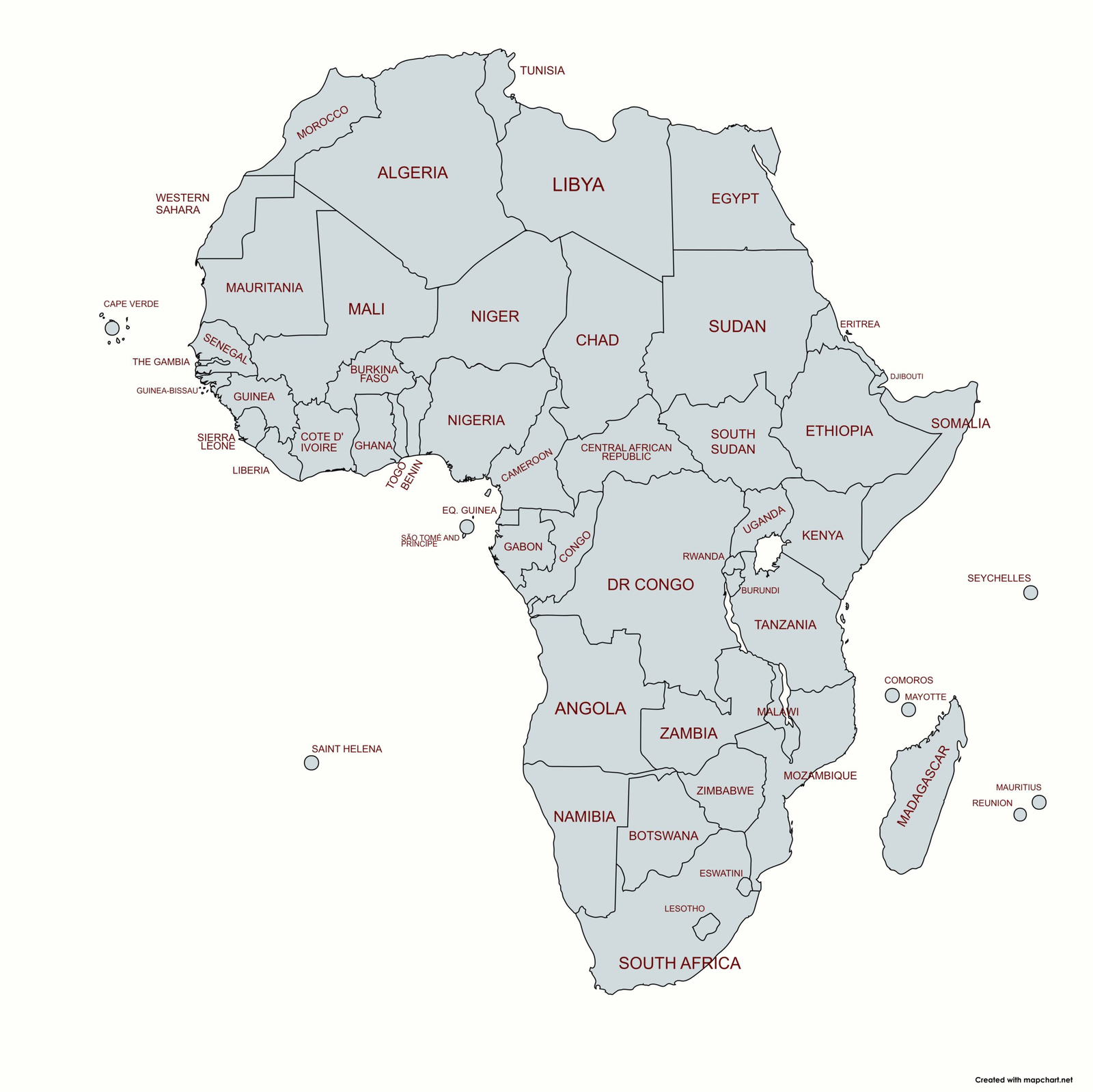
AFRICA
Contents
AFRICA: COMPREHENSIVE GEOGRAPHICAL NOTES
1. EXTENT
Geographical Location and Boundaries
Africa is the second-largest continent by land area and comprises 54 sovereign states recognized by the United Nations. The continent measures approximately 11.7 million square miles (30.2 million square kilometers), representing more than one-fifth of the world’s land area.
Latitudinal and Longitudinal Position:
– Africa is unique in being the only continent where the Equator (0° latitude) and the Prime Meridian (0° longitude) intersect
– The Equator divides Africa almost equally into two parts, with the greater portion lying north of the Equator due to the bulge formed by West Africa
– Bounded between the Tropic of Cancer (23°30’N) in the north and the Tropic of Capricorn (23°30’S) in the south
Terrestrial Boundaries:
– Northern extremity: Al-GhÄ«rÄn Point (near Cape Blanc), Tunisia
– Southern extremity: Cape Agulhas, South Africa
– Easternmost point: Xaafuun (Hafun) Point, near Cape Guardafui, Somalia
– Westernmost point: Almadi Point (Pointe des Almadies), Cape Verde, Senegal
Maritime Boundaries:
– West: Atlantic Ocean
– North: Mediterranean Sea
– East: Red Sea and Indian Ocean
– South: Meeting point of Atlantic and Indian Oceans
Continental Connections:
– Separated from Europe by the Mediterranean Sea
– Connected to Asia at the northeast extremity by the Isthmus of Suez (163 km wide), which is transected by the Suez Canal
– The Sinai Peninsula of Egypt (east of the Suez Canal) is often considered geopolitically part of Africa
—
2. REGIONAL DIVISIONS WITH COUNTRY NAMES
Africa is typically divided into five to six major regions, each with distinct geographical, cultural, and economic characteristics:
Northern Africa (Maghreb Region)
Countries: Algeria, Egypt, Libya, Morocco, Sudan, Tunisia, Western Sahara
Key Characteristics:
– Bounded by the Mediterranean Sea to the north
– Dominated by the Atlas Mountains and Sahara Desert
– Predominantly Arab and Berber populations
– Includes the Nile Delta and Suez Canal region
Western Africa (West Africa)
Countries: Benin, Burkina Faso, Cape Verde, Côte d’Ivoire, Gambia, Ghana, Guinea, Guinea-Bissau, Liberia, Mali, Mauritania, Niger, Nigeria, Senegal, Sierra Leone, Togo, Saint Helena
Key Characteristics:
– Situated roughly at the 10°E longitude
– Most populous region with Nigeria being the continent’s most populous country
– Characterized by savanna and transition zones (Sahel)
– Rich in agricultural and mineral resources
Central Africa (Middle Africa)
Countries: Angola, Cameroon, Central African Republic, Chad, Congo, Democratic Republic of Congo (DRC), Equatorial Guinea, Gabon, Sao Tome and Principe
Key Characteristics:
– Contains the Congo Basin with tropical rainforests
– Traverse the Equator
– Rich in mineral resources (copper, cobalt, diamonds)
– Contains major river systems (Congo, Chari, Ubangui)
Eastern Africa (East Africa and Horn of Africa)
Countries: Burundi, Comoros, Djibouti, Eritrea, Ethiopia, Kenya, Madagascar, Malawi, Mauritius, Mozambique, Rwanda, Seychelles, Somalia, South Sudan, Tanzania, Uganda, Zambia, Zimbabwe, Reunion, Mayotte
Subdivisions:
– Horn of Africa: Djibouti, Eritrea, Ethiopia, Somalia (extends into the Arabian Sea)
– Great Lakes Region: Burundi, Kenya, Rwanda, Tanzania, Uganda, and parts of DRC, Ethiopia, Zambia
– Coastal and Island nations: Mauritius, Seychelles, Comoros, Madagascar, Reunion
Key Characteristics:
– Home to the East African Rift Valley
– Most rural region with lowest urbanization
– Contains major lakes (Victoria, Tanganyika, Malawi, Turkana)
– Diverse climates from highlands to coastal regions
Southern Africa
Countries: Botswana, Eswatini (Swaziland), Lesotho, Namibia, South Africa
Key Characteristics:
– Southernmost region of the continent
– Generally drier climate
– Well-developed economies and infrastructure
– Contains significant mineral wealth
—
3. MAJOR PHYSICAL DIVISIONS (DETAILED EXPLANATION)
A. PLATEAUS
The African continent is predominantly characterized by plateau formations rather than long mountain chains. These plateaus are saucer-shaped with steep edges facing the coasts and extend from the Guinea coast to Somaliland and from north Sahara to the Cape Province.
Classification of African Plateaus:
1. South African Plateau (Southern Africa)
– Location: South Africa, Namibia, Botswana, Zimbabwe
– Characteristics: Bounded east, west, and south by bands of high ground that fall steeply to the coasts
– Features:
– Forms an inverted saucer shape
– The plateau rim consists of three parallel steps with level ground between them
– Elevation: Generally 1,000-2,500 feet, with some areas exceeding 3,000 feet
– Connected towards the northeast with the East African plateau
– Sub-divisions:
– Great Karoo: Semi-desert plateau region; arid and barren; important grazing area
– Kalahari Plateau: Plateau proper; characterized by arid conditions; sparse vegetation
2. East African Plateau (East Africa and Ethiopian Highlands)
– Location: Kenya, Uganda, Ethiopia, Tanzania, Rwanda, Burundi
– Characteristics:
– Slightly greater average elevation than the South African plateau
– Formed by a widening out of the eastern axis of high ground
– Subdivided into multiple zones running north and south, consisting of ranges, tablelands, and depressions
– Contains the East African Rift Valley system
– Elevation: 3,000-4,000 feet on average
– Major Sub-regions:
– Ethiopian Highlands: Rugged mass of mountains; largest continuous area of high altitude in the continent; elevation 6,000-10,000 feet; contains Lake Tana (source of Blue Nile); cooler despite proximity to Equator
– Kenyan Highlands: Fertile plateaus with volcanic soils; home to Mount Kenya
– Bie Plateau (Angola): Important for copper production and cattle rearing
– Katanga Plateau (DRC): Rich in mineral resources (copper and uranium deposits); farming and ranching
– Adamawa Plateau (Cameroon): Savanna vegetation; bauxite deposits; elevation 4,000-5,000 feet
—
B. MOUNTAINS
While Africa lacks long continuous mountain chains typical of other continents, it possesses several significant mountain ranges and peaks.
Major Mountain Systems:
1. Atlas Mountains (Northern Africa)
– Location: Morocco, Algeria, Tunisia
– Length: Approximately 1,500 miles (2,400 km)
– Formation: Folded mountains; distinct from the rest of the continent
– Characteristics:
– Separated from the Sahara to the south by a depressed desert area
– Elevated steppes between seaward and landward heights (up to 160 km broad)
– Numerous wadis flowing towards the Sahara
– Well-vegetated in northern slopes with cedar forests (Cedrus atlantica above 1,600 m)
– Highest Peaks: Mount Toubkal (13,671 feet); various peaks exceeding 10,000 feet
– Climate: Mediterranean climate on northern slopes; semi-arid to desert on southern slopes
2. Ethiopian Highlands (Ethiopian Plateau)
– Location: Ethiopia, parts of Eritrea
– Characteristics:
– Rugged, elevated mass of mountains
– Largest continuous area of high altitude in the continent
– Volcanic plateaus with fertile soils
– Elevation: 6,000-13,000 feet
– Features: Deep gorges, river valleys, isolated peaks
– Lake Tana: Important source of Blue Nile; highest lake in Ethiopia
– Cooler climate due to altitude despite equatorial location
3. East African Highlands and Mountains
– Mount Kilimanjaro (Tanzania): Africa’s highest mountain; elevation 19,341 feet (5,895 m); dormant volcanic cone; snow-capped even at equatorial latitude
– Mount Kenya (Kenya): Elevation 17,057 feet (5,199 m); volcanic origin; important water source
– Mount Cameroon (Central Africa): Elevation 13,435 feet (4,095 m); active volcano; westernmost African mountain of significant height
– Rwenzori Mountains (Mountains of the Moon) (Uganda-DRC border):
– Location: Uganda and Democratic Republic of Congo (Kinshasa) border
– Thought to be the “Mountains of the Moon”
– Mount Stanley (Margherita Peak): 16,795 feet (5,119 m); highest peak of the system
– Physical separator between Mediterranean/Atlantic coasts and Sahara Desert
– Covers approximately 240 sq. miles
4. Drakensberg Mountains (Southern Africa)
– Location: South Africa
– Characteristics: Steep escarpment in the eastern part of South Africa
– Vegetation: Dense forests on slopes; temperate forests with Podocarpus, Apodytes, Halleria species
– Importance: Water source; scenic regions
5. Cape Ranges (Southern Africa)
– Location: Cape Peninsula, South Africa
– Height: Low-lying mountains (no higher than 6,000 feet)
– Characteristics: Southern boundary of South Africa; temperate forests on ocean-facing slopes
—
C. DESERTS
Deserts cover approximately 60% of the African continent, representing vast arid regions with minimal precipitation and sparse vegetation.
Major Desert Systems:
1. Sahara Desert
– Size: Largest hot desert in the world; approximately 3.3-3.6 million square miles (9 million square kilometers)
– Location: Stretches across the entire width of North Africa from the Atlantic Ocean to the Red Sea
– Countries: Libya, Algeria, Egypt, Tunisia, Chad, Morocco, Eritrea, Niger, Mauritania, Mali, Sudan (primary contributors)
– Characteristics:
– Generally slight elevation with occasional mountain massifs reaching 7,900 feet (2,400 m)
– Topographical Features:
– Chotts and Dayas: Shallow, seasonally inundated basins with water deposition
– Oasis Depressions: Large areas surrounding underground water sources
– Gravel-covered Plains (Reg/Hamada): Extensive flat regions covered with gravel and stone
– Sand Dunes (Erg): Large sand sea formations with shifting dunes
– Mountain Massifs: Ahaggar (Central Sahara) and Tibesti (Central-Eastern Sahara) with resistant granite formations; peaks exceeding 9,500 feet
– Climate: Extremely arid with rainfall below 100 mm annually; diurnal temperature range exceeds annual range
– Vegetation: Sparse desert vegetation including rough grasses, scrub, thorny bushes, and cacti; concentrated in oases
2. Kalahari Desert
– Location: Southern Africa (Botswana, Namibia, Zambia, Angola, Zimbabwe)
– Size: Approximately 350,000 square miles (900,000 square kilometers)
– Characteristics:
– Semi-arid desert with scattered vegetation
– Vegetation: Scrub woodland with acacia (Acacia karroo), pseudo-steppe, drought-resistant grasses
– Topography: Relatively flat with subtle undulations; sandy soils
– Water: Limited surface water; underground sources
– Inhabitation: San People have inhabited this difficult terrain historically
– Wildlife: Adapted species to arid conditions
3. Namib Desert
– Location: Southwestern Africa (Namibia, Angola)
– Size: Approximately 31,200 square miles (80,900 sq km)
– Characteristics:
– One of the oldest deserts; narrow coastal strip
– Extreme aridity with minimal rainfall
– Unique ecosystem with specialized desert-adapted fauna and flora
– Combination of sand dunes and gravel plains
4. Somali Desert
– Location: Horn of Africa (Eastern Ethiopia, Somalia, Kenya)
– Characteristics:
– Arid coastal desert zone
– Rainfall: Below 200 mm annually
– Vegetation: Semi-desert grassland, deciduous shrubland with Acacia and Commiphora
– Pastoralism: Predominant land use
—
D. RIVERS
African rivers are lifelines to the continent, providing essential resources for agriculture, transportation, and hydroelectric power generation. Five major river systems dominate:
Major African Rivers:
1. Nile River
– Length: Longest African river; approximately 4,130 miles (6,650 km) for the White Nile alone; world’s longest or second-longest river (by some measures)
– Source:
– White Nile: Lake Victoria (Uganda), further sources potentially in Burundi or Rwanda mountains
– Blue Nile: Lake Tana (Ethiopia) at 6,000 feet elevation
– Course and Tributaries:
– Flows generally northward through East and Northeast Africa
– White Nile: Primary source from Uganda; flows through South Sudan and Sudan
– Blue Nile: Originates in Ethiopia; joins White Nile near Khartoum, Sudan; contributes 80% of water during flood season
– Major cities: Jinja, Juba, Khartoum, Aswan, Luxor, Cairo
– Discharges into Mediterranean Sea via the Nile Delta in Egypt
– Characteristics:
– Average Discharge: 98,800 cubic feet per second (2,800 m³/s)
– Flooding Pattern: Seasonal flooding crucial for Egyptian agriculture
– Basin: Extends through 11 countries in its watershed
– Economic Importance: Critical for Egyptian civilization, irrigation, and hydroelectric power
– Ripon Falls: Identified by explorer James Speke as the source outlet from Lake Victoria
– Suez Canal: Built across the Nile Delta; significant waterway for international trade
2. Congo River
– Length: 2,922 miles (4,700 km); second-longest river in Africa; ninth longest globally
– Source: Chambeshi River in northeastern Zambia
– Course:
– Forms the largest drainage basin in Africa
– Unique Feature: Only river in the world crossing the Equator twice
– Flows through Democratic Republic of Congo and Republic of Congo; tributaries drain Cameroon, Central African Republic, Burundi, Rwanda, Tanzania, Zambia, Angola
– Major cities: Bukama, Kisangani, Lisala, Mbandaka, Brazzaville, Kinshasa
– Discharges into Atlantic Ocean at Moanda, DRC
– Characteristics:
– Average Discharge: 1,476,153 cubic feet per second (41,800 m³/s); second only to the Amazon globally
– Depth: Deepest river in the world; 720 feet (220 m) deep in places
– Course: Contains many rapids, waterfalls, swamps, lakes, and islands
– Development: Established approximately 1.5-2 million years ago
– Biodiversity: Highest diversity of fish species of any African river system
– Basin Population: Approximately 75 million people rely on the Congo River for livelihoods
– Products Transported: Cotton, coffee, timber, minerals, rubber
– Basin Area: Spans approximately 1.3 million square miles (3.7 million sq km)
3. Niger River
– Length: 2,611 miles (4,200 km); third-longest river in Africa
– Source: Mountains in southwestern Guinea, West Africa
– Unique Course:
– Despite source being only 150 miles from the Atlantic Ocean, flows inland into the Sahara Desert
– Makes a wide arc through Mali, turning southeast near Timbuktu
– Flows southward to Niger Delta in Nigeria
– Inner Niger Delta: Between Timbuktu and Gao; fertile oasis with seasonal flooding; important for crop cultivation and bird migration
– Countries: Guinea, Mali, Niger, Nigeria
– Discharge:
– Average Discharge: 197,373 cubic feet per second (5,589 m³/s)
– Discharges into Gulf of Guinea, Atlantic Ocean
– Characteristics:
– Most of the river is navigable
– Larger commercial ships restricted to lower reaches and high-water periods
– Smaller boats used for trading for centuries
– Mouth: Highly branched delta system; oil-rich region; environmental challenges due to petroleum extraction
– Major Cities: Tembakounda, Bamako, Timbuktu, Niamey, Onitsha
– Historical Confirmation: British explorers Richard and John Lander confirmed the discharge point into Atlantic Ocean only in 1830
4. Zambezi River
– Length: 1,599 miles (2,574 km); longest eastward-flowing river in Africa
– Source: Mwinilunga, northwestern Zambia
– Course:
– Flows through Democratic Republic of Congo, Angola, Zambia, Namibia, Zimbabwe, and Mozambique
– Discharges into Indian Ocean from Mozambique
– Major cities: Cazombo, Mongu, Katima Mulilo, Livingstone, Kariba, Tete
– Characteristics:
– Average Discharge: 172,335 cubic feet per second (4,880 m³/s)
– Upper Zambezi: Slow-flowing due to flat topography; forms extensive floodplains; shallow and up to 15 miles (25 km) wide in places; sparsely populated; annual flooding influences settlement patterns
– Water Color: Appears orange in places due to suspended clay and silt
– Dams: Flows into Gariep Dam and Vanderkloof Dam in South Africa; used for water supply and hydroelectricity generation
– Victoria Falls: Major waterfall at river confluence; spectacular natural phenomenon between Zimbabwe and Zambia
– Tributaries: Largest tributary is the Vaal River
– Wildlife: Relatively pristine and unexplored; home to diverse wildlife and bird populations
– Basin: Important for regional development and energy production
5. Orange River
– Location: Southern Africa
– Characteristics:
– Flows through South Africa
– Forms borders between countries
– Waters appear orange due to clay and silt suspension
– Used for irrigation and hydroelectric generation
– Important for water supply to arid regions
Other Notable Rivers:
– Senegal River: Borders between Mauritania and Senegal
– Gambia River: Flows through Gambia
– Volta River: West Africa
– Benue River: Niger tributary in West Africa
– Limpopo River: Cuts the Tropic of Capricorn twice; forms borders in Southern Africa
—
E. LAKES
Africa contains the largest concentration of freshwater lakes on Earth, collectively holding approximately 25% of the planet’s unfrozen surface freshwater. The Great Lakes region contains 10% of the world’s fish species.
The African Great Lakes (East African Rift Valley Lakes):
1. Lake Victoria
– Location: Tanzania, Uganda, Kenya borders (East African Rift system)
– Size: Largest lake in Africa; second-largest freshwater lake in the world by surface area; approximately 68,800 square kilometers
– Characteristics:
– Water Source for Nile: Primary source of the White Nile
– Tributaries: Fed by numerous rivers and streams
– Drainage: Connected to Nile River system
– Biodiversity: Over 500 fish species; extensive cichlid populations
– Unique Invasion: Introduction of Nile Perch has affected local fish populations
– Economic Importance: Critical for regional economies; fishing industry; transportation; hydroelectric potential
– Regional Countries: Bordering states (Tanzania, Uganda, Kenya) depend heavily on its resources
2. Lake Tanganyika
– Location: Central East Africa (Tanzania, Democratic Republic of Congo, Burundi, Zambia)
– Size:
– Second-largest freshwater lake by volume and depth
– 673 km in length; approximately 32,900 sq km in area
– Depth: Second deepest lake in the world; significant depth allows for unique ecosystem
– Characteristics:
– Freshwater Content: Contains almost 18% of the world’s freshwater
– Fish Diversity: Over 350 fish species, including unique cichlids; richest freshwater ecosystem diversity
– Geological Significance: Located in the Great Rift Valley
– Economic Activities: Fishing; tourism; scuba diving and snorkeling
– Water Quality: Clear waters; suitable for marine recreation
3. Lake Malawi (Lake Nyasa)
– Location: Malawi, Mozambique, Tanzania (East African Rift)
– Size:
– World’s eighth-largest freshwater lake by area
– Approximately 29,600 sq km
– 580 km in length
– Characteristics:
– Fish Species: Over 1,000 fish species; one of the richest freshwater ecosystems globally
– Cichlid Diversity: Distinctive cichlid populations found nowhere else
– Economic Activities: Fishing; tourism; water sports (kayaking, snorkeling, diving)
– Beauty: Clear golden beaches; scenic views
– Tourism Destination: Cape Maclear popular among backpackers and nature enthusiasts
– Water Quality: Clear, pristine waters
4. Lake Turkana
– Location: Northern Kenya; parts extend into Ethiopia (East African Rift)
– Characteristics:
– Unique Feature: Largest permanent desert lake in the world; world’s largest alkaline lake
– Water Quality: Highly saline and alkaline; habitat only for specialized organisms
– Wildlife: Home to crocodiles, flamingos, and diverse bird species
– Color: Famous for blue-green hues
– UNESCO Status: World Heritage Site
– Tourism: Central Island National Park features three active volcanic craters
– Economy: Local fishing provides livelihoods; Nile Perch and Tilapia species
– Geological Importance: Contains evidence of early human evolution
5. Lake Albert
– Location: Uganda-Democratic Republic of Congo border
– Characteristics:
– One of Africa’s largest and deepest lakes
– Surface Area: Approximately 5,300 sq km
– Depth: 51 meters average
– Nile System: Important component of the Nile drainage system
– Flora and Fauna: Diverse bird species (African fish eagles, stork-like birds); fishing-based economy
– Economy: Local populations depend on fishing for livelihoods
Other Important Lakes:
– Lake Chad: Highly variable; once extensive; borders multiple countries in Sahel region; important for irrigation; Chari River primary inflow
– Lake Tana (Lake Tsana): Ethiopia; source of Blue Nile; elevation 6,000 feet; important water reservoir
– Lake Kivu: DRC-Rwanda border; deep rift valley lake; clear waters
– Lake Mweru: DRC-Zambia border
– Lake Bangweulu: Zambia; shallow lake with extensive papyrus swamps
– Lake Rukwa: Tanzania; closed drainage basin
– Lake Natron: Tanzania-Kenya border; highly saline; pink-colored due to algae; home to specialized organisms including flamingos
Lake Characteristics and Significance:
– Great Lakes Region: Comprises 10 countries (Burundi, Democratic Republic of Congo, Ethiopia, Kenya, Malawi, Mozambique, Rwanda, Tanzania, Uganda, Zambia)
– Drainage Systems: Lakes drain into multiple river systems (White Nile, Congo River, Indian Ocean)
– Biodiversity: 10% of world’s fish species; unique endemic species
– Human Settlement: Important population centers; fishing communities; transportation routes
– Water Resources: Critical for drinking water, irrigation, hydroelectric power
– Economic Activities: Fishing industry; tourism; water transportation
– Climate Influence: Lakes moderate regional climates; influence rainfall patterns
—
4. CLIMATE AND NATURAL VEGETATION OF AFRICA
Africa’s climate varies dramatically across the continent due to its vast size, equatorial position, and varied topography. The continent experiences eight major climatic zones.
CLIMATIC ZONES OF AFRICA
1. Equatorial (Tropical Wet) Climate
Distribution: Central Africa; equatorial belt spanning West and Central Africa; areas near the Congo Basin
Characteristics:
– Rainfall: Heavy and reliable precipitation; 1,500+ mm annually
– Temperature: Hot year-round; average 24-27°C; high humidity
– Seasons: Two wet and two dry seasons; no distinct winter; relatively uniform throughout the year
– Pressure: Low atmospheric pressure; convergence of trade winds
– Weather Patterns: Frequent thunderstorms and convectional rainfall
Regions Experiencing Equatorial Climate:
– Congo Basin (DRC, Republic of Congo, Cameroon, Gabon)
– Coastal regions of West Africa
– Parts of East Africa
Natural Vegetation – Tropical Rainforest:
– Structure: Luxuriant, evergreen, densely packed vegetation
– Canopy: Multiple layers; tall emergent trees (up to 60+ meters); dense middle canopy; thick undergrowth
– Hardwood Trees: Mahogany, teak, ebony; valuable timber species
– Flora Characteristics:
– Broad-leaved trees; no deciduous adaptation needed
– Thick vines (lianas) connecting canopy layers
– Dense undergrowth of ferns, palms, and shrubs
– Rich biodiversity; thousands of plant species
– Fauna: Primates (gorillas, chimpanzees, bonobos), forest elephants, jaguars, snakes, birds
– Economic Value: Timber; medicinal plants; biodiversity hotspot
– Human Impact: Deforestation for agriculture, logging, and settlement; secondary forest regrowth replacing primary forests
2. Tropical Wet-and-Dry (Savanna) Climate
Distribution: Between equatorial rainforests and desert; extensive belt across West, Central, and East Africa; includes Sahel region; East African plateaus
Characteristics:
– Rainfall: Seasonal; 500-1,200 mm annually; concentrated in one season
– Distinct Seasons:
– Wet/Rainy Season (Summer): 4-8 months depending on latitude; heavy precipitation
– Dry Season (Winter): Prolonged drought; minimal rainfall below 50 mm
– Temperature: Hot year-round; annual range small; diurnal (daily) range large
– Trade Wind Influence: Seasonal shifting of trade wind patterns
– Evaporation: High evaporation rates during dry season
Sub-types:
– Sudan Savanna: Transition between Sahel and more humid zones
– Guinea Savanna: Wetter savanna with taller vegetation
Natural Vegetation – Savanna Grassland and Woodland:
Savanna Grassland:
– Grass Characteristics:
– Tall grasses (6-12 feet/2-4 meters high); elephant grass may reach 15 feet
– Coarse, tussocky grasses
– Green and lush during rainy season; yellow and dormant during dry season
– Scattered Trees:
– Acacia species (umbrella-shaped)
– Baobab trees (thick-barked, water-storing)
– Eucalyptus (in some regions)
– Deciduous trees shedding leaves during dry season
– Tree Adaptations:
– Broad trunks with water-storing tissues
– Deep root systems reaching groundwater
– Small leaves reducing transpiration water loss
– Umbrella-shaped canopy minimizing wind exposure
– Thick bark resistant to fire
Savanna Woodland (Miombo Woodland):
– Distribution: Southern Tanzania, Zambia, Zimbabwe, Mozambique
– Composition:
– Brachystegia trees: Dominant species (B. floribunda, B. glaberrima, B. taxifolia, etc.)
– Canopy height exceeding 15 meters; some reaching 30 meters
– Dense wood suitable for construction and fuel
– Deciduous; sheds leaves in dry season
– Understory: Shrubs, herbs, and grasses
– Economic Use: Timber; charcoal; grazing; agriculture after clearing
Sudanian Woodland:
– Occurs in Sahel transition zone
– Wooded grassland with scattered trees
– More open than Miombo
– Supports pastoralism in semi-arid zones
Vegetation Dynamics:
– Wet Season Appearance: Verdant landscape; lush grasses
– Dry Season Appearance: Golden grasslands; sparse water; bare branches
– Fire Ecology: Fire plays crucial role; adapted vegetation; annual burning maintains grassland
– Transition Zones: Vegetation gradually merges from desert into savanna into forest
Regional Variations:
– East African Serengeti and Masai Mara: Open grasslands; minimal trees; famous for wildlife migrations
– Southern African Savannas: Varied vegetation; mix of grassland and woodland
– West African Savanna: Transition from Sahel to forest zones; agricultural focus
Economic Activities:
– Pastoralism and livestock herding (cattle, goats, sheep)
– Crop cultivation (millet, sorghum, groundnuts)
– Wildlife tourism
– Safari destinations
Wildlife: Supports largest herbivore populations (elephants, giraffes, zebras, wildebeests, antelopes) and predators (lions, cheetahs, leopards)
3. Semi-Arid/Sahel Climate
Distribution: Sahel region; belt south of Sahara Desert; extends from Mauritania to Sudan; includes parts of Mali, Burkina Faso, Niger, Chad
Characteristics:
– Rainfall: 250-500 mm annually; variable and unreliable; concentrated in brief wet season
– Vegetation Transition: Between desert and savanna
– Temperature: Hot; significant seasonal temperature variation
– Drought Risk: High vulnerability to drought; variable rainfall creates food insecurity
Natural Vegetation:
– Vegetation Type: Wooded grassland to semi-desert grassland
– Flora:
– Dominant Species: Anogeissus, Acacia species
– Sparsely distributed trees (lower density than savanna)
– Low shrubs and thorny bushes
– Coarse, short grasses
– Minimum vegetation cover; often bare ground visible
– Adaptations: Extreme drought resistance; minimal water requirements
– Dry Season: Landscape appears almost desert-like
Economic Activities:
– Pastoralism (primary livelihood); nomadic and semi-nomadic herding
– Subsistence agriculture
– Vulnerable to desertification; ongoing environmental degradation
– Climate variability causes periodic famines
Expansion: Sahara Desert encroaching southward (desertification); climate change impacts
4. Hot Desert Climate
Distribution: Sahara Desert; Kalahari Desert; Namib Desert; parts of Somalia; Sinai Peninsula
Characteristics:
– Rainfall: Below 200 mm annually; often negligible (less than 50 mm)
– Temperature:
– Extremely hot during day (40-50°C)
– Cold nights due to clear skies and low humidity
– Diurnal Range: Large daily temperature variation (20-40°C difference)
– Annual Range: Small; minimal seasonal temperature variation
– Humidity: Extremely low; dry conditions
– Air Pressure: Generally stable; trade wind influence
– Wind: Prevailing winds; occasional dust storms (Harmattan in Sahara)
Natural Vegetation – Desert Vegetation:
– Sparse Distribution: Continuous vegetation cover absent; scattered plants with bare ground
– Vegetation Types:
– Xerophytic Plants: Extreme drought adaptation
– Desert Scrub: Thorny bushes and low shrubs
– Rough Grasses: Stunted and sparse
– Cacti and Succulents: In some desert regions; water storage tissues
– Halophytes: Salt-tolerant plants in salt basins (chotts)
– Plant Adaptations:
– Reduced leaf surface area
– Deep root systems; some reaching groundwater 30+ meters below surface
– Waxy cuticle reducing water loss
– Ability to remain dormant during extended droughts
– Rapid growth during rare rainfall periods
– Oasis Vegetation:
– Date palms
– Acacia trees
– Grasses and herbs around water sources
– Settlements around oases (human occupation concentrated here)
Wildlife: Highly specialized desert-adapted species; camels, desert foxes, snakes, scorpions, insects
Economic Activities:
– Nomadic pastoralism (camel herding)
– Oasis agriculture (dates, grain)
– Mining operations
– Limited human settlement
5. Mediterranean Climate (Southern Africa)
Distribution: Northern Africa (around Mediterranean coast); Southern tip of South Africa (Cape Region)
Characteristics:
– Location: Between 30° and 45° latitude; western margins of continents
– Rainfall: 300-900 mm annually; concentrated in winter months; dry summers
– Temperature:
– Mild, temperate winters (5-15°C)
– Warm summers (20-30°C)
– Small annual temperature range
– Frost rare
– Pressure/Wind: Shifting wind belt influence; westerlies in winter; trade winds in summer
Natural Vegetation – Mediterranean Vegetation:
– Flora Types:
– Forests: Quercus suber (Cork oak), Q. ilex (Holm oak), Pinus species (Pine)
– Shrubland (Maquis/Macchia): Evergreen shrubs; dwarf trees
– Grassland: Secondary vegetation after forest clearing
– Heathland: On poor soils; Erica species
– Scrub: Low shrubby vegetation
– Plant Characteristics:
– Evergreen trees and shrubs; retain leaves year-round
– Hard, thick leaves reducing evaporation
– Drought-adapted species
– Fire-resistant adaptations
– Specific Species (Southern Africa – Cape Region):
– Temperate forest with Podocarpus, Ocotea, Olea capensis
– Cape Fynbos: Unique, species-rich shrubland; endemic species
– Erica (Heath) species; very high biodiversity
Fire Ecology: Fire plays natural role; vegetation adapted to periodic burning
Economic Activities:
– Wine production (grapes)
– Fruit cultivation (olives, citrus, pomegranates)
– Forestry
– Tourism
– Mediterranean agriculture
Degradation: Overgrazing; deforestation; replacement by secondary vegetation
6. Humid Subtropical Climate
Distribution: Eastern South Africa (Natal, KwaZulu-Natal); parts of southern Mozambique; coastal regions
Characteristics:
– Rainfall: 750-1,500 mm annually; year-round distribution; summer peaks
– Temperature:
– Mild winters (no frost typically)
– Warm, humid summers
– Moderate annual temperature range
– Humidity: High; maritime influence
Natural Vegetation:
– Lowland Areas: Subtropical forests; grasslands
– Montane Areas: Temperate forests; bamboo forests at higher elevations; cool climate vegetation
– Flora:
– Tree species like Syzygium, Englerophytum
– Lush undergrowth; ferns
– Grasses: Medium height; wither in dry winters
– Montane Transition: As altitude increases, vegetation shifts to temperate forest and cool-climate types
Economic Activities:
– Sugar cane cultivation (Natal region)
– Fruit and flower growing
– Horticulture and viticulture
– Forestry
– Intensive agriculture
7. Temperate/Cool Highland Climate
Distribution: High-altitude regions throughout Africa; Ethiopian Highlands; East African mountains; South African highlands (Drakensberg); Atlas Mountains
Characteristics:
– Altitude Influence: Climate determined by elevation; temperature decreases 0.6°C per 100 meters of altitude
– Rainfall: Varies with altitude and aspect; orographic precipitation on windward slopes
– Temperature: Cool to cold; frost possible; snow on highest peaks
– Vegetation Zones: Distinct vertical zones with altitude
Natural Vegetation:
– Lower Montane (1,500-2,500 m):
– Tropical montane forest
– Dense, lush vegetation
– Evergreen broad-leaved trees
– High biodiversity
– Replaced in many areas by secondary grassland
– Mid-Montane (2,500-3,500 m):
– Montane forest with different species composition
– Dense ombrophilous (shade-loving) forest
– Reduced tree size compared to lowland
– Constant cloud cover in some regions (cloud forest)
– Upper Montane/Subalpine (3,500-4,000+ m):
– Alpine meadows and grasslands
– Stunted trees and shrubs
– Herbaceous vegetation
– Unique high-altitude adapted species
– Specific Examples:
– Drakensberg: Montane evergreen forest with Podocarpus species; temperate grasslands
– Ethiopian Highlands: Cloud forests; evergreen forests transitioning to alpine meadows
– Mount Kenya/Kilimanjaro: Tropical forest → montane forest → alpine meadows → snow and glaciers
Unique Features:
– Afromontane Vegetation: High-altitude forests unique to African mountains
– Endemism: Many species found only on specific mountains
– Permanent Snow: On highest peaks (Kilimanjaro, Kenya, Rwenzori)
Economic Activities:
– Limited agriculture (high-altitude crops: potatoes, grains)
– Forestry (in appropriate zones)
– Tourism (mountain climbing; scenic areas)
– Water source protection
8. Mangrove/Coastal Climate Zones
Distribution: Coastal areas; river estuaries and deltas; tidal zones
Natural Vegetation – Mangrove Forests:
– Location: Coastal plains; fringing coasts; seaward sides
– Characteristics:
– Salt-tolerant trees and shrubs
– Exposed root systems (prop roots) for stability
– Specialized for saline, waterlogged soils
– Dense, impenetrable vegetation
– Creates protective barrier against storms and erosion
– Flora: Avicennia, Rhizophora species; salt-excluding mechanisms
– Fauna: Fish nurseries; crustaceans; birds
– Economic Value: Fishing grounds; timber (limited); nursery habitat
—
VEGETATION ZONES – SUMMARY MAP
Vertical Arrangement (North to South/By Latitude):
1. Mediterranean vegetation (North Africa, South Africa Cape)
2. Desert (Sahara, Kalahari, Namib)
3. Semi-desert/Sahel (grassland and scrub)
4. Savanna woodland and grassland (extensive belt)
5. Tropical rainforest (central equatorial regions)
6. Savanna and woodland (southern side)
7. Mediterranean and temperate (southern tip)
Altitude Influence:
– Lowest regions: Desert, savanna
– Mid-altitude: Savanna, transition zones
– Higher altitude: Montane forest, cloud forest
– Highest peaks: Alpine meadows, snow, glaciers
Factors Controlling Vegetation Distribution:
1. Rainfall: Primary determinant; divides desert from savanna from forest
2. Temperature: Affects growing season; frost in highland areas
3. Soils: Fertile soils support dense vegetation; poor soils support sparse vegetation
4. Relief: Altitude creates distinct vegetation zones
5. Fire: Natural and human-caused fires shape savanna and grassland vegetation
6. Human Activity: Deforestation, cultivation, pastoralism modify natural vegetation
—
5. HUMAN GEOGRAPHY
POPULATION SIZE AND DISTRIBUTION
Overall Population Statistics
– Total Population (2025): Approximately 1.4+ billion people
– Population Growth Rate: Approximately 2.5% per annum (highest of any major region)
– Comparative Growth: Higher than global average (1%); higher than Asia’s average rate
– Projected Growth: Rapid population expansion expected to continue through mid-21st century
Regional Population Variations
Highest Fertility Rates:
– Central Sahel (Mali, Niger, Burkina Faso): 5-6+ children per woman
– Central Africa (DR Congo, Angola): 5-6+ children per woman
– East Africa (selected countries): 4-5+ children per woman
– South Sudan, Somalia: 4-5+ children per woman
Lower Fertility Rates:
– North Africa (Algeria, Egypt, Tunisia, Morocco): 2-3 children per woman
– Southern Africa (South Africa, Botswana, Zimbabwe): 2-3 children per woman
Population Density and Distribution
Average Population Density: 39.3 people per square kilometer (2015); increased from 3.3 (1900) and 7.5 (1950)
Distribution Pattern:
– Highly Focal Distribution: 90% of population concentrated in less than 10% of land surface in certain regions
– Regions of High Concentration:
– North African coast (Mediterranean coast)
– East African coast (Swahili coast)
– South African regions (mining and agricultural areas)
– Areas around major lakes (Great Lakes region, Lake Chad)
– River valleys (Nile Delta, Niger valley, Congo basin)
Sparse Regions:
– Sahara Desert: Minimal population outside oases
– Kalahari Desert: Very low population density
– Interior Highlands: Variable; some well-populated (Ethiopian Highlands), others sparse
– Central Africa: Variable density; forest regions less densely populated than anticipated
– Arid and Semi-arid Zones: Generally lower population density
Regional Density Comparison:
– Northern Africa: Highest focal population concentration; 90% population in less than 8% territory
– Western Africa: More uniform settlement distribution; higher population concentration along coast and river valleys
– Central Africa: Variable; concentrated along major rivers and in certain highland areas
– Eastern Africa: More dispersed; concentration in highlands (Kenya, Uganda) and around lakes
– Southern Africa: High variation between countries; clustered in mining regions (South Africa) and coastal areas
MAJOR POPULATION CENTERS AND URBANIZATION
Urbanization Trends
Historical Growth:
– 1950: Only ~7% urban (approximately 37 million people)
– 1980: ~27% urban
– 2000: ~35% urban
– 2010: ~40% urban
– 2019: ~43% urban (average); significant regional variation
– Projected 2050: ~50-60% urban (expected to reach 50% by ~2041)
Urbanization Rate: Among fastest in the world, driven by:
– Rural-to-urban migration seeking employment and opportunities
– Natural increase in urban areas
– Expansion of city boundaries
Regional Urbanization Levels (2019):
– Highest: Gabon (90%), South Africa (67%), Libya (80%), Egypt (42% excluding sparsely settled areas)
– Lowest: Burundi (19%), Uganda (23%), Malawi (17%)
– North Africa: Most urbanized (50%+)
– Southern Africa: Highly urbanized (50%+)
– West Africa: Increasing rapidly; approximately 40-43%
– East Africa: Most rural; approximately 30% urbanized (significantly lower than rest of Africa)
– Central Africa: Variable; approximately 35-40%
Major Cities and Metropolitan Areas
Megacities (10+ million population):
– Lagos, Nigeria: Africa’s largest city; 10+ million; port city; economic hub
– Cairo, Egypt: 10-15 million; ancient civilization center; Nile Delta region
– Kinshasa, Democratic Republic of Congo: 10+ million; on Congo River; capital
– Luanda, Angola: Rapidly growing; 5+ million
– Alexandria, Egypt: Major port city; Mediterranean coast
Major Metropolitan Areas (5-10 million):
– Johannesburg/Pretoria, South Africa
– Ibadan, Nigeria
– Addis Ababa, Ethiopia (capital)
– Dar es Salaam, Tanzania
– Nairobi, Kenya
– Abidjan, Côte d’Ivoire
– Accra, Ghana
– Casablanca, Morocco
– Algiers, Algeria
Capital Cities (various sizes):
– Regional importance despite varying population sizes
– Administrative and political centers
– Often located in interior regions or coast
Urbanization Challenges and Characteristics
Rapid Urban Growth Challenges:
– Inadequate housing; sprawling slums
– Insufficient infrastructure (water, sanitation, electricity)
– Unemployment and underemployment
– Traffic congestion
– Pollution (air, water, waste)
– Provision of adequate services (health, education) difficult
Urban Poverty:
– Large proportion of urban population lives in slums and informal settlements
– Limited job creation; informal economy dominance
– Social services inadequate
– Living conditions often worse than rural poverty
Settlement Patterns Emerging:
– Urban sprawl; expansion beyond city boundaries
– Secondary town development along major roads and corridors
– Linear settlement patterns connecting regional capitals
– Examples: Coast of Gulf of Guinea to Sudanian zone; Eastern Great Lakes region
Productivity Gains: Analysis suggests shift from rural to urban employment could account for 20-50% of productivity growth in Africa (McKinsey Global Institute, 2010)
Optimal Urbanization: Urbanization levels around 70% or higher may reduce growth (beyond optimal point); currently most African nations below this threshold
ETHNIC AND CULTURAL COMPOSITION
Major Ethnic Groups and Language Families
Language Families (Primary):
1. Niger-Congo Languages (largest family)
– Distribution: West, Central, Southeast, Southern Africa
– Speakers: 500+ million people
– Dominant Branches:
– Bantu Languages: Spread across sub-Saharan Africa south of Equator (approximately 500+ distinct languages)
– Non-Bantu Niger-Congo: Yoruba, Igbo, Fulani, Akan, Wolof (West Africa)
– Bantu Expansion: Historic migration of Bantu-speaking peoples from West African savanna, progressively expanding south and east across most sub-Saharan Africa
– Major Language Groups:
– Yoruba, Igbo, Fulani, Akan, Wolof (West Africa)
– Swahili (East Africa); spoken by tens of millions
– Zulu (Southern Africa)
– Various linguistic groups across regions
2. Afroasiatic Languages
– Distribution: North Africa, Horn of Africa, Sahel, parts of Middle East
– Homeland: Debated; either Western Asia or Africa
– Major Languages:
– Arabic: Most widely spoken single language in Africa; ~330 million speakers (2017); North and Northeast Africa
– Amharic: Ethiopia; official language
– Oromo: Ethiopia and Kenya; 30+ million speakers
– Berber/Tamazight: North Africa (Morocco, Algeria); 10+ million speakers
– Somali: Horn of Africa (Somalia, Kenya, Ethiopia, Djibouti)
3. Nilo-Saharan Languages
– Distribution: Tanzania to Sudan, Chad to Mali
– Status: Unity debated among linguists
– Speakers: Millions across diverse ethnic groups
– Geographic Spread: Scattered across Sahel, East Africa, parts of Central Africa
4. Khoisan Languages
– Distribution: Concentrated in Kalahari Desert region (Namibia, Botswana)
– Status: Possibly no phylogenetic unit; distinct language isolates
– Speakers: Very small numbers (declining)
– Historic Significance: Languages of indigenous San and Khoikhoi peoples
– Endangerment: Rapidly disappearing as speakers adopt dominant regional languages
Total Language Diversity
– Total Languages in Africa: 2,000+ distinct and separate languages
– Widely Spoken Languages (10+ million speakers): Approximately 40-50
– Language Endangerment: Large number of languages spoken by small communities; lacking written records; disappearing as globalization increases; local languages lost to lingua francas
– Language Preservation: Major challenge; many indigenous languages without written systems
Major Ethnic Groups (by region)
North Africa:
– Berbers: Primarily in northwestern Africa (Morocco, Algeria); traditionally nomadic and sedentary communities; distinct culture and language (Tamazight); estimated 10+ million speakers
– Egyptians and Libyans: Predominantly Arab; Arabized over centuries; Arabic-speaking Muslim majority
– Nilo-Saharan Speakers: Eastern Sudan; groups like Nubians, Fur, Masalit, Zaghawa; intermixed with Arab migrants
West Africa:
– Yoruba: Nigeria and Benin; 20+ million speakers; significant cultural influence; traditional kingdoms
– Igbo: Nigeria; 10+ million speakers; distinct ethnic identity
– Fulani (Fula): Pastoral/semi-pastoral group spread across Sahel; Nigeria, Cameroon, Mali, Mauritania, Guinea; 10+ million people
– Akan: Ghana and Côte d’Ivoire; 20+ million speakers
– Wolof: Senegal and Mauritania; influential in West African culture and trade
– Hausa: Northern Nigeria, Niger; 10+ million speakers
– Manding peoples: Mali, Senegal, Guinea; historical significance (Mali Empire)
Central Africa:
– Bantu-speaking Peoples: Predominant; diverse ethnic groups
– Cameroon: Over 200 distinct ethnic groups; multilingual; linguistically most diverse region
– DRC: Hundreds of distinct ethnic groups; Lingala widely used as lingua franca
– Pygmy Peoples: Small-statured indigenous groups in Central African rainforests (DRC, Congo, Cameroon); hunting-gathering heritage; marginalized in modern societies
East Africa:
– Nilotic Groups: South Sudan, East Africa (Kenya, Uganda, Tanzania); pastoral traditions; groups like Maasai, Samburu, Dinka, Nuer
– Bantu Groups: Tanzania, Kenya, Uganda; agricultural communities; diverse ethnic identities
– Swahili People: East African coast; mixed African-Arab heritage; dominant in coastal trade and culture
– Ethiopians: Diverse ethnic groups; Amhara, Oromo, Tigray, Somali; long history of statehood
– Somali: Pastoral groups in Somalia, Kenya, Ethiopia, Djibouti; nomadic and semi-nomadic traditions
Southern Africa:
– Bantu Groups: Zulu (South Africa), Sotho, Tswana, Xhosa, Shona (Zimbabwe), Chewa (Malawi); largest population groups
– San (Bushmen): Indigenous hunter-gatherer groups; Kalahari Desert; small remaining populations; marginalized; endangered languages
– Khoikhoi (Hottentot): Pastoral groups in Southern Africa; historically dominant; largely absorbed into mixed-race (Coloured) population in South Africa
– European Descendants: South Africa, Namibia; Afrikaaner and English-speaking communities; historical colonial settlers
Madagascar:
– Malagasy: Austronesian language speakers; unique mix of Southeast Asian and African heritage
– Diverse Ethnic Groups: Multiple Malagasy groups; distinct cultural practices
Religion
Major Religions:
– Islam: Predominant in North Africa, parts of West Africa, Horn of Africa; ~55% of African population
– Sunni Islam: majority
– Sufi Islam: significant mystical traditions
– Christianity: ~42% of African population
– Roman Catholicism: Significant in Central Africa, parts of East Africa
– Protestantism: Various denominations; significant in East and Southern Africa
– African Independent Churches: Blend of Christian and traditional beliefs
– Traditional African Religions: Significant in many regions; ancestral veneration; belief in spirits; often syncretic with Islam and Christianity
– Judaism: Small communities; particularly in North Africa and South Africa
– Hinduism and Other Religions: Small populations; mainly immigrant communities
DEMOGRAPHIC CHARACTERISTICS
Age Structure:
– Young Population: Africa has youngest population of any continent; high proportion under 25 years
– Median Age: Approximately 19 years (compared to global average ~31 years)
– Dependency Ratios: High; large proportion of children dependent on working-age population
Mortality:
– Infant Mortality: High in many regions; varies by country; 30-100+ per 1,000 live births in poorest regions
– Life Expectancy: Improved significantly; ranges from 50-80 years depending on country; sub-Saharan Africa generally lower than North Africa
– Causes of Death: Infectious diseases (malaria, tuberculosis, HIV/AIDS); maternal mortality; malnutrition; accidents
Health Challenges:
– HIV/AIDS: Significant impact in Southern and East Africa; declining mortality with improved treatment
– Malaria: Endemic in tropical and subtropical regions; major killer of children
– Tuberculosis: Significant disease burden
– Malnutrition: Affects development of children; food insecurity in some regions
MIGRATION PATTERNS
Internal Migrations:
– Rural-to-Urban Migration: Dominant trend; people moving from rural agricultural areas to cities seeking employment and opportunities
– Seasonal Migration: Agricultural workers; pastoral communities following rainfall
– Labor Migration: Movement to mining regions and industrial centers (e.g., to South Africa)
Historical Migrations (Long-term Population Movements):
– Bantu Expansion: Largest documented migration; progressive spread of Bantu-speaking peoples from West African savanna across sub-Saharan Africa over centuries; resulted in current distribution of Bantu languages and peoples
International/Cross-Border Migrations:
– Regional Movements: Migration within and between African countries; movement to South Africa for work
– Diaspora Communities: African migrants to Europe, Americas, Asia; remittances back to home countries significant for local economies
– Refugee Movements: Displaced persons from conflicts; particularly in Horn of Africa, Central Africa
LANGUAGE AND CULTURAL SIGNIFICANCE
Colonial Language Influences:
– French: Official language in most West and Central African former French colonies (Benin, Burkina Faso, Cameroon, Central African Republic, Chad, Congo, DRC, Côte d’Ivoire, Equatorial Guinea, Gabon, Mali, Niger, Senegal, Togo)
– English: Official or co-official in former British colonies (Ghana, Kenya, Nigeria, South Africa, Tanzania, Uganda, Zimbabwe)
– Portuguese: Angola, Mozambique, Guinea-Bissau, Cape Verde, São Tomé and PrÃncipe (former Portuguese colonies)
– Afrikaans: South Africa, Namibia
Linguistic Diversity Challenges:
– Over 2,000 languages requires multilingualism for communication
– National unity challenges in multi-ethnic states
– Educational implications (instruction in which language?)
– Language loss as globalization increases
Lingua Francas (Inter-ethnic Communication Languages):
– Arabic: North Africa; around 100 million speakers in Africa
– Swahili: East Africa; 10+ million speakers
– English: Southern Africa; many West African countries
– French: Central and West Africa; former French colonies
– Hausa, Yoruba, Igbo, Zulu, Amharic, Oromo: Regional lingua francas in their respective regions
—
6. ECONOMIC GEOGRAPHY
OVERVIEW OF AFRICAN ECONOMIES
Economic Significance
– Contribution to Global Economy: Growing but still modest compared to other continents
– Market Size: Combined GDP of all African countries approximately $3+ trillion (2023-2024 estimates)
– Economic Growth: Varied; some countries experiencing rapid growth (5-7% annually); others slower (2-3%)
– Development Status: Most countries classified as lower-middle income; some least developed; few high-income (South Africa, Mauritius, Botswana)
Characteristics of African Economies
– Dependence on Primary Sectors: Agriculture and mining dominate many economies; limited manufacturing and services
– Colonial Legacy: Economic structures reflect colonial extraction patterns; export-oriented economies
– Foreign Direct Investment (FDI): Increasing but concentrated in resource extraction and specific sectors
– Informal Economy: Large proportion of economic activity occurs outside formal systems; employment and income generation
– Trade: Increasing with China, India, and other emerging economies
—
MAJOR ECONOMIC SECTORS
1. AGRICULTURE
Importance:
– Employment: Primary sector employing 60-70% of rural population; 40%+ of total workforce in many countries
– GDP Contribution: Agriculture contributes 15-30% of GDP in sub-Saharan Africa; 15-25% in North Africa; 10-15% in more developed economies like South Africa
– Food Security: Critical for meeting domestic food requirements; export revenue source
– Development Constraint: Limited productivity; lack of investment; subsistence-oriented
Agricultural Products:
Subsistence Crops:
– Millet and sorghum (Sahel region; drought-resistant)
– Maize/corn (widespread; staple)
– Cassava (root crop; widespread)
– Yams (West Africa)
– Beans and legumes
– Groundnuts (peanuts)
Cash Crops (Export-Oriented):
– Cocoa: Côte d’Ivoire (largest producer); Ghana; West Africa
– Coffee: Ethiopia, Kenya, Uganda, Tanzania, Rwanda, Burundi (East and Central Africa; high-altitude regions)
– Tea: Kenya, Tanzania, Malawi, Zimbabwe (East and Southern Africa)
– Cotton: Mali, Benin, Burkina Faso, Uganda (West and East Africa)
– Sugar Cane: Mauritius, South Africa, Tanzania, Egypt (irrigation)
– Horticulture: Fruits and vegetables; Zimbabwe, Kenya, South Africa; increasingly important export product
– Sisal: Tanzania (fiber crop)
– Oil Crops: Palm oil (West Africa); groundnuts; coconuts
Livestock Production:
– Cattle herding: Pastoralists in Sahel, East Africa, and Southern Africa; large herds; subsistence and commercial
– Goats and sheep: Widespread; adapted to arid regions
– Poultry: Increasing commercial production
– Fishing: Freshwater (lakes and rivers); marine (coast); important protein source
Challenges:
– Low Productivity: Limited use of modern technology; poor seeds; insufficient fertilizer; subsistence-oriented cultivation
– Land Tenure: Unclear land ownership; limited access to land for marginalized groups
– Water Availability: Irrigation infrastructure limited; rainfall variability; droughts affecting production
– Market Access: Limited infrastructure; transport costs high; price fluctuations
– Climate Change: Increasing droughts and unpredictable rainfall; desertification
– Food Insecurity: Periodic famines in Sahel and East Africa; inadequate food production
Opportunities:
– Potential: Africa could produce 2-3 times more cereals and grains than currently; significant untapped potential
– Value Addition: Processing and agro-industries; horticulture expansion
– Investment: Infrastructure (irrigation, storage, roads, ports); improved seeds and technology; market development
– Sub-Saharan Contribution: ~23% of GDP from agriculture
2. MINING AND MINERAL EXTRACTION
Continental Significance:
– Global Mineral Wealth: Africa contains ~30% of global mineral reserves; produces ~40% of global gold
– Mineral Production: ~1 billion tonnes annually (2019); worth ~$406 billion (2019)
– Energy Resources: 12% of world oil; 8% of natural gas
– Export Significance: Extractive industries comprise 60-70% of Africa’s total exports
– Revenue Importance: Significant government revenue; foreign exchange earnings; employment
Major Minerals and Producing Countries:
Precious Metals:
– Gold: Leading export; Ghana (largest African producer); South Africa, Mali, Burkina Faso; Tanzania; Tanzania also significant; production for jewelry and electronics
– Platinum Group Metals: South Africa (world’s largest reserves; 90% of world platinum); Zimbabwe; critical for industrial catalysts
– Silver: Associated with other mineral mining; Egypt; secondary production
Diamonds:
– Industrial Diamonds: Democratic Republic of Congo (world’s leading producer); Botswana (gem-quality; foremost producer); South Africa, Namibia, Angola
– Gem Quality: Botswana leading; high-value jewelry market
– Economic Impact: Significant revenue for producing countries; large export earnings
Base Metals:
– Copper: Democratic Republic of Congo (leading producer; ~60% global supply); Zambia, Zimbabwe, Tanzania; critical for tech industry; increasing demand for renewable energy and batteries
– Cobalt: Democratic Republic of Congo (world’s leading producer; ~60% global supply); critical for rechargeable batteries; essential for tech industry; cobalt prices volatile
– Iron Ore: South Africa, Mauritania, Guinea; steel production
– Zinc and Lead: Associated with copper mining; Tanzania, Zambia
– Nickel: Madagascar, Tanzania; stainless steel production
Industrial Minerals:
– Diamonds (industrial): DRC, Botswana, South Africa
– Phosphates: Morocco (world’s largest reserves; ~28% of global supply); Tunisia; fertilizer production
– Salt: Many countries; chemical industry
– Gypsum: Various countries
– Limestone and Cement: Construction industry
– Bauxite: Guinea (major reserves); Cameroon; aluminum production
Energy Resources:
– Oil and Natural Gas: Nigeria (major producer; significant reserves); Angola, Equatorial Guinea, Gabon (Central Africa); Libya, Algeria (North Africa); emerging production in other countries
– Coal: South Africa (major producer; significant reserves); Zimbabwe; power generation; South Africa has world’s largest coal reserve
Rare Earth Elements:
– Limited production currently; China dominates global market
– Potential reserves in several African countries; emerging production
Top Mineral Producing Countries (Annual Mineral Production Value, 2024):
1. South Africa: $124,963 million (gold, platinum, diamonds, coal, iron ore, chromium)
2. Nigeria: ~$45,000 million (oil dominant)
3. Algeria: $38,699 million (oil, natural gas, phosphates)
4. Angola: $32,042 million (oil, diamonds, gold)
5. Libya: $27,027 million (oil, industrial minerals)
6. Egypt: $23,225 million (gold, copper, precious metals)
7. Ghana: ~$20,000 million (gold; largest African gold producer)
8. Mali: ~$15,000 million (gold)
9. DRC: ~$12,000 million (copper, cobalt, diamonds)
10. Zimbabwe: $9,767 million (platinum, chrome, gold, coal, diamonds)
Challenges in Mining Sector:
– Environmental Degradation: Mining causes habitat destruction, water pollution, soil degradation
– Social Impacts: Displacement of communities; limited benefit to local populations
– Resource Curse: Countries with abundant resources often experience poor governance, conflict, inequality
– Price Volatility: Commodity prices fluctuate; revenue instability
– Limited Beneficiation: Little processing; export of raw materials; limited value addition
– Labor Issues: Poor working conditions; child labor in some mines; limited employment benefits
– Sustainability: Non-renewable resources; need for economic diversification
Opportunities:
– Value Addition: Processing minerals locally; manufacturing from raw materials
– Technology Upgrades: Modern extraction methods; environmental protection
– Diversification: Reducing dependence on single mineral; developing multiple sectors
3. ENERGY SECTOR
Current State:
– Access: Limited electricity access in many regions; ~60% of sub-Saharan Africa lacks reliable electricity
– Sources: Coal (South Africa); oil (Nigeria, Angola); hydroelectric (East Africa, Central Africa); natural gas (Nigeria, Algeria)
– Challenges: Inadequate generation capacity; aging infrastructure; limited transmission networks; high costs
Power Generation:
– Hydroelectric: Major source in East and Central Africa; dams on major rivers (Nile, Congo, Zambezi); climate-dependent; drought risks
– Thermal (Coal/Gas/Oil): South Africa’s coal-based power; Nigeria’s gas power; limited in other regions
– Renewable Energy: Growing sector; solar potential (high insolation in desert regions); wind (coastal areas); hydroelectric
– Biomass: Fuelwood; agricultural waste; traditional energy source in rural areas
Oil Production:
– Nigeria: Africa’s largest producer; primary export
– Angola: Significant producer; Southern Africa
– Algeria and Libya: North African producers
– Emerging Producers: Kenya, Tanzania, Ghana, Uganda; new discoveries
Natural Gas:
– Nigeria: Major producer; exports LNG (liquefied natural gas)
– Algeria: Significant reserves and production
– Emerging: DRC, Mozambique; projected production expansion
Renewable Energy Growth:
– Solar: High potential in Sahara and other arid regions; increasingly competitive costs
– Wind: Coastal areas; Ethiopia expanding wind capacity
– Hydroelectric Challenges: Climate variability; competing water demands
4. MANUFACTURING AND INDUSTRY
Current Status:
– Limited Development: Manufacturing sector underdeveloped compared to other regions; limited industrialization
– Employment: Secondary sector employment relatively low; primarily in formal urban areas
– Contribution: Manufacturing contributes 10-20% of GDP (variable by country)
– Focus: Processing of raw materials; textiles; food processing; limited high-tech manufacturing
Manufacturing Sectors:
Resource-Based Industries:
– Metal Processing: Aluminum smelting (dependent on imported raw materials; power-intensive); steel production (South Africa)
– Oil Refining: Nigeria, Angola, South Africa; limited local capacity
– Food Processing: Agricultural product processing; beverages; limited value addition currently
– Textile and Clothing: Egypt, Ethiopia, Kenya, Zimbabwe; growing sector; labor advantages
– Leather Products: Ethiopia (tanning); Zimbabwe
Challenges in Manufacturing:
– Infrastructure Deficits: Limited transportation; unreliable electricity; inadequate water supply
– Labor Issues: Limited skilled workforce; training needs; wage expectations variable
– Capital Constraints: Limited access to financing; investment needs high
– Market Size: Small domestic markets; integration into regional trade limited
– Technology Gaps: Limited innovation; dependence on imported technology
– Policy Environment: Trade barriers; tariffs; regulatory uncertainties
Opportunities:
– Value Addition: Processing mineral and agricultural products locally
– Labor Advantages: Lower labor costs compared to Asia; proximity to European markets
– Regional Integration: AfCFTA (African Continental Free Trade Area) expanding market access
– Industrial Zones: Special Economic Zones; tax incentives; attracting investment
5. SERVICES SECTOR
Growing Significance:
– Contribution: Increasing share of GDP; 40-50% in more developed economies; 30-40% in developing economies
– Employment: Rapidly growing sector; particularly in urban areas
– Growth Drivers: Urbanization; increasing incomes; technological advancement
Key Service Sectors:
Telecommunications:
– Rapid Growth: Mobile phone penetration highest among developing regions
– Mobile Services: Primary mode of communication; financial services via mobile (M-Pesa in Kenya model)
– Internet: Increasing but limited bandwidth; high costs in some regions
– Employment: Growing direct and indirect employment
– Digital Economy: E-commerce; fintech; software development; business process outsourcing
Banking and Financial Services:
– Formal Banking: Limited in rural areas; urban concentration
– Mobile Banking: Rapid expansion; financial inclusion through mobile platforms
– Microfinance: Growing; serves underserved populations
– Insurance: Limited penetration; expanding in commercial sectors
– Stock Markets: Present in major economies (South Africa, Nigeria, Kenya, Egypt); limited liquidity and sophistication
Tourism and Hospitality:
– Importance: ~7% of GDP (2019); $169 billion contribution to economy
– Tourist Attractions:
– Wildlife Tourism: Safari tourism; national parks (Serengeti, Masai Mara, Kruger National Park); endangered species
– Cultural Tourism: Ancient civilizations; historical sites (Pyramids, Timbuktu)
– Beach Tourism: Coastal resorts; island destinations (Mauritius, Seychelles, Zanzibar)
– Adventure Tourism: Mountain climbing (Kilimanjaro, Kenya); white-water rafting; hiking
– Employment: Direct employment in hotels, guides, transport; indirect employment in crafts, agriculture
– Infrastructure Gaps: Limited tourism infrastructure; inadequate accommodation; transportation challenges
– Potential: Growing middle class; African tourists; increasing international awareness
Transport and Logistics:
– Road Transport: Primary mode; limited infrastructure; many unpaved roads
– Rail Transport: Limited network; colonial-era infrastructure; limited investment in expansion
– Ports: Critical for trade; many operating below capacity; infrastructure improvements needed
– Air Transport: Growing civil aviation; limited by high costs; international routes concentrated
– Challenges: Transport costs high; infrastructure gaps limiting regional trade
Healthcare Services:
– Limited Access: Primary healthcare accessible; specialized care limited
– Brain Drain: Medical professionals emigrate; limited workforce
– Private Healthcare: Growing in urban areas; limited in rural regions
– Medical Tourism: Potential; South Africa developing this sector
Education Services:
– Primary Education: Access improving; enrollment increasing; quality challenges
– Secondary and Higher Education: Limited capacity; private institutions growing
– Skills Development: Training centers; vocational education; emerging IT skills training
– International Students: African students study abroad; limited reverse flow
6. TRADE AND COMMERCE
Trade Patterns:
– Direction: Historically export-oriented toward former colonial powers (France, UK, Portugal, Belgium)
– Partners: Increasing trade with China, India, USA, Europe
– Products: Raw materials (oil, minerals, agricultural products) comprise 60-70% of exports
– Imports: Machinery, vehicles, manufactured goods, fuel
– Trade Deficit: Many countries import more than export; trade imbalances
Regional Trade:
– Intra-African Trade: Limited; ~15-20% of total trade (compared to 50%+ for other regions); improving with AfCFTA
– African Continental Free Trade Area (AfCFTA): Launched 2021; aims to increase regional trade through tariff reduction and market integration
– Regional Blocs: ECOWAS (West Africa), EACS (East Africa), SADC (Southern Africa); varying effectiveness
Trade Commodities:
– Exports: Oil and gas (Nigeria, Angola, Algeria); minerals (gold, diamonds, copper, cobalt); agricultural products (cocoa, coffee, tea, cotton); limited manufactured goods
– Imports: Machinery and equipment; vehicles; chemicals; food (many countries depend on imports for food); fuel products
Foreign Direct Investment (FDI):
– Inflows: Increasing but concentrated in resource extraction and specific countries
– Origin: China (significant); Western countries (declining share); regional African investment growing
– Sectors: Mining and oil; telecommunications; infrastructure; manufacturing (limited)
– Challenges: Regulatory uncertainties; infrastructure gaps; security concerns; limited skilled workforce in some regions
7. INFRASTRUCTURE
Transportation:
– Roads: Primary mode; many unpaved; limited maintenance; costly transport
– Railways: Colonial-era networks; limited expansion; plans for new links (Standard Gauge Railway in East Africa)
– Ports: Critical for trade; capacity limitations; congestion in major ports
– Airports: Growing civil aviation; limited international connections; high costs
Energy Infrastructure:
– Generation: Inadequate capacity; aging facilities; need for expansion
– Transmission: Limited networks; high transmission losses
– Distribution: Last-mile challenges; rural electrification incomplete
– Renewable Energy: Potential for large-scale solar and wind; investment needs high
Water and Sanitation:
– Access: Improving but still limited; ~40% sub-Saharan Africa lacks safe drinking water
– Sanitation: Limited; open defecation still prevalent in some regions
– Investment Needed: Large; water harvesting; treatment infrastructure
Digital Infrastructure:
– Mobile Networks: Extensive coverage; fiber optic cables expanding
– Internet Backbone: Improving; submarine cables; satellite connections
– Data Centers: Growing; regional hubs developing
—
ECONOMIC SECTORS BY COUNTRY TYPE
Resource-Rich Countries (Oil, Minerals, Diamonds)
Examples: Nigeria, Angola, South Africa, DRC, Zambia, Zimbabwe, Botswana, Mauritania, Sierra Leone, Guinea
Characteristics:
– Mining/oil extraction dominant; 60-70%+ of exports
– Significant government revenue from resource extraction
– Limited economic diversification
– Vulnerability to commodity price fluctuations
– Resource Curse risk: Poor governance, conflict, inequality, limited poverty reduction despite resource wealth
– Development Challenges: Limited human capital investment; brain drain; inequality
– Success Stories: Botswana (diamond management), Mauritius (diversified beyond initial focus)
Agricultural-Dependent Countries
Examples: Ethiopia, Kenya, Tanzania, Uganda, Malawi, Rwanda, Burkina Faso, Mali, Senegal
Characteristics:
– Agriculture employs 60-80%+ of population
– High proportion of population engaged in subsistence farming
– Vulnerable to climate variability and droughts
– Food insecurity during poor harvests
– Limited industrialization
– Development potential through agricultural productivity improvement
– Export crops significant (coffee, tea, cotton)
Diversified Economies
Examples: South Africa, Egypt, Nigeria (diversifying), Kenya (urbanization, services), Ethiopia
Characteristics:
– Multiple economic sectors; manufacturing, services, agriculture, mining
– Larger economies; more developed infrastructure
– Growing service sectors; telecommunications significant
– More developed financial sectors
– Urban centers with diverse economic activity
– Better positioned for economic growth
– Higher human capital investment
Small, Landlocked Countries
Examples: Botswana, Rwanda, Lesotho, Burkina Faso, Mali, Niger
Characteristics:
– Limited market size; trade constraints
– Dependence on regional trade
– Infrastructure development challenges
– Limited manufacturing despite labor advantages
– Often specialized economies (mining, agriculture)
– Development challenges due to isolation
Emerging Economies
Examples: Ethiopia, Rwanda, Tanzania
Characteristics:
– Rapid GDP growth; 7-10% annually
– Industrial policy emphasis; manufacturing development
– Urban expansion; rural-urban migration
– Improving infrastructure; Chinese investment
– Growing middle class
– Potential for sustained growth if policies continue
—
ECONOMIC CHALLENGES AND OPPORTUNITIES
Challenges:
– Low Productivity: Agriculture and services dominated; limited technology adoption; low per capita income
– Infrastructure Gaps: Transportation, energy, water, digital infrastructure inadequate
– Human Capital: Limited education; skills gaps; brain drain of professionals
– Governance Issues: Corruption; weak institutions; policy inconsistency
– Debt: Growing public debt; debt servicing consuming large budgets
– Climate Change: Droughts, floods, desertification affecting agriculture and livelihoods
– Conflict: Civil conflicts, border disputes, terrorism disrupting economies in some regions
– Market Size: Small domestic markets; limited regional integration; competition from imports
Opportunities:
– Demographic Dividend: Young, growing population; potential if education and employment opportunities provided
– Natural Resources: Vast mineral wealth; renewable energy potential; agricultural land
– Urbanization: Growing urban centers; expanding consumer markets; opportunities for services and manufacturing
– Technology Adoption: Mobile technology; digital payments; e-commerce; leapfrogging potential
– Regional Integration: AfCFTA; regional trade expansion; market access
– Investment: Foreign direct investment; internal investment; diaspora investment
– Agricultural Transformation: Production increase potential; value addition; agro-industries
– Manufacturing: Labor cost advantages; regional integration; manufacturing hub potential
– Renewable Energy: Solar and wind potential; clean energy transition
– Education and Skills: Improved human capital; workforce development; innovation


Discover more from Simplified UPSC
Subscribe to get the latest posts sent to your email.


