Geography of Australia and Oceania
Contents
Geography of Australia and Oceania
Introduction
Geography of Australia and Oceania: Australia and Oceania constitute the smallest continent by population density but encompass an extraordinarily diverse range of geographical, climatic, and ecological features. The region comprises Australia, New Zealand, Papua New Guinea, and thousands of Pacific islands distributed across the world’s largest ocean. This comprehensive study covers the physical geography, climate systems, natural resources, and regional divisions essential for competitive examinations like UPSC.
Part 1: Geography of Australia
1.1 Location and Physical Boundaries
Position and Size
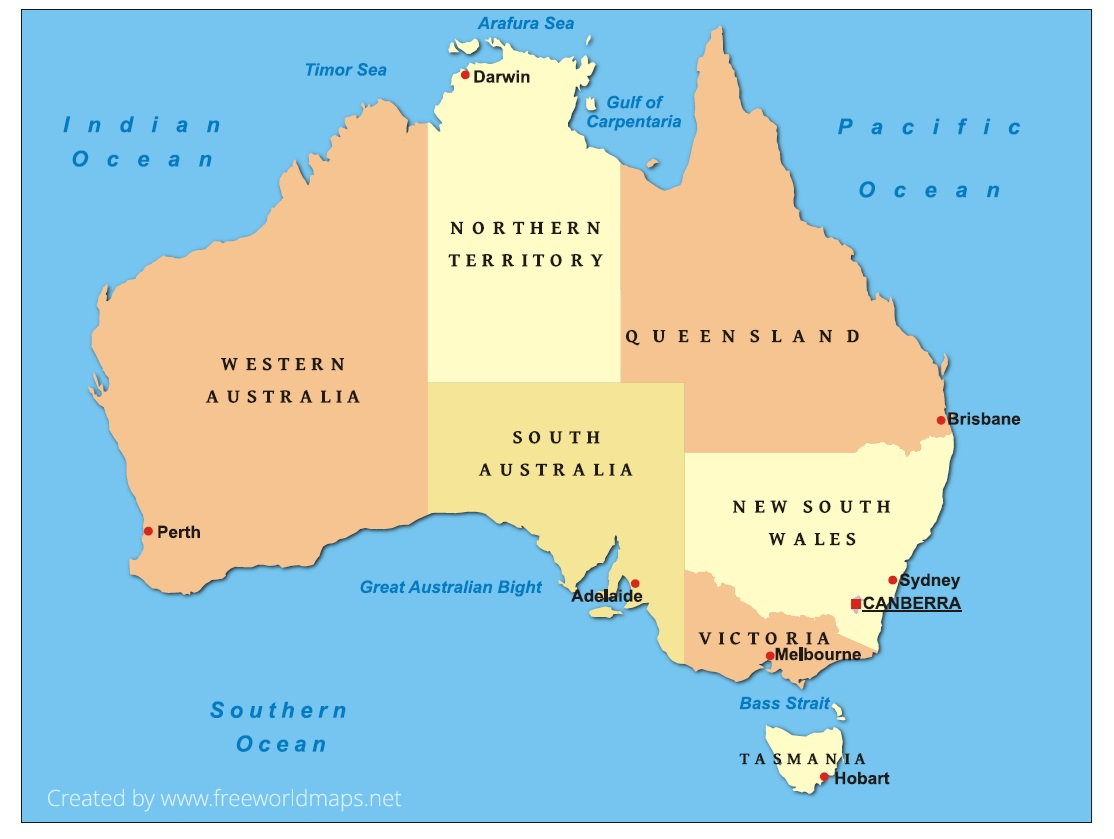
Located in the Southern Hemisphere, positioned between the Pacific and Indian Oceans
Sixth-largest country in the world by area: 7,741,222 km²
Bounded by the Timor Sea to the northwest, Coral Sea to the northeast, Tasman Sea to the southeast, and Indian Ocean to the west and southwest
Lies approximately between 10°S and 44°S latitudes and 113°E and 154°E longitudes
The Great Australian Bight forms a significant indentation on the southern coast
Continental Character
Only continent-country in the world (a single continental landmass forming a sovereign nation)
Often referred to as an island continent due to its complete ocean encirclement
Separated from Antarctica approximately 34 million years ago
1.2 Landform Divisions
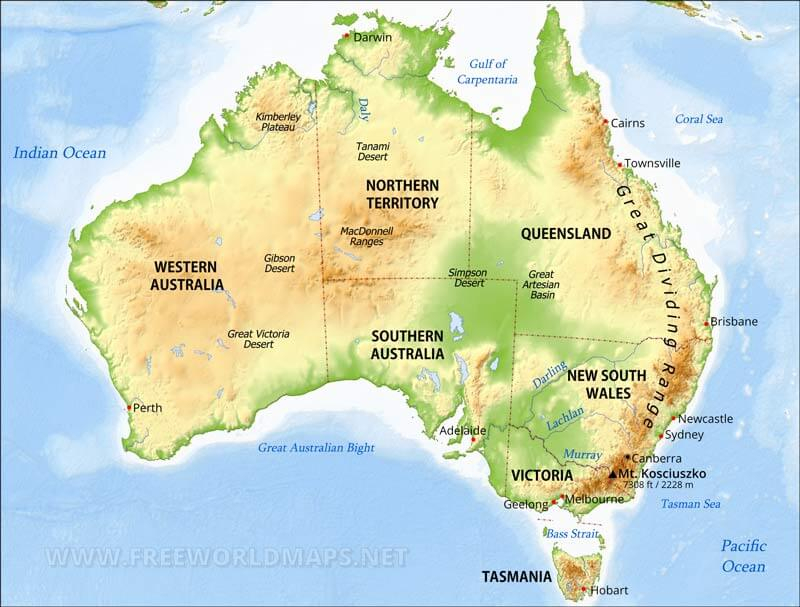
Australia’s mainland can be divided into six distinct landform regions, each with unique geological and topographical characteristics:
Eastern Highlands (Eastern Uplands)
Extends from Cape York Peninsula in the north to Victoria in the south
Includes the Great Dividing Range, the continent’s most substantial mountain chain
Stretches over 3,500 km from northeastern Queensland to the Grampians in western Victoria
Complex system of mountain ranges, plateaus, upland areas, and escarpments with ancient geological history
Comprises the Great Escarpment, which separates inland-flowing rivers from Pacific Ocean-bound rivers
Maximum elevation: Mount Kosciuszko at 2,228 meters (7,310 feet), the highest peak in Australia
Characterized by fertile volcanic soils in eastern areas, particularly in Queensland and New South Wales
Significant rainfall due to orographic effects from moisture-bearing winds
Eastern Alluvial Plains and Lowlands
Located between the Eastern Highlands and the interior
Includes the Murray-Darling Basin, one of the world’s most important river systems
Encompasses the Lake Eyre Basin in central areas
Extends north to the Gulf of Carpentaria
Characterized by sedimentary deposits and alluvial soils, making these areas relatively fertile
Important agricultural regions supporting livestock and cropping
South Australian Highlands
Includes the Flinders Range in South Australia
Comprises the Eyre Peninsula and Yorke Peninsula
Transitional region between the humid east and arid interior
Characterized by rolling hills and low mountain ranges
Western Plateau (Australian Shield)
Covers approximately one-third of Australia’s total area
An ancient continental shield comprising rocks formed during the Precambrian period (570 million to 3.5 billion years ago)
Contains cratons such as the Yilgarn and Pilbara Cratons
Includes multiple individual plateaus: Kimberley, Hamersley, Yilgarn, and others
The Nullarbor Plain forms part of this region—an uplifted sea floor of Miocene age, composed of limestone
Characterized by low relief and ancient weathered rocks
Contains significant mineral deposits and naturally supports sparse vegetation
Central Deserts and Low Mountain Ranges
Occupies much of Australia’s interior
Characterized by numerous flat-topped mountain ranges: MacDonnell Ranges, Musgrave Ranges, Stuart Range
Contains Uluru (Ayers Rock) and Kata Tjuta, prominent isolated geological features resistant to erosion
Includes the Great Sandy Desert, Gibson Desert, Great Victoria Desert, Simpson Desert, and Tanami Desert
Topography results from millions of years of erosion and sediment redistribution in a largely internal drainage system
Minimal human population; historically inhabited by Aboriginal peoples
Northern Plateau and Basins
Includes the “Top End” region of the Northern Territory
Characterized by plateaus interspersed with sedimentary basins
Important drainage areas including the Daly, Adelaide, and Katherine Rivers
Tropical and monsoonal climate influences create relatively higher precipitation
Historically less developed compared to eastern and southern regions
1.3 Geological Features and Structure
Overall Geological Characteristics
Australia is located on the lowest, flattest, and oldest continental landmass on Earth
Only 6 percent of the continental area rises above 2,000 feet (600 meters) in elevation
Topography results primarily from prolonged erosion by wind and water spanning millions of years
Ancient geological formations date back approximately three billion years
Major Geological Events
During the Permian Period, Australia was positioned near the South Pole and experienced glaciation
Australia separated from the Gondwana supercontinent, leading to its current isolated position
Tectonic movements and subsidence created major sedimentary basins: Eromanga, Murray-Gippsland, Eucla, Carpentaria, and Lake Eyre
The Great Dividing Range was uplifted during the Paleogene and Neogene periods, forming the Great Escarpment
Volcanic Activity
Extensive volcanic activity occurred in eastern Australia during Paleogene and Neogene periods
Massive lava plains were created, with volcanic soil now representing some of the world’s most fertile land
Mount Gambier in South Australia, the continent’s youngest mainland volcano, last erupted approximately 6,000 years ago
The Heard Island and McDonald Islands in the Southern Ocean remain volcanically active (eruptions recorded in mid-1980s and 1990s)
Mineral Deposits and Economic Geology
Western Plateau contains significant mineral wealth due to its ancient basement rocks
The Yilgarn and Pilbara Cratons are particularly mineral-rich regions
Darling Fault separates different geological terranes with varying ages and compositions
1.4 Climate Systems
Australia experiences diverse climatic zones largely determined by latitude, ocean currents, atmospheric circulation patterns, and topography:
Tropical Climate (Northern Australia)
Extends across the Top End and northern coastal areas
Characterized by the Australian monsoon system
Wet season (November to March): Brings monsoonal rainfall, high humidity, and occasional tropical cyclones
Dry season (April to October): Marked by clear skies, lower humidity, and milder temperatures
Annual rainfall: 500-2,500 mm in coastal areas; rapidly decreases inland
Monsoonal Influences
The Australian monsoon develops from seasonal heating of the continent relative to surrounding oceans
Low-pressure systems form over the heated landmass, drawing moist air from the Indian Ocean, Timor Sea, and Arafura Sea
The monsoon trough oscillates between “active” phases (intense rainfall, 4-8 weeks) and “inactive” phases (reduced rainfall)
The Madden-Julian Oscillation (30-90 day cycle) influences transitions between active and inactive phases
Desert and Arid Climate (Central Australia)
Covers approximately one-third of the continent
Characterized by extremely low and unreliable rainfall (less than 250 mm annually in many areas)
Temperature extremes: Range from below 0°C in highland areas to 40°C+ in interior regions
High evaporation rates due to intense solar radiation and low humidity
Sparse vegetation adapted to water scarcity
Steppe/Semi-arid Climate
Covers another third of Australia
Irregular rainfall ranging from 250-500 mm annually
Suitable for pastoral activities (livestock grazing) in favorable years
Experiences periodic droughts that can last several years
Temperate Climate (Southern Australia)
Occurs in Victoria, southern New South Wales, South Australia, and Tasmania
Four distinct seasons (summer, autumn, winter, spring)
Receives rainfall throughout the year, with winter peaks in southern regions
Average temperatures range from 0-5°C in winter to 15-20°C in summer
More reliable precipitation supports diverse vegetation and agriculture
Maritime Influences on Climate
Indian Ocean effects: Sea surface temperatures influence rainfall patterns. The Indian Ocean Dipole (IOD) is a major driver of climate variability
Positive IOD: Cooler waters near Australia = reduced rainfall in winter/spring
Negative IOD: Warmer waters near Australia = enhanced rainfall in winter/spring
Pacific Ocean effects: El Niño and La Niña patterns influence eastern Australia’s rainfall and temperature
Southern Ocean: Cool waters and frontal systems contribute to southern Australia’s temperate climate
Climate Variability and Extremes
El Niño: Associated with reduced rainfall and increased drought risk across much of Australia
La Niña: Generally brings above-average rainfall
Tropical cyclones: Occur in northern coastal areas during the wet season, occasionally penetrating inland
Extreme heat events: Increasingly common in the interior and may extend to coastal regions
1.5 Hydrological Systems
Major River Systems
Approximately 50% of Australia’s rivers drain inland, terminating in ephemeral salt lakes or simply disappearing into the landscape through evaporation
Murray-Darling Basin: The continent’s largest river system, spanning 1 million km². The Murray River (2,508 km) flows from the Eastern Highlands to South Australia. The Darling River joins the Murray, creating an integrated system vital for irrigation and agriculture
Eastern rivers: Short, swift-flowing rivers (Hunter, Hawkesbury, Illawarra) originating in the Eastern Highlands and flowing to the Pacific
Northern rivers: Daly, Adelaide, and Katherine Rivers support the Top End’s tropical ecosystems
Lake systems: Lake Eyre Basin in central Australia represents the lowest point of inland drainage; typically receives water only during high-rainfall periods
Groundwater
The Great Artesian Basin underlies much of eastern Australia’s interior, representing one of the world’s largest groundwater reservoirs
Critical for pastoral activities in semi-arid regions
Ancient water sources often with limited recharge rates, raising sustainability concerns
1.6 Natural Resources and Economic Significance
Mineral Resources
Australia is the world’s leading exporter of iron ore, with major mining regions in Western Australia (Pilbara region)
Top five mineral exports by value:
Iron ore
Liquefied natural gas (LNG)
Coal
Gold (among world’s top three producers)
Copper
Additional significant exports: Lithium, nickel, cobalt, uranium, bauxite/aluminium
Over the decade 2014-15 to 2023-24, mining contributed $2.9 trillion in resources export revenue
Mining generated 21% of the economy’s growth, $268 billion in wages, $227.5 billion in company taxes, and $167 billion in royalties
Geographic Distribution of Mineral Resources
Western Australia: Dominates gold production; major iron ore deposits in the Pilbara
Queensland: Significant coal reserves; coal mining centers in the inland
Northern Territory: Bauxite, uranium, and other minerals
South Australia: Copper deposits
Agricultural Resources
Wool industry: Historically the world’s greatest wool producer; sheep raising dominates pastoral areas
Grain cultivation: Wheat, barley, and other cereals in southern regions with adequate rainfall
Dairy and beef cattle: Established in temperate zones
Tropical agriculture: Sugar cane in Queensland; tropical fruits and crops in the north
Energy Resources
Coal reserves in Queensland and New South Wales support both domestic consumption and export
Natural gas reserves, particularly in Western Australia, support LNG exports
Renewable energy potential: Solar resources abundant across the continent; wind resources in southern regions; geothermal potential in some areas
1.7 Biodiversity and Ecology
Endemism and Uniqueness
Australia is one of seventeen megadiverse countries containing approximately 70% of the world’s biodiversity
Extraordinary level of endemism developed through millions of years of isolation:
85-93% of plant species endemic to Australia
87% of mammals endemic (including kangaroos, koalas, wombats)
93% of reptiles endemic
94% of frogs endemic
More than 80% of invertebrates endemic
Australia is home to half the world’s marsupial species and most monotremes (egg-laying mammals)
Major Ecosystems
Tropical and subtropical rainforests: Northern Queensland; highly biodiverse
Eucalyptus forests and woodlands: Dominate eastern and southern regions; fire-adapted ecosystems
Grasslands and savannas: Northern and central regions; support pastoral industries
Desert ecosystems: Interior regions; specially adapted flora and fauna
Mediterranean ecosystems: Southern regions (southwestern Australia is an internationally recognized biodiversity hotspot)
Temperate rainforests: Tasmania and southwestern Victoria; contain ancient plant species
Marine Biodiversity
Great Barrier Reef: World’s largest coral structure, stretching over 2,300 kilometers along the northeast coast
Comprises approximately 3,400 individual coral reefs, 760 fringing reefs, and 300 coral cays
Supports hundreds of coral species and thousands of fish species
Under threat from warming ocean temperatures and pollution
Demonstrates recent recovery with 2022 surveys showing 36-year-best coral regrowth
Conservation Status
Approximately 13% of original native vegetation has been completely converted (primarily to agriculture)
Further 62% has been subject to varying degrees of disturbance
Only 25% of original estimated native vegetation remains intact
Major threats: Habitat loss and fragmentation, invasive species (56 invasive vertebrate species, 32 invasive plant species), climate change, inappropriate fire regimes
1.8 States and Territories
Australia comprises six states and two territories:
| State/Territory | Capital | Population (2025) | Area (km²) | Key Features |
|---|---|---|---|---|
| New South Wales | Sydney | 7,317,500 | 800,642 | Most populous; major cities; Eastern Highlands |
| Victoria | Melbourne | 5,640,900 | 227,444 | Most densely populated state; developed infrastructure |
| Queensland | Brisbane | 5,647,500 | 1,729,742 | Great Barrier Reef; tropical north; agricultural areas |
| Western Australia | Perth | 3,030,183 | 2,527,013 | Largest state by area; mining center; isolated development |
| South Australia | Adelaide | 1,898,587 | 984,321 | Wine region; mineral resources; historical center |
| Tasmania | Hobart | 576,109 | 68,401 | Smallest state; island location; cool climate |
| Australian Capital Territory | Canberra | 366,900 | 2,360 | Planned capital city; located between NSW and Victoria |
| Northern Territory | Darwin | 231,200 | 1,346,200 | Tropical north; vast interior; sparse population |
1.9 The Great Barrier Reef: A Unique Ecosystem
Formation and Structure
Stretches over 2,300 kilometers along Queensland’s northeast coast
Consists of approximately 2,100 individual reefs and 800 fringing reefs
Built by billions of tiny coral polyps that extract calcium from seawater to form limestone skeletons
Living coral forms only a thin layer capping massive structures of calcareous sand and rubble
Current living reef structure is 6,000 to 8,000 years old
Coral Types and Biodiversity
Approximately 600 different coral types found in the reef
Two main categories: Hard corals (framework builders) and soft corals (ecosystem dwellers)
Supports approximately 1,500 fish species, 400 coral species, 4,000 mollusk species, and countless other organisms
500 species of marine algae live on the reef
Threats and Conservation
Warming ocean temperatures causing coral bleaching
Pollution from agricultural runoff and coastal development
Rising sea levels and ocean acidification
2022 survey showed greatest recovery in 36 years with two-thirds of reef regrowth by fast-growing Acropora coral
Designated as a World Heritage Site and Marine Protected Area
1.10 Aboriginal Geography and Cultural Landscape
Historical Habitation
Aboriginal peoples have inhabited Australia for at least 50,000 years, making them one of the world’s oldest continuous cultures
Original settlement occurred before the last ice age, with populations adapting to diverse environments including deserts, forests, and coastal areas
All major ecosystems and regions were occupied when Europeans arrived in the late 18th century
Traditional Lands and Desert Regions
Aboriginal peoples traditionally occupied distinct tribal territories with well-established boundaries
Important desert tribes include: Arrernte, Luritja, Pitjantjatjara, Dieri, and others
The Pitjantjatjara sphere of influence extended from Uluru to the Nullarbor Plain
Approximately one-third of Australia’s deserts are now Aboriginal lands, managed as nature reserves
Cultural Significance
Important cultural sites: Uluru, Kata Tjuta, and numerous rock art sites across the continent
Outback landscape contains sacred sites integral to Aboriginal spiritual traditions
Land rights recognized under Commonwealth Native Title legislation
Modern Aboriginal communities maintain cultural practices while adapting to contemporary challenges
Part 2: New Zealand
2.1 Location and Physical Setting
Geographic Position
Located in the southwestern Pacific Ocean, approximately 2,000 kilometers southeast of Australia
Lies between 34°S and 47°S latitudes and 166°E and 178°E longitudes
Part of Zealandia, a submerged microcontinent nearly half the size of Australia
Part of the “Ring of Fire,” indicating high tectonic and volcanic activity
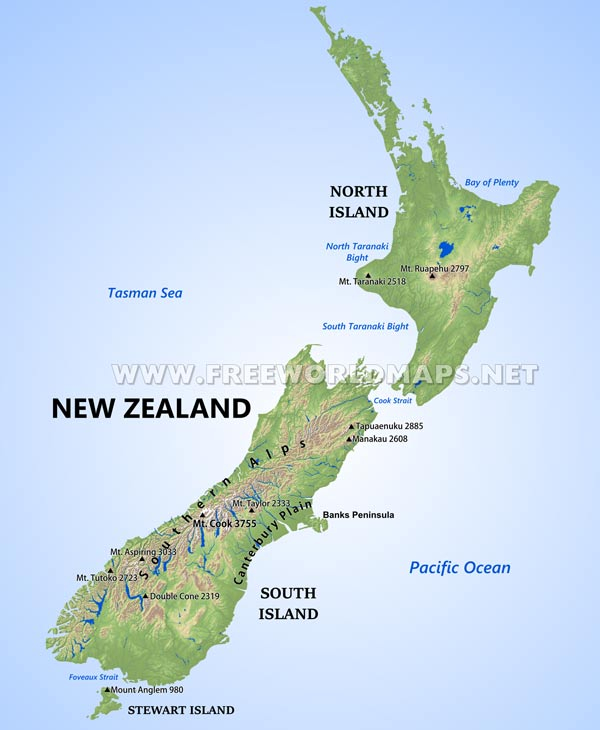
Island Configuration
Consists of two main landmasses: North Island and South Island
Stewart Island and numerous smaller offshore islands (Chatham Islands, etc.)
Total land area: 268,838 km²
Highly mountainous with rugged coastlines featuring fiords and numerous bays
2.2 North Island Geography
Physical Features
Dominated by the North Island Volcanic Plateau in the central region
Contains several active stratovolcanoes (isolated volcanic mountains)
Lake Taupō occupies a massive volcanic caldera (collapsed volcanic crater)
Formed by the Oruanui eruption approximately 26,500 years ago, which ejected 1,170 cubic kilometers of material
Characterized by hot springs, geysers, and geothermal features (Rotorua is the major geothermal center)
Eastern side features rolling hills and gentle farmland
Mountain ranges run through the center like a “spine”
Geothermal Resources
Active volcanic and thermal areas provide geothermal energy for electricity generation and heating
Rotorua region famous for geysers and hot springs exploited for both recreation and energy
2.3 South Island Geography
Physical Features
Larger landmass than the North Island (12th-largest island in the world)
Dominated by the Southern Alps, which run nearly the entire length of the island
Contains New Zealand’s highest peak: Mount Cook (3,764 meters)
Eastern side features the Canterbury Plains—vast, relatively flat agricultural areas
West Coast characterized by rough, rugged coastlines with high rainfall
Fjordland region on the southwestern coast features dramatic fiords (deep glacial valleys invaded by seawater)
Glaciers and Landforms
Spectacular glaciers cover mountainous areas due to high elevation and proximity to moisture-bearing winds
Fox Glacier and Franz Josef Glacier are major tourist attractions
Rivers are often swift and unnavigable, particularly in mountainous areas
Eastern rivers are wide and braided, formed from glacial meltwater (Wairau, Waimakariri, Rangitata Rivers)
2.4 Geological Evolution
Ancient History
New Zealand’s oldest rocks date back over 500 million years, originally part of the Gondwana supercontinent
Gondwana began fragmenting approximately 160 million years ago
New Zealand separated from Gondwana approximately 85 million years ago
Current Tectonic Setting
Sits at the boundary of two major tectonic plates: Pacific Plate and Australian Plate
These plate boundaries grind together, causing:
Frequent earthquakes (major seismic activity is characteristic of the region)
Volcanic activity and creation of new topography
Rapid uplift in some regions (Southern Alps are actively rising)
Formation of the Alpine Fault, a major active fault line
Subduction and Plate Mechanics
North Island: Pacific Plate is forced under the Australian Plate (subduction), causing back-arc volcanism and numerous large calderas
South Island: Reverse arrangement—Australian Plate forced under Pacific Plate, causing rapid uplift and frequent earthquakes
Transition zone at top of South Island characterized by significant uplift and active faults
Economic Geology
South Island contains two major goldfields: Otago and the West Coast
High-grade metamorphic rocks and gemstones (pounamu) exposed by rapid erosion of Southern Alps
Alpine Fault accessible to geologists studying active plate boundaries
2.5 Cave Systems and Karst Topography
Formation Types
Chemical dissolution of limestone by water (karst topography)
Lava caves formed from volcanic activity
Sea caves formed by wave erosion
Important Regions
Waitomo District: Major karst region with extensive cave systems
Takaka Hill in the Tasman District: Significant limestone areas
Punakaiki on the West Coast: Notable cave and coastal features
Hawke’s Bay and Fiordland: Additional cave systems
2.6 Climate
Temperature Patterns
Mild temperate climate varies with latitude and altitude
Alpine areas experience below-zero temperatures and snow in winter
Subtropical influences in the far north
Southern regions cooler and more temperate
Precipitation
High rainfall, particularly on western slopes and mountainous areas
West Coast of South Island experiences very high rainfall due to orographic effects (moisture-laden winds forced upward by mountains)
East of mountains (rain shadow areas) receives less precipitation
Snowfall common at high elevations
2.7 Biodiversity and Ecology
Endemic Species
Isolated for millions of years, New Zealand developed unique flora and fauna
Predominantly birds and flightless birds (kiwi) before human arrival
Limited native mammal fauna before human introduction of mammals
Ancient plant species, particularly in temperate rainforests
Vegetation Zones
Subtropical forests in the far north
Temperate rainforests in the northwest and southwest
Alpine vegetation at high elevations
Grasslands and shrublands in many areas, often created through historical burning
Part 3: Oceania (Pacific Islands)
3.1 Definition and Regional Boundaries
Geographic Scope
Collective name for islands throughout the Pacific Ocean
Most restricted definition encompasses more than 10,000 islands with total land area approximately 317,700 square miles (822,800 km²)
Located in the world’s largest ocean, spanning a vast area from near Southeast Asia to near the Americas
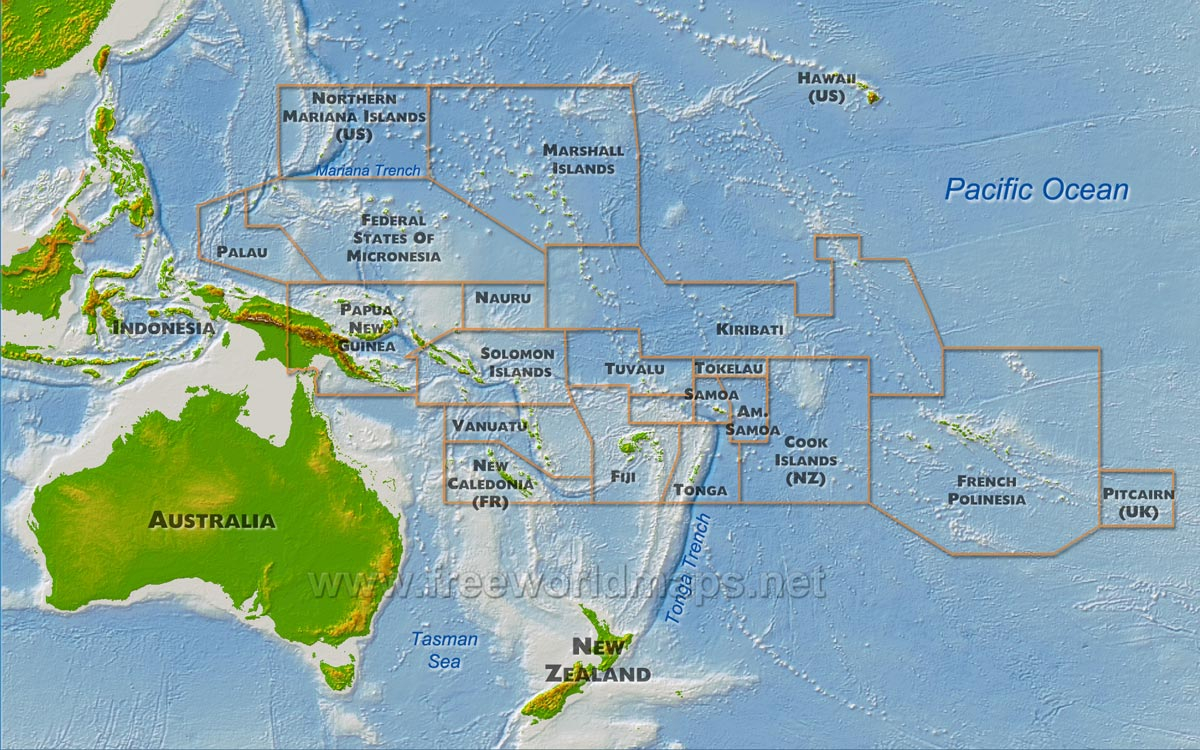
Fourteen Countries of Oceania
Australia and New Zealand are sometimes included or excluded depending on the definition. The additional island nations are:
Papua New Guinea (13,620,000 population; 462,840 km²)
Fiji (900,300 population; 18,274 km²)
Solomon Islands (815,500 population; 28,896 km²)
Samoa (210,800 population; 2,831 km²)
Vanuatu (332,600 population; 12,189 km²)
Kiribati (126,700 population; 811 km²)
Tonga (99,900 population; 747 km²)
Federated States of Micronesia (105,400 population; 702 km²)
Marshall Islands (39,700 population; 181 km²)
Palau (17,600 population; 459 km²)
Tuvalu (10,600 population; 26 km²)
Nauru (12,100 population; 21 km²)
3.2 Classification by Island Type
The Andesite Line
A geological boundary dividing the Pacific Basin
Separates basaltic volcanic islands of central and eastern Pacific from islands of western Pacific margin
Western margin islands formed mainly of metamorphosed rocks, sediment, and andesitic volcanic material
Line runs along eastern borders of Japan, the Marianas, New Guinea, Solomon Islands, Fiji, and New Zealand
Continental Islands
Larger landmasses separated from continents by sea level changes and tectonic activity
Include Papua New Guinea, New Zealand, and various island groups
Generally higher and larger than oceanic islands
Rich, fertile soils supporting diverse vegetation
Examples: Marianas, New Guinea, Bismarcks, Solomon Islands, Vanuatu, Fiji, New Caledonia
High Islands (Volcanic Islands)
Formed by volcanic eruptions building land above sea level
Characterized by steep central peaks with ridges and valleys spreading seaward
Rich volcanic soils support fertile agricultural areas and large populations
Significant part of the “Ring of Fire” around the Pacific Basin’s boundary
Prone to earthquakes and volcanic activity
Common in Melanesia; found throughout Polynesia
Low Islands (Coral Islands)
Formed from skeletons and living bodies of small marine organisms called corals
Generally low elevation (often only a few meters above sea level)
May form atolls—irregular rings of small islands (cays) surrounding a central lagoon
Lagoons typically represent eroded volcanic craters now below sea level
Most world’s atolls found in the Pacific Ocean
Land areas generally small with sandy, dry soils making farming difficult
Found predominantly in Micronesia and parts of Polynesia
Raised Coral Formations
Some coral islands have been uplifted through tectonic processes
Example: Guam’s northern half consists of coralline limestone plateau (approximately 500 feet elevation)
Southern Guam has volcanic mountains reaching over 1,300 feet elevation
3.3 Melanesia
Geographic Location and Composition
Located north and east of Australia
Includes Papua New Guinea, Fiji, Solomon Islands, Vanuatu, and New Caledonia
Name means “black islands,” referring to the darker skin color of inhabitants
Contains approximately 40% of Pacific Island population
Characterized by mixture of continental and oceanic islands
Geological and Physical Features
Major part of the “Ring of Fire” with extensive volcanic activity
High volcanic islands with complex mountain systems
Papua New Guinea dominates the region with extensive highlands and mountains
Numerous active and recently active volcanoes
Deep ocean trenches (western boundary marked by the Andesite Line)
Key Island Groups
Papua New Guinea: Largest country by population in Oceania; mountainous terrain covers 72% of the country
Fiji: Archipelago of more than 300 islands; mixture of Melanesian and Polynesian cultural influences
Solomon Islands: Consist of six major islands and over 900 smaller islands; predominantly Melanesian population
Vanuatu: Volcanic island chain; also part of Ring of Fire
New Caledonia: French territory; significant mineral resources
Climate
Tropical climate with high rainfall
Susceptible to tropical cyclones
Distinct wet and dry seasons
Biodiversity
Part of the “Coral Triangle” (spanning from Malaysia to Solomon Islands to Philippines) with extraordinary marine biodiversity
Dense tropical forests in highland areas
Rich reef ecosystems
3.4 Micronesia
Geographic Location
Located north of the Equator and east of the Philippines
Includes Palau, Guam, Northern Mariana Islands, Federated States of Micronesia, Nauru, Marshall Islands, and Kiribati
Name means “small islands”
Characterized by thousands of small islands scattered across vast ocean areas
Island Composition
Predominantly low coral islands and atolls
Some high volcanic islands (Palau, Guam, Northern Marianas)
Most islands rise only a few feet above sea level
Sandy, dry soils making agriculture difficult
Notable Geographic Features
Palau: Archipelago of approximately 340 volcanic and coral islands, only nine inhabited
Jellyfish Lake contains approximately 5 million golden jellyfish unique to the lake
Kiribati: Scattered atolls; highest point merely 4.6 meters above sea level
Mariana Trench: Located near Guam; deepest part of Earth’s oceans (approximately 11 kilometers deep)
Climate and Vulnerability
Tropical oceanic climate
Vulnerable to tropical cyclones
Extremely vulnerable to sea level rise and climate change due to low elevation
Some island nations face existential threats from rising sea levels
Cultural Diversity
Distinct linguistic and cultural groups
Languages and traditions differ from Polynesia
3.5 Polynesia
Geographic Location
“Triangle of Polynesia” roughly encompasses: Hawaii to the north, New Zealand to the southwest, Easter Island to the southeast
Covers vast expanse of central and eastern Pacific Ocean
Includes Samoa, Tonga, Tuvalu, French Polynesia, and others
Island Types
Mix of high volcanic islands and low coral atolls
Fewer active volcanoes than Melanesia and Micronesia
More atolls and coral reef systems
Generally flatter topography than Melanesian islands
Climate
Tropical climate modified by ocean currents and trade winds
Monsoon influences in western areas
Some atolls experience limited precipitation
Key Island Groups
Samoa: Cultural heart of Polynesia; includes Upolu and Savai’i
Tonga: Kingdom of Tonga; includes Tongatapu and Ha’apai groups
French Polynesia: Includes Society Islands (Tahiti, Bora Bora), Marquesas, Tuamotu Atolls, and Austral Islands
Tuvalu: Chain of nine atolls; extremely low elevation
Biodiversity and Marine Features
Coral reef systems support diverse marine life
Birdlife: Diverse endemic bird species
Marine resources: Rich fishing grounds
Vulnerability to Climate Change
Low-elevation atolls particularly threatened by rising sea levels
French Polynesia’s Hao Atoll exemplifies climate change impacts
Some nations designated as least-developed countries
3.6 Geographic and Climatic Unity: Island Formation and Settlement
Island Formation Pattern
Many plants and animals reached Pacific islands from southern Asia during the last glacial period when sea levels were low
After sea level rise, species adapted to individual island environments
Isolation created distinct endemic species and cultural groups on each island
Navigation and Settlement
Pacific Islanders were among the world’s most remarkable seafarers
Settled islands through extraordinary navigation techniques using stars, ocean swells, cloud movements, and animal behavior
Lapita cultural complex (3,500 years ago) initiated major eastward migration
Settlements extended to Hawaii, Easter Island, and New Zealand by approximately 1200 CE
Most remarkable human migrations in history achieved without modern navigation tools
Climate Characteristics
Most islands experience tropical or subtropical climates
Trade winds moderate temperatures in many areas
Monsoon influences in western regions
Seasonal variation between dry and wet seasons
Vulnerable to tropical cyclones during active seasons
Part 4: Regional Contrasts and Special Features
4.1 Australia vs. Oceania: Key Differences
| Feature | Australia | Oceania (Islands) |
|---|---|---|
| Landmass | Single continent-sized landmass | Thousands of smaller islands scattered across vast ocean area |
| Topography | Flat to gently rolling; only 6% above 2,000 feet | Highly variable: high volcanic mountains to atolls barely above sea level |
| Geology | Ancient continental shield; very stable | Active plate boundaries; volcanic activity; high seismicity |
| Climate | Arid to temperate; monsoon in north | Tropical throughout; highly vulnerable to cyclones and rising sea levels |
| Biodiversity | Highly endemic with unique fauna (marsupials) | Diverse and endemic; heavy dependence on marine resources |
| Population | 27+ million concentrated on coast | Total ~46 million across 14 nations; sparse island populations |
| Economic Focus | Mining and agriculture | Tourism, fishing, agriculture; growing climate refugee concerns |
| Development | Highly developed infrastructure | Mixture of developing and least-developed nations |
4.2 The Pacific Ring of Fire and Tectonic Significance
Geographic Extent
Belt of volcanic and seismic activity encircling the Pacific Ocean
Encompasses the Pacific plate boundary and associated subduction zones
Stretches approximately 40,000 kilometers
Key Features
Major volcanoes: Mount Fuji (Japan), Mount Pinatubo (Philippines), numerous Polynesian and Melanesian volcanoes
Frequent earthquakes due to intense plate tectonics
Tsunamis occasionally generated by submarine earthquakes
Creates hazardous living conditions but also geothermal resources
Regional Impact
Melanesia directly on the Ring of Fire
Polynesian volcanoes represent either active hotspots or remnants of ancient activity
Micronesian islands (particularly Mariana Trench region) represent deepest plate subduction
4.3 Ocean Currents and Their Influence
Major Currents Affecting Australia
East Australian Current: Warm water flowing south along the east coast; influences climate and marine ecosystems
Western Australian Current: Cold water flowing north; creates cooler climates and arid conditions in Western Australia
Southern Ocean Circulation: Cool currents influencing Tasmania and southern mainland Australia
Pacific Island Currents
Trade winds drive predictable ocean circulation patterns
El Niño and La Niña phenomena significantly influence rainfall and marine ecosystems
Equatorial currents affect island settlements and marine resources
4.4 Environmental Challenges and Conservation
Australia
Habitat loss and fragmentation from agricultural expansion
Invasive species threatening endemic wildlife (cane toads, rabbits, feral cats)
Climate change increasing fire frequency and intensity
Water scarcity in inland regions
Great Barrier Reef bleaching and degradation
Oceania
Rising sea levels threatening low-lying atolls and coastal settlements
Coral reef degradation from warming and acidification
Overfishing and marine resource depletion
Limited freshwater resources
Tropical cyclone damage and increasing storm intensity
Limited capacity for environmental protection and climate adaptation
Conservation Measures
Australia: Expanding marine protected areas; Aboriginal land management integrating traditional knowledge
Oceania: International climate action; marine spatial planning; adaptation strategies
Both regions: Biodiversity hotspot designation supporting conservation prioritization


Discover more from Simplified UPSC
Subscribe to get the latest posts sent to your email.