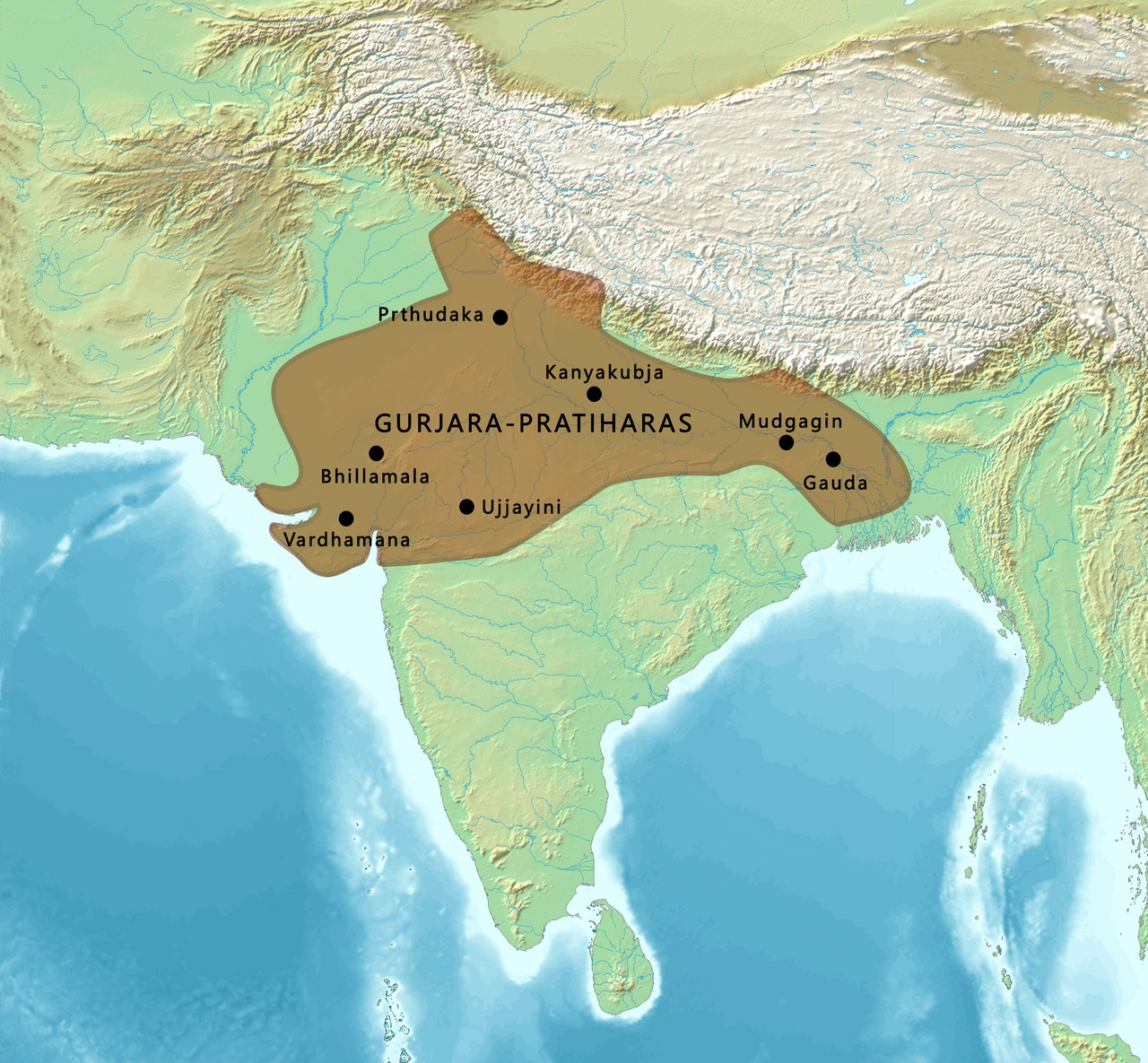
Gurjara Pratihara Dynasty
Contents
Gurjara Pratihara Dynasty
Origin and Early History
The Gurjara Pratihara dynasty emerged in the early medieval period, roughly from the mid‑8th century to the first half of the 11th century CE, and ruled over western and northern India.
Their early history is partly veiled in myth, with some sources suggesting they migrated from Central Asia after the Gupta period and settled in Rajasthan, then known as the Gurjara‑desha; the term “Gujarat” itself seems derived from “Gurjara”.
| King | Reign (CE) | Major Work / Key Achievements |
|---|---|---|
| Nagabhata I | 730–760 CE | Laid foundation of the Gurjara‑Pratihara Empire; successfully resisted Arab invasions and established dominance in Rajasthan–Malwa. |
| Kakustha / Devaraja | 760–780 CE | Successors of Nagabhata I; maintained continuity of the dynasty during a transitional phase (less documented but politically important). |
| Vatsaraja | c. 780–800 CE | Expanded the empire eastwards; fought against the Rashtrakutas and became a key player in the Tripartite Struggle with Palas and Rashtrakutas. |
| Nagabhata II | 800–833 CE | Defeated the Rashtrakutas in the west, shifted capital‑region to Kannauj, and checked further Arab advances in western India. |
| Ramabhadra | 833–836 CE | Son of Nagabhata II; ruled briefly, acting as a bridge to the next powerful ruler, Mihira Bhoja. |
| Mihira Bhoja / Bhoja I | 836–885 CE | Golden age of the Pratiharas; empire at its peak, stretching from Gujarat–Kathiawar in the west to Bengal in the east; praised by Arab traveller Al‑Mas’udi as “King Baura”. |
| Mahendrapala I | 885–910 CE | Expanded and consolidated the empire further; maintained control over a large area from Bengal to Gujarat; also supported religious and cultural institutions. |
| Bhoja II | 910–913 CE | Short‑lived reign after Mahendrapala I; signs of internal weakness and revolts began to appear. |
| Mahipala I | 913–944 CE | Tried to stabilize administration amid rising pressures from Rashtrakutas and other feudatories; central power started weakening. |
| Mahendrapala II | 944–948 CE | Continued rule under strong external pressure; many feudatories became practically independent. |
| Devapala | 948–954 CE | Weak central authority; most regions were effectively independent. |
| Vinayakapala | 954–955 CE | Very short reign; no real control over former territories. |
| Mahipala II | 955–956 CE | Brief rule during the final phase of fragmentation. |
| Vijayapala II | 956–960 CE | Another short‑lived ruler, signalling further decline. |
| Rajapala | 960–1018 CE | Extremely long but largely nominal reign; most of the empire had already broken up. |
| Trilochanapala | 1018–1027 CE | One of the last rulers; only nominal authority left over former territories. |
| Yashapala | 1024–1036 CE | Last known ruler of the Gurjara‑Pratihara line; marked the end of the once‑powerful dynasty. |
The dynasty’s name has two components:
Gurjara: denoting their ethnic or regional origin.
Pratihara: literally meaning “door‑keeper”/”protector”, recalling a legendary claim that their ancestor Lakshmana served as Rama’s door‑keeper in the Ramayana.
In bardic tradition, the Gurjara‑Pratiharas are grouped among the Agnikula Rajput clans (along with the Chalukyas, Chahamanas, and Paramaras), said to be born out of a fire‑ritual on Mount Abu.
Major Rulers and Political History
The Gurjara‑Pratiharas rose to prominence after the decline of Harsha’s empire and became the central power in north India, especially around Kannauj, competing with the Palas (Bengal) and Rashtrakutas (Deccan) in the Tripartite Struggle.
Nagabhata I (c. 730–760 CE)
Founder of the Pratihara Empire in historical terms; stabilized a kingdom stretching from Gujarat to Gwalior.
Famously repulsed the Arab invasions from Sindh, thus checking the westward expansion of the Caliphate into India.
Defeated Dantidurga of the Rashtrakutas, though his victory was short‑lived; his successors inherited a substantial core territory.
Vatsaraja (c. 775–800 CE)
Shifted the centre of power first to Ujjain and later to Kannauj, aspiring to dominate the Gangetic plains.
In the Tripartite Struggle, he defeated Dharmapala of the Pala dynasty and initially seemed poised to control Kannauj, but was later routed by Dhruva of the Rashtrakutas, who briefly captured Kannauj.
Nagabhata II (c. 800–833 CE)
Revived the empire after the Rashtrakuta setback, recovering Malwa and consolidating gains in Rajasthan and Gujarat.
Captured Kannauj from Chakrayudha, defeating Dharmapala in the process and extending his influence as far east as Munger in Bihar.
Rebuilt the Shiva temple at Somnath, repaired after Arab raids, underscoring the dynasty’s role in defending Hindu religious centres.
Bhoja I / Mihir Bhoja (c. 836–885 CE)
Considered the greatest ruler of the Gurjara‑Pratihara dynasty; his reign marks the zenith of the empire.
Capitalised on Kannauj (also called Mahodaya), which became the imperial centre controlling much of north India.
A Vaishnavite patron, he adopted the title “Adivaraha” and expanded his sway over the Arabs of Sindh, Chandalas, and Kalachuris.
Arab travellers such as Al‑Masudi testify to the strength of Pratihara cavalry, dubbing him “King Baura” and highlighting his military reputation.
Mahendrapala I (c. 885–910 CE)
Son of Mihir Bhoja; expanded the empire further, with his dominions stretching from the Narmada to the Himalayas, eastward into Bengal, and westward towards Sindh.
Took the title “Maharajadhiraja of Aryavarta”, reflecting his claim as sovereign of northern India.
Patronised Rajashekhara, a prominent Sanskrit poet and dramatist, whose works like Karpuramanjari, Kavya Mimansa, and Viddhasalabhanjika were composed at the Pratihara court.
Later Decline
Mahipala I (c. 913–944 CE): The empire began to fragment; Indra III of the Rashtrakutas sacked Kannauj, and the Rashtrakutas captured Gujarat, depriving the Pratiharas of direct sea access.
Rajyapala (c. 960–1018 CE): Faced the Ghaznavid invasion; fled Kannauj when Mahmud of Ghazni attacked. Later killed by Vindhyadhar of the Chandela dynasty, symbolising the eclipse of Pratihara power.
Yashpala (c. 1024–1036 CE): Last notable Pratihara ruler; thereafter, the dynasty splintered into regional branches, while feudatories like the Chandelas, Paramaras, Tomaras, and Chahamanas carved out independent states.
Administration and Political Structure
The Gurjara‑Pratiharas evolved a decentralised but hierarchical administrative system balancing central authority and feudal (samanta) structure.
Central Authority
The king stood at the apex with grand titles such as “Maharajadhiraja”, “Parameshwara”, and “Parambhaterak”, asserting ritual and political supremacy.
The king nominated samantas (feudal chiefs), who maintained armies and provided military support; they also received land grants and were often called Mahasamantahipati or Mahapratihara.
Officials and Local Administration
Important officials included:
Kottapala (fort commander).
Tantrapala (king’s representative in samanta states).
Dandapashika / Dandanayaka (overseeing police and justice).
Baladhikrita (chief of the army).
The empire was divided into bhuktis (provinces), each comprising several mandalas; mandalas contained cities and villages, enabling layered supervision.
Villages were largely self‑administered through elders (Mahattaras) and a gramapati, a state‑appointed officer advising on local issues.
Urban Administration
Cities were managed by corporate councils such as Goshthi, Panchakula, Sanviyaka, and Uttarapshobha, indicating a degree of urban autonomy.
This efficient administrative machinery helped sustain long‑term defence against external invasions and internal revolts.
Social Conditions
Society under the Gurjara‑Pratiharas was broadly governed by the four‑fold varna system, but with some flexibility.
Brahmanas were prominent, especially Chaturvedins and Bhattas, and remained the primary recipients of land grants.
Kshatriyas (often called “Kataria” in Arab accounts) included the ruling dynasty and various Rajput clans.
Vaishyas and Shudras were engaged primarily in agriculture, trade, and artisanal occupations.
Insights from Arab Sources
The Arab writer Ibn Khurdadab speaks of seven classes, including Savakufria (ruling class), Kataria (Kshatriyas), Sudaria (Shudras), Basuria (Vaishyas), and Sandila (Chandalas).
The same accounts indicate blurring of economic roles—Vaishyas performing tasks akin to Shudras and Shudras taking up Vaishya‑like economic roles—suggesting some social fluidity.
Gender and Social Practices
Polygamy was practised by the elite, though monogamy remained common among ordinary people.
Sati existed but was not widespread; references to royal women and scholars like Rajashekhara’s wife Avanti Sundari show that women were active in cultural and literary spheres.
Royal women were not bound by strict purdah, and upper‑class women were trained in music, dance, and painting.
Art, Architecture, and Culture: Mahu‑Gujjara Style
The Gurjara‑Pratiharas were great patrons of temple architecture and Sanskrit literature, giving rise to the Maha‑Gujjara (or Māru‑Gurjara) style.
Key Temples and Sites
Teli‑ka‑Mandir, Gwalior: One of the oldest and most impressive Pratihara‑period temples, dedicated to Shakti, with a distinctive rectangular sanctum and double‑oblong shikhara.
Osian (Rajasthan): A cluster of early temples (Hindu and Jain) featuring five‑bay mulaprasadas, porches, and open halls with richly carved pillars.
Bateshwar (Bateshwar group of temples, Madhya Pradesh) and Baroli (Rajasthan) reflect the evolution of Latina shikharas, phamsana roofing, and faceted socles.
Architectural Features
Predominance of Nagara style with Latina shikharas, purna‑kalasha capitals, and ghana‑dwaras (central projections) on temple walls.
Use of phamsana (pyramidal) roofs for mandapas and porches, and later experimentation with sekharī‑type shikharas, anticipating Chandela and Paramara architecture.
Sculptural and Literary Achievements
Sculptures from Kannauj and Osian depict Vishwarupa Vishnu, marriage of Shiva‑Parvati, and graceful Sursundari female figures, illustrating the maturity of Pratihara sculpture.
The court of Mahendrapala I hosted Rajashekhara, whose works combine literary theory and historical insight, making the Pratihara era a high watermark of early medieval Sanskrit literature.
Decline and Legacy
Several factors led to the decline of the Gurjara‑Pratihara dynasty:
Rise of Feudatories: The Chandelas, Paramaras, Tomaras, Chahamanas, and others declared independence, eroding the core of the empire.
Rashtrakuta Invasions: Indra III and other southern powers disrupted stability in the north‑central belt.
Ghaznavid Attacks: Mahmud of Ghazni’s sack of Kannauj in 1018 shattered the last remnants of Pratihara authority, accelerating fragmentation.
Despite their decline, the Gurjara‑Pratiharas left a profound legacy in north Indian polity, temple architecture, and Rajput confessional identity, shaping the political landscape that preceded the Delhi Sultanate.
Read More: Ancient India Notes
Discover more from Simplified UPSC
Subscribe to get the latest posts sent to your email.
