Population and Associated Issues in India
Contents
Population and Associated Issues in India
Overview
Population and Associated Issues: India is currently the world’s most populous country with about 1.46 billion people in 2025, accounting for nearly 17.8% of the global population. Rapid but gradually slowing population growth has created both opportunities (demographic dividend) and serious challenges related to employment, resources, social justice and environmental sustainability.
Salient Features of India’s Population
India’s population shows distinctive structural and qualitative features that shape its development trajectory.
Size, Rank and Growth Stage
India’s population is estimated at around 1.45–1.46 billion in 2024–25 and remains the world’s most populous country.
Annual growth has slowed to about 0.9% by 2024–25, much lower than the 2%+ levels of the 1970s–1980s, showing late-expanding demographic transition.
According to World Population Prospects 2024, India’s population is projected to keep growing till around the 2050s–2060s and then peak near 1.7 billion before gradually declining.
Demographic Transition Stage
Historically, India moved from high birth and high death rates (pre‑independence) to high birth but rapidly declining death rates (1950s–1980s), causing population explosion.
With sustained fertility decline, India is now in the late expanding stage: birth rates have fallen close to replacement while death rates remain relatively low, creating a temporary bulge in the working‑age population.
Young Age Structure and Demographic Dividend
In 2025, about 24–26% of Indians are below 15 years, around 68% in the working‑age group 15–64 years, and 7–7.5% are 65+.
The median age is still below 30 years (around 29–30 years in 2024–25), making India one of the youngest major economies.
Since around 2018, the working‑age population has been larger than the dependent population; this favourable age structure is expected to last till roughly 2055, creating scope for a long demographic dividend window.
High Population Density and Spatial Imbalance
Average population density is close to 490 people per sq. km in 2024, up from about 382 in 2011 and 147 in 1960, with some states exceeding 800–1,000 persons per sq. km.
Population is highly concentrated in the Indo‑Gangetic plains (Uttar Pradesh, Bihar, West Bengal), coastal belts and major urban–industrial corridors, while states such as Arunachal Pradesh or Mizoram remain sparsely populated.
Skewed Sex Ratio and Son Preference
NFHS‑5 data show that the national sex ratio at birth remains below the natural level, though it has marginally improved from around 919 to about 927 girls per 1,000 boys.
Economic Survey 2017–18 highlighted an estimated 21 million “unwanted” girls and about 63 million “missing women” due to son preference, sex‑selective practices and differential care.
Urbanisation and Migration
Around 36–37% of Indians live in urban areas as of mid‑2020s, up from about 31% in 2011 and 27.5% in 2000, driven largely by rural‑to‑urban and intra‑state migration.
Major cities and urban agglomerations face intense population pressure, leading to proliferation of slums, informal employment and stressed infrastructure.
Historical Pattern of Population Growth in India
Understanding long‑term trends helps to relate population with development and policy responses.
Pre‑Independence to 1951: High Mortality, Modest Growth
Up to the early 20th century, India’s population grew slowly due to high death rates caused by famines, epidemics, poor sanitation and low medical coverage.
In 1951, at the time of the first post‑independence Census, population was about 361 million; the decadal growth (1941–51) was around 13–14%, still moderate compared to later decades.
1951–1981: Onset of Population Explosion
Improvements in public health, vaccines and basic infrastructure significantly reduced mortality after independence, especially infant and child mortality.
However, high fertility persisted; decadal growth rose sharply: 21.5% (1961–71) and around 24.7% (1971–81), marking the classic phase of “population explosion”.
1981–2011: Gradual Fertility Decline
From the 1980s onward, fertility began to decline due to higher female literacy, delayed marriage, urbanisation, access to contraception and family welfare programmes.
The decadal growth rate fell from about 23.9% in 1981–91 to 21.5% in 1991–2001 and further to 17.7% in 2001–2011, as highlighted by official analyses of Census and National Population Policy targets.
2011 Onwards: Slowing Growth and Emerging Ageing
Post‑2011, annual growth has continued to slow towards about 0.9% per year, with fertility dipping below replacement level.
Projections from UN’s World Population Prospects 2024 suggest India’s population will peak around early 2060s at about 1.7 billion before starting a slow decline, bringing long‑term ageing concerns.
Key Demographic Indicators for India
Demographic indicators help in quantifying population dynamics and planning interventions.
Population Size, Growth Rate and Density
| Indicator (approx.) | 2000 | 2011 | 2024–25 |
|---|---|---|---|
| Population (billion) | 1.06 | 1.21 | 1.45–1.46 |
| Annual growth rate | ~1.96% | ~1.64% | ~0.9% |
| Density (persons/sq. km) | ~356 | 382 | ~488–492 |
These figures show clear deceleration in growth but continued pressure on land and ecosystems due to rising density.
Fertility Indicators
NFHS‑5 and official releases confirm that India’s Total Fertility Rate (TFR) declined from 2.2 in 2015–16 (NFHS‑4) to 2.0 in 2019–21, below the replacement level of 2.1.
Urban TFR is around 1.6 while rural TFR is roughly 2.1, showing that future growth will increasingly be driven by a few high‑fertility states and rural pockets.
Only a small set of states such as Bihar and Meghalaya still record TFR significantly above replacement, whereas most large and medium states are at or below 2.1.
Mortality, Life Expectancy and Health
Life expectancy at birth in India has risen steadily and is now above 69–70 years, reflecting improved survival due to expanded immunisation, maternal and child health services and disease control.
NFHS‑5 documents declines in infant and under‑five mortality and improvements in antenatal care, institutional deliveries and child vaccination, all of which reinforce population stabilisation.
Sex Ratio and Sex Ratio at Birth
NFHS‑5 notes that sex ratio at birth has improved only marginally, from 919 to 927 girls per 1,000 boys, indicating continued gender bias despite legal measures like the PCPNDT Act.
Several states still have sex ratio at birth below 950, and a few even below 900, pointing to spatially concentrated discrimination.
Age Structure and Dependency Ratio
Current age structure is roughly 24–26% below 15 years, about 68% between 15–64 years and around 7% 65+.
The dependency ratio (non‑working age to working age population) has fallen significantly since 2001, indicating more earners per dependent, which is vital for harnessing demographic dividend.
Urbanisation and Migration Indicators
Urban share of population has risen from about 27.5% in 2000 to over 36% by mid‑2020s, with steady growth expected in future decades. (CSEP)
Large volumes of rural‑to‑urban migration, seasonal migration of informal workers, and interstate migration (e.g., from BIMARU to southern and western states) are reshaping demographic patterns and labour markets.
Social and Structural Factors Behind Population Growth
Population dynamics in India are rooted in deep socio‑economic and cultural contexts.
High Fertility in Specific Regions and Groups
Access to contraceptives and reproductive health services remains uneven, particularly in remote rural, tribal and impoverished areas.
NFHS‑5 shows that while overall contraceptive prevalence has risen to around two‑thirds of married women, unmet need for family planning still stands near 9–10%, concentrated among the poor and less educated.
Early Marriage and Teenage Pregnancies
Despite legal minimum marriage age (18 for women, 21 for men), around one‑fourth of women in NFHS‑5 reported being married before 18, leading to a longer reproductive span and higher lifetime fertility.
Early marriage is more prevalent in rural, low‑income and educationally backward communities, reflecting entrenched patriarchy and social norms.
Son Preference and Gender Norms
Cultural norms valuing sons as economic and ritual “assets” (old‑age support, lineage continuation, inheritance) drive repeated childbearing until a male child is born.
Sex‑selective abortions, neglect of girl children and lower investments in daughters’ health and education have produced skewed sex ratios and large numbers of “missing” women.
Poverty, Illiteracy and Low Female Autonomy
Poor households often view larger families as economic insurance: more earners, support in old age, and backup against high child mortality in earlier generations.
Low levels of female literacy and workforce participation reduce women’s bargaining power in fertility decisions and delay the transition to small‑family norms.
Religious and Cultural Beliefs
In some communities, children are perceived as “gifts of God” and family planning is culturally or religiously discouraged, slowing fertility decline.
Mistrust of modern contraceptives, myths about side‑effects and limited male participation in family planning reinforce high fertility in specific pockets.
Migration and Illegal Inflows
Localised population surges in border districts and urban peripheries can also reflect cross‑border and internal migration (e.g., from neighbouring countries or poorer Indian states), adding to demographic pressure and identity politics.
Issues and Challenges Associated with Population Growth
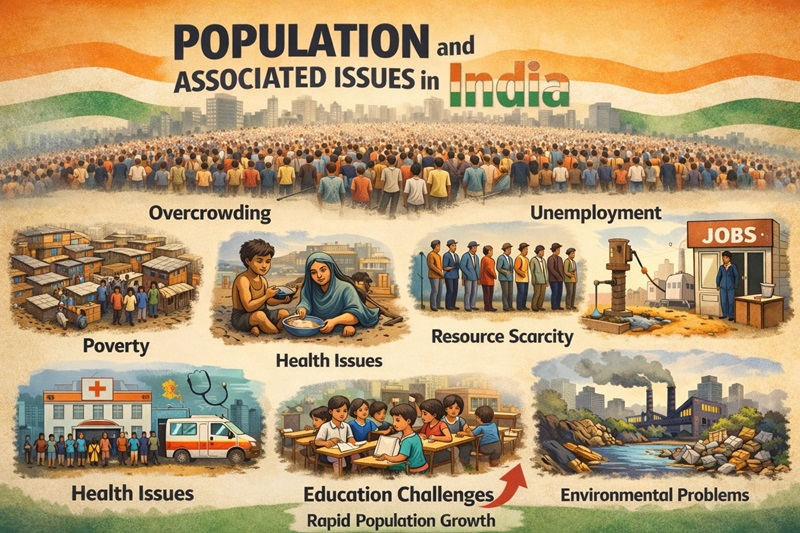
Population growth in India is associated with multi‑dimensional challenges—economic, social, environmental and governance‑related.
Unemployment, Underemployment and Jobless Growth
Each year, millions of young people enter the labour force, but formal job creation in manufacturing and high‑productivity services has not kept pace, leading to high levels of open unemployment and disguised unemployment.
A large share of workers remain in low‑productivity agriculture or informal services with poor wages and no social security, limiting the potential benefits of a large workforce.
Persistent Poverty and Inequality
Even with rapid GDP growth in some years, population pressure dilutes per capita gains, and large segments of the population struggle to secure basic needs like nutrition, healthcare and housing.
High dependency in poor households, land fragmentation, and unequal access to education and assets exacerbate income and wealth inequality, leading to inter‑generational transmission of poverty.
Pressure on Land, Water and Food Security
Rising population density and urban expansion result in conversion of agricultural land, forest clearance and encroachments on commons, increasing land scarcity and landlessness.
Demand for food grains, fruits, vegetables and animal products is growing; without parallel gains in productivity and supply chains, this can aggravate inflation, malnutrition and regional food insecurity.
Over‑extraction of groundwater and pollution of rivers and lakes threaten long‑term water security for irrigation and drinking purposes.
Strain on Infrastructure and Basic Services
Rapid population growth in cities has outstripped capacity for planned housing, leading to large slum populations lacking sanitation, clean water and secure tenure.
Public transport, roads, sewage networks, waste management and digital infrastructure are often overwhelmed, creating congestion, health hazards and productivity losses.
Education and Human Capital Deficits
Overcrowded classrooms, high pupil–teacher ratios and inadequate facilities in many government schools undermine learning outcomes, particularly for first‑generation learners.
Population pressure makes it harder to ensure universal access to quality secondary and higher education or vocational training, weakening the skill base required to exploit demographic dividend.
Health System Overload
A large and growing population increases demand for preventive and curative services, from maternal and child health to chronic disease management, stretching human resources and finances.
Unequal distribution of doctors, nurses and health infrastructure between urban and rural areas leads to spatial health inequities and out‑of‑pocket expenditure burdens.
Environmental Degradation and Climate Vulnerability
Higher population implies more consumption of energy, minerals and biomass, contributing to deforestation, biodiversity loss, soil erosion and pollution.
Urban and industrial emissions, combined with household biomass burning, worsen air and water quality, increasing disease burden and climate vulnerability for millions.
More people living in climate‑sensitive zones (coastal belts, flood plains, drought‑prone regions) heightens exposure to disasters, displacement and livelihood loss.
Social Tensions, Conflicts and Governance Challenges
Competition for scarce jobs, land, water, reservations and public services can amplify caste, communal and regional tensions, posing law‑and‑order challenges.
Managing a very large and heterogeneous population demands strong state capacity for targeting welfare schemes, maintaining updated databases, and coordinating across levels of government.
Ageing and Future Care Burden
Although India is currently young, falling fertility and rising longevity imply that the share of elderly will rise significantly in the second half of the century.
Without adequate preparation—pensions, geriatric care, social support and age‑friendly infrastructure—the country may face a double burden of supporting both young dependents and an ageing population.
Demographic Dividend: Opportunities and Conditions
Demographic dividend refers to the accelerated economic growth that can result from changes in the age structure when the working‑age population grows larger relative to dependents.
India’s Demographic Window
India’s demographic dividend phase is considered to have begun around 2005–06, when the working‑age population started to exceed the dependent population significantly.
Estimates suggest this window can last roughly 50 years, from about 2005–06 to 2055–56, with the share of working‑age population peaking close to 65% around the mid‑2030s or early 2040s.
Economic Survey 2018–19 indicated that India’s dividend would peak around 2041, when the 20–59 age group is expected to constitute about 59% of the total population.
Potential Economic Gains
With more workers relative to dependents, savings can rise, investments increase, and productivity improve, boosting GDP growth.
A young, flexible labour force can attract global manufacturing and services investment, especially as several advanced economies and China face rapid ageing and shrinking workforces.
Regional Variation in Dividend
Southern and western states (e.g., Kerala, Tamil Nadu, Karnataka, Maharashtra) already have low fertility and are moving toward ageing, with narrower demographic windows.
Northern and central states (e.g., Uttar Pradesh, Bihar, Madhya Pradesh, Rajasthan) will experience their demographic dividend later and for longer, but currently lag in education, health and job creation.
This staggered transition creates opportunities for internal labour mobility but also risks of regional inequality if human capital gaps persist.
Preconditions to Realise the Dividend
To convert demographic potential into actual gains, several enabling conditions are critical.
Quality Education and Skill Development
Universal access to quality school education, especially for girls and marginalised groups, is essential to raise productivity.
Large‑scale skilling, reskilling and upskilling programmes must align with emerging sectors such as green energy, digital technologies, care economy and manufacturing.
Productive Employment Generation
Labour‑intensive manufacturing (textiles, food processing, electronics assembly) and modern services (tourism, logistics, IT‑enabled services) must expand fast enough to absorb new entrants.
Facilitative industrial policy, ease of doing business, infrastructure development and MSME support are essential to avoid jobless growth.
Health and Nutrition
A healthy workforce requires investments in primary healthcare, sanitation, clean drinking water, and nutrition, especially during the first 1,000 days of life.
Addressing the triple burden of malnutrition (undernutrition, micronutrient deficiency, overweight) and rising non‑communicable diseases is crucial.
Gender Equality and Women’s Workforce Participation
Enhancing female education, safety, childcare facilities and property rights, and reducing unpaid care burdens can significantly raise women’s labour force participation.
When women delay marriage and childbirth and participate in paid work, fertility declines further and household savings and human capital investments tend to rise.
Good Governance and Institutional Capacity
Effective public institutions are needed to deliver services, regulate markets, protect rights, and manage urbanisation and migration rationally.
Stable macroeconomic policies, financial inclusion and social protection help channel demographic gains into broad‑based development.
Without these conditions, a youth bulge can turn into a “demographic disaster” characterised by mass unemployment, frustration and social unrest.
Policy Framework and Government Initiatives
India has a long history of population‑related policies and programmes aimed at stabilising growth while improving human development.
Evolution of Population Policy
Early Initiatives (1950s–1970s): India was the first country to launch a national family planning programme in 1952, initially focused on birth control through clinical services and later emphasising sterilisation and IUDs.
1976 National Population Policy: Proposed raising marriage age, monetary incentives for sterilisation, and integration of family planning with maternal and child health; coercive sterilisation excesses during Emergency created backlash and mistrust.
Reorientation in Late 1970s–1990s: The approach shifted from “family planning” to broader “family welfare”, stressing voluntary acceptance, maternal–child health, nutrition and women’s empowerment.
National Population Policy 2000 (NPP 2000)
NPP 2000 provided a comprehensive framework to meet reproductive and child health needs and to achieve population stabilisation by 2045.
Short‑term goals included addressing unmet need for contraception, strengthening health infrastructure and integrating services; medium‑term goals focused on bringing TFR to replacement level; long‑term aim was a stable population consistent with sustainable development.
The policy emphasised decentralised planning, involvement of Panchayati Raj Institutions and civil society, and convergence with literacy, nutrition and poverty alleviation programmes.
Family Planning and Reproductive Health Programmes
Key ongoing initiatives include:
Family Planning Programme: Offers a “cafeteria approach” of contraceptives (condoms, OCPs, IUCDs, injectables, sterilisation) through the public health system with increasing emphasis on spacing methods.
Mission Parivar Vikas (2016): Targets districts with TFR ≥ 3 in high‑focus states, expanding access to contraceptives, counselling and behaviour‑change communication.
Home Delivery of Contraceptives by ASHAs: Accredited Social Health Activists deliver contraceptives to doorstep in rural areas, improving last‑mile access.
Schemes for Delaying and Spacing Births: Initiatives like Prerna strategy encourage later marriage, delayed first childbirth and adequate spacing between children.
Legal and Social Measures
Prohibition of Child Marriage Act (amended Bill 2021): Proposes raising minimum marriage age for women from 18 to 21, aligning with men and aiming to reduce early pregnancies; the Bill has been under parliamentary scrutiny.
PCPNDT Act (1994, amended 2003): Prohibits sex‑selection and regulates prenatal diagnostic techniques to combat female foeticide and skewed sex ratios.
Programmes for Girls and Women: Schemes like Beti Bachao, Beti Padhao and various conditional cash transfers seek to improve the value of the girl child, female literacy and nutritional status, indirectly affecting fertility and age at marriage.
Human Capital and Employment‑Centric Schemes
Initiatives such as Skill India, Make in India, Start‑up India, Digital India and various state‑level skilling missions aim to create employment and enhance productivity of the youth cohort.
Expansion of health insurance (e.g., Ayushman Bharat – PMJAY) and primary health infrastructure intends to reduce out‑of‑pocket expenditure and improve workforce health.
Managing Population and Maximising Dividend
India’s demographic trajectory offers a narrowing window where informed policy choices can turn population into a true asset.
Consolidate Fertility Decline with Rights‑Based Approach: Maintain voluntary, informed choice in family planning, focus on high‑fertility pockets, and address unmet need through quality services and counselling instead of coercive “two‑child norm” experiments.
Invest Heavily in Education and Health: Prioritise early childhood care, foundational learning, secondary education, technical and vocational training, and robust primary healthcare to build human capital.
Create Inclusive, Green and Labour‑Intensive Growth: Promote sectors that can absorb large numbers of workers while staying environmentally sustainable—renewable energy, sustainable agriculture, circular economy activities, urban public transport and affordable housing.
Strengthen Gender Equality and Social Protection: Expand childcare, safe transport, flexible work, and legal protections to increase women’s workforce participation; design pensions and health coverage to prepare for inevitable ageing.
Improve Data, Governance and Federal Coordination: Use regular surveys (NFHS, Periodic Labour Force Survey), digital registries and local‑level planning to tailor responses to diverse demographic realities across states.
Handled with foresight, India can move from debates on “population explosion” to a calibrated strategy that stabilizes numbers, enhances human capabilities and ensures inclusive, sustainable development.
Salient Features of Indian Society
Women’s Participation in the Workforce in India
Role of women and Women’s Organization
Discover more from Simplified UPSC
Subscribe to get the latest posts sent to your email.