The Gupta Empire
Contents
Gupta Empire
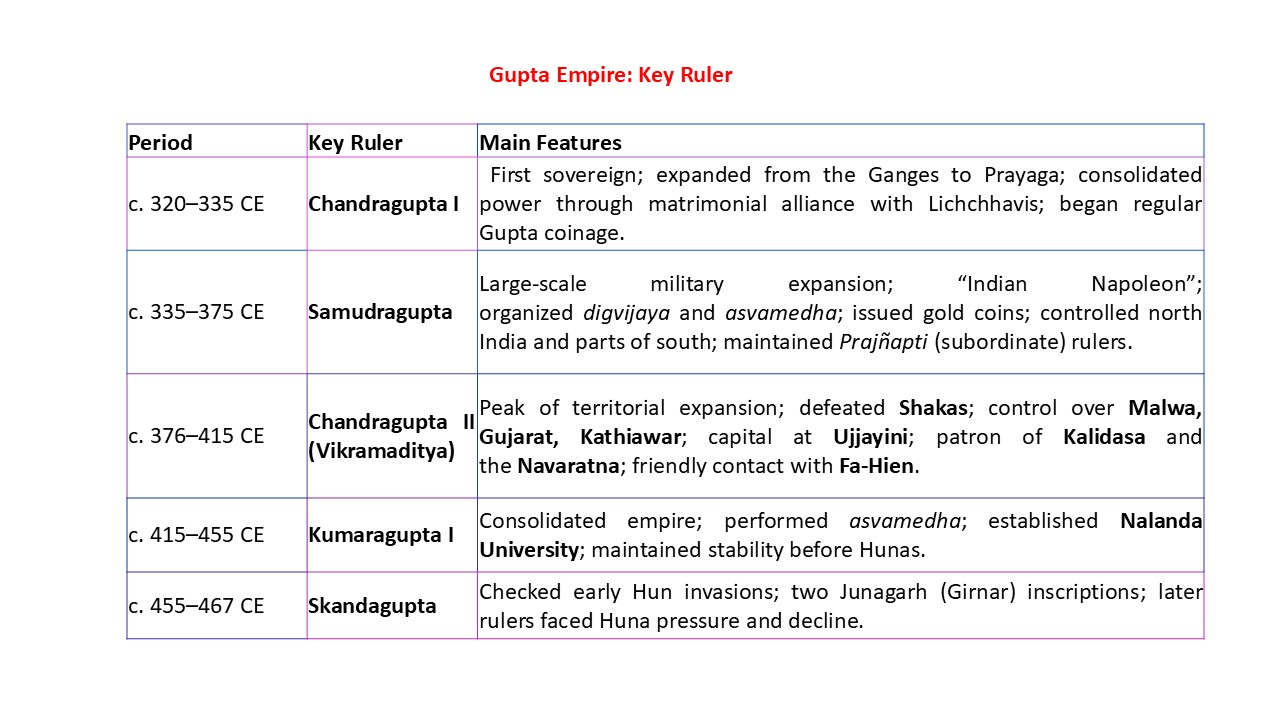
Rulers & Timeline
Chandragupta I (320-335 CE): Founded Gupta Empire through matrimonial alliance with Lichchhavi kingdom of Nepal and established hierarchical administration.
Samudragupta (335-375 CE): Conquered 21 kingdoms through military campaigns; issued Ashwamedha gold dinars depicting universal kingship.
Chandragupta II Vikramaditya (376-413/415 CE): Defeated Western Kshatrapas; presided over cultural zenith with court of nine gems (Navaratnas) including Kalidasa and Aryabhata.
Kumaragupta I (415-455 CE): Founded Nalanda University (427 CE), world’s greatest center of learning for 800 years.
Skandagupta (455-467 CE): Successfully defended against Huna invasions but depleted treasury; marked beginning of empire’s decline.
Administration & Polity

Hierarchical Structure: King → Mahanandayaka (chief justice) → Uparika (provincial governor) → Ayuktaka (district officer) → Gramapati (village headman).
Revenue Sources: Land tax (Bali), commercial tax (Sulka 2-5%), and forced labor (Visthi) were primary state income sources.
Provincial System: Empire divided into Bhuktis (provinces), Vishayas (districts), and Grama (villages) with carefully organized officials.
Military Organization: Specialized corps (elephants, cavalry, infantry) under Senapati; intelligence networks under Duta maintained security.
Judicial System: Mahanandayaka presided over courts based on Smriti texts; absence of capital punishment was noted by Fa-Hien.
Economy & Trade
Gold Dinars: Gupta coins of 85-95% gold purity were finest in ancient world; issued in largest quantities depicting diverse royal iconography.
Maritime Trade: Control of Arabian Sea ports (Broach, Tamralipti, Kalyan) facilitated trade with Roman Empire, Persia, and Southeast Asia.
Merchant Guilds: Shreni (guild) system controlled quality, pricing, and apprenticeship; Nagarasresthi (chief merchant) represented merchant interests in administration.
Agricultural Base: Gangetic plains’ fertility provided surplus supporting urban centers, administrators, and scholars.
Trade Decline: Loss of western ports to Hunas, Eastern Romans learning silk cultivation, and Mediterranean market decline reduced prosperity from 5th century.
Art, Architecture & Literature
Sarnath Buddha Head: Exemplifies Gupta sculpture’s serene expression, elegant proportion, and spiritual elevation representing classical Indian aesthetics.
Kalidasa: Supreme Sanskrit poet-dramatist; Shakuntalam recognized as world’s greatest drama; established classical literary standards.
Aryabhata (b. 476 CE): Calculated pi as 3.1416, theorized Earth’s rotation, calculated solar year as 365.3586805 days—revolutionizing mathematics and astronomy.
Ajanta & Bagh Caves: Preserve only two surviving examples of Gupta-era fresco paintings depicting Jataka tales and Buddhist narratives.
Iron Pillar of Delhi: Demonstrates metallurgical excellence—7.2 meter wrought iron pillar with minimal rust after 1600+ years.
Temple Architecture: Deogarh Vishnu Temple exemplifies early Nagara style with sanctum (garbhagriha), porch (ardhamandapa), and vertical spire (shikhara).
Religion & Philosophy
Hindu Revival: Guptas performed Ashwamedha sacrifice; granted extensive tax-free lands to Brahmanas; reinforced Vedic ritual and brahmanical authority.
Nalanda University: Founded 427 CE; housed hundreds of scholars and thousands of students; taught Buddhist philosophy, logic, medicine, astronomy, and mathematics.
Buddhist Philosophy: Nagarjuna (Madhyamaka school), Asanga & Vasubandhu (Yogacara school), Dinnaga (logic), Dharmakirti (epistemology) refined Buddhist thought.
Religious Tolerance: Guptas simultaneously patronized Hindu temples, Buddhist monasteries, and Jain temples with tax-exemptions—exemplifying unprecedented pluralism.
Brahmanical Dominance: Brahmanas elevated to supreme varna status; accumulated substantial land wealth through grants; monopolized religious authority and higher learning.
Society & Social Structure
Varna Expansion: Four varnas subdivided into numerous castes (Jati); foreign traders, tribal peoples integrated at varied caste levels; hereditary occupations enforced.
Untouchables Growth: Chandalas and untouchable groups engaged in meat trade, leather work, cremation; subject to social disabilities and prohibited from cities.
Women’s Status: High-varna women lacked independence and property rights; low-varna women had greater mobility and economic participation in agriculture.
Forced Labor (Visthi): State mandated peasant labor for roads, irrigation, fortifications without regular wages—functioned as labor-based taxation.
Guild System: Shreni controlled quality standards, pricing, apprenticeship; specialized in weavers, metalworkers, potters, oil pressers with organized hierarchy.
Decline & Causes (455-550 CE)
Huna Invasions: Toramana and Mihirakula’s invasions from 5th century onward caused continuous warfare, disrupted northwest trade routes, and drained imperial treasury.
Political Fragmentation: Skandagupta’s weak successors (Purugupta, Kumaragupta II, Buddhagupta) lost control to increasingly independent provincial governors and feudal chiefs.
Economic Collapse: Loss of western ports, disruption of silk road trade, currency debasement (reduced gold content in coins), and agricultural disruption weakened prosperity.
Feudalization Paradox: Extensive land grants to Brahmanas and officials created competing power centers, decentralizing imperial authority irreversibly.
Religious Shift: Later rulers’ shift toward Buddhism allegedly alienated traditional Brahmanical support; weakened Hindu religious legitimacy basis.
Military Exhaustion: Simultaneous defense of multiple frontiers impossible; Huna cavalry superior to Gupta chariot/elephant corps; officer demoralization from unpaid soldiers.
Multicausal Decline: Not sudden collapse but gradual fragmentation over 95-100 years resulting from interaction of Huna pressure, internal political weakness, economic disruption, and feudal decentralization.
Legacy & Influence
Administrative Model: Gupta hierarchical provincial structure adopted by subsequent dynasties (Pushyabhuti/Harsha, Pala, Pratiharas, medieval sultanates).
Sanskrit Supremacy: Gupta patronage established Sanskrit as imperial language; continued dominance through medieval period and spread to Southeast Asia.
Numismatic Unmatched: Gupta gold dinars remain unparalleled in ancient Indian coinage for artistic merit, technical quality, and iconographic innovation.
Classical Standards: Gupta sculpture (Sarnath), literature (Kalidasa), painting (Ajanta), and architecture became aesthetic template for all subsequent Indian art.
Nalanda’s Global Role: Transmitted Buddhist philosophy, Indian mathematics, and scientific knowledge to Tibet, China, Japan, Korea, and Southeast Asia for 800 years.
Intellectual Foundation: Aryabhata’s mathematics and Gupta-era astronomy influenced Islamic science and eventually European mathematics through Arabic translations.
Southeast Asian Indianization: Gupta administrative models, Sanskrit language, Hindu-Buddhist culture, temple architecture influenced Java, Cambodia, Thailand, Malaya, Vietnam.
UPSC Critical Points
Samudragupta ≠ Chandragupta II: Samudragupta maximized territorial extent (21 kingdoms); Chandragupta II maximized economic prosperity and cultural flowering.
Ashwamedha Coins: Only Samudragupta and Kumaragupta I issued horse sacrifice coins claiming universal kingship and Vedic legitimacy.
Tamralipti Port: Primary port for North Indian maritime trade during Gupta period; hub for Buddhist pilgrimage and Chinese-Southeast Asian traders.
Visthi Definition: Forced labor system where peasants provided unpaid labor for state projects—functioned as labor-based taxation extracting state resources.
Decline Complexity: Not single cause but interaction of military (Hunas), political (weak rulers), economic (trade loss), and feudal (decentralization) factors.
Nalanda Founded: 427 CE by Kumaragupta I; became world’s greatest learning center; transmitted Buddhist and scientific knowledge across Asia for 800 years.
Kalidasa Court: Flourished in Chandragupta II’s court (c. 390-410 CE); authored Shakuntalam (world’s greatest drama) and Meghaduta (pinnacle of lyric poetry).
Aryabhata Birth: 476 CE; calculated pi (3.1416), theorized Earth’s rotation, solar year (365.3586805 days)—revolutionary contributions to mathematics and astronomy.
Iron Pillar: Mehrauli Pillar near Delhi—7.2 meters, wrought iron, minimal rust after 1600 years—demonstrates Gupta metallurgical sophistication.
Religious Tolerance: Unique simultaneous patronage of Hindu, Buddhist, and Jain institutions with tax exemptions—exemplifying unprecedented religious pluralism.
Introduction: The Golden Age of India
The Gupta Empire (c. 320-550 CE) represents the classical age of ancient India, often celebrated as the “Golden Age” for its unparalleled advancements in art, literature, science, mathematics, and administration. This period witnessed the empire expand across the Indian subcontinent, establishing a sophisticated administrative apparatus that became a model for subsequent Indian kingdoms. The Guptas, originating from the fertile plains of Eastern Uttar Pradesh and Bihar, leveraged local iron ore deposits and agricultural prosperity to build a centralized imperial state that patronized intellectuals, artists, and scholars. The era was marked by religious tolerance, economic prosperity, and cultural synthesis that influenced Indian civilization for centuries. For UPSC aspirants, understanding the Gupta period is essential as it provides insights into classical Indian polity, economics, social structures, and the foundations of Hindu revival alongside Buddhist and Jain coexistence.
Part 1: Origin and Early History of the Gupta Empire
Founder and Initial Establishment
The Gupta dynasty was founded by Sri Gupta, a skilled administrator and strategist who established the initial kingdom. However, the actual expansion of the Gupta Empire into a major imperial power began under his successors. The Guptas are believed to have originally belonged to the Vaishya caste but were subsequently recognized as Kshatriyas by Brahmanical scholars, a reclassification that legitimized their rule and aligned them with the dominant political and religious order of the time.
Geographic Origin
– Primary Centers: Prayag (Allahabad, UP), Pataliputra (Patna, Bihar), and Ujjain (Avanti, MP)
– Economic Base: Eastern U.P. and Bihar regions with abundant iron ore resources
– Agricultural Advantage: Rich Gangetic plains supporting a strong agrarian economy
Dating and Chronology
The Gupta period is dated from 319-320 CE, with the empire’s territorial expansion and consolidation occurring over approximately 230 years (c. 320-550 CE). The chronology is established through epigraphic evidence, inscriptions on pillars, coins, and accounts by foreign travelers like Fa-Hien (Faxian) and later Xuanzang.
Part 2: Timeline of the Gupta Empire
| Ruler | Reign Period | Key Events & Achievements |
|---|---|---|
| Sri Gupta | c. 240–280 CE | Founder of the Gupta dynasty; laid the foundation of Gupta rule in Magadha |
| Ghatotkacha | c. 280–319 CE | Consolidated early Gupta power; limited territorial expansion |
| Chandragupta I | 319–335 CE | Formal beginning of Gupta Empire (c. 320 CE); matrimonial alliance with Lichchhavis of Nepal; expanded territory from Ganges basin to Prayag |
| Samudragupta | 335–375 CE | Greatest conqueror of the dynasty; Ashwamedha sacrifice; Allahabad Pillar inscription; subdued ~21 kingdoms; established pan-Indian political supremacy |
| Chandragupta II (Vikramaditya) | 376–413/415 CE | Defeated Western Kshatrapas (Shakas) in Gujarat & Malwa; empire at its zenith; patron of Navaratnas (Kalidasa, Aryabhata); Chinese pilgrim Faxian visited |
| Kumaragupta I | 415–455 CE | Founded Nalanda University (c. 427 CE); long and stable reign; maintained imperial unity; performed Ashwamedha sacrifice |
| Skandagupta | 455–467 CE | Successfully repelled Huna invasions; military strain led to treasury depletion; marked beginning of imperial decline |
| Later Gupta Rulers | 467–550 CE | Purugupta, Kumaragupta II, Buddhagupta, Narasimhagupta Baladitya, Vajra, Vishnugupta; internal weakness and Huna pressure; final collapse by c. 550 CE |
Part 3: Important Rulers and Their Contributions
Chandragupta I (320-335 CE): The Founder of the Empire
Chandragupta I is credited with founding the Gupta Empire in 320 CE, though the dynasty existed in name before his accession. His strategy combined military conquest with matrimonial alliances, establishing a pattern that future rulers would follow.
Key Achievements:
– Conquered and consolidated territories from the Ganges River to Prayag
– Entered into a matrimonial alliance with the Lichchhavi kingdom of Nepal, securing his northern borders and gaining legitimacy through this prestigious connection
– Established the administrative centers at Prayag, Pataliputra, and Ujjain
– Initiated the practice of granting the title Maharaja (great king) to provincial governors
– Laid the foundation for the empire’s expansion under his successors
– Issued gold coins (dinars) establishing Gupta numismatic excellence
– Set up efficient revenue administration based on land surveys
Administrative Legacy: Chandragupta I established the hierarchical administrative structure that would define Gupta governance, with the king at the apex directing provincial governors and district officials.
Samudragupta (335-375 CE): The Conqueror and Military Genius
Samudragupta is regarded as one of ancient India’s greatest military leaders and is often compared to Napoleon of India. His reign witnessed the maximum territorial expansion of the Gupta Empire, and his achievements are documented in the famous Allahabad Pillar Inscription (Prayaga Prashasti) composed by his court poet Harisena.
Military Conquests:
– North Indian Campaigns: Conquered and annexed 21 kingdoms, extending Gupta dominion from the Himalayan foothills to the Deccan
– Southern Campaigns: His influence extended over kingdoms in Karnataka, Andhra Pradesh, and Tamil Nadu, though he did not directly annex southern territories but established suzerainty
– Eastern Campaigns: Conquered Bengal and Assam, bringing them under direct Gupta control
– Western Expansion: Extended control over Kathiawar and parts of Rajasthan
– Coastal Dominance: Established naval supremacy, controlling maritime trade routes
Administrative Achievements:
– Issued the Ashwamedha (horse sacrifice) gold dinars, depicting him performing the vedic ritual, symbolizing his role as a universal monarch and restorer of Vedic order
– Adopted grandiose titles: Samrat (emperor), Chakravartin (universal ruler), and Maharajadhiraja (king of kings)
– Organized the empire into provinces headed by governors with varying degrees of autonomy
– Established an efficient intelligence network for imperial security
Cultural Patronage:
– Supported arts and learning; patronized scholars and poets
– Issued coins of exceptional artistic merit, depicting various themes including military exploits and religious devotion
– Commissioned the Allahabad Pillar inscription, a masterpiece of classical Sanskrit
Legacy: Samudragupta’s reign represented the zenith of Gupta military power and territorial extent. His administrative model of controlling diverse kingdoms through military might combined with diplomatic relations became the template for later Indian empires.
Chandragupta II Vikramaditya (376-413/415 CE): The Golden Age Personified
Chandragupta II, also known by the title Vikramaditya (meaning “sun of valor”), presided over the Gupta Empire during its cultural and intellectual zenith. His reign is considered the epitome of the “Golden Age,” characterized by unprecedented prosperity, cultural achievements, and intellectual advancement.
Military and Political Achievements:
– Defeated the Western Kshatrapas (Shakas) in Gujarat and Malwa, eliminating the last major rival power in northern India
– Secured control of the Arabian Sea ports, boosting maritime trade with the Roman Empire and Southeast Asia
– Established matrimonial alliances through his daughter Prabhavati Gupta, who married the Vakataka ruler Rudrasena II, creating a powerful alliance network
– Adopted the title Vikramaditya, previously used only by a king of Ujjain who defeated the Sakas in 58 BCE, symbolizing his position as the ultimate victor over the Shakas
– Titles: Simhavikrama (lion-valorous), Vikramanka (mark of valor), Akalavara (timely warrior)
Economic Expansion:
– Issued gold, silver, and copper coins in abundant quantities, reflecting economic prosperity
– Minted silver denarees and copper dalers specifically for the newly acquired Gujarat and Kathiawar regions to facilitate trade
– Promoted trade routes and commerce, establishing India as the center of Asian trade
Intellectual and Cultural Achievements:
– Court of Nine Gems (Navaratnas): Patronized nine greatest scholars, artists, and poets of the time, including:
– Kalidasa – the greatest Sanskrit poet and dramatist, author of Shakuntalam and Meghaduta
– Aryabhata – the mathematician and astronomer who discovered the value of pi, calculated the solar year accurately, and theorized that Earth rotates on its axis
– Varahamihira – astronomer and mathematician, author of Brihat Samhita
– Vararuci – grammarian
– Other luminaries in various fields of knowledge
Diplomatic Achievements:
– The Chinese traveler Fa-Hien (Faxian) visited India during his reign (c. 399-412 CE), providing eyewitness accounts of Gupta prosperity, administration, and tolerance
– Established trade and diplomatic relations with the Eastern Roman Empire, Southeast Asian kingdoms, and China
– His reign facilitated the spread of Indian culture and Buddhism to Southeast Asia and East Asia
Administrative Innovations:
– Refined the administrative structure established by his predecessors
– Implemented extensive land grants to Brahmanas and religious institutions, a policy that had far-reaching social and economic consequences
– Promoted Sanskrit culture as the language of elite and administration
Legacy: Chandragupta II’s reign represented the apogee of Gupta prosperity, combining military success, economic prosperity, intellectual achievement, and cultural flowering. His court became a beacon of learning that attracted scholars from across Asia.
Kumaragupta I (415-455 CE): The Reformer and Educator
Kumaragupta I continued the prosperity and stability established by his predecessors, though his long reign also witnessed the beginning of external threats that would eventually destabilize the empire.
Key Achievements:
– Founded Nalanda University (c. 427 CE), establishing what would become the world’s greatest center of learning for nearly 800 years, attracting scholars and students from across Asia
– Assumed titles Mahendra (great Indra), Mahendraditya, and Ashvamedha Parakrama (victorious in horse sacrifice)
– Performed the Ashwamedha sacrifice, issuing commemorative gold dinars depicting the ritual, reinforcing his position as a Vedic monarch
– Maintained territorial integrity despite initial Huna raids during the latter part of his reign
– Issued the largest variety of gold and silver coins, indicating economic prosperity and diverse administrative regions
– Patronized arts and learning; supported construction of temples and monasteries
Military and Administrative Achievements:
– Defended the empire against initial Huna incursions under Toramana, though he could not prevent their eventual establishment in northwestern provinces
– Maintained efficient provincial administration and land revenue collection
– Encouraged agricultural innovation and land reclamation through Brahmanical settlements
Educational and Cultural Impact:
– Nalanda University under his patronage became the undisputed center of Mahayana Buddhist learning and also taught Vedic studies, logic, medicine, astronomy, mathematics, and philosophy
– Hosted renowned scholars like Aryabhata, who is believed to have taught at Nalanda
– Facilitated the transmission of Indian knowledge to Tibet, China, Japan, Korea, and Southeast Asia through Buddhist pilgrims
Economic Challenges:
– Faced debasement of currency (reduction in gold content of coins) during the later years of his reign due to Huna pressures and treasury depletion
– This monetary decline foreshadowed the empire’s eventual economic weakening
Legacy: Kumaragupta I balanced military defense with cultural and educational advancement. His establishment of Nalanda University became his most enduring contribution, transcending the empire’s political decline and continuing to influence Asian intellectual history for centuries.
Skandagupta (455-467 CE): The Last Great Warrior and Beginning of Decline
Skandagupta, the grandson of Chandragupta II, represents the final flourish of Gupta military power before the empire’s rapid fragmentation.
Military Achievements:
– Defended the empire vigorously against Huna invasions, particularly under Toramana and Mihirakula
– Repaired and rebuilt fortifications and administrative centers damaged by Huna raids
– Issued coins depicting martial prowess and victory
– Adopted title Kramaditya (victor in succession/battle)
– An inscription at Junagarh (Girnar) records his governor’s successful restoration of irrigation works damaged during Huna invasions
Military Challenges:
– Despite initial success, the constant warfare drained the imperial treasury
– The empire’s military resources were insufficient to simultaneously defend all frontiers
– Huna forces successfully established themselves in Gandhara, Punjab, and parts of Gujarat and Malwa
Administrative Decline:
– Skandagupta’s aggressive military policies and depleted resources marked the beginning of imperial decline
– His successors were significantly weaker, unable to maintain Gupta authority
– Historical accounts suggest his conduct became increasingly vicious, alienating local chiefs and officials
Legacy: Skandagupta’s reign marks the transition from the Gupta Empire’s age of expansion and prosperity to one of contraction and fragmentation. While he temporarily arrested the Huna advance, he could not reverse the fundamental weakening of imperial authority.
Later Rulers and the Decline Phase (467-550 CE)
Following Skandagupta, the Gupta Empire was ruled by a series of increasingly weak rulers:
– Purugupta, Kumaragupta II, Buddhagupta, Narasimhagupta Baladitya, Vajra, and Vishnugupta
Key Characteristics of This Period:
– Loss of territorial control to Huna kingdoms and regional powers
– Fragmentation into provincial states as governors became increasingly independent
– Economic decline due to loss of trade routes and agricultural disruption
– Military weakness as central authority could not maintain a strong defense
– Religious shift toward Buddhism among some later rulers, which may have alienated traditional Brahmanical support
By 550 CE, the Gupta Empire had ceased to exist as a unified political entity, though Gupta cultural, administrative, and religious influences continued to shape subsequent Indian kingdoms.
Part 4: Territory and Extent of the Gupta Empire
Geographic Expansion Over Time
Under Chandragupta I (320-335 CE):
– Core territories: Central India, Gangetic plains, parts of eastern India
– Extent: Ganges to Prayag in the east-west axis; Himalayan foothills to central India in the north-south axis
Under Samudragupta (335-375 CE) – Maximum Territorial Extent:
– North India: Complete control from the Himalayan foothills to the Narmada River
– Eastern India: Bengal, Odisha (Odisha), Assam, and eastern regions
– Deccan: Suzerainty over kingdoms in Karnataka and Andhra Pradesh (not direct annexation)
– Western India: Control over western Malwa and parts of Rajasthan
– Southern Influence: Extended influence over kingdoms in Tamil Nadu and the Deccan without direct control
Under Chandragupta II (376-413/415 CE):
– Addition of Gujarat and Malwa: Defeated the Western Kshatrapas, bringing Gujarat and western Malwa under direct Gupta control
– Arabian Sea Ports: Established control over Broach (Barygaza) and other ports, critical for maritime trade
– Maximum Economic Reach: While territorial extent under Samudragupta was greater, economic control and prosperity was highest under Chandragupta II
The Four Regional Centers of Power
1. Prayag (Allahabad, Uttar Pradesh): Sacred and administrative center; site of famous Allahabad Pillar with Samudragupta’s inscriptions
2. Pataliputra (Patna, Bihar): Capital city; administrative headquarters; ancient seat of Mauryan power
3. Ujjain (Avanti, Madhya Pradesh): Cultural and commercial center; hub of trade routes
4. Mathura (Uttar Pradesh): Religious and artistic center; major center of Gupta sculpture
Trade Routes and Economic Geography
– Land Routes: Control of the Silk Road routes to Central Asia and China
– Maritime Routes: Arabian Sea ports facilitating trade with the Roman Empire, Persia, and Southeast Asia
– River Networks: Control of Ganges, Brahmaputra, and Godavari river systems for internal trade and communication
Important Ports and Trading Centers
| Port / City | Location | Trade Importance |
|---|---|---|
| Broach (Barygaza) | Gujarat (mouth of Narmada) | Major Indo-Roman trade port; export of textiles, spices, ivory; mentioned in Periplus of the Erythraean Sea |
| Tamralipti | Bengal coast (near modern Tamluk, WB) | Principal port of eastern India; North Indian trade outlet; major Buddhist pilgrimage and maritime link to Southeast Asia |
| Kalyan | Western coast (near Mumbai, Maharashtra) | Important Arabian Sea gateway; active in coastal and overseas trade |
| Ghantasala | Andhra coast (Krishna delta) | Key port for foreign trade; maritime contact with Southeast Asia |
| Ujjain | Central India (Malwa region) | Major inland trade hub; junction of north–south and east–west land routes; connected riverine trade |
Part 5: Gupta Polity and Administration
The Gupta administrative system represented one of ancient India’s most sophisticated governmental structures. The empire was organized hierarchically, with the king at the apex and authority delegating downward through provincial governors, district officials, and village headmen.
The Royal Court and King’s Authority
Status and Titles of the Monarch:
– The king held divine status, considered an earthly manifestation of God
– Primary titles: Paramabhattaraka (supreme overlord), Paramesvara (supreme lord), Samrat (emperor), Chakravartin (universal ruler)
– The king was the supreme source of justice, law, and authority
The Royal Palace Hierarchy:
– Mahapratihara (chief of palace guards): Responsible for palace security and ceremonial functions
– Pratihara (ceremonial overseer): Managed court ceremonies and royal protocol
– Duta (ambassador): Handled diplomatic relations and intelligence
– Various other officials managing specific domains (treasury, military, justice)
Council of Ministers and Central Administration
Mahanandanayaka (Chief Justice)
Mahasandhivigrahika (Minister of Peace and War):
Revenue and Financial Officials:
– Akshapataladhikrita: Oversaw account registers and royal treasury; prevented financial misconduct
– Pustapala: Maintained records, verified transactions, and ensured accurate documentation
– Samaharta: Chief revenue officer responsible for tax collection
Military Officials:
– Mahabaladhikrita: High-ranking military commander
– Senapati: Commander-in-chief of the army
– Specialized commanders: Pilupati (elephant corps), Asvapati (cavalry), Narapati (infantry)
Provincial Administration
Three-Tier Territorial Division:
1. Bhuktis (Provinces):
– Largest administrative units
– Headed by Uparika (provincial governor), directly appointed by the king
– Governed with significant autonomy but under imperial oversight
– In Bengal, provinces were called Mandala
2. Vishayas (Districts):
– Subdivisions within provinces
– Managed by Ayuktaka or Vishayapati (district officer), appointed by provincial governors
– Responsible for local administration, tax collection, and justice
– Typical district included 100-200 villages
3. Villages (Grama):
– Basic administrative unit
– Headed by Gramapati or Gramadhyaksha (village headman)
– In North Bengal: Astakuladhikrana system, which included village representatives (Gramikas, Kutumbis, Mahattaras)
Provincial Administrative Council (Adhikarana) in Bengal:
The adhikarana system exemplifies the sophistication of Gupta administration:
– Nagarasresthi (chief merchant): Represented commercial interests
– Sarthavaha (caravan master): Managed trade caravans and merchant associations
– Prathama Kulika (artisan head): Represented craftspeople and guilds
– Prathama Kayastha (scribe chief): Managed records and documentation
– Pustapala (record keeper): Maintained official documents
These officials collectively managed provincial affairs, ensuring representation of diverse social groups.
Military Organization
The Gupta military was highly organized and specialized:
Command Structure:
– Senapati: Commander-in-chief, reports directly to the king
– Mahabaladhikrita: High-ranking military officers overseeing overall military operations
– Specialized Corps Commanders:
– Pilupati: Elephant corps commander
– Asvapati: Cavalry commander
– Narapati: Infantry commander
– Other specialists for navy, chariot corps, and siege warfare
Logistics and Support:
– Ranabhandagarika: Military supply officer responsible for provisions, weapons, and soldier welfare
– Bhatasvamin: Officer managing barracks and military cantonment
– Military factories and armories maintained by specialized officials
Intelligence and Espionage:
– Operational intelligence network under Dutaka (messenger/spy)
– Reports directly to the king and central ministers
– Maintained security against internal rebellions and external threats
Revenue Administration
The Gupta revenue system was efficient and comprehensive, generating substantial state income:
Land Revenue (Primary Source):
– Bali (land tax): Main form of revenue, assessed on agricultural produce
– Typically amounted to 1/6th to 1/4th of the produce, depending on fertility and regional conditions
– Collected by district and provincial officials through Akshatapaladhikrita
Commercial Taxes:
– Sulka (merchant tax): Duty levied on goods during intercity trade, typically 2-5% of value
– Applied to textiles, oils, spices, metals, and other valuable commodities
– Collected at trading centers and ports
Specialized Taxes:
– Uparikara (commodity tax): Specific tax on certain products like textiles and oils
– Hadamana: Tax on cattle and livestock
– Visthi (forced labor): Peasants could be required to provide labor for state projects (roads, irrigation, fortifications)
Royal Income from Non-Tax Sources:
– Profits from royal estates and farms
– Treasure troves and mineral extraction (particularly iron ore)
– Salt production monopoly
– Woodlands and forests
– Fines and judicial penalties
Financial Management:
– Regular audits by Pustapala to verify collections and prevent corruption
– Detailed account registers maintained by Akshapataladhikrita
– Records preserved on palm leaves and birch bark in multiple copies
Judicial System
Hierarchy of Courts:
– Royal Court (Chakravartini): King serves as supreme judge for high-profile cases
– Mahanandanayaka’s Court: Chief justice’s court handling major disputes and appeals
– Uparika’s Court: Provincial court for important cases
– Ayuktaka’s Court: District court for routine disputes
– Village Council (Grama-buddhas): Elders resolved local disputes
Principles of Justice:
– Laws based on Smriti texts (Manusmriti, Yajnavalkya Smriti, Narada Smriti)
– Consideration of custom and usage specific to regions and communities
– Proportionate punishment for different social classes (Varna system)
– Appeals allowed from lower courts to higher courts
– Absence of capital punishment under normal circumstances (noted by Fa-Hien)
Legal Innovations:
– Recognition of women’s property rights, particularly regarding gifts received during marriage (Stri-dhan)
– Written contracts for business transactions
– Guild regulation of crafts and commerce
Part 6: Gupta Empire Economy
The Gupta period witnessed unprecedented economic prosperity, driven by agricultural productivity, extensive trade networks, skilled craftspeople, and efficient administration. This economic strength was foundational to the empire’s cultural and intellectual achievements.
Agricultural Economy
Primary Economic Base:
– The Gangetic plains provided fertile soil for cultivation of rice, wheat, barley, millet, and pulses
– Regular monsoons and efficient irrigation systems ensured consistent harvests
– Agricultural surplus supported urban centers, administrators, scholars, and artisans
Irrigation System:
– Maintenance and expansion of ancient canal networks
– Construction of tanks (artificial reservoirs) and wells
– Junagarh inscription records restoration of irrigation works damaged by Huna invasions
– Agricultural productivity increased due to Brahmanical settlers clearing forests and bringing land under cultivation
Land Grants and Feudalization:
– Extensive grants of land to Brahmanas and religious institutions, documented in numerous inscriptions and copper plates
– These grants were tax-free or tax-reduced, strengthening the Brahmanical class
– Unintended consequence: Rise of priestly landlords and feudal system, reducing status of peasants
– Forced labor (Visthi) imposed on peasants in central and western regions for land clearance and construction
Coinage and Monetary System
Gold Coinage (Dinars) – The Gold Standard:
The Gupta period is renowned for numismatic excellence, with gold dinars representing the highest achievement in ancient Indian coinage
Specifications and Quality:
– Weight and Purity: Gold dinars were struck with remarkable uniformity, indicating state control and standardization
– Purity: Approximately 85-95% gold, slightly less than Kushan coins but still very high
– Artistry: Exceptional artistic merit with deep reliefs, elegant proportions, and refined execution
– Iconography: Depicted kings in various poses (standing, riding, hunting, worshipping) and goddesses representing royal authority and divine sanction
Extent of Circulation:
– Gold dinars served as currency for major transactions, military payments, and administrative salaries
– Used for land transactions, noble appointments, and trade with distant regions
– Archaeological finds indicate circulation in Southeast Asia and maritime trade regions
– One of the largest quantities of gold coins issued by any ancient Indian dynasty
Silver and Copper Coinage:
– Silver denarees minted by Chandragupta II and later rulers for regional trade, particularly in newly conquered Gujarat and Kathiawar
– Copper dalers issued in limited quantities for local transactions
– Reduced use of copper coins compared to Kushans
Decline in Coinage Quality:
– By the reign of Skandagupta and later, gold content in coins decreased due to treasury depletion and military expenses
– Shift toward silver-plated copper coins
– Visual decline in artistic execution and weight uniformity reflected political instability
Trade and Commerce
Internal Trade Networks:
– Well-developed overland and river trade routes connecting major cities and ports
– Guild system (Shreni) organized merchants, craftspeople, and traders
– Merchant associations (Sarthavaha) managed long-distance caravans
– Standardized weights and measures facilitated commerce
External Trade Routes:
1. Silk Road (Overland to Central Asia and China):
– Exports: Spices, textiles, gems, metals, iron, perfumes
– Imports: Silk, horses, jade, fur
– Gupta merchants and Buddhist pilgrims traveled these routes extensively
2. Maritime Trade (Arabian Sea):
– Major Ports: Broach (Barygaza), Tamralipti, Kalyan, Ghantasala
– Eastern Roman Empire Trade: India exported spices, textiles, and gems; imported wine, glass, Mediterranean goods
– Southeast Asian Trade: Extensive commercial and cultural exchange
3. Trade with East Asia:
– China: Silk, porcelain, tea
– Facilitated by Buddhist pilgrims traveling along Silk Road
– Gupta merchants established trading posts in Southeast Asia
Trading Partners:
– Eastern Roman (Byzantine) Empire: Major importer of Indian spices and textiles
– Persia: Intermediary in trade with Central Asia and Mediterranean
– Southeast Asia (Java, Sumatra, Malaya): Growing market for Indian goods and culture
– China: Increasing trade during later Gupta period
Trade Decline Factors (Later Period):
– Loss of control over western ports to Huna invasions
– Western Roman Empire’s fall (476 CE) reduced demand for Indian luxuries in Mediterranean
– Eastern Romans learned silk cultivation from China, reducing India’s monopoly
– Gradual shift of maritime trade routes to Persian and Arab intermediaries
– Migration of silk weavers from Gujarat to Mandasor in Malwa due to weakened demand
Merchant Guilds and Crafts
Guild Organization (Shreni System):
– Well-organized guilds for weavers, potters, metalworkers, jewelers, carpenters, and oil pressers
– Guilds controlled quality standards, pricing, and apprenticeship
– Sarthavaha (caravan chief) headed merchant associations
– Nagarasresthi (chief merchant) represented merchant interests in provincial administration
Major Craft Centers:
– Mathura: Center for sculpture, particularly Buddha images and Hindu deities
– Sarnath: Renowned for Buddha sculptures of exceptional quality
– Ujjain: Hub for luxury goods (textiles, perfumes, gems)
– Varanasi: Textiles, particularly silk and cotton
– Western India: Centers of metalworking and gem cutting
Craft Products:
– Textiles: Silks, cottons, and fine linens; major export commodity
– Metalwork: Iron, copper, brass, and gold items; iron working of exceptional quality (Iron Pillar of Delhi)
– Ceramics: High-quality pottery and tiles
– Gems and Jewelry: Semi-precious and precious stone work
– Perfumes and Incense: Aromatic goods for domestic and export markets
Decline in Long-Distance Trade
Despite the empire’s prosperity, the Gupta period witnessed a relative decline in long-distance maritime trade compared to the Kushans:
– Reduction in Roman demand as the Eastern Roman Empire became economically weaker
– Loss of Silk Road trade dominance to Persian and Arab intermediaries
– Decreased export of Indian silk after Eastern Romans learned cultivating silkworms
– Fragmentation of the empire after 467 CE disrupted trade routes and reduced access to ports
Part 7: Art and Architecture of the Gupta Period
The Gupta period represents the classical peak of Indian art, establishing aesthetic standards and artistic conventions that influenced Indian art for centuries. Gupta art is characterized by grace, elegance, sophisticated proportion, and refined execution – a style termed “classical decorum.”
Sculpture: The Crown of Gupta Art
Major Sculptural Centers:
1. Mathura School:
– Known for red sandstone sculptures in the Greco-Buddhist tradition
– Produced images of Buddha, Hindu deities, and Jain Tirthankaras
– Characterized by robust forms and dynamic poses
– Notable works: Buddha images, Vishnu and Lakshmi figures, yaksha and yakshi sculptures
2. Sarnath School:
– Developed white stone (sandstone) sculpture tradition
– Renowned for serene and spiritually elevated Buddha images
– Figures characterized by gentle expression, spiritual tranquility, and refined proportions
– The Buddha Head from Sarnath is among the finest examples of classical Indian sculpture
– Pillar Capital with four lions became inspiration for India’s national emblem
3. Other Important Centers:
– Benares: Specialized in Shaiva sculptures and ritual images
– Western India: Centers in Gujarat and Rajasthan producing fine sculptures
– Bengal: Buddhist sculptural tradition influenced by Sarnath school
Characteristics of Gupta Sculpture:
| Feature | Description |
|---|---|
| Material | Red sandstone (Mathura), white sandstone (Sarnath), alabaster in western regions |
| Technique | High relief to full round sculpture; excellent understanding of anatomy and proportion |
| Proportions | Ideal proportions based on mathematical ratios and established aesthetic canons |
| Expression | Serene, peaceful, spiritually elevated; free from exaggerated emotions |
| Iconography | Hindu deities in characteristic poses; Buddha in meditation and teaching poses; Jain Tirthankaras |
| Details | Intricate treatment of drapery, jewelry, ornaments, and hair with great attention to minute details |
| Finish | Smoothly polished surfaces, subtle modeling, and sophisticated shading |
Major Sculptural Themes:
1. Buddha Images:
– Seated Buddha in meditation and teaching poses
– Standing Buddha figures with hand gestures (mudras) indicating blessings or fearlessness
– Spiritual tranquility evident in facial expression
– The Sarnath Buddha head exemplifies serene expression and elegant proportion
2. Hindu Deities:
– Vishnu and Avatars: Vishnu with standard attributes, Krishna figures, Rama
– Shiva: In meditation, dancing (nataraja postures emerging in later Gupta period), with family groups
– Lakshmi: Goddess of wealth and prosperity, often depicted with attendants
– Durga: Goddess defeating buffalo demon, warrior iconography
3. Jain Tirthankaras:
– Twenty-four Jain saints represented in characteristic standing and seated poses
– Distinguished by specific hair styles, hand gestures, and accompanying symbols
4. Secular Figures:
– Yaksha and Yakshi (divine spirits) depicting beauty and prosperity
– Royal portraits and commemorative sculptures
– Donor portraits in temple inscriptions
Influence and Legacy:
– Gupta sculptural style became the template for classical Indian sculpture
– Transmitted to Southeast Asia, Java, and Indonesia through Buddhist connections
– Influenced later dynasties (Chalukyas, Pallavas, Cholas) in their sculptural traditions
– Established aesthetic standards that defined “Indian beauty” in art
Temple Architecture: Formative Period
The Gupta period witnessed the emergence of structural temple architecture, establishing templates for later Hindu temple design.
Early Structural Temples:

1. Deogarh Temple (Uttar Pradesh):
– Vishnu Temple dating to 5th century CE
– Features: Simple sanctum (garbhagriha), entrance porch (ardhamandapa), and pillared assembly hall
– Richly carved exterior with panels depicting mythological scenes
– Represents early example of North Indian (Nagara) temple architecture
2. Sanchi Temple (Madhya Pradesh):
– Vishnu Temple, though primarily known for stupas from earlier periods
– Demonstrates transition from wooden to stone construction

3. Udayeshwar Temple (Udaypur, Vidisha):
– Early Nagara style temple with vertical spire
– Incorporates principles that would define later North Indian temple architecture
Characteristics of Early Gupta Temple Architecture:
– Simple plan: Central sanctum (garbhagriha) containing deity image
– Vertical emphasis: Spire (shikhara) rising above sanctum, emphasizing transcendence
– Decorated exteriors: Lavishly carved panels depicting gods, goddesses, mythological narratives
– Porches and halls: Antechambers and assembly halls for rituals and congregation
– Stone construction: Shift from wood to stone enabling greater durability and complexity
Buddhist Architecture:
– Stupas continued from earlier tradition, though some renovation and expansion occurred
– Viharas (monasteries): Stone-built monasteries replacing wooden structures
– Chaitya halls: Prayer halls with Buddha images replacing aniconic stupas
– Ajanta and Ellora Caves: Associated with Gupta cultural influence (though patronage involved various rulers)
Architectural Principles:
– Harmony and proportion: Mathematical ratios determining structural and aesthetic balance
– Integration of sculpture: Architecture and sculpture unified in creating religious experience
– Orientation and symbolism: Temples oriented to cardinal directions with cosmic symbolism
– Acoustic design: Interior spaces designed for ritual chanting and acoustic effects
Painting: Gupta Artistic Excellence
Ajanta Caves Paintings:
The Ajanta Caves preserve some of the finest examples of Indian classical painting, though patronage involved multiple rulers and dynasties over several centuries. Gupta cultural influence is evident in the paintings’ style and technique.
Characteristics:
– Tempera technique: Colors applied on plaster surface using natural pigments (ochre, indigo, vermillion)
– Color palette: Rich, varied colors with sophisticated shading and modeling
– Composition: Narrative scenes from Buddhist texts (Jataka tales) and the life of Buddha
– Perspective: Early perspective techniques with overlapping figures indicating depth
– Human figures: Graceful, elegant proportions; expressive faces; graceful postures
– Detail work: Intricate patterns on clothing, jewelry, architectural elements
Themes Depicted:
– Jataka Tales: Previous lives of Buddha illustrating moral lessons
– Buddha’s Life: Birth, enlightenment, teaching, and parinirvana
– Bodhisattvas: Divine beings assisting in salvation
– Lay Donors: Wealthy patrons and merchants, indicating trade connections
– Flora and Fauna: Detailed depiction of plants, animals, and natural scenes
Bagh Caves Paintings:
– Located in central India, Bagh Caves preserve another important site of Gupta-era painting
– Similar technique and themes to Ajanta, though in less pristine condition
– Represents spread of Gupta artistic influences across the subcontinent
Technical Innovation:
– Development of fresco and tempera techniques combining water-based and pigment application
– Underpainting and sketching visible in some sections, indicating careful planning
– Color chemistry: Sophisticated understanding of pigments and their durability
– Perspective and proportion: Mathematical basis for figure proportions and spatial relationships
Influence on Later Art:
– Established the classical Indian painting tradition followed in later cave temples and courts
– Transmitted to Southeast Asian art through Buddhist connections
– Influenced Mughal and later Indian miniature painting through artistic principles
Minor Arts and Crafts

Metalwork:
1. Iron Work – The Iron Pillar:
– Located near Delhi, the Iron Pillar of Delhi (Mehrauli Pillar) stands as testament to Gupta metallurgical excellence
– Height: 7.2 meters; Weight: Approximately 6 tons
– Composition: High-quality wrought iron with minimal rust despite 1600+ years
– Inscription: Commemorates Chandragupta II’s victories and attributes
– Demonstrates sophisticated iron ore processing, smelting, and forging techniques
– Indicates knowledge of metallurgy, composition control, and anti-corrosive properties
2. Gold and Silver Jewelry:
– Gold ornaments: Necklaces, bracelets, rings, and ear ornaments of exceptional craftsmanship
– Silver vessels: Plates, bowls, and ritual vessels with detailed relief work
– Gem setting: Sophisticated techniques for setting precious and semi-precious stones
– Archaeological finds indicate high standards of artisanal skill
3. Bronze Sculptures:
– Bronze casting of exceptional quality for religious and secular figures
– Lost-wax casting technique producing fine details
– Particularly renowned for Shiva and Buddha bronzes
Textiles:
– Silk production and weaving: Center of silk textile production, though inferior to Chinese silk
– Cotton textiles: Fine muslin and cotton fabrics, major export commodity
– Dyeing techniques: Sophisticated understanding of natural dyes and color fastness
– Patterns and designs: Geometric and floral patterns influenced by Greco-Roman and Persian designs
Ceramics and Pottery:
– Terra-cotta sculptures: Small figurines of exceptional artistic quality
– Wheel-thrown pottery: Functional wares of refined form
– Red polished ware: High-quality ceramics with glossy finish
– Ritual vessels: Specially designed pottery for religious ceremonies
Glass Work:
– Beads and ornaments: High-quality glass work, possibly influenced by Roman techniques
– Vessels: Drinking vessels and decorative items
– Indicates sophisticated glass-making knowledge and trade connections with Roman Empire
Part 8: Literature and Learning
The Gupta period stands as one of history’s greatest ages of intellectual achievement and literary creativity. Sanskrit literature reached its classical perfection, and scientific knowledge advanced dramatically under imperial patronage.
Sanskrit Literature: The Golden Age
Kalidasa: The Supreme Poet
Kalidasa (c. 375-415 CE) was the greatest Sanskrit poet and dramatist, whose works represent the pinnacle of classical Sanskrit literature. He flourished in the court of Chandragupta II, one of the “nine gems” (Navaratnas) of that magnificent court.
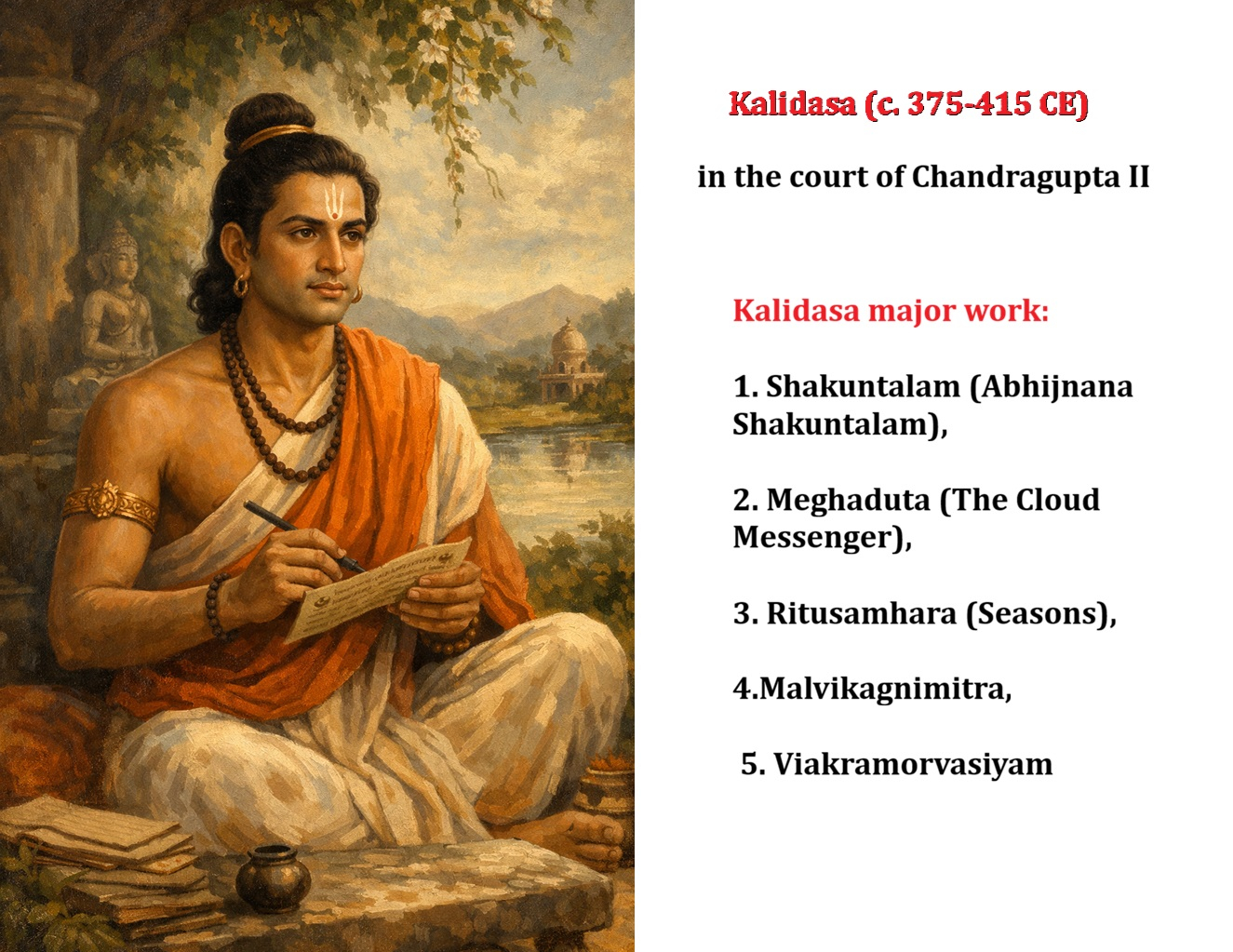
Major Works: Shakuntalam (Abhijnana Shakuntalam), Meghaduta (The Cloud Messenger), Ritusamhara (Seasons), Malvikagnimitra, Viakramorvasiyam
1. Shakuntalam (Abhijnana Shakuntalam):
– A play in seven acts (probably reduced from original form)
– Plot: Love story of King Dushyanta and the maiden Shakuntala, separated and reunited through divine intervention
– Themes: Love, duty, divine grace, separation and reunion
– Literary Significance: Considered one of the finest works of world literature; acclaimed for its poetry, dramatic construction, and emotional depth
– Influence: Translated into numerous languages; influenced European Romanticism when discovered in 18th century
2. Meghaduta (The Cloud Messenger):
– An akavya (lyric poem) of 120 verses
– Form: Monologue of a lovelorn yaksha (divine spirit) requesting a cloud to carry message to his beloved
– Literary Innovation: Uses the journey of cloud across geographical regions as poetic framework
– Poetic Excellence: Renowned for lyrical beauty, sophisticated imagery, and musical quality of Sanskrit verse
– Demonstrates unparalleled mastery of Sanskrit grammar and vocabulary
3. Ritusamhara (Seasons):
– Poem describing the six seasons and their effects on nature and human emotions
– Employs erotic sentiment (shringar rasa) as primary emotional tone
– Demonstrates sophisticated understanding of aesthetic theories
4. Malvikagnimitra:
– Drama depicting the love of King Agnimitra for the servant girl Malavika
– Political themes: Duty, loyalty, and governance
– Theatrical sophistication in plot construction
5. Viakramorvasiyam:
– Drama with mythological theme
– Explores themes of desire, virtue, and divine will
Literary Influence:
– Established the classical standard for Sanskrit dramatic and poetic composition
– Influenced all subsequent Sanskrit literature and served as model for dramatists and poets
– Works translated into Chinese, Arabic, European languages; influenced global literature
– Established aesthetic principles (rasa – sentiment, alankara – figures of speech) that became foundational to Indian literary criticism
Theory of multiple Kālidāsas
Some scholars, including M. Srinivasachariar and T. S. Narayana Sastri, believe that works attributed to "Kālidāsa" are not by a single person. According to Srinivasachariar, writers from 8th and 9th centuries hint at the existence of three noted literary figures who share the name Kālidāsa. These writers include Devendra (author of Kavi-Kalpa-Latā), Rājaśekhara and Abhinanda. Sastri lists the works of these three Kalidasas as follows:
Aryabhata: The Mathematician and Astronomer 

Aryabhata (born 476 CE, flourished 499 CE) was one of ancient India’s greatest mathematicians and astronomers, whose contributions transformed mathematical and scientific thought.
Major Work: Aryabhatiya
A mathematical and astronomical text of 123 verses covering:
Mathematical Contributions:
1. Zero and Decimal System: Aryabhata used a place-value system with zero, foundational to modern mathematics
2. Value of Pi (π): Calculated pi as approximately 3.1416, extraordinarily accurate for the 5th century
3. Trigonometric Functions: Developed early sine values and trigonometric ratios for astronomical calculations
4. Algebra: Advanced algebraic techniques and equations
5. Square and Cube Roots: Methods for calculating square and cube roots
Astronomical Contributions:
1. Rotation of Earth: Theorized that the Earth rotates on its own axis, not the celestial sphere moving around static Earth (revolutionary for the time)
2. Solar Year Calculation: Calculated the solar year as 365.3586805 days – astonishingly accurate, differing from modern measurements by only 3 minutes
3. Lunar and Solar Eclipses: Explained eclipses as phenomena of shadow and light, not divine events
4. Planetary Motion: Calculated motions of planets relative to Earth
5. Celestial Coordinates: Established system for determining positions of celestial bodies
Scientific Method:
– Combined observation, calculation, and mathematical reasoning
– Moved from mythological explanations to rational, scientific understanding
– Established model for subsequent Indian astronomical work
Legacy:
– His work was translated into Arabic (Al-Khwarizmi’s Arzand) and transmitted to Islamic world
– Influenced development of algebra and trigonometry in Islamic mathematics
– His methods became standard in Islamic and medieval European astronomy
– Recognized as father of Indian mathematics and pivotal figure in history of science
Varahamihira: Astronomer and Mathematician
Varahamihira (505-587 CE) was a later Gupta-era astronomer whose major work was:
Brihat Samhita (Great Compilation):
– Comprehensive text covering astronomy, astrology, weather forecasting, architecture, medicine, and alchemy
– Advanced astronomical calculations and observations
– Practical applications for agriculture, building construction, and medicine
– Influenced Islamic and European science
Other Notable Scholars and Writers
Bhartrihari:
– Grammarian and poet of uncertain dating (possibly 5th century)
– Compiled linguistic theories and poetic compositions
– Work on Sanskrit grammar helped standardize the language
Vararuci:
– Grammarian contributing to Sanskrit language standardization
– Developed rules of grammar following Panini’s system
Bhasa:
– Sanskrit dramatist of possibly late Gupta period
– Wrote elaborate dramas with complex plots
Vatsyayana:
– Author of Kamasutra, text on human relationships and aesthetics
– Philosophical and practical treatise
Scientific and Technical Texts
Yuktidipika:
– Commentary on Aryabhata’s work
– Further elaboration of astronomical and mathematical concepts
Surya Siddhanta:
– Important astronomical text calculating celestial phenomena
– Used for lunar and solar eclipse predictions
Medical Texts:
– Susruta Samhita and Charaka Samhita continued to be studied and refined
– Advances in surgery, anatomy, pharmacology, and clinical medicine
The Sanskrit Language
Status and Use:
– Official language of Gupta administration, elite education, and high culture
– Prakrit languages continued as vernacular for common people
– Sanskrit was language of:
– Court and administration
– Sacred rituals and religious texts
– High literature and scholarship
– Intellectual discourse
Literary Refinement:
– Panini’s grammatical system provided standardized rules
– Creation of classical vocabulary and standardized terminology
– Development of poetic and dramatic conventions
– Sanskrit literature reached unparalleled sophistication and refinement
Influence and Spread:
– Sanskrit spread to Southeast Asia (Java, Sumatra, Malaya, Cambodia, Thailand) through Brahmanical and Buddhist missionaries
– Became language of elite and administration in these regions
– Influenced development of Southeast Asian literatures and inscriptions
Transmission of Knowledge to Asia
Role of Buddhist Pilgrims:
Buddhist scholars and pilgrims traveled the Silk Road routes, carrying Indian texts and knowledge to:
– China: Sutras, mathematical texts, and astronomical knowledge
– Tibet: Buddhist philosophy, logic, epistemology, and tantric texts
– Southeast Asia: Brahmanical and Buddhist knowledge through Sanskrit inscriptions and teachings
– Korea and Japan: Buddhist texts and philosophical traditions
Translation Movement:
– Pilgrims like Xuanzang (629-645 CE, slightly later than main Gupta period) and Yijing (671-695 CE) translated Sanskrit texts into Chinese
– Indian mathematical and astronomical knowledge reached Islamic world through Arabic translations
– Established India as the intellectual center of the ancient world
Part 9: Religion During the Gupta Period
The Gupta period witnessed remarkable religious development, characterized by Hindu revival, continued Buddhist and Jain flourishing, and unprecedented religious tolerance and coexistence. This religious eclecticism distinguished Gupta civilization and influenced all subsequent Indian history.
Hindu Revival and Brahmanical Resurgence
Restoration of Vedic Traditions:
The Guptas, while originally vaishyas, became ardent supporters of Brahmanical Hinduism. Brahmanical scholars portrayed them as divine incarnations, establishing their legitimacy as Kshatriyas and patrons of dharma.
Royal Patronage of Hindu Institutions:
– Funded construction of temples dedicated to Vishnu, Shiva, and other deities
– Sponsored Vedic rituals and sacrifices, particularly the Ashwamedha (horse sacrifice)
– Granted lands and villages to Brahmanical institutions and brahmanas
– Appointed Brahmanas to high administrative positions
Revival of Sacred Texts:
– Purana literature: Standardization and canonization of Hindu mythological texts
– Mahabharata and Ramayana: Established in their classical Sanskrit form
– Smriti texts: Legal and ethical texts codifying dharma (duty) and ritual
Hindu Philosophical Schools:
– Patronage of Vedantic philosophy and non-dualistic interpretations
– Support for Nyaya (logic) and Vaisheshika (philosophy) schools
– Development of Bhakti (devotional) theology, though full Bhakti movement emerged later
Ashwamedha Sacrifice:
– Samudragupta and Kumaragupta I performed the Ashwamedha (horse sacrifice), the most prestigious Vedic ritual
– Symbolized universal kingship and restoration of Vedic order
– Commemorated on gold coins, emphasizing imperial legitimacy
Buddhism: Continued Flourishing Under Patronage
Despite Hindu revival, Buddhism continued to thrive under Gupta patronage, particularly Mahayana Buddhism.
Buddhist Institutional Development:
1. Nalanda Mahavihara (Great Monastery):
– Founded: c. 427 CE by Kumaragupta I
– Location: Near Rajagriha (Rajgir), Bihar
– Structure: Large monastic complex with temples, stupas, libraries, dormitories, and teaching halls
– Faculty: Housed hundreds of scholars and thousands of students
– Curriculum: Buddhist philosophy, logic, epistemology, metaphysics, medicine, mathematics, astronomy
– Influence: Became world’s greatest center of Buddhist learning, attracting scholars from China, Tibet, Java, and Korea
– Scholars: Included luminaries like Aryabhata, Nagarjuna, Dharmakirti, Dinnaga, Asanga, Vasubandhu
– Library: Contained extensive collection of Sanskrit texts, Buddhist and non-Buddhist works
– Later Support: Received patronage from Pala dynasty rulers (8th-12th centuries) and continued prominence until 13th century Muslim invasion
2. Other Buddhist Monasteries:
– Expansion and renovation of existing viharas (monasteries)
– Construction of new monastic complexes across the empire
– Support for forest hermitages and meditation centers
Buddhist Art and Architecture:
– Stupas: Continued construction and renovation, though focus shifted to temples
– Chaitya Halls: Prayer halls with Buddha images replacing aniconic stupas
– Buddha Images: Transition from aniconic representation to iconic images (Buddha figure)
– Artistic Patronage: Commissioning of Buddha sculptures, relief panels, and paintings
Mahayana Buddhism:
– Bodhisattva ideal: Emphasis on enlightened beings assisting in salvation of all sentient beings
– Multiple Buddhas: Recognition of multiple Buddhas across time and space (cosmic Buddhism)
– Buddha worship: Rituals and devotion directed toward Buddha figures
– Philosophical development: Refinement of Yogacara (consciousness-based philosophy) and Madhyamaka (emptiness philosophy)
Buddhist Scholars and Philosophers:
Nagarjuna (c. 2nd century, but his works studied extensively during Gupta period):
– Founder of Madhyamaka school
– Doctrine of Shunyata (emptiness) – central concept in Mahayana Buddhism
Asanga and Vasubandhu (4th-5th centuries):
– Founders of Yogacara school
– Advanced theory of consciousness and perception
– Influenced all subsequent Buddhist epistemology
Dinnaga (c. 5th century):
– Philosopher and logician
– Developed Buddhist logic and epistemology
– Influenced both Buddhist and Hindu philosophical schools
Dharmakirti (c. 6th-7th century):
– Refined Buddhist logic and epistemology
– Argued against external reality, positing consciousness as fundamental
– Influenced Tibetan Buddhist philosophy
Royal Buddhist Patronage:
– Narasimhagupta Baladitya (late 5th century): Influenced by Mahayana Buddhism, constructed a 300-foot-high vihara at Nalanda and a sangharama (monastery)
– Vajra (son of Narasimhagupta): Continued patronage of Buddhist institutions
– Xuanzang’s accounts: Describe magnificence of Buddhist monasteries and generosity of Gupta rulers toward Buddhism
Jainism: Continued Support and Development
Jain Institutions:
– Guptas maintained patronage of Jain temples and monasteries
– Digambara (sky-clad) and Shvetambara (white-clad) sects coexisted
– Jain scholarship and philosophy continued to develop
Jain Art and Architecture:
– Sculpted images of 24 Jain Tirthankaras (saints) became established in temple art
– Distinctive iconography for each Tirthankara (associated symbols, poses, characteristics)
– Jain caves and cave temples, particularly in western and central India
Jain Philosophy:
– Anekantavada (many-sidedness): Philosophical principle recognizing multiple perspectives and truths
– Development of sophisticated logic and epistemology
– Ethical principles of non-violence (Ahimsa) influencing broader Indian thought
Jain Texts:
– Compilation and refinement of Jain canonical texts (Agamas)
– Development of Jain commentarial tradition
– Literary and philosophical works in Sanskrit and Prakrit
Religious Tolerance and Coexistence
State Policy of Religious Pluralism:
The Gupta administration exemplified remarkable religious tolerance unique for its time:
– Multiple religions supported simultaneously: Hindu temples, Buddhist monasteries, and Jain temples received state patronage
– Tax-free status granted to religious institutions regardless of faith tradition
– Absence of religious persecution: No evidence of forced conversions or religious suppression
– Interreligious borrowing: Hindu, Buddhist, and Jain ideas influenced each other; temples sometimes contained multiple religious traditions
Evidence from Foreign Accounts:
– Fa-Hien’s Observations (c. 399-412 CE):
– Noted prevalence of Buddhism and Buddhist monasteries
– Observed Hindu temples and rituals
– Commented on general prosperity and low crime rate
– Noted absence of capital punishment under normal circumstances
– Described welfare institutions supported by wealthy patrons
Syncretism and Philosophical Exchange:
– Buddhist and Hindu philosophers engaged in intellectual debate and reciprocal influence
– Logic and epistemology shared across traditions
– Concepts from one tradition adopted and adapted by others
– No evidence of theological hostility or exclusivism
Institutional Religious Development
Standardization of Rituals:
– Vedic rituals performed according to standardized texts and procedures
– Temple worship rituals established and codified
– Monastic disciplines (Vinaya) of Buddhism codified and enforced
Religious Education:
– Nalanda and other monasteries taught Buddhist philosophy, logic, and meditation
– Vedic schools (Tol) taught Vedantic philosophy and sacred texts
– Guilds and professional associations maintained religious education
– Apprenticeship in religious and priestly roles
Pilgrimages and Sacred Geography:
– Establishment of pilgrimage circuits to sacred sites (Varanasi, Mathura, Bodh Gaya, etc.)
– Construction and renovation of temples at sacred sites
– Pilgrimage inscriptions left by devotees at major temples
Religious Syncretism in Art and Iconography
Temple Architecture and Decoration:
– Hindu temples incorporated Buddhist artistic elements
– Some temples contained images of multiple religious traditions
– Artistic conventions shared across traditions
– Narrative panels depicted mythological stories from Hindu epics and Buddhist texts
Philosophical Integration:
– Hindu Vedantic philosophy incorporated Buddhist concepts of ultimate reality
– Buddhist logic influenced Hindu philosophical schools
– Jain ethics influenced both Hindu and Buddhist moral teachings
Part 10: Social Structure and Society During the Gupta Period
Gupta society was fundamentally hierarchical, structured by the Varna system (social classes) and increasingly complex Jati system (caste divisions). However, the period also witnessed significant changes in social status, particularly with the rise of Brahmanical dominance and shifting roles of various social groups.
Varna System and Brahmanical Dominance
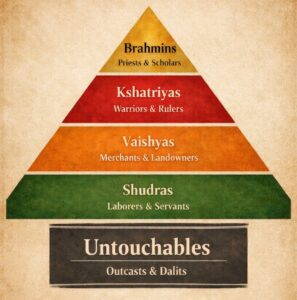
Four Varnas (Social Classes):
1. Brahmanas (Priests and Scholars):
– Status Enhancement: Rose to supreme position during Gupta period
– Land Grants: Extensive grants of cultivable land and villages (documented in numerous copper-plate inscriptions)
– Tax Exemptions: Land grants were typically tax-free or tax-reduced
– Administrative Roles: Occupied high positions in state administration (judges, ministers, governors)
– Religious Authority: Monopoly over religious ritual performance and Vedic interpretation
– Educational Role: Controlled higher learning and transmission of sacred knowledge
– Economic Status: Accumulation of substantial wealth through land ownership, transformed many from priests to landlords
2. Kshatriyas (Warriors and Rulers):
– Guptas themselves were elevated to this varna despite vaishya origins
– Maintained exclusive right to kingship and military leadership
– Owned vast territories and military forces
– Participated in intellectual and cultural patronage
3. Vaishyas (Merchants and Farmers):
– Engaged in trade and commerce, organizing merchant guilds
– Controlled agricultural production through land ownership
– Accumulated wealth through commerce and guilds
– Some elevated to kshatriya status through acquisition of political power (like the Guptas)
4. Shudras (Laborers and Servants):
– Traditionally performing menial and polluting tasks
– Status Improvement: Permitted to hear recitations of Ramayana and Mahabharata (previously restricted)
– Religious Participation: Allowed to worship Krishna and perform domestic rituals
– Economic Improvement: Improvement in economic status due to land demand and labor scarcity
– Agricultural Association: By late Gupta period, increasingly associated with agricultural labor
Proliferation of Castes (Jati System)
Multiplication of Jati (Subcastes):
– Existing castes subdivided, and new castes emerged through:
– Assimilation of foreigners: Each group of foreign traders or settlers classified as a new caste
– Tribal integration: Tribal peoples brought under caste system, often assigned low status
– Professional specialization: Development of new crafts and professions created new castes
– Geographical segregation: Different regions developed distinct caste hierarchies
Examples of New Castes:
– Hunas (Huns): Initially outsiders, gradually integrated into Rajput caste by Gupta period’s end
– Foreign Merchants: Greek, Syrian, and Persian traders classified into vaishya or kshatriya castes
– Tribal Groups: Forest peoples and agricultural tribes incorporated with low status
– Craft Specialists: New castes of weavers, metalworkers, stone-cutters, etc. created
Caste as Administrative Tool:
– Caste classification used for revenue assessment and labor obligation
– Hereditary occupations enforced through caste rules
– Guild regulations reinforced caste hierarchies and professional standards
Increase in Untouchables (Chandalas)
Growing Untouchable Population:
– Chandala and other “untouchable” groups grew in number and visibility
– Fa-Hien’s Observations: Noted the presence of Chandalas in Gupta society
– Occupations: Engaged in meat trade, leather work, cremation, and other ritually polluting occupations
– Disabilities and Restrictions:
– Prohibited from entering cities during auspicious occasions
– Subject to various social disabilities and restrictions
– Lived outside village boundaries
– Treated as beneath the four-varna system
– Origin: Result of incorporating tribal peoples and criminal populations into caste system at lowest levels
Status of Women
Variation by Varna:
The status of women varied significantly based on varna and social class:
Higher Varna Women (Brahmana, Kshatriya):
– Lack of Independence: No independent means of livelihood; economically dependent on male relatives
– Restricted Movement: Limited freedom to move in public; confined to household
– Wealth Accumulation: Limited property rights; wealth controlled by husbands/fathers
– Marriage Restrictions: Restricted to marrying within varna and often within subcastes
– Widow Status: High-varna widows prohibited from remarriage (first documented case of widow-immolation (Sati) in 510 CE)
Lower Varna and Shudra Women:
– Economic Participation: Engaged in agricultural operations and domestic services, granting more freedom
– Economic Independence: Partial income from their labor; some economic autonomy
– Mobility: Greater freedom to move outside home for economic activities
– Remarriage: Permitted to remarry (unlike high-varna widows)
Women’s Property Rights:
– Stri-dhan (female property): Gifts received at marriage recognized as wife’s personal property
– Gupta and post-Gupta law books: Expanded scope of female property rights
– Property Transactions: Women permitted to sell and mortgage immovable property
– Inheritance: Inheritance of landed property generally restricted to male heirs, though women could receive shares in some circumstances
Practices and Restrictions:
– Polygamy: High-varna men increasingly practiced polygamy; women treated as property
– Niyoga: Practice of brother-in-law marrying widow for progeny (prohibited for higher varnas; permitted for shudras)
– Widow Remarriage: Allowed for shudras and lower castes; prohibited for higher varnas
– Education: Restricted access to Vedic education for most women; some high-varna women received literary education
Urban and Rural Society
Urban Centers:
– Major Cities: Prayag, Pataliputra, Ujjain, Mathura, Varanasi, Sarnath
– Urban Population: Merchants, artisans, priests, administrators, laborers
– Urban Infrastructure: Bazaars, temples, monasteries, administrative buildings, public wells
– Social Hierarchies: More fluid in urban centers; economic success could elevate social status
Rural Society:
– Village Structure: Agricultural villages headed by headman (Gramapati) and governed by village council (Grama-buddhas) composed of elders
– Village Economy: Based primarily on agriculture; some craft specialization
– Land Ownership: Variation between royal lands, temple lands, brahmanical lands, and private holdings
– Peasant Status: Varied based on land ownership; subject to various taxes and labor obligations (Visthi)
– Tribal Integration: Gradual incorporation of tribal peoples into village system, usually with low status
Forced Labor (Visthi)
System of Forced Labor:
– Visthi (forced labor): State could mandate labor from peasants for state projects
– Types of Labor: Road construction, irrigation canal building, fortification repair, quarrying, etc.
– Geographic Variation: Particularly enforced in central and western India
– Compensation: Not entitled to regular wages, though occasionally provided subsistence
– Impact: Reduced peasant productivity and contributed to their lower status
– Epigraphic Evidence: Recorded in inscriptions and administrative texts
Economic Consequences:
– Forced labor represented significant state extraction of resources
– Reduced peasant capacity to earn income from agriculture
– Contributed to decline in peasant prosperity in some regions
– Created grievances and potential for peasant unrest
Part 11: Causes and Process of Gupta Empire Decline
The decline of the Gupta Empire was not sudden but a gradual process involving multiple interconnected factors. From Skandagupta onward (455 CE), the empire fragmented into regional states, finally disappearing by 550 CE.
Primary Causes of Decline
1. Huna Invasions – The External Military Threat
The Huna (Hun) Problem:
– First Invasions: Initial raids during Kumaragupta I’s reign under Toramana (c. 5th century)
– Intensification: Major invasions under Mihirakula (c. 500-530 CE) during Skandagupta’s reign
– Military Pressure: Continuous warfare drained imperial treasury and military resources
Territorial Loss to Hunas:
– Northwestern Frontier: Loss of Gandhara and parts of Punjab to Huna control
– Western Regions: Establishment of Huna kingdoms in Gujarat and Malwa
– Administrative Disruption: Forced displacement of administrative officials and disruption of revenue collection
– Economic Impact: Loss of western ports and trade routes critical to maritime commerce
2. Political Factors – Internal Collapse of Authority
Weak Succession and Incompetent Rulers:
– Skandagupta’s Conduct: Historical accounts suggest increasingly vicious and unpopular behavior
– Successor Weakness: Rulers after Skandagupta (Purugupta, Kumaragupta II, Buddhagupta, etc.) were significantly weaker
– Lack of Leadership: Unable to command respect of nobility or maintain military discipline
– Court Intrigues: Increasing internal conflicts and power struggles within royal family
Feudalization and Loss of Central Control:
– Increasing Independence: Provincial governors and feudal chiefs increasingly independent
– Land Grants Backfire: Extensive grants to brahmanas and officials created competing power centers
– Decentralization: Once grants were given, state lost direct control over these territories
– Competing Authorities: Multiple power centers claiming authority, fragmenting empire
– Federal Breakdown: Transition from imperial centralism to feudal fragmentation
Regional Rebellions:
– Internal Revolts: Recorded evidence of regional chiefs rebelling against central authority
– Loss of Legitimacy: Weak rulers unable to enforce obedience or command loyalty
– Opportunistic Uprisings: Local powers took advantage of imperial weakness to assert independence
3. Economic Decline
Loss of Prosperity:
– Trade Route Disruption: Huna control of northwestern routes disrupted overland silk road trade
– Port Loss: Loss of western maritime ports to Hunas reduced maritime trade
– Economic Fragmentation: Regional fragmentation disrupted long-distance commerce
– Market Collapse: Loss of demand for Indian luxuries in Mediterranean due to Roman Empire’s decline
Revenue Decline:
– Huna Devastation: Military campaigns and raids disrupted agriculture in affected regions
– Reduced Tax Collection: Loss of control over territories reduced tax revenue
– Land Debasement: Debasement of currency (reduction of gold content in coins) reflected treasury depletion
– Inflation and Economic Instability: Currency debasement caused inflation and economic instability
Agricultural Disruption:
– Crop Failures: Documented evidence of droughts and crop failures
– Natural Disasters: Floods in some regions disrupted irrigation and agriculture
– War Damage: Military campaigns destroyed crops and irrigation infrastructure
– Labor Shortage: Military conscription reduced agricultural labor availability
Trade Decline Specifically:
– Silk Weavers’ Migration: Silk weavers from western India migrated to Mandasor in Malwa due to weakened demand
– Shift of Professions: Many weavers shifted to other occupations as textile trade declined
– Loss of Monopoly: Eastern Romans learned silk cultivation, reducing India’s trade advantage
– Reduced Demand by 5th Century: Weakened demand for Indian silk by mid-5th century reflected broader trade decline
4. Religious Shift and Loss of Brahmanical Support
Buddhist Influence on Later Rulers:
– Narasimhagupta Baladitya: Later Gupta ruler influenced by Mahayana Buddhism
– Religious Shift: Some later rulers reportedly adopted Buddhism instead of traditional Hinduism
– Loss of Traditional Support: Brahmanical classes and traditional Hindu elites may have withdrawn support
5. Loss of Military Supremacy
Military Decline:
– Skandagupta’s Wars: Continuous warfare depleted treasury and officer corps
– Succession Instability: Weak succession undermined military discipline
– Officer Demoralization: Unpaid soldiers and officers demoralized
– Mercenary Problems: Increased reliance on mercenary forces which were unreliable
6. Structural and Administrative Factors
Overextension:
– Enormous empire was difficult to control given communication and transportation technology
– Multiple simultaneous crises (Huna invasions, trade disruption, drought) overwhelmed administration
– Centralized administration proved inflexible in responding to regional crises
Feudalization Process:
– Land Grants Paradox: Grants intended to increase productivity ended up decentralizing power
– Brahmanical Landlords: Priestly landlords accumulated power independent of state
– Authority Fragmentation: Multiple legitimate authorities claimed overlapping jurisdictions
Bureaucratic Rigidity:
– Rigid administrative hierarchy prevented adaptive responses to crises
– Corruption and inefficiency in later period
– Loss of administrative efficiency as empire fragmented
Regional Fragmentation:
1. Northwestern Region: Lost to Huna kingdoms under Mihirakula and his successors
2. Western Region (Gujarat, Malwa): Lost to Huna kingdoms and independent regional powers
3. Central Region: Came under Vakataka influence or independent regional rulers
4. Eastern Region: Remained under later Gupta rulers (Narasimhagupta, Vajra) but with reduced power
5. Deccan: Escaped Gupta control entirely; ruled by Vakataka, Chalukya, and other dynasties
Successor States and Powers:
– Pushyabhuti Dynasty (Vardhana): Emerged in North India (c. 550-650 CE) under Harsha
– Vakataka Dynasty: Remained powerful in central and western Deccan
– Chalukyas: Emerged as major power in southern India
– Regional Kingdoms: Numerous small kingdoms and principalities replaced imperial unity
Previous Year Questions and Model Answers
UPSC Prelims Questions (with explanations)
Question 1 (UPSC Prelims 1999)
Which one of the following ports handled the North Indian trade during the Gupta period?
a) Tamralipti
b) Broach
c) Kalyan
d) Cambray
Answer: (a) Tamralipti
Explanation:
Tamralipti (also spelled Tamralipta or Tamluk), located on the Bengal coast near the mouth of the Brahmaputra River, was the primary port for North Indian maritime trade during the Gupta period. It served as the hub for Buddhist pilgrimage routes and was the main port from which Chinese and Southeast Asian traders accessed northern India.
While Broach (Barygaza) became important after Chandragupta II’s conquest of Gujarat, it primarily served western and Roman trade. Kalyan was important but secondary to Tamralipti for north Indian trade. Cambray (Khambhat) was a later medieval development.
Question 2 (UPSC Prelims 2010)
There are only two known examples of cave paintings of the Gupta period in ancient India. One of these is paintings of Ajanta caves. Where is the other surviving example of Gupta paintings?
a) Bagh Caves
b) Ellora Caves
c) Lomas Rishi Caves
d) Nasik Caves
Answer: (a) Bagh Caves
Explanation:
The Bagh Caves in Madhya Pradesh contain the second major surviving example of Gupta-era paintings. Both Ajanta and Bagh caves preserve classical Indian fresco and tempera paintings demonstrating the artistic sophistication of the Gupta period.
The paintings depict:
– Jataka tales (Buddha’s previous lives)
– Buddha’s life narrative
– Bodhisattva figures
– Lay donors and patronage scenes
– Floral and faunal motifs
While Ellora also has paintings, they represent later periods. Nasik caves have inscriptions but limited paintings. Lomas Rishi is primarily sculptural.
Question 3 (UPSC Prelims 2019)
With reference to forced labour (Visthi) in India during the Gupta period, which one of the following statements is correct?
a) It was considered a source of income for the State, a sort of tax paid by the people
b) It was totally absent in the Madhya Pradesh and Kathiawar regions of the Gupta Empire
c) The forced labourer was entitled to weekly wages
d) The eldest son of the labourer was sent as the forced labourer
Answer: (a) It was considered a source of income for the State, a sort of tax paid by the people
Explanation:
Visthi (or Vishti) was a system of forced labor (corvée) where peasants could be mandated to provide labor for state projects such as:
– Road construction
– Irrigation canal building
– Fortification repair
– Military supply tasks
This labor was not compensated with regular wages; it functioned as a form of taxation or tribute paid in labor rather than money or goods. The state extracted substantial productive capacity through this mechanism.
Option (c) is incorrect – there is no evidence of wage payment for Visthi labor.
Option (b) is incorrect – Visthi was particularly common in central and western India.
Option (d) is incorrect – there is no rule about eldest son specifically.
Question 4 (UPSC Prelims 2020)
With reference to the period of Gupta dynasty in ancient India, the towns Ghantasala, Kadura and Chauf were well known as:
a) Ports handling foreign trade
b) Capitals of powerful kingdoms
c) Places of exquisite stone art and architecture
d) Important Buddhist pilgrimage centres
Answer: (a) Ports handling foreign trade
Explanation:
Ghantasala, Kadura (Kottara), and Chauf were all port towns on the Andhra and Deccan coasts that served as important centers for maritime trade during the Gupta period.
These ports handled:
– Trade with Southeast Asia
– Trade with the Eastern Roman Empire and Mediterranean
– Export of spices, textiles, and Indian luxury goods
– Import of foreign goods and materials
The ports were significant in the maritime trade networks that connected the Gupta Empire to distant regions, contributing to the empire’s economic prosperity.
UPSC Mains Questions (with model answers)
Question 1 (UPSC Mains 2017)
How do you justify the view that the level of excellence of the Gupta numismatic art is not at all noticeable in later times? (15 marks)
Model Answer:
The Gupta period (c. 320-550 CE) represented the absolute pinnacle of Indian numismatic (coin) art, creating gold dinars of unparalleled artistic merit, technical sophistication, and iconographic complexity. The assertion that this excellence declined in later periods is substantially justified through numismatic, political, and economic evidence.
Excellence of Gupta Numismatic Art:
The gold dinars of Gupta rulers, particularly those of Samudragupta, Chandragupta II, and Kumaragupta I, exemplify numismatic excellence:
1. Artistic Merit:
– Exceptional relief work with deep, precisely executed designs
– Graceful portrayal of rulers in diverse poses (standing, riding, hunting, worshipping)
– Elegant proportions following classical aesthetic canons
– Refined execution showing sophisticated understanding of anatomy and composition
2. Technical Quality:
– Remarkably uniform weight and dimensions despite hand-striking
– High gold purity (85-95%), indicating state control and metallurgical sophistication
– Consistent striking technique and careful die preparation
– Artistic execution unmatched in ancient Indian coinage
3. Iconographic Innovation:
– Archer type: King drawing bow, symbolizing valor
– Ashwamedha type: Depicting horse sacrifice, claiming universal monarchy
– Lyrist type: King playing musical instrument, emphasizing cultural patronage
– Peacock type: King feeding peacock, demonstrating leisure and refinement
– Goddess types on reverse depicting multiple divine aspects
– Each type conveying specific political and religious messages
Decline in Later Periods:
The assertion that this excellence was “not at all noticeable in later times” is justified:
1. Skandagupta’s Decline (455-467 CE):
– Gupta coinage shows marked decline in artistic execution and variety
– Fewer coin types issued
– Gold content significantly reduced (financial crisis evident)
– Relief quality and proportion deteriorate noticeably
– Design execution becomes coarser
2. Post-Gupta Period Decline:
– Subsequent dynasties issued fewer gold coins, more silver and copper
– Artistic merit declined substantially – less varied designs, cruder execution
– Huna coinage showed no artistic merit, primarily featuring inscriptions
– Regional kingdoms never achieved Gupta-era artistic standards
3. Medieval Period:
– Islamic Sultanates: Religious prohibition on idolatry meant coins featured only text and geometric designs, completely abandoning figural representation
– Mughal coins: Similarly restricted to inscriptions and portraits of rulers in profile
– European influence: Later Indian coins became monotonous, losing all aesthetic content
Reasons for Decline:
1. Economic Collapse:
– Imperial prosperity and economic surplus that enabled artistic experimentation disappeared
– Treasury depletion from Huna wars made funding artistic coins economically irrational
2. Political Fragmentation:
– Weak successor rulers lacked resources or interest in artistic patronage
– Regional kingdoms focused on survival rather than artistic achievement
– Loss of centralized authority that could enforce standardization
3. Religious and Cultural Shifts:
– Religious conversion influenced coin iconography
– Loss of Brahmanical support for Hindu royal imagery
– Islamic influence prohibited religious imagery on coins
4. Metallurgical Decline:
– Loss of imperial gold supplies as trade routes disrupted
– Reduced access to high-quality gold
– Technical skill dispersed with fragmentation of empire
Qualifications to the Assertion:
While the general assertion is justified, some nuance is warranted:
1. Limited Excellence in Later Periods: While not matching Gupta standards, some later dynasties produced respectable coins:
– Pala dynasty in Bengal maintained Buddhist imagery quality
– Some Chalukya and Chola coins showed artistic merit
– Medieval sultanates excelled in calligraphic inscription design
2. Survival of Iconographic Traditions: Some Gupta iconographic and design elements survived in:
– Hindu temple coin designs
– Regional variations preserving ruler imagery
– Buddhist coins in peripheral regions
3. Different Aesthetic Standards: Later periods developed different artistic standards:
– Emphasis on inscription and calligraphy rather than figural art
– Integration of multiple languages and scripts
– Pragmatic designs serving political needs over artistic expression
Conclusion:
The assertion that Gupta numismatic excellence was “not at all noticeable in later times” is substantially justified. The Gupta period represents an unparalleled peak of integrated political, religious, and artistic expression in coinage. The factors that enabled this excellence—imperial prosperity, centralized authority, skilled artisans, economic surplus for patronage, religious support for royal iconography—all collapsed with the empire.
While later periods produced coins of functional quality and occasional artistic merit, none achieved the combination of technical perfection, artistic innovation, iconographic complexity, and consistent excellence that characterized Gupta dinars. The decline in numismatic art thus reflects the broader decline of the Gupta imperial system and classical Indian civilization from its peak.
Question 2 (UPSC Mains 2021 – Thematic)
Discuss the main contributions of the Gupta period and the Chola period to Indian heritage and culture. (20 marks)
Model Answer Framework:
I. GUPTA PERIOD CONTRIBUTIONS (c. 320-550 CE):
Political and Administrative:
– Centralized imperial administration with hierarchical provincial structure
– Concept of Chakravartin (universal monarch) reinforcing imperial ideology
– Model of federalized empire with provincial autonomy
Cultural and Literary:
– Establishment of Sanskrit as imperial and classical language
– Kalidasa – greatest Sanskrit poet and dramatist (Shakuntalam, Meghaduta)
– Canonization of Mahabharata and Ramayana in classical form
– Peak of classical Sanskrit literature and dramaturgy
Scientific and Mathematical:
– Aryabhata – revolutionary discoveries in mathematics (zero, pi value, place-value system)
– Astronomical innovations – theory of Earth’s rotation, accurate solar year calculation
– Varahamihira’s contributions to astronomy and mathematics
– Nalanda University – world’s premier learning center
Artistic and Architectural:
– Sarnath and Mathura sculpture schools – classical artistic standards
– Early temple architecture establishing Nagara style
– Ajanta and Bagh cave paintings demonstrating classical painting techniques
– Iron Pillar of Delhi – metallurgical excellence
Religious:
– Hindu revival and brahmanical resurgence
– Support for Buddhism and Jainism alongside Hinduism
– Religious tolerance and coexistence model
– Foundation for later Hindu temple construction tradition
II. CHOLA PERIOD CONTRIBUTIONS (c. 850-1200 CE):
[This section would detail distinct Chola contributions to be compared with Gupta period, providing comprehensive comparative analysis]
III. SYNTHESIS AND COMPARATIVE ANALYSIS:
Legacy comparison, mutual influences, and lasting impact on Indian civilization
Read More: Ancient India Notes
Discover more from Simplified UPSC
Subscribe to get the latest posts sent to your email.
