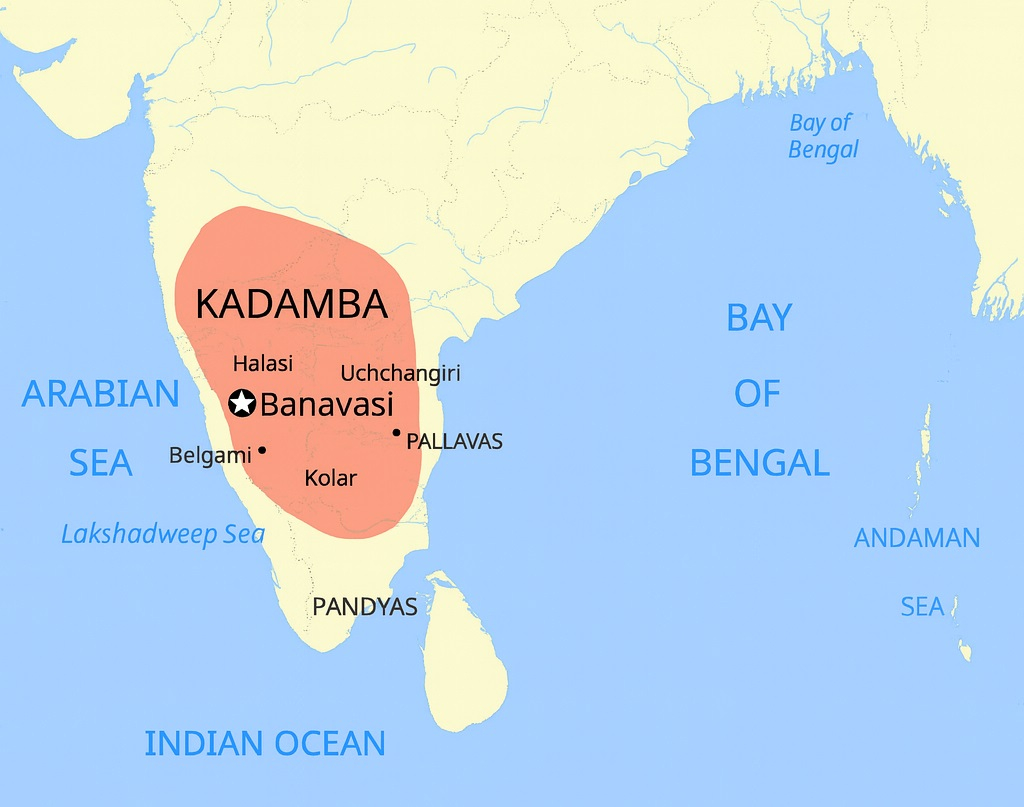
The Kadambas of Banavasi
Contents
The Kadambas of Banavasi
Origin and Formation of the Dynasty
The Rise of Mayurasharma
Military Campaigns and Independence
- The Pallavas of Kanchi
- The Traikutas and Abhiras
- The Sendrakas and Pariyathrakas
- The Maukharis and Punnatas
To celebrate his victories, Mayurasharma performed horse sacrifices (Ashwamedha) and granted 144 villages (brahmadeyas) to Brahmins of Talagunda.

Capital – Banavasi
- Banavasi was mentioned by the renowned Sanskrit poet Kalidasa in his famous work Meghaduta
- Chinese traveler Xuanzang (Huen Tsang) and Greco-Roman writer Ptolemy referred to Banavasi in their accounts
- The region was earlier ruled by the Satavahanas and Chutus before the Kadambas established their supremacy
Administrative Importance: From Banavasi, the Kadambas organized the Banavasi-mandala, one of the oldest Indian administrative provinces. This territory eventually expanded to include regions between the Varada and Tungabhadra rivers. A 5th-century copper coin with Kannada script inscription was discovered here, proving the early administrative use of the Kannada language.
Important Rulers of the Kadamba Dynasty
| Ruler | Reign | Key Contributions |
|---|---|---|
| Mayurasharma | 345–365 CE | Founded the dynasty; defeated Pallavas; established Banavasi as capital |
| Kangavarma | 365–390 CE | Successor of Mayurasharma; maintained independence against Vakatakas |
| Bhagiratha | 390–415 CE | Issued gold coins with Kannada inscriptions |
| Raghu | 415–425 CE | Died fighting the Pallavas |
| Kakusthavarma | 425–450 CE | Greatest ruler; expanded kingdom; matrimonial alliances with Guptas and Vakatakas |
| Shantivarma | 450–465 CE | Erected the famous Talagunda pillar inscription |
| Mrigeshavarman | 465–495 CE | Patronized Jainism; made grants to Jain establishments |
| Ravivarman | 495–515 CE | Participated in Jain festivals; continued religious patronage |
| Krishnavarman II | 516–540 CE | Last significant ruler; defeated by Pallavas around 540–565 CE |
Kakusthavarma – The Greatest Kadamba Ruler
- Territorial expansion into the Malnad region, coastal Karnataka, and northern Tamil Nadu
- Strategic matrimonial alliances with powerful dynasties including the Guptas of northern India, the Gangas, and the Vakatakas
- Military victories against rivals like the Pallavas and consolidation of power over lesser rulers such as the Punnatas, Alupas, Kongalvas, and Pandyas of Uchangi
- Construction of a Mahadeva temple mentioned in Greek writings of the period
The Gudnapur inscription provides valuable information about his military achievements.
Administration of the Kadambas
Central Administration
- The King was considered a divine representative and held centralized power
- A council of ministers assisted the king in governance
- The Mahasabha (great assembly) played a crucial role in local governance and decision-making
Territorial Divisions
| Division | Description |
|---|---|
| Nadus | Districts – primary administrative units |
| Kampanas | Sub-districts – enabling efficient local management |
| Vishaya | Province-level territorial unit |
Key Administrative Features
- Land Revenue System: An innovative system based on land productivity that fueled agricultural growth and trade
- Judicial System: A robust judicial framework ensuring law and order
- Military Organization: Strategic use of cavalry and elephants in warfare
- Diplomatic Relations: Careful maintenance of alliances with neighboring kingdoms
Administrative Officials
- Lekhakas – Writers and scribes who maintained records
- Rajamantri – Royal ministers
- Senapati – Military commanders
Economy and Trade
Coinage System
- Coins were typically made of copper and bore various symbols including conches and chakras
- Gold coins of King Bhagiratha (390–415 CE) bearing the old Kannada legend “Sri” and “Bhagi” have been discovered
- A 5th-century copper coin with the Kannada script inscription “Srimanaragi” was discovered at Banavasi
- Coins with the epithet “sri dosharashi” belonged to King Krishnavarman II
Trade and Commerce
- Banavasi and other centers served as vital trading hubs
- Maritime activities contributed to economic prosperity and cultural exchange
- Guilds and associations flourished, suggesting a vibrant internal and external trade network
Religion and Society
Religious Patronage
The Kadambas were followers of Vedic Hinduism while also showing remarkable religious tolerance by patronizing multiple faiths.Hinduism:
Mayurasharma was a Brahmin by birth and promoted Brahminic faith
Kings were devotees of Kartikeya (Murugan/Skanda)
The Madhukeshwara Temple at Banavasi dedicated to Lord Shiva was patronized by Kadamba rulers
Jainism:
- Several later Kadamba kings, including Shivakoti, adopted Jainism
- Kings made grants to Jain establishments including temples, basadis, and monasteries
- Inscriptions reference various Jain sects: Nirgranthas, Shvetapatas, Yapaniyas, and Kurchakas
- The Halsi grant of King Kakusthavarman begins with an invocation to Jinendra (Lord of the Jinas)
- King Mrigeshavarman made grants for activities including temple maintenance, anointing images with ghee, worship, and decorating with flowers
Society
- Society was broadly divided into castes based on the Varna system – Brahmins, Kshatriyas, Vaishyas, and Shudras
- Brahmins held high social status
- Women had property rights and educational access
- The Kadambas established Agraharas (Brahmin settlements) for education and religious purposes
Language and Literature
Kannada Language Development
- The Kadambas were the first rulers to use Kannada as an additional official administrative language
- Three Kannada inscriptions from their early rule at Banavasi have been discovered
- The Halmidi inscription (c. 450 CE) is evidence of early administrative use of Kannada
- Several Kadamba dynasty coins bearing Kannada inscriptions “Vira” and “Skandha” have been found
Important Inscriptions
| Inscription | Significance |
|---|---|
| Talagunda Pillar Inscription | Sanskrit inscription (455–470 CE) providing detailed history of Kadamba origins and Mayurasharma’s rise |
| Gudnapur Inscription | Details Kakusthavarma’s military achievements |
| Halmidi Inscription | Earliest known Kannada inscription (c. 450 CE) |
| Halsi Inscriptions | Important grants and religious records |
| Chandravalli Inscription | Historical records of the dynasty |
Patronage of Literature
- Court poets like Durvinita and Ravikirti composed works in Sanskrit and Prakrit
- Adikavi Pampa, the first great poet of Kannada, wrote his epics in Banavasi (though in a later period)
- The dynasty promoted Sanskrit, Prakrit, and early Kannada literature
Art and Architecture
Features of Kadamba Architecture
- Kadamba Shikara: A stepped pyramidal tower rising without decoration, topped with a pinnacle (Stupika or Kalasha)
- Vimana: Usually square in plan with a pyramidal tower and horizontal stepped stages
- Garbhagriha: Square sanctum surrounded by a circumambulatory path (pradakshina patha)
- Use of locally sourced stone giving regional character
Important Architectural Monuments
- Madhukeshwara Temple, Banavasi: Built in the 5th–9th century; dedicated to Lord Shiva; the only visible standing monument from Kadamba times
- Pranaveswara Temple, Talagunda: Houses the famous Talagunda pillar inscription
- Hattikeshwara, Kalleshwara, and Someshwara temples at Halasi: 5th-century monuments representing the oldest surviving Kadamba structures
- Jain Basadis at Halasi: The most ancient stone temple in Karnataka

Jain Monuments:
- Jain temples at Shravanabelagola and Halebid
- Ratnatraya Basti at Bilgi
Architectural Legacy
Kadamba architecture constituted an important link between Satavahana, Pallava, and Chalukya architecture. Many temples at Aihole, Badami, and Hampi were later built incorporating the Kadamba style.
Decline of the Kadamba Dynasty
Causes of Decline
- External Invasions: Successive attacks by the Chalukyas, Pallavas, and Gangas weakened the dynasty
- Internal Conflicts: Later rulers could not match the military prowess of early kings
- Military Defeats: The last significant ruler, Krishnavarman II, was defeated by the Pallavas around 540–565 CE
Absorption by Chalukyas
- By the 6th century, the Kadamba kingdom was absorbed into the Chalukya Empire of Badami
- The Badami Chalukyas rose to prominence at the decline of the Kadamba kingdom
- Kirtivarman I of the Chalukyas (566–597 CE) conquered the Kadamba territory
Later Kadamba Branches
| Branch | Period | Territory |
|---|---|---|
| Kadambas of Hangal | 980–1347 CE | Banavasi, Hangal region; feudatories of Western Chalukyas |
| Kadambas of Goa | 10th–14th century CE | Goa and Konkan; enjoyed over 250 years of independence |
| Kadambas of Halasi | Medieval period | Belgaum region |
| Kadambas of Bankapur | Medieval period | Central Karnataka |
Legacy and Significance
Historical Significance
- First Indigenous Dynasty: They were the first native rulers of Karnataka, ending the rule of foreign dynasties like Satavahanas and Pallavas
- Kannada Administrative Language: Pioneers in using Kannada for official purposes
- Foundation of Regional Identity: Their era serves as a starting point for studying Karnataka as an enduring geo-political entity
Cultural Contributions
- Architectural Innovation: Founded the Kadamba style of architecture that influenced Chalukya and Hoysala styles
- Religious Harmony: Promoted both Hinduism and Jainism, fostering religious tolerance
- Literary Patronage: Contributed to Sanskrit and early Kannada literature development
Important Inscriptions – Summary Table
| Inscription | Location | Period | Key Information |
|---|---|---|---|
| Talagunda Pillar Inscription | Talagunda, Shimoga | 455–470 CE | Origin of Kadambas, Mayurasharma’s story |
| Gudnapur Inscription | Gudnapur | 5th century | Kakusthavarma’s military victories |
| Halmidi Inscription | Halmidi | c. 450 CE | Earliest Kannada inscription |
| Halsi Grant | Halasi | 5th century | Invocation to Jinendra; Jain patronage |
| Chandravalli Inscription | Chandravalli | 5th century | Dynasty records |
| Banavasi Inscription | Banavasi | 5th century | Mrigeshavarman’s grants to Jain shrine |
Conclusion
The Kadambas of Banavasi represent a watershed moment in Karnataka’s history. As the first indigenous dynasty to rule the region, they established political sovereignty, administrative systems, and cultural institutions that shaped the trajectory of South Indian civilization. Their contributions to Kannada language development, temple architecture, religious harmony, and administrative governance created a lasting legacy that influenced subsequent dynasties including the Chalukyas and Hoysalas. The Kadamba era serves as the foundation stone for understanding the evolution of Karnataka as a distinct cultural and political entity in the Indian subcontinent.
also read: Early Medieval India


Discover more from Simplified UPSC
Subscribe to get the latest posts sent to your email.


