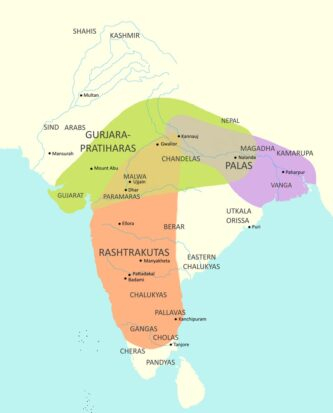
The Tripartite Struggle
The Tripartite Struggle over Kannauj: Causes, Phases, and Consequences (UPSC‑oriented Notes)
The “Tripartite Struggle” over Kannauj refers to the prolonged, multi‑phase conflict between the Gurjara‑Pratihara, Pala, and Rashtrakuta dynasties for control of Kannauj and hegemony over northern India during the 8th–10th centuries CE. Kannauj, located in the central Ganges Doab, became a symbol of imperial legitimacy after Harsha’s empire, and its strategic, economic, and symbolic importance made it the focal point of triangular rivalry among the three major powers of early medieval India.
Contents
1. Introduction: The Tripartite Struggle and Kannauj
The Tripartite Struggle (also called the “Kannauj Triangle Wars” or “Kannauj Triangle Conflict”) spanned roughly from the late 8th to the 10th century CE. It was not a single war but a series of campaigns and shifting alliances among three major dynasties:
Gurjara‑Pratiharas (Western and Central India, capital at Kannauj after the 9th century).
Palas (Eastern India, Bengal and Bihar, capital at Pataliputra later at Munger).
Rashtrakutas (Deccan, capital at Manyakheta).
Control over Kannauj, the former seat of Harsha’s empire, was seen as a mark of supremacy in northern India (“Lord of Uttarapatha/Uttarpatha”), and all three dynasties claimed this title to legitimise their imperial status.
2. Causes of the Tripartite Struggle
2.1 Strategic‑Geopolitical Causes
Kannauj lay at the crossroads of major trade routes in the Ganga–Yamuna Doab, linking eastern, western, and northern India; it also connected overland routes to the Silk Road network.
The region was agriculturally rich, providing steady revenue to sustain large armies and complex administrations, making it highly attractive during the post‑Gupta period of regionalisation.
2.2 Imperial Ambition and Symbolic Legitimacy
After the decline of the Gupta and Harsha‑era empires, no single power could claim pan‑Indian unity; Kannauj symbolised imperial continuity.
The Rashtrakuta rulers aspired to the title Sakalottarpathanath (Lord of All Uttarapatha), while the Palas sought Uttarpathaswami; control of Kannauj was essential to substantiate these claims.
2.3 Economic and Commercial Motives
The Gangetic trade belt around Kannauj was crucial for commerce, especially links to ports in Gujarat and the Bay of Bengal, which were vital for foreign trade and taxation.
The Gujarat–Malwa region, bordering the Pratihara core, was also a contested zone because of its proximity to the western coast and trade routes.
2.4 Power Vacuum after Harsha and the Ayudha Dynasty
After Harsha’s death (c. 647 CE), Kannauj passed to the weak Ayudha dynasty, which failed to maintain strong central authority.
This political vacuum allowed the three powerful dynasties to intervene, using alliances with local rulers and puppet kings in Kannauj to legitimise their campaigns.
3. Phases of the Tripartite Struggle (Phase‑wise Detailed Analysis)
Phase I (c. 790–800 CE): Vatsaraja, Dharmapala, and Dhruva
Background: The Pratihara king Vatsaraja (son of Nagabhata I) launched an aggressive expansion into the Ganga valley, aiming to capture Kannauj while challenging the rising Pala power.
Initial clash: Vatsaraja attacked Indrayudha, the ruler of Kannauj, defeated him, and installed him as a Pratihara vassal, bringing Kannauj under indirect Pratihara domination.
Pala intervention: The Pala emperor Dharmapala opposed this Pratihara advance into the Ganga plains; he supported the Ayudha‑ruler Chakrayudha of Kannauj, forming an alliance against Vatsaraja.
Battle of Prayag: Vatsaraja defeated the combined forces of Dharmapala and Chakrayudha at Prayag, consolidating his control over Kannauj for a short period.
Rashtrakuta intervention: The Rashtrakuta ruler Dhruva Dharavarsha marched north, defeating both Dharmapala at Gauda (Bengal) and Vatsaraja at another major battle, effectively breaking the northern front of both dynasties.
Outcome of Phase I:
After Dhruva’s victories, the immediate Pratihara and Pala gains were rolled back; the Rashtrakutas did not hold Kannauj permanently but severely weakened their northern rivals.
Dhruva’s southward return allowed Dharmapala to reinstall Chakrayudha as a puppet in Kannauj, elevating himself as the de facto lord of northern India for a time.
Phase II (early 9th century CE): Nagabhata II, Govinda III, and the Shifting Frontiers
Pratihara resurgence: Nagabhata II (c. 795–833 CE), seeking to recover from his father’s defeats, launched a fresh campaign against Kannauj.
Defeat of Dharmapala: Nagabhata II defeated Dharmapala at Munger and then captured Kannauj, displacing Chakrayudha and establishing Kannauj as the Pratihara capital.
Rashtrakuta counter‑attack: The Rashtrakuta ruler Govinda III intervened again, marching north and defeating Nagabhata II, temporarily occupying Kannauj and asserting Rashtrakuta dominance in the north.
Strategic withdrawal: Govinda III had to return to the Deccan to deal with internal and southern threats, leaving Kannauj once again without a stable overlord.
Result of Phase II:
Kannauj changed hands repeatedly, reflecting the triangular nature of the conflict; no single dynasty could hold it for long.
The Pratiharas gradually consolidated control, setting the stage for later Pratihara dominance under Mihira Bhoja.
Phase III (mid–late 9th century CE): Mihira Bhoja, Devapala, and Indra III
Pratihara zenith: Mihira Bhoja (c. 836–885 CE), known as Adi‑Varaha, restored Pratihara power, reasserting control over Kannauj and expanding westward against the Arab menaces.
Pala strength in the east: Devapala (Pala) maintained strong control over Bengal and Bihar, frequently clashing with the Pratiharas in the eastern Ganga plains, but did not permanently hold Kannauj.
Rashtrakuta intervention under Indra III: The Rashtrakuta ruler Indra III launched another northern expedition in the early 10th century, attacking Kannauj and looting it for a time.
Failure of permanent occupation: Indra III too had to retreat south due to internal pressures, allowing the Pratiharas to regain control of their capital.
Phase IV (10th century CE): Decline and Fragmentation
By the 10th century, all three dynasties were weakened by prolonged warfare, internal revolts, and pressure from emerging regional powers (Chandela, Kalachuri, Chola, etc.).
The Gurjara‑Pratiharas remained the most associated with Kannauj politically, but their empire gradually fragmented, paving the way for smaller Rajput‑style kingdoms in North India.
4. Consequences of the Tripartite Struggle
4.1 Political Consequences
The struggle led to prolonged political instability in the Ganga plains, preventing the emergence of a stable, centralised empire for centuries.
Weakening of the three major dynasties indirectly facilitated the success of later invasions, including those of Mahmud of Ghazni and the Ghurids, as North India lacked a strong, unified front.
4.2 Economic and Urban Decline
Repeated invasions and plundering of Kannauj disrupted trade routes and damaged agricultural productivity in the Doab, leading to the economic decline of the city.
Several classical urban centres like Mathura, Prayag, Kaushambi, and Varanasi also witnessed a relative decline, contributing to the gradual shift from urban‑centred Gupta‑era economy to a more rural‑temple‑centred economy.
4.3 Rise of Regional and Feudal Polities
The exhaustion of the three imperial powers created a power vacuum which allowed the rise of regional dynasties such as the Chandelas of Bundelkhand, Kalachuris of Tripuri, and Gahadavalas of Kannauj.
The struggle also accelerated the process of feudalisation, with increased land grants to samantas and religious institutions, weakening central authority and intensifying agrarian dependence.
4.4 Cultural and Historiographical Impact
Despite the political chaos, the period saw rich cultural and artistic development, especially in temple architecture and patronage of art and literature by the Pratiharas, Palas, and Rashtrakutas.
For historiography, the Tripartite Struggle marks a key transition from “classical” imperial structures to early medieval regional polities, making it a crucial topic for understanding the evolution of state and society in India.

also read: Early Medieval India
Discover more from Simplified UPSC
Subscribe to get the latest posts sent to your email.

