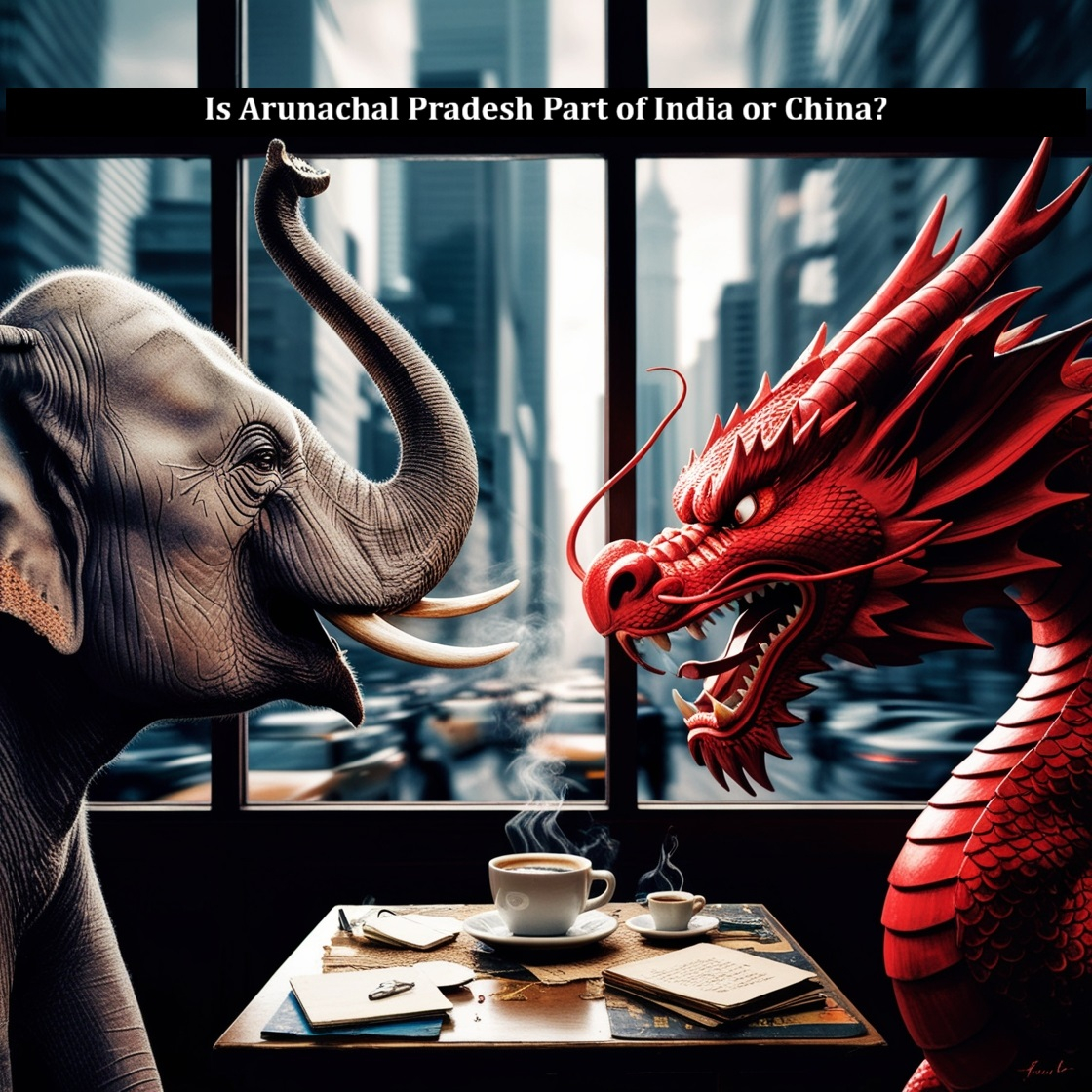
Is Arunachal Pradesh Part of India or China?
Contents
Is Arunachal Pradesh Part of India or China?
Introduction
The question of Arunachal Pradesh’s sovereignty remains one of Asia’s most contentious geopolitical disputes. While India exercises administrative control and considers the territory an integral part of its northeastern region, China periodically asserts its claims, referring to the area as “South Tibet.” This comprehensive analysis examines the historical trajectory through British colonial treaties, China’s forceful seizure of Tibet, the geographical barriers that separate these regions, the spiritual heritage rooted in Buddhist traditions, and the enduring cultural links that bind Arunachal Pradesh to India. The evidence overwhelmingly supports Arunachal Pradesh as an indisputable part of India, grounded in international law, geographical realities, and centuries of cultural continuity.
Part 1: How China Seized Sovereign Tibet and Then Claimed Arunachal Pradesh
Tibet’s Independence and De Facto Sovereignty (1912-1950)
Following the collapse of the Qing Dynasty in 1912, Tibet emerged as a de facto independent state with full sovereign recognition from neighboring nations. The 13th Dalai Lama declared that Tibet’s relationship with China ended with the fall of the Qing dynasty and proclaimed independence. During the 38-year period from 1912 to 1950, Tibet functioned as a completely independent nation with its own government, military, diplomatic corps, and international relations.
Tibet maintained independent international relations with all neighboring countries, including Britain, Nepal, and others who had diplomatic representatives stationed in Lhasa. The British government formally recognized Tibet’s independent status, binding itself not to recognize any Chinese sovereignty or rights over Tibet unless China signed the Simla Convention of 1914—which China notably refused to do. Nepal similarly confirmed Tibet’s independent status in 1949 when presenting documents to the United Nations in support of its own membership application.
Throughout this period, Tibet remained carefully neutral, refusing to align with China or any other power, even during the Second World War despite intense international pressure. The Tibetan government issued formal proclamations reaffirming its independence, strengthened its defenses, and maintained all the institutional apparatus of a sovereign nation-state.
The Invasion of October 1950: China’s Forceful Seizure
China’s territorial ambitions fundamentally changed on October 7, 1950, when the People’s Liberation Army (PLA) crossed the Jinsha (Yangtze) River and invaded the eastern Tibetan province of Kham. What unfolded was not a mere border incursion but a calculated military invasion designed to bring Tibet under Chinese communist control.
The invasion was launched with overwhelming force. Approximately eighty thousand Chinese soldiers advanced across the plateau, overwhelming the ill-equipped Tibetan army of barely 8,000 men. By October 19, 1950, Chinese troops had captured the strategic town of Chamdo, with over 3,000 Tibetans taken prisoner and at least 180 killed in direct combat, though some sources document casualties exceeding 3,000.
Significantly, for most Tibetans, the invasion occurred without warning or preparation. The invasion represented a strategic move by the Chinese Communist Party (CCP) under Mao Zedong to consolidate territorial control. For the Chinese leadership, Tibet offered multiple strategic advantages: control over Asia’s water sources (the region contains the headwaters of major Asian rivers), high-ground military advantage against India, and entry into the Himalayan region. The invasion fit neatly into Mao’s broader vision of “liberating” territories historically connected to China—Xinjiang, Inner Mongolia, and Tibet—under communist control.
The Seventeen-Point Agreement: Legitimizing Occupation Under Duress
Following the military invasion, Chinese representatives forced Tibetan delegates to negotiate a political settlement. On May 23, 1951, the Seventeen-Point Agreement was signed in Beijing. This agreement, formally titled the “Agreement of the Central People’s Government and the Local Government of Tibet on Measures for the Peaceful Liberation of Tibet,” was signed under military duress by Tibetan plenipotentiaries with no genuine bargaining power.
The agreement was fundamentally coercive. While the 14th Dalai Lama ratified it on October 24, 1951, this ratification occurred under duress—the United States had even informed him that accepting the agreement would disqualify Tibet from receiving American assistance and support. The treaty contained false provisions claiming that Tibet “sought Chinese protection from imperialist powers” and that Tibet wished to unify with China, statements that bore no relationship to Tibetan popular sentiment or government positions.
Critically, the Seventeen-Point Agreement broke its own promises almost immediately. The agreement explicitly promised autonomy to Tibet and guarantees for religious freedom. Within years, these commitments were systematically violated, as the Chinese government imposed increasingly tight political and cultural control over Tibet.
The Connection to Arunachal Pradesh Claims
This forceful seizure of Tibet became the foundation for China’s subsequent claims over Arunachal Pradesh. Since the British Simla Convention of 1914 had established the McMahon Line as the boundary between Tibet and British India, once China occupied Tibet in 1950-1951, it inherited these territorial disputes. China’s strategy was to argue that since it now controlled Tibet, it also inherited any territorial claims that Tibet might have possessed—including disputed areas along the McMahon Line such as Arunachal Pradesh.
However, this argument carries fundamental logical and legal flaws. China never accepted the Simla Convention when it was signed, and the principle of international law prohibits using military conquest to establish legal territorial rights. An invasion and occupation do not retroactively validate territorial claims or nullify pre-existing international agreements. By this logic, any country could invade another and then assert the invaded territory’s historical claims—a doctrine that would destabilize international law itself.
Part 2: Himalayan Geography and Natural Barriers Separating China from Arunachal Pradesh
The Eastern Himalayas: A Geological Fortress
The Eastern Himalayas, extending from the Sikkim-Nepal border in the west to the Brahmaputra River in the east, form a formidable natural barrier between the Tibetan Plateau and India’s northeastern plains. Unlike their western counterparts, the Eastern Himalayas are geologically younger and significantly more tectonically active, representing a continuation of the ongoing collision zone between the Indian Plate and the Eurasian Plate that began approximately 50 million years ago.
This collision process created distinct structural characteristics that distinguish the Eastern Himalayas from other mountain ranges. The region exhibits steep relief and narrow valleys due to rapid uplift and high erosion rates. The mountains are organized in parallel ranges: the Great Himalayas (also called Inner Himalayas) containing high snow-clad peaks; the Lesser or Middle Himalayas with moderate elevations and forested slopes; and the Siwalik or Outer Himalayas composed of younger sedimentary rocks forming foothills.
The Eastern Himalayan range averages approximately 6,000 meters elevation and spans a length of 2,400 kilometers, creating a towering wall that naturally separates the Tibetan Plateau from the Indian subcontinent. This geographical division has persisted for millions of years and remains one of Earth’s most significant natural boundaries.
The Tibetan Plateau: A Different Geographic and Climatic Zone
North of the Himalayas and east of the Karakorum ranges lies the Tibetan Plateau, also known informally as the “Roof of the World”. The Tibetan Plateau is the largest and highest plateau on Earth, averaging more than 4,000 meters above sea level with a total area of approximately 2.5 million square kilometers—representing just over a quarter of China’s entire territorial area.
The plateau’s vast expanse and extreme elevation create a fundamentally distinct climatic and ecological zone from the regions to its south. The Tibetan Plateau is hemmed in from the north by the Kunlun Mountains and from the south by the Himalayan Range, creating a geographic compartment with its own weather systems and environmental characteristics.
This geographic separation creates profound climatic consequences. During summer months, the intense solar heating of the plateau’s surface drives strong convection, which acts as a “heat pump” pulling moisture inward from the Indian subcontinent. Conversely, during winter, the extreme cooling of the plateau results in an outflow of cold, dense air that effectively shuts off monsoon circulation, preventing moisture penetration into the plateau.
The South Asian Monsoon and Orographic Effects
The Southwest Monsoon, which dominates from June to September, represents the primary moisture transport system affecting northeastern India. Warm, moisture-laden air rises from the Bay of Bengal and moves northwestward across the Indian subcontinent. When these monsoon winds encounter the Eastern Himalayan ranges, they are forced to rise, cool, and release precipitation through a process called orographic rainfall.
The consequences are dramatic. Areas in northeastern India, including Arunachal Pradesh, receive the highest rainfall in India—exceeding 400 centimeters annually in some locations. These regions receive heavy rainfall from May through September as the monsoon winds hit the mountain barriers. The western coast of India similarly receives intense precipitation from Arabian Sea monsoons hitting the Western Ghats.
In contrast, the Tibetan Plateau, positioned north of this mountain barrier, remains in a rain shadow zone. The Himalayas effectively block the moisture-laden monsoon winds, preventing significant precipitation from reaching the plateau. This creates radically different ecological conditions: northeastern India experiences tropical and subtropical forests with abundant water resources, while the Tibetan Plateau remains a high-altitude, arid environment with minimal precipitation.
This natural division explains why Arunachal Pradesh’s climate, ecology, and human populations are fundamentally oriented toward the Indian monsoon system rather than the Tibetan Plateau’s continental climate. The mountains that physically separate these regions also represent a climatic and ecological divide that has shaped settlement patterns, agriculture, and cultural development for millennia.
The Monsoon Trough and Atmospheric Circulation
The monsoon trough—an elongated low-pressure zone running parallel to the Himalayan Mountains from northwest Rajasthan to the Bay of Bengal—represents the frontal boundary between monsoon circulations. During the summer monsoon season, this trough intensifies and becomes a generator of rain-producing weather systems, particularly lows and depressions that originate over the Bay of Bengal and migrate westward.
These synoptic-scale weather systems have 4-5 day life cycles and bring abundant rainfall to northeastern India, including Arunachal Pradesh. Stronger easterlies in the monsoon trough increase vorticity, which promotes rainfall generation. The Tibetan Plateau’s influence on surface pressure patterns further modulates this system: rising surface pressure over the plateau actually weakens the mid-tropospheric cyclone over East India, creating complex atmospheric interactions that reinforce the natural separation between the Plateau and the monsoon-dominated regions to the south.
Part 3: Origins of Buddhism and Its Spread to Arunachal Pradesh and Tibet
Buddhism’s Ancient Origins in India
Buddhism originated approximately 2,500 years ago in the Indian subcontinent, specifically in the northeastern region of what is now Nepal, during the 5th century BCE. The religion was founded by Shakyamuni Buddha, also known as Gautama Buddha, the historical Buddha who established this spiritual tradition.
Siddhartha Gautama, a prince from the Shakya clan, initially pursued ascetic disciplines seeking liberation but eventually abandoned extreme practices to pursue a “Middle Way,” eventually achieving enlightenment through meditation under the Bodhi Tree at Bodhgaya. Bodhgaya remains the most important Buddhist pilgrimage site worldwide, as the location where Shakyamuni Buddha attained enlightenment approximately 2,500 years ago.
Following his enlightenment, Buddha taught the dharma (spiritual doctrine) to his first five ascetic companions, who became his initial disciples and formed the bhikshu (monastic) sangha—the monastic community that became Buddhism’s institutional foundation. At Vulture Peak Mountain near Rajagriha, Buddha delivered teachings on the nature of phenomena as involving shunyata (emptiness) and anatma (selflessness), core philosophical concepts that would define Buddhist thought.
Buddhism’s Expansion Across Asia
Buddhism spread throughout Asia through multiple pathways over subsequent centuries. Emperor Ashoka, who ruled India from 268 to 232 BCE, played a pivotal role in Buddhism’s expansion by adopting it as India’s state religion and providing state support for missionary activities. Buddhist missionaries traveled throughout Asia, establishing communities and monasteries that transmitted the faith to diverse populations.
By approximately 520 CE, Buddhism had reached China when Bodhidharma traveled from India and founded Chan (Zen) Buddhism. In 538 CE, Buddhism entered Japan from Korea. The religion evolved into distinct traditions across different regions—Theravada Buddhism in Southeast Asia, Mahayana Buddhism in East Asia, and increasingly sophisticated tantric traditions in Tibet and Mongolia.
The Emergence of Tibetan Buddhism and the Gelug School
Tibetan Buddhism emerged as a distinct form of Mahayana Buddhism, incorporating tantric elements and practices, particularly following the arrival of Indian Buddhist masters in Tibet. In the 11th century CE, around 1000-1070 CE, the great Indian Buddhist scholar Acharya Dipamkara Shrijnana (known as Atisha) traveled to Tibet at the invitation of Tibetan rulers who sought to restore purity to Buddhist teachings that had become corrupted during periods of political upheaval.
Atisha lived in Tibet for approximately 17 years, residing in western Tibet, central Tibet, and Nyethang, where he delivered extensive teachings on both Sutra and Tantra—the scriptural and esoteric dimensions of Buddhist practice. He wrote the influential text “A Lamp On The Path To Enlightenment”, which clarified misinterpretations of dharma that had spread throughout Tibet and established clear principles for Buddhist philosophical and practical traditions.
Atisha founded the KADAM TRADITION, which provided the foundational philosophical and pedagogical framework for subsequent Buddhist development in Tibet. His most important Tibetan disciple, Lama Drom Tonpa, inherited and transmitted these lineages and is believed by many to be an early incarnation of the Dalai Lamas themselves.
The Gelug tradition, founded by Je Tsongkhapa (1357-1419) in the early 14th century, represented a reform and renewal of the Kadam tradition. The Gelug school strongly emphasized the monastic system as the foundation for rigorous study and practice of Buddha’s teachings of both Sutra and Tantra. Tsongkhapa’s works provided “a comprehensive view of Buddhist philosophy and practice that integrates sutra and tantra, analytical reasoning, and yogic meditation”.
The Gelug school, also called the “New Kadam” or “Yellow Hat” tradition, emerged as the dominant Buddhist school in Tibet and Mongolia from the end of the 16th century onward, both religiously and politically. The school maintained close alliances with Mongol rulers, who provided political patronage and protection against rival Buddhist schools. This political alignment significantly strengthened Gelug influence across the Tibetan plateau and Mongolian regions.
Buddhism’s Spread to Arunachal Pradesh
Buddhism reached Arunachal Pradesh through multiple pathways, particularly through trade and pilgrimage routes across the Himalayas and the region’s proximity to Tibet. The Monpa and Sherdukpen tribes were among the earliest adopters of Buddhism, blending their indigenous beliefs and practices with Buddhist teachings beginning in the 17th century.
The Monpa people of Arunachal Pradesh specifically adopted the Gelug sect of Tibetan Buddhism in the 17th century, following the influence of Merag Lama, an influential Buddhist teacher educated in Bhutan. The Tawang Monastery, founded in 1680-1681, became the central religious institution around which Monpa Buddhist culture developed and continues to play a central role in the daily lives of Monpa communities.
Significantly, the sixth Dalai Lama, Tsangyang Gyatso, was born in Tawang, Arunachal Pradesh in the 17th century. This historical connection directly links Arunachal Pradesh to Tibetan Buddhist leadership and demonstrates that Tawang’s spiritual significance predates modern political disputes by centuries.
Cultural Synthesis: Buddhism and Indigenous Traditions
While Buddhism became dominant among certain Arunachal Pradesh tribes, indigenous animistic and shamanistic traditions persisted and blended with Buddhist practice. The Monpa, though devoted followers of Buddhism, maintained belief systems connected to nature worship, ancestor veneration, and local deities. Local priests called Bonpo, Frami, and Yumin perform rituals that blend Buddhist and pre-Buddhist traditions, serving as shamans and healers in their communities.
This cultural synthesis reflects Buddhist philosophy’s flexibility and adaptability in encountering diverse local traditions. Rather than entirely replacing indigenous practices, Buddhism incorporated elements of local belief systems while introducing ethical and philosophical frameworks derived from Shakyamuni Buddha’s teachings. The Choskar festival celebrated by Monpa Buddhists features lamas reading scriptures while villagers walk around fields with sutras, praying for agricultural prosperity—blending Buddhist ritual with agricultural concerns central to tribal economies
The Colonial Era: British India and Arunachal Pradesh
Early British Engagement and Non-Interference Policy
During the late 18th and 19th centuries, when the British East India Company expanded its control across the Indian subcontinent, Arunachal Pradesh remained largely peripheral to direct colonial administration. The region, inhabited by numerous independent tribal communities, was considered geographically remote and economically insignificant. British policy, therefore, adopted a pragmatic approach of minimal direct intervention while maintaining strategic control over the frontier.
The British recognized that the tribal societies of Arunachal Pradesh had functioned autonomously for centuries, maintaining their own governance systems, customs, and trade networks. Rather than impose rigid colonial structures immediately, the British preserved traditional local authority, employing systems such as the Inner Line Permit—a mechanism originating from earlier Ahom kingdom regulations—which controlled external access to tribal territories and protected indigenous rights.
The Treaty of Yandabo (1826) and British Consolidation
The strategic importance of Arunachal Pradesh became apparent following the Treaty of Yandabo in 1826, which ended the First Anglo-Burmese War. Through this treaty, the British East India Company secured control over Assam, Manipur, Arakan, and Taninthai from the Burmese Kingdom. With the acquisition of Assam, British India now controlled the plains directly south of Arunachal Pradesh, establishing a contiguous frontier that required demarcation and administrative oversight.
The treaty marked a turning point in colonial strategy toward the northeastern frontier. As the British consolidated their power in Assam and Bengal, they recognized the need to establish clear boundaries and maintain peaceful relations with the tribal regions to the north. This recognition laid the groundwork for the subsequent demarcation of boundaries that would formally incorporate Arunachal Pradesh into the Indian administrative structure.
The Simla Convention and the McMahon Line: Legal Foundation of India’s Claim
The Simla Convention of 1914
The most crucial historical moment in establishing Arunachal Pradesh as part of India came through the Simla Convention of 1914 (also spelled Shimla). This diplomatic conference, held in the British hill station of Simla, brought together representatives from British India, Tibet, and China to resolve territorial disputes in the eastern Himalayan region.
The convention’s significance lay in its formal recognition of boundary demarcations through a documented agreement. Sir Henry McMahon, the Foreign Secretary of British India and chief British negotiator, played a pivotal role in these discussions. McMahon, a respected diplomat and British Indian Army officer (1862-1949), possessed extensive experience in frontier diplomacy and understood the geopolitical complexities of the region.
The McMahon Line: Drawing the Border
The most detailed McMahon Line map, dated March 24-25, 1914, was signed by the Tibetan and British representatives as a bilateral accord. This line extended approximately 890 kilometers along the crest of the Eastern Himalayas, running from Bhutan in the west to the Brahmaputra River in the east, effectively establishing the boundary between Tibet and British India.
The McMahon Line incorporated Arunachal Pradesh entirely within Indian territory. Under this agreement, India’s sovereignty encompassed the region, with clear geographical demarcation based on natural features such as river watersheds and mountain ridges. The Shimla Treaty explicitly recognized Tawang, one of Arunachal Pradesh’s most significant towns, as falling within Indian territory.
China’s Rejection and the Historical Dispute
A critical issue in understanding the legitimacy of the McMahon Line involves China’s position at the Simla Convention. While Chinese representatives attended the conference, they ultimately did not sign the final agreement. China’s objection centered on its argument that Tibet, under Chinese suzerainty, possessed no independent authority to negotiate and sign international treaties.
China contended that the convention violated its sovereignty over Tibet and that any boundary agreement required Chinese participation and consent. This position, however, ignored the historical reality that Tibet maintained significant autonomy during this period and that Britain, as India’s sovereign power, possessed the legal authority to negotiate on behalf of its Indian territories.
Importantly, India’s current borders with Tibet are based on the McMahon Line, and this boundary is now recognized internationally. India consistently maintained that the Simla Convention established legitimate boundaries and that China’s subsequent occupation of Tibet in 1950 did not retroactively invalidate agreements that existed prior to that occupation.
The 1962 Sino-Indian War and Its Aftermath
Military Confrontation over Arunachal Pradesh
The territorial dispute over Arunachal Pradesh came to a head during the Sino-Indian War of 1962. China launched coordinated military offensives in October 1962, with operations targeting both Ladakh in the west and Arunachal Pradesh (then known as the North-East Frontier Agency or NEFA) in the east.
Chinese forces crossed the McMahon Line and temporarily occupied significant portions of Arunachal Pradesh, including the strategically important town of Tawang. However, after approximately one month of fighting, China unilaterally declared a ceasefire in November 1962 and withdrew to positions it considered strategically defensible.
The war, though brief, demonstrated that territorial dispute remained unresolved. Yet India’s subsequent continuous administrative control, combined with the international legal framework of the McMahon Line, reinforced India’s claim. The Line of Actual Control (LAC) emerged as the de facto boundary following the ceasefire, though it remains a point of periodic contention.
Administrative Integration and Statehood
NEFA to Arunachal Pradesh: Institutional Recognition
Following independence in 1947, the Indian government administered the region as the North-East Frontier Agency (NEFA), officially recognizing it as part of the Indian union. This administrative designation reflected India’s legal position that Arunachal Pradesh constituted Indian territory as per the McMahon Line and inherited colonial agreements.
In 1972, the territory was renamed “Arunachal Pradesh”—meaning “Land of the Dawn-Lit Mountains”—a name that resonates with both geographical and cultural significance. The name captures the region’s position as India’s easternmost state, where the sun rises first over the Indian landscape.
The culmination of institutional integration occurred on February 20, 1987, when Arunachal Pradesh attained full statehood. This transformation from tribal territory to union territory (1972) to full-fledged state (1987) represented the formalization of Arunachal Pradesh’s status as an integral part of the Indian nation.
Cultural Connections: Arunachal Pradesh’s Deep Integration with Indian Civilization
Ancient Indian Textual References
Beyond political and legal frameworks, Arunachal Pradesh’s connection to India extends into the deepest layers of Indian civilization through ancient scriptural texts. The region finds extensive mention in foundational Hindu texts, establishing cultural continuity spanning millennia.
The Mahabharata, one of the world’s oldest epic narratives, references Arunachal Pradesh multiple times. The epic narrates that Arjuna, one of the five Pandava brothers central to the epic’s narrative, ventured into the region during his pilgrimage. According to the text, Arjuna met Ulupi, a Naga princess, in present-day Tirap district, and their union produced Iravan, perpetuating the connection between Arunachal Pradesh and the broader Vedic civilization.
The Kalika Purana, a 10th-century Sanskrit scripture, provides detailed descriptions of Arunachal Pradesh’s geography, referring to it as the “Prabhu Mountains”. The text describes “the region’s dense forests, mighty rivers, and its association with tribal deities,” accurately capturing the region’s physical and spiritual characteristics. The Purana’s description of inhabitants as “Kiratas,” believed to represent early Mongoloid peoples, demonstrates ancient Indian civilization’s awareness of and engagement with the region’s unique tribal populations.
Mythological Associations and Sacred Narratives
Hindu mythology is replete with stories linking revered figures to Arunachal Pradesh. According to tradition, Sage Parshurama, an avatar of Vishnu and one of Hinduism’s most revered saints, sought purification by washing off his sins in the Lohit District of Arunachal Pradesh. Similarly, Maharshi Vyasa, the legendary author of the Mahabharata and Puranas, is believed to have meditated within the region, drawing upon its spiritual energy.
Lord Krishna, central to Hindu theology, is connected to Arunachal Pradesh through the region’s association with Bhishmaknagar, the kingdom of King Bhishmaka of Vidarbha. According to tradition, Krishna married Rukmini, a princess from this region, establishing a matrimonial link between the Vedic heartland and Arunachal Pradesh.
Additionally, the sixth Dalai Lama, Tsangyang Gyatso, was born in Tawang, Arunachal Pradesh in the 17th century, establishing connections between the region and Tibetan Buddhist traditions while demonstrating that Tawang’s spiritual significance predates modern political disputes.
Tribal Diversity and Indigenous Heritage
Arunachal Pradesh’s cultural identity rests fundamentally on its extraordinary tribal diversity. The state is home to over 26 major tribal groups, each possessing distinct languages, customs, social structures, and artistic traditions. Major tribes include the Adi, Apatani, Aka, Miji, Galo, Nishi, Monpa, Idu-Mishmi, and numerous others.
These communities have developed intricate systems of cultural practices, ritual observances, and festive celebrations that reflect centuries of adaptation to the Himalayan environment while maintaining connections to broader Indian cultural patterns. The Tani clans—including Adi, Apatani, Galo, Nyishi, and Tagin communities—trace their mythical heritage to Abotani (literally “father of tribes”), according to whom the first rice cultivation techniques were introduced, establishing agriculture as the civilizational foundation.
Agricultural Festivals and Seasonal Celebrations
Arunachal Pradesh’s diverse tribes celebrate elaborate harvest festivals that demonstrate both ecological adaptation and spiritual worldviews consistent with Indian civilization. The Dree Festival, celebrated by the Apatani tribe in July, marks the culmination of the agricultural season and honors Ane Dree, the goddess of crops and fertility.
The Dree celebration encompasses sacrificial offerings, prayers performed by village priests (nyibu), traditional dances in elaborate tribal attire, rhythmic drumming, and communal feasting featuring traditional dishes like apong (rice/millet beer), puluh (rice cakes), and fish curry. The festival embodies the tribe’s reverence for nature, dependence on agriculture, and spiritual philosophy—themes resonating throughout Indian civilization from the Vedas onward.
Similarly, the Apatani celebrate Myoko, the Adi observe Podi-Barbi, Miju observe Tam-la-du, and Digaru Mishmi observe Boori-Boot, among numerous other harvest festivals across different tribal communities. Each festival reflects identical agricultural cycles, seasonal patterns, and thanksgiving traditions prevalent throughout India’s diverse regions.
Dance, Music, and Artistic Traditions
The artistic traditions of Arunachal Pradesh’s tribes reflect broader Indian cultural patterns while maintaining distinct local expressions. Ponung (or Ponu), performed by both men and women of various tribes, celebrates joyous occasions and anticipated good fortune, featuring rhythmic movements and communal participation. This communal dance tradition parallels similar folk dance forms found across India.
War dances, ritual dances connected to Buddhist traditions, and priest-led chanting accompany important religious and social occasions. The Apatani tribe particularly maintains rich oral traditions through folk narratives called Miji-Migun, Busi-Ayu, and elaborate festivals like Marun and Yapung, through which elders transmit cultural knowledge to younger generations.
Religious and Spiritual Integration
Arunachal Pradesh encompasses both Hindu and Buddhist spiritual traditions, reflecting India’s multicultural and multireligious character. The Tawang Monastery, founded in 1680-1681 by Merak Lama Lodre Gyatso in accordance with the 5th Dalai Lama’s wishes, represents the largest Buddhist monastery in India and stands as a remarkable architectural and spiritual achievement. This monastery belongs to the Gelug school of Vajrayana Buddhism and historically maintained religious associations with Drepung Monastery of Lhasa.
The monastery, situated at 10,000 feet elevation in Tawang’s valley, houses over 450 monks and contains 65 residential buildings, valuable scriptures (Kangyur and Tengyur), and magnificent Buddha figures. Its integration into India’s institutional and cultural fabric demonstrates how Arunachal Pradesh seamlessly incorporates diverse spiritual traditions within India’s pluralistic framework.
Meanwhile, Hindu temples, ancestor worship practices, and rituals connected to nature and agricultural cycles persist among tribal communities, reflecting integration with Hindu philosophical worldviews.
Conclusion
The question “Is Arunachal Pradesh part of India or China?” finds its definitive answer through multiple convergent lines of evidence. Legally, the McMahon Line established during the 1914 Simla Convention between British India and Tibet formally demarcated Arunachal Pradesh as Indian territory. This boundary, while disputed by China, remains internationally recognized and forms the basis of India’s eastern frontier.
Historically, British colonial administration recognized and preserved Arunachal Pradesh’s connection to the Indian administrative structure, beginning with the Treaty of Yandabo in 1826 and culminating in the region’s integration into independent India and eventual statehood in 1987.
Most profoundly, Arunachal Pradesh’s cultural fabric reveals deep-rooted connections to Indian civilization spanning millennia. Ancient Hindu texts reference the region’s sacred geography and revered figures. Over 26 diverse tribal communities maintain agricultural festivals, artistic traditions, and spiritual practices consistent with Indian cultural patterns. The Tawang Monastery represents Indian Buddhism’s largest spiritual center. These cultural realities demonstrate that Arunachal Pradesh constitutes an integral and organic part of Indian civilization.
Arunachal Pradesh is unequivocally part of India—by legal treaty, administrative integration, and most importantly, by the undeniable cultural and civilizational bonds forged over centuries. China’s periodic territorial claims represent political assertions unsupported by historical documents, legal treaties, or contemporary reality. India’s governance of Arunachal Pradesh reflects not occupation but rightful sovereignty over territory that has belonged to Indian civilization since antiquity.


Discover more from Simplified UPSC
Subscribe to get the latest posts sent to your email.