Fundamental Duties
Contents
Fundamental Duties:
Introduction
The rights and duties of citizens are correlative and inseparable. However, the original Constitution (1950) contained only Fundamental Rights and not Fundamental Duties. The framers incorporated the duties of the State as Directive Principles of State Policy instead. Fundamental Duties were added later through the 42nd Constitutional Amendment Act in 1976, and another duty was added in 2002 through the 86th Amendment Act.
Historical Context and Development
Original Constitutional Framework
The original Constitution included:
Fundamental Rights for citizens and all persons
Directive Principles of State Policy as duties of the State
Absence of Fundamental Duties for citizens
The framers believed that incorporating duties was unnecessary at that time.
42nd Constitutional Amendment Act (1976)
Following the recommendation of the Swaran Singh Committee, the 42nd Amendment Act added:
A new Part IVA to the Constitution
Article 51A, which specified ten Fundamental Duties of citizens
This amendment was enacted during the Internal Emergency (1975-1977) when the need for emphasizing citizen duties became apparent.
86th Constitutional Amendment Act (2002)
Added one more Fundamental Duty regarding education of children, bringing the total to eleven.
International Perspective
The Fundamental Duties in the Indian Constitution are inspired by the Constitution of the erstwhile USSR, which emphasized the inseparable nature of rights and duties.
Comparative Analysis:
Major Democratic Countries (USA, Canada, France, Germany, Australia): Do not specifically contain a list of duties of citizens
Japan: Perhaps the only democratic constitution containing a list of citizen duties
Socialist Countries: Gave equal importance to fundamental rights and duties (USSR model)
Swaran Singh Committee Recommendations (1976)
Background
The Congress Government established the Sardar Swaran Singh Committee to recommend the incorporation of fundamental duties following the operational challenges faced during the Internal Emergency.
Key Recommendations
Inclusion of Separate Chapter: The committee recommended including a separate chapter on fundamental duties in the Constitution
Citizen Consciousness: Emphasized that citizens should be aware that enjoying rights comes with the responsibility of performing duties
Enforcement Mechanisms: Suggested provisions for penalties and punishments for non-compliance
Recommendations Not Accepted
Despite the committee’s suggestions, the Congress Government did not incorporate:
Penalty and Punishment Provisions: Parliament should impose appropriate penalties for non-compliance with duties
Legal Immunity for Enforcement: Laws imposing penalties should not be challengeable in courts on grounds of infringement of Fundamental Rights
Duty to Pay Taxes: The committee recommended making tax payment a fundamental duty, but this was not included
Note: The 42nd Amendment included ten duties instead of the eight recommended by the committee.
List of Fundamental Duties (Article 51A)
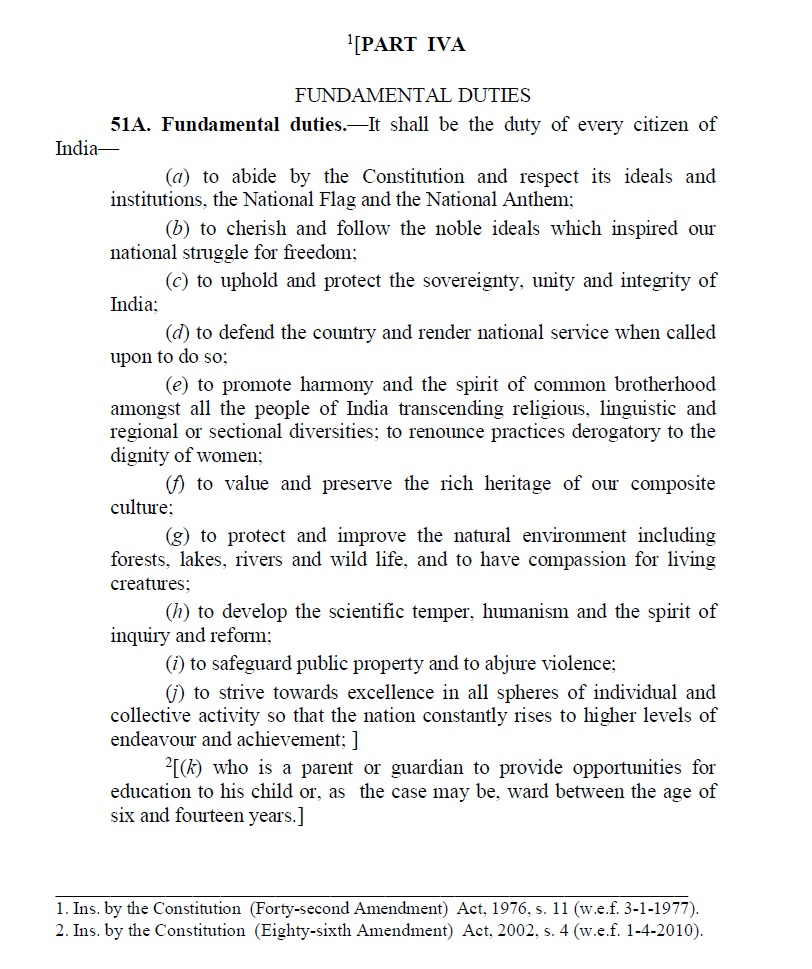
The fundamental duties noted in the constitution are as follows:
| Article 51 A | Provision |
| (a) | To abide by the Constitution and respect its ideals and institutions, the National Flag and the National Anthem. |
| (b) | To cherish and follow the noble ideals which inspired our Indian freedom Struggle. |
| (c) | To uphold and protect the sovereignty, unity, and integrity of India. |
| (d) | To defend the country and render national services when called upon to do so. |
| (e) | To promote harmony and the spirit of common brotherhood amongst all the people of India transcending religious, linguistic, and regional or sectional diversities; to renounce practices derogatory to the dignity of women. |
| (f) | To value and preserve the rich heritage of our composite culture. |
| (g) | To value, protect and improve the natural environment including forests, lakes, rivers, and wildlife, and to have compassion for living creatures. |
| (h) | To develop the scientific temper, humanism, and spirit of inquiry and reform. |
| (i) | To safeguard public property and to abjure violence. |
| (j) | To strive towards excellence in all spheres of individual and collective activity so that the nation constantly rises to higher levels of endeavor and achievement. |
| (k) | Duty of the parent or guardian to provide opportunities for education to his child, as the case may be, between the age of six and fourteen years (added by 86th Amendment Act, 2002). |
It shall be the duty of every citizen of India:
(a) Constitutional Respect To abide by the Constitution and respect its ideals and institutions, the National Flag and the National Anthem
(b) Historical Consciousness To cherish and follow the noble ideals that inspired the national struggle for freedom
(c) National Sovereignty To uphold and protect the sovereignty, unity and integrity of India
(d) National Defense To defend the country and render national service when called upon to do so
(e) Social Harmony To promote harmony and the spirit of common brotherhood amongst all the people of India transcending religious, linguistic and regional or sectional diversities and to renounce practices derogatory to the dignity of women
(f) Cultural Preservation To value and preserve the rich heritage of the country’s composite culture
(g) Environmental Protection To protect and improve the natural environment including forests, lakes, rivers and wildlife and to have compassion for living creatures
(h) Scientific Advancement To develop scientific temper, humanism and the spirit of inquiry and reform
(i) Public Property and Non-Violence To safeguard public property and to abjure violence
(j) Excellence and National Progress To strive towards excellence in all spheres of individual and collective activity so that the nation constantly rises to higher levels of endeavour and achievement
(k) Child Education (Added by 86th Amendment, 2002) To provide opportunities for education to his child or ward between the age of six and fourteen years
Features of Fundamental Duties
Classification of Duties
Moral Duties: Cherishing noble ideals of the freedom struggle (reflect ethical principles)
Civic Duties: Respecting the Constitution, National Flag, and National Anthem (legal and civic obligations)
Cultural Roots
The duties codify values that have been integral to Indian tradition, mythology, religions, and practices. They essentially represent a codification of tasks integral to the Indian way of life.
Scope and Application
Limited to Citizens Only: Unlike some Fundamental Rights that extend to both citizens and foreigners, Fundamental Duties apply exclusively to Indian citizens
No Extension to Foreigners: Foreigners are not bound by these duties
Legal Enforceability
Non-Justiciable Character: Like Directive Principles of State Policy, Fundamental Duties are non-justiciable
No Direct Court Enforcement: The Constitution does not provide for their direct enforcement by courts
No Legal Sanction for Violation: There is no direct legal penalty for violating these duties
Parliamentary Enforcement: Parliament is free to enforce them through suitable legislation
Criticisms of Fundamental Duties
1. Incomplete List
The list is not exhaustive and does not cover other important duties such as:
Casting vote (electoral participation)
Paying taxes (recommended by Swaran Singh Committee)
Family planning
This incompleteness undermines the comprehensiveness of citizen obligations
2. Vagueness and Ambiguity
Certain duties are vague and difficult for common people to understand:
“Noble ideals” (subject to multiple interpretations)
“Composite culture” (undefined parameters)
“Scientific temper” (lacks clear definition)
Different interpretations can lead to inconsistent application
3. Moral Precepts Without Legal Force
Criticized as a mere “code of moral precepts” due to their non-justiciable character
No legal consequences for non-performance
The Swaran Singh Committee had suggested penalties, but these were not incorporated
Questions the practical utility of duties without enforcement mechanisms
4. Superfluous Inclusion
Critics argue that:
These duties would be performed by law-abiding citizens regardless of constitutional inclusion
Over 99.9% of citizens are already law-abiding
Codifying duties implies lack of confidence in citizens’ voluntary compliance
5. Structural Placement
Placement as Part IVA after Part IV (Directive Principles) undermines their significance
Should have been placed after Part III (Fundamental Rights) to maintain parity
Current positioning reduces their value and constitutional importance
Significance and Importance of Fundamental Duties
1. Reminder of Citizen Obligations
Reminds citizens that rights come with corresponding responsibilities
Creates awareness that duties to the country, society, and fellow citizens must be fulfilled alongside rights
Establishes a balance between individual freedoms and social responsibilities
2. Deterrent Against Anti-National Activities
Serves as a warning against:
Anti-national activities (burning the national flag)
Antisocial activities (destroying public property)
Subversive elements and unconstitutional agitations
3. Source of Inspiration and Discipline
Inspires citizens and promotes a sense of discipline and commitment
Creates a feeling that citizens are not mere spectators but active participants in realizing national goals
Strengthens democratic values and social cohesion
4. Aid in Constitutional Interpretation
Supreme Court Ruling (1992): In determining the constitutionality of any law, if a court finds that the law seeks to give effect to a fundamental duty, the court may consider such law to be ‘reasonable’ in relation to Article 14 (Equality Before Law) or Article 19 (Freedoms) and thus save the law from unconstitutionality.
This principle enhances the interpretive value of duties in judicial review
5. Legal Enforceability
Can be enforced by law through appropriate legislation passed by Parliament
Allows for the imposition of penalties or punishments for failure to fulfill duties
Creates a basis for legislative action to promote compliance
6. Democratic Balance
As articulated by then Prime Minister Indira Gandhi:
Inclusion of duties would help strengthen democracy
The moral value of fundamental duties is not to smother rights but to establish a democratic balance
Makes people conscious of their duties equally as they are conscious of their rights
Official Justification for Inclusion
H.R. Gokhale (Law Minister) Statement
“In post-independent India, particularly on the eve of emergency in June 1975, a section of the people showed no anxiety to fulfil their fundamental obligations of respecting the established legal order. The provisions of chapter on fundamental duties would have a sobering effect on these restless spirits who have had a host of anti-national subversive and unconstitutional agitations in the past.”
Indira Gandhi (Prime Minister) Statement
Argued that inclusion of fundamental duties would:
Help strengthen democracy
Establish a democratic balance by making people conscious of their duties equally as they are conscious of their rights
Not smother rights but complement them with responsibilities
Recognition of Historical Necessity
The Congress Party declared the non-inclusion of fundamental duties in the original Constitution as a “historical mistake” and claimed that what the framers failed to do was being done through the 42nd Amendment Act.
Post-Emergency Consensus
Initial Opposition
The Opposition in Parliament strongly opposed the inclusion of fundamental duties by the Congress Government, raising concerns about:
State overreach
Erosion of citizen freedoms
Lack of confidence in people’s voluntary compliance
Validation Through Subsequent Government Action
The Janata Government (headed by Morarji Desai) in the post-emergency period:
Did not annul the Fundamental Duties despite undoing many other 42nd Amendment provisions through the 43rd Amendment (1977) and 44th Amendment (1978)
This demonstrated eventual consensus on the necessity of including Fundamental Duties
Strengthening Through 2002 Amendment
The addition of an 11th Fundamental Duty (education of children) in 2002 through the 86th Amendment Act further validated the importance and relevance of the fundamental duties concept.
Legal Implementation of Fundamental Duties
Verma Committee Observations (1999)
The Verma Committee on Fundamental Duties of Citizens identified existing legal provisions that facilitate implementation:
1. Prevention of Insults to National Honour Act (1971)
Prevents disrespect to the Constitution of India
Protects the National Flag
Protects the National Anthem
2. Criminal Laws – Communal Harmony
Provide punishments for encouraging enmity between different sections of people on grounds of:
Language
Race
Place of birth
Religion
3. Protection of Civil Rights Act (1955)
Provides punishments for offences related to caste and religion
Addresses discrimination and violation of civil rights
4. Indian Penal Code (IPC)
Declares imputations and assertions prejudicial to national integration as punishable offences
5. Unlawful Activities (Prevention) Act (1967)
Provides for declaration of communal organizations as unlawful associations
Prevents destabilization through organized communal activities
6. Representation of the People Act (1951)
Disqualifies members of Parliament or state legislatures for:
Corrupt practices
Soliciting votes on grounds of religion
Promoting enmity between different sections of people on grounds of caste, race, language, or religion
7. Wildlife (Protection) Act (1972)
Prohibits trade in rare and endangered species
Protects biodiversity and natural environment
8. Forest (Conservation) Act (1980)
Checks indiscriminate deforestation
Prevents diversion of forest land for non-forest purposes
Promotes environmental conservation
Opposition Perspectives
C.K. Daphtary (Former Attorney General of India)
Opposed the inclusion on the grounds that:
More than 99.9% of citizens were already law-abiding
No need to tell people about their duties
Satisfied and contented people willingly perform duties
Inclusion implies that people are not content after 26 years, which reflects poorly on the state
A.K. Sen’s Critique
Argued that:
Fundamental duties reduce democratic setup to a “harsh school master” scenario
Instead of thriving on willing cooperation and confidence, the state resorts to command
Though people created the Sovereign Democratic Republic, the state now acts as a master enjoining obedience
Reflects a loss of state confidence in citizens
D.D. Chawla (President, National Forum of Lawyers and Legal Aid, Delhi)
Criticized the vague and abstract language:
Duties should be spelled out in concrete form
“Noble ideals” is ambiguous (could include various interpretations)
“Rich heritage of composite culture” lacks clear definition
“Scientific temper, humanism and spirit of inquiry and reform” are beyond comprehension of common people
Duties should be worded to catch the imagination of the common man
Key Distinctions
Fundamental Duties vs. Fundamental Rights
| Aspect | Fundamental Rights | Fundamental Duties |
|---|---|---|
| Availability | Available to all persons (citizens and foreigners) | Available only to citizens |
| Justiciability | Justiciable (can be enforced by courts) | Non-justiciable (cannot be directly enforced by courts) |
| Legal Sanction | Direct legal consequences for violation | No direct legal consequences; requires Parliamentary legislation |
| Court Enforcement | Can be directly enforced by courts | Require enabling legislation for court enforcement |
| Scope | Extensive (protect individual liberties) | Complementary (promote national interest and social harmony) |
Fundamental Duties vs. Directive Principles of State Policy
| Aspect | Fundamental Duties | Directive Principles |
|---|---|---|
| Applicability | Duties of citizens | Duties of the State |
| Purpose | Guide citizen behavior and obligations | Guide state policy and governance |
| Enforcement | Can be enforced through legislation | Cannot be directly enforced by courts |
| Constitutional Position | Part IVA (added in 1976) | Part IV (original Constitution) |
| Focus | Individual responsibility and conduct | Welfare and development of society |
Summary of Important Points
Constitutional Evolution
1950: Original Constitution included only Fundamental Rights; duties not incorporated
1976: 42nd Amendment added Part IVA with ten Fundamental Duties following the Internal Emergency
2002: 86th Amendment added the 11th Fundamental Duty regarding child education
Legal Character
Non-justiciable but enforceable through Parliamentary legislation
Serve as interpretive aids in determining constitutional validity of laws
Complement Fundamental Rights rather than restrict them
Practical Significance
Establish democratic balance between rights and responsibilities
Deter anti-national and antisocial activities
Promote citizen participation in national development
Inspire discipline and commitment to national goals
Implementation Framework
Multiple existing laws implement various fundamental duties
Parliament has discretion to create new legislation for enforcement
Courts cannot directly enforce duties but can use them in constitutional interpretation
Critical Debate
Supporters view them as essential for democratic discipline and balance
Critics argue they are vague, non-enforceable, and superfluous
Despite opposition, subsequent governments maintained and expanded the duties
The 2002 addition of education duty shows continued relevance
Questions for Self-Assessment
What was the historical reason for not including Fundamental Duties in the original Constitution?
Which committee recommended the inclusion of Fundamental Duties, and when?
Name the act and year in which Fundamental Duties were first added to the Constitution.
List all 11 Fundamental Duties as per Article 51A.
Distinguish between Fundamental Duties and Directive Principles of State Policy.
Explain the concept of “non-justiciable” in relation to Fundamental Duties.
How do courts use Fundamental Duties in determining constitutional validity of laws?
Analyze the criticisms leveled against the inclusion of Fundamental Duties.
Discuss the significance of Fundamental Duties in strengthening democracy.
Compare the approach to duties in the Indian Constitution with the USSR Constitution.


Discover more from Simplified UPSC
Subscribe to get the latest posts sent to your email.


