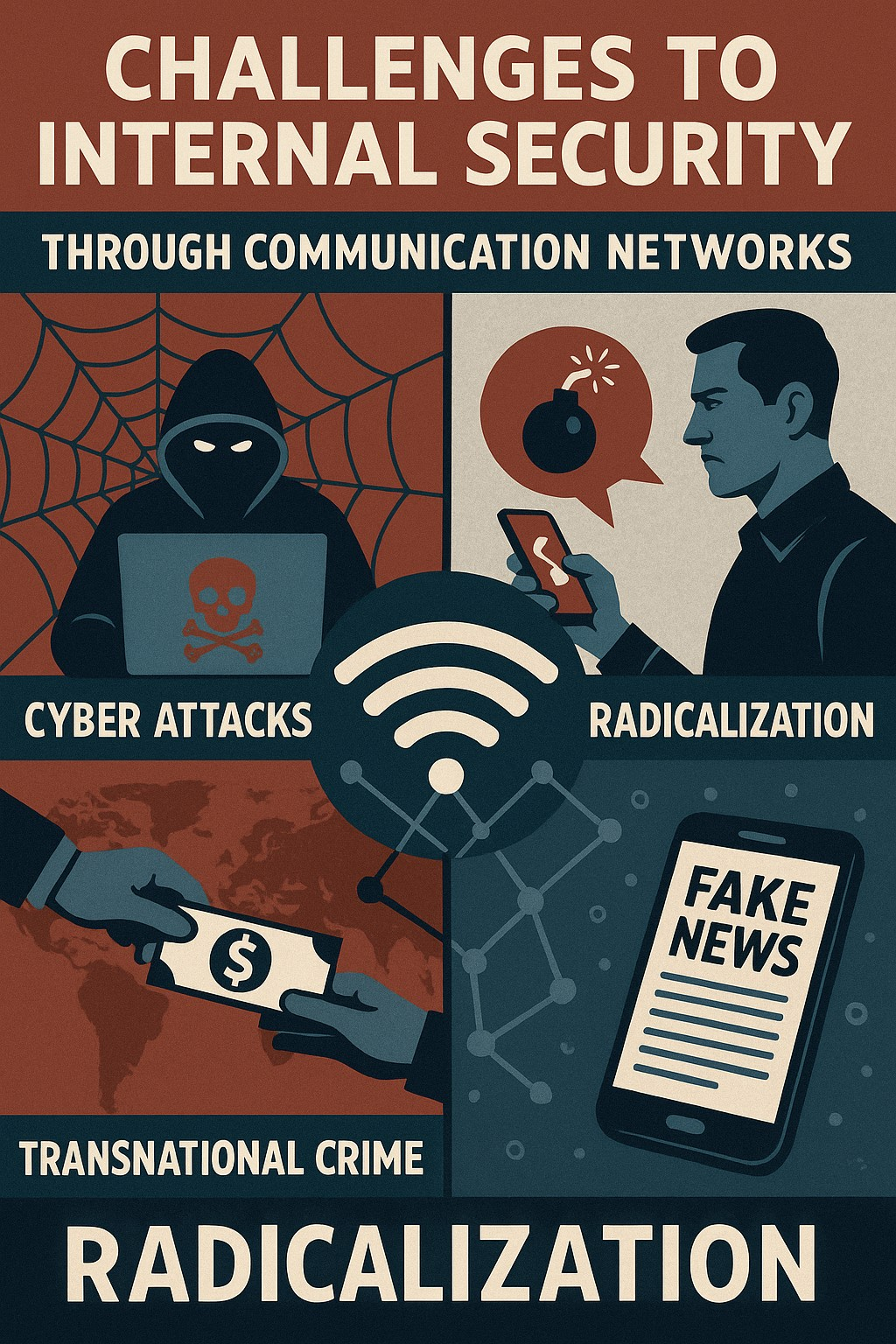
Challenges to Internal Security Through Communication Networks
Contents
Challenges to Internal Security Through Communication Networks:
1. Introduction
Communication networks have become the backbone of modern society, facilitating instant information exchange across vast distances and enabling critical infrastructure operations. However, this digital interconnectedness has simultaneously created unprecedented vulnerabilities that threaten India’s internal security. The rapid proliferation of internet connectivity, mobile phones, and social media platforms has fundamentally transformed the nature of security threats facing the nation. Unlike traditional security challenges that operate within geographical boundaries, threats through communication networks are borderless, anonymous, and continuously evolving. The complexity is further amplified by the dual nature of these networks—they simultaneously serve as instruments of progress and vectors for malicious activities. This article examines the multifaceted challenges posed by communication networks to India’s internal security, exploring natural and human-induced threats, institutional responses, and contemporary developments within the framework of UPSC preparation.
2. What Are Communication Networks?
Communication networks are systems of interconnected computers, devices, and infrastructure that enable the transmission of data, voice, and multimedia content across local and global distances. These networks form the foundation of digital connectivity and include:
Types of Communication Networks:
Telecom Networks: Mobile and landline systems that facilitate voice and data transmission through technologies like 4G, 5G, and fiber optics.
Internet Infrastructure: The global system of interconnected networks that transmit data through protocols such as IP (Internet Protocol), enabling services like email, web browsing, and cloud computing.
Social Media Platforms: Digital ecosystems (WhatsApp, Facebook, Twitter, Telegram) that enable user-generated content and mass communication.
Critical Infrastructure Networks: Specialized systems controlling power grids, transportation, banking, finance, oil and gas, aviation, railways, nuclear facilities, defense systems, and government operations.
Definition Under Indian Law:
The Information Technology Act, 2000 defines Critical Information Infrastructure (CII) as “computer resources, the incapacitation or destruction of which shall have a debilitating impact on national security, economy, public health or safety.” This definition encompasses communication networks as core components of a nation’s critical infrastructure.
3. Role of Communication Networks in National Security and Development
Communication networks play an indispensable role in India’s national development and security architecture:
Positive Roles:
Economic Growth: Communication networks facilitate e-commerce, digital payments, remote work, and innovation, contributing significantly to India’s GDP. The digital economy is projected to reach $1 trillion by 2030, largely dependent on secure communication networks.
Governance and Public Service Delivery: Digital platforms enable direct citizen-government interaction through e-governance portals, reducing corruption and improving service efficiency. Direct Benefit Transfer (DBT) schemes, Aadhaar authentication, and online tax systems are critical for administrative functioning.
Healthcare and Education: Telemedicine and online education became lifelines during the COVID-19 pandemic, demonstrating the essential role of communication networks in ensuring continuity of critical services across remote and urban areas.
Emergency Response and Disaster Management: Real-time communication is vital for coordinating rescue operations, distributing relief, and managing disaster situations effectively.
Intelligence and Law Enforcement: Secure communication enables coordination between security agencies, intelligence operations, and maintains situational awareness against security threats.
Military and Defense Operations: Communication networks are fundamental to military command and control systems, strategic operations, and maintaining national defense capabilities.
4. Threats to Communication Networks: Natural and Human-Induced
Natural Threats (Environmental and Technical):
Natural Disasters: Earthquakes, floods, cyclones, and lightning strikes can damage physical infrastructure of communication networks, including fiber optic cables, towers, and data centers.
Equipment Failures: Hardware degradation, software bugs, and network congestion can disrupt service availability and create vulnerabilities exploitable by malicious actors.
Power Failures: Dependency on electrical supply makes networks vulnerable to power outages, requiring backup systems and redundancy measures.
Human-Induced Threats:
1. Cybercrime and Financial Fraud:
Types: Phishing, identity theft, ransomware attacks, and financial fraud targeting individuals, organizations, and government institutions.
Impact: The BSNL data breach of May 2024 exposed sensitive information of millions of users, including IMSI numbers and SIM card details, demonstrating the scale of vulnerability in critical telecom infrastructure.
Scope: Bank fraud, cryptocurrency theft, credit card fraud, and unauthorized money transfers cause losses exceeding billions of rupees annually.
2. Cyber Terrorism and Infrastructure Disruption:
Definition: Use of computer networks and digital systems to damage vital national infrastructure without physical violence.
Target Sectors: Power grids, water treatment facilities, banking systems, air traffic control, and railway networks.
Examples: Attempted cyberattacks on India’s power grid through malware-infected emails sent to energy sector employees demonstrate the tangible threat to operational technology (OT) systems.
Attribution: Pakistan-based APT (Advanced Persistent Threat) groups have targeted India’s critical infrastructure, attempting lateral movement across network layers using remote access tools and ICS malware.
3. Information Warfare and Misinformation:
Fake News Campaigns: Morphed videos, manipulated images, and false narratives spread through social media to incite communal violence.
Historical Incidents:
September 2013 Muzaffarnagar riots (morphed YouTube video triggered communal violence)
2012 Assam violence (offensive clips and hate messages triggered mass exodus)
WhatsApp rumors causing mob lynchings (2017-2018)
Election Interference: Deepfake videos and fake social media campaigns during elections (2024 general elections witnessed multiple deepfakes)
Polarization: Coordinated disinformation campaigns deliberately targeting specific communities to create social divisions.
4. Radicalization and Extremist Recruitment:
Platforms Used: Telegram, Instagram, YouTube, TikTok, and encrypted messaging applications.
Terrorist Organizations: ISIS, Hizbul Mujahideen, Al-Qaeda, and Lashkar-e-Taiba use social media for recruitment, propaganda, and operational coordination.
Vulnerable Population: Youth in conflict zones (Kashmir, North-East India) are particularly targeted through romanticized depictions of extremist ideologies.
Evidence: Interception of propaganda materials by NIA targeting vulnerable individuals for recruitment into terror groups. Cases of Indian youths attempting to join ISIS through online radicalization have been documented.
5. Espionage and Data Exfiltration:
Foreign Intelligence Operations: State-sponsored cyber espionage by China, Pakistan, and other adversarial nations targeting defense organizations, research institutions, and government networks.
Salt Typhoon Incident (2024): A global cyberespionage operation attributed to China’s Ministry of State Security (MSS) compromised telecom operators (AT&T, Verizon in the US; targeted India’s BSNL). Over 278 GB of data was exfiltrated, including subscriber information and operational data.
Supply Chain Attacks: Embedding malicious payloads in firmware updates and telecom equipment used by Indian operators, compromising networks at foundational levels.
6. Phishing and Social Engineering:
Phishing Attacks: Deceptive emails mimicking legitimate organizations to steal credentials, leading to unauthorized system access.
Targeted Attacks: Snapchat payroll breach (2016) where employees were tricked into sharing sensitive information through CEO impersonation.
Baiting and Pretexting: USB drives containing malware distributed as business documents to lure victims into compromising networks.
7. Man-in-the-Middle (MitM) Attacks:
Mechanism: Hackers intercept communications between two parties without detection.
Objectives: Steal sensitive data, inject malicious content, manipulate exchanges.
DigiNotar Breach (2011): Fraudulent certificates issued for Google used in Iran for communication interception.
8. Encryption and “Going Dark” Problem:
Challenge: End-to-end encryption (E2EE) used by WhatsApp, Signal, and other platforms prevents even service providers from accessing message content.
Law Enforcement Dilemma: “Going Dark” phenomenon where encrypted communications remain impenetrable even with legal court orders.
Tension: Balance between individual privacy rights (fundamental under Indian Constitution) and public safety/national security requirements.
Complexity: India’s proposal for traceability in encrypted communications creates vulnerabilities if implemented improperly, potentially compromising entire security architecture.
9. Malware and Ransomware:
Operational Technology Threats: ICS (Industrial Control Systems) malware targeting power generation, oil and gas, and transportation sectors.
Ransomware Campaigns: Attackers encrypt critical systems and demand ransom, disrupting hospital operations, government services, and business continuity.
Zero-Day Exploits: Attackers exploit previously unknown software vulnerabilities before developers can patch them.
10. Honey Trapping and Blackmail:
Mechanism: Criminals establish false relationships online to extract sensitive information, especially targeting military personnel and government officials.
National Security Risk: Compromised officials become vulnerable to coercion and espionage.
5. Importance of Securing Communication Networks
Securing communication networks is critical for multiple dimensions of national security and development:
National Security: Communication networks are essential for coordinating defense operations, intelligence gathering, and counter-terrorism efforts. Vulnerabilities can be exploited by adversaries for espionage and operational planning.
Economic Sovereignty: Digital infrastructure underpins financial systems, e-commerce, and digital transactions. Cyberattacks on banking systems and payment networks directly threaten economic stability. The financial sector’s dependency on secure networks makes them prime targets for cyber criminals.
Public Safety and Emergency Response: Real-time communication systems are vital for emergency services (police, fire, ambulance), disaster management, and public warning systems during crises.
Preventing Radicalization and Terrorism: Securing networks helps prevent terrorist organizations from using digital platforms for recruitment, coordination, and operational planning.
Data Privacy and Citizen Protection: Protecting communication networks safeguards personal data, financial information, and sensitive business information from theft and misuse.
Critical Infrastructure Resilience: Power grids, water systems, transportation networks, and healthcare systems depend on secure communication for operational continuity.
Democratic Processes: Securing elections through communication infrastructure prevents manipulation and ensures democratic integrity.
Technological Sovereignty: Countries that depend on foreign technologies for network security become vulnerable to foreign control and espionage. Building indigenous cybersecurity capabilities ensures technological independence.
6. Challenges to Internal Security Through Communication Networks
6.1 Technical and Operational Challenges:
Network Complexity and Legacy Systems:
India’s communication infrastructure comprises diverse technologies spanning multiple generations—from 2G networks still operational in rural areas to emerging 5G infrastructure. This heterogeneity creates multiple entry points for attackers. Legacy systems often lack security updates and modern protective mechanisms, while rapid technological evolution outpaces security implementation timelines.
Vulnerability Assessment and Remediation:
The volume of potential vulnerabilities in modern networks exceeds the capacity of organizations to identify and patch. Zero-day exploits (previously unknown vulnerabilities) remain undetected until weaponized. Patching timelines for critical systems must balance security urgency with operational continuity, creating windows of vulnerability.
Encryption Paradox:
While encryption is essential for privacy and security, it simultaneously prevents law enforcement agencies from accessing evidence necessary for investigations. The architectural design of E2EE means that even service providers cannot decrypt user communications, creating the “Going Dark” problem. India faces pressure to mandate “backdoors” for law enforcement access, but such backdoors create vulnerabilities exploitable by criminals and foreign intelligence agencies.
Supply Chain Security:
Communication networks depend on hardware and software from multiple vendors globally. The Salt Typhoon incident demonstrated how compromised supply chains can embed persistent backdoors in network infrastructure, affecting millions of users across multiple countries.
Bandwidth and Processing Capacity:
Large-scale cyberattacks (DDoS attacks) can overwhelm network capacity, causing service disruptions. The growing volume of data and increasing connectivity devices exceed current monitoring and defense capabilities.
6.2 Legal and Regulatory Challenges:
Jurisdictional Complexities:
Cybercrimes often involve actors from multiple countries, making investigation, prosecution, and extradition complicated. Different countries have varying legal frameworks and data protection standards.
Cross-Border Data Flows:
India’s data localization requirements mandate that certain data be stored within the country, but global data flows for services like cloud computing create jurisdictional conflicts.
Privacy vs. Security Trade-offs:
The Information Technology Act’s provisions for government surveillance (Section 69) create tension with privacy rights. The Justice B.N. Srikrishna Committee Report (2017) highlighted gaps in personal data protection, addressing weaknesses that exist despite subsequent amendments.
International Cooperation:
Mutual Legal Assistance Treaties (MLATs) and international cooperation mechanisms move slowly compared to the pace of cyber threats, limiting the ability to prosecute cross-border cybercrimes.
6.3 Institutional and Resource Challenges:
Skill Gaps and Capacity Building:
India faces a severe shortage of cybersecurity professionals and digital forensic experts. Law enforcement agencies, particularly in states, lack trained personnel to investigate cybercrimes, leading to low conviction rates. The NCTC (National Cybercrime Training Centre) addresses capacity building but cannot keep pace with demand.
Coordination and Information Sharing:
Multiple agencies operate with overlapping mandates—I4C, NCIIPC, CERT-In, NIA, CBI, State Police, and intelligence agencies. Information asymmetries and bureaucratic silos impede rapid threat response. The absence of real-time threat intelligence sharing mechanisms reduces situational awareness.
Financial and Infrastructure Investment:
Creating robust cybersecurity infrastructure requires substantial capital investment. Smaller states and organizations lack resources for adequate defense mechanisms, creating uneven security landscapes.
Forensic Challenges:
Digital evidence collection, preservation, and analysis require specialized expertise. India faces challenges in maintaining forensic standards that meet court scrutiny, sometimes rendering valid digital evidence inadmissible.
6.4 Societal and Behavioral Challenges:
Low Cyber Hygiene Awareness:
The Indian population has limited awareness of cyber risks. People routinely reuse passwords, fall victim to phishing, use unsecured Wi-Fi, and neglect software updates. Behavioral change requires sustained educational campaigns, which are resource-intensive.
Insider Threats:
Employees with access to sensitive systems may intentionally or unintentionally compromise security through careless handling of data or deliberate espionage. Adequate background checks and access controls remain inconsistently implemented.
Rapid Technology Adoption without Security Planning:
The rush to digitalize government services, banking, and commerce sometimes proceeds without adequate security planning. Hastily deployed systems often have significant vulnerabilities.
6.5 Adversarial and Strategic Challenges:
State-Sponsored Cyber Threats:
Sophisticated actors funded by foreign governments (China, Pakistan, Russia) conduct persistent attacks on India’s infrastructure with advanced tools, patience, and resources exceeding what non-state actors can muster. Attribution remains challenging due to spoofing and proxy tactics.
Non-State Actors and Criminal Syndicates:
Well-organized cybercriminal networks operate across borders with specialized roles (hackers, money launderers, negotiators). They continuously innovate tactics to evade defenses.
Adaptation to Counter-Measures:
As India implements new security measures, adversaries adapt quickly. Each defensive innovation is matched by new attack methodologies, creating an endless cycle of escalation.
Disinformation Campaigns and Foreign Interference:
Foreign actors spread targeted disinformation to influence Indian elections, religious harmony, and strategic perceptions. Attribution is difficult, and counter-narratives struggle to reach audiences already exposed to false information.
7. Recent Developments (2023-2025)
7.1 Regulatory and Policy Developments:
Telecom Cyber Security Rules, 2024:
The Department of Telecommunications notified comprehensive Telecom Cyber Security (TCS) Rules on November 21, 2024 (with amendments on October 22, 2025). Key provisions include:
Mandatory reporting of security incidents within the timeframe specified (recent amendments clarified that reporting should occur within a reasonable period of becoming aware of incidents)
Definition of ‘certified agencies’ for standardized security audits
Establishment of a centralized digital portal for government-telecom entity communications
Enhanced controls on telecom identifier usage to prevent fraud
IMEI and SIM card tracking mechanisms
Restrictions on message transmission that breaches telecom cyber security
Compliance requirements for implementing security policies and vulnerability assessments
These rules represent India’s proactive approach to securing telecommunication infrastructure following incidents like the BSNL breach.
National Cyber Security Reference Framework (NCRF) 2023:
Developed to address evolving cyber threats across critical sectors, the NCRF provides:
Strategic guidance for organizations in critical infrastructure sectors
Revised security structures and proactive approaches
Sector-specific security protocols
Alignment with international best practices
National Cyber Security Strategy (NCSS):
The strategy (evolved from 2020 version) focuses on 21 key areas for creating secure, reliable, and resilient cyberspace, including:
Strengthening cyber defenses of critical infrastructure
Developing indigenous cybersecurity capabilities
International cooperation mechanisms
Public-private partnerships
7.2 Institutional Developments:
Indian Cybercrime Coordination Centre (I4C) Expansion:
Since its inauguration in January 2020, the I4C has emerged as India’s nodal agency for combating cybercrime. Recent achievements:
Blocked 295,000+ SIM cards used for fraud
Blocked 46,000+ IMEI numbers
Blocked 2,800+ websites and 595+ mobile applications engaged in illegal activities
Operationalized National Cybercrime Reporting Portal (NCRP) for 24/7 complaint filing
Launched CyberDost social media initiative for cyber awareness
Implemented Citizen Financial Cyber Fraud Reporting and Management System for near-real-time prevention of fund siphoning
Toll-free helpline 1930 for cybercrime assistance
I4C Components:
National Cyber Crime Threat Analytics Unit (TAU)
National Cybercrime Reporting Portal (NCRP)
National Cybercrime Training Centre (NCTC)
Cyber Crime Ecosystem Management Unit
National Cybercrime Research and Innovation Centre
National Cybercrime Forensic Laboratory (NCFL)
Platform for Joint Cyber Crime Coordination Team
Telecom Security Operations Centre (TSOC):
The Department of Telecommunications established TSOC to:
Detect cyber threats on Indian telecommunication networks
Issue alerts for threat mitigation
Coordinate with CERT-In and other sectoral CSIRTs
Digital Intelligence Platform (DoT):
Shares information on telecom resource misuse with stakeholders to prevent cyber crime and financial fraud.
7.3 Recent Cyber Incidents and Lessons:
BSNL Data Breach (May 2024):
India’s largest telecom provider (BSNL) suffered a significant cyberattack exposing over 278 GB of sensitive data, including:
IMSI numbers (International Mobile Subscriber Identity)
SIM card details
Subscriber information
Operational configurations
The attack was attributed to a hacker named ‘kiberphant0m’ and data was offered for sale on the dark web. The government formed an inter-ministerial committee to audit telecom networks and enhance security.
Salt Typhoon Global Cyberespionage (2024):
A sophisticated operation linked to China’s Ministry of State Security targeted telecommunications operators globally. Characteristics included:
Supply chain compromise through malicious firmware updates
Exploitation of zero-day vulnerabilities
Lateral movement within networks targeting core routing systems and subscriber databases
Custom malware with obfuscation for persistence
Threat to Indian telecom infrastructure prompted enhanced monitoring
India’s Cyber Attack Surge (2025):
According to threat intelligence, India experienced multiple coordinated attacks on critical infrastructure during 2025:
Attacks on energy grids using malware-infected email attachments
Attempts to infiltrate SCADA (Supervisory Control and Data Acquisition) systems
Exploitation of unpatched OT (Operational Technology) protocols and default credentials
Attribution to Pakistan-based APT groups
CERT-In issued alerts and advisory measures
7.4 International Cooperation:
US-India Cybercrime MOU (January 2025):
The United States and India signed a Memorandum of Understanding for collaboration in cybercrime investigation. Implementation through:
US Homeland Security Investigations Cyber Crimes Center
US Immigration and Customs Enforcement (ICE)
Indian Cybercrime Coordination Centre (I4C)
This strengthens bilateral capacity for investigating transnational cybercrimes.
Google’s DigiKavach (October 2023):
Google launched DigiKavach in partnership with I4C to protect Indian users from online fraud, leveraging machine learning for threat detection.
8. Previous Years UPSC Mains Questions (2011-2025) on This Topic
Questions Based on Communication Networks, Internet, Social Media, and Cyber Threats:
2023:
Q.1) What are the internal security challenges being faced by India? Give out the role of Central Intelligence and Investigative Agencies tasked to counter such threats. (250 words) (15 Marks)
2022:
Q.3) What are the different elements of cyber security? Keeping in view the challenges in cyber security, examine the extent to which India has successfully developed a comprehensive National Cyber Security Strategy. (250 Words) (15 Marks)
Q.1) What are the maritime security challenges in India? Discuss the organisational, technical and procedural initiatives taken to improve the maritime security. (150 Words) (10 Marks)
2021:
Q.2) Analyse the multidimensional challenges posed by external state and non-state actors, to the internal security of India. Also discuss measures required to be taken to combat these threats. (250 Words) (15 Marks)
Q.4) Keeping in view India’s internal security, analyse the impact of cross-border cyber-attacks. Also discuss defensive measures against these sophisticated attacks. (150 Words) (10 Marks)
2020:
Q.3) What are the determinants of left-wing extremism in Eastern part of India? What strategy should Government of India, civil administration and security forces adopt to counter the threat in the affected areas? (250 Words) (15 Marks)
Q.6) Discuss different types of cyber crimes and measures required to be taken to fight the menace. (150 Words) (10 Marks)
2019:
Q.7) What is Cyber Dome Project? Explain how it can be useful in controlling internet crimes in India. (150 Words) (10 Marks)
2018:
Q.8) Data security has assumed significant importance in the digitized world due to rising cyber-crimes. The Justice B. N. Sri krishna Committee Report addresses issues related to data security. What, in your view, are the strengths and weaknesses of the Report relating to protection of personal data in cyber space? (250 Words) (15 marks)
2017:
Q.9) Discuss the potential threats of Cyber-attack and the security framework to prevent it. (150 Words) (10 Marks)
2016:
Q.11) Use of Internet and social media by non-state actors for subversive activities is a major security concern. How have these been misused in the recent past? Suggest Effective guidelines to curb the above threat. (200 Words) (12.5 Marks)
2015:
Q.12) Religious indoctrination via social media has resulted in Indian youth joining the ISIS. What is ISIS and its mission? How can ISIS be dangerous to the internal security of our country? (200 Words) (12.5 Marks)
Q.13) Considering the threats cyberspace poses for the country, India needs a “Digital Armed Force” to prevent crimes. Critically evaluate the National Cyber Security Policy, 2013 outlining the challenges perceived in its effective implementation. (200 Words) (12.5 Marks)
(Also related) Q. – Discuss the advantage and security implications of cloud hosting of server vis-a-vis in-house machine-based hosting for government businesses. (200 Words) (12.5 Marks)
2014:
Q. – Considering the threats cyberspace poses for the country, India needs a “Digital Armed Force” to prevent crimes. Critically evaluate the National Cyber Security Policy, 2013 outlining the challenges perceived in its effective implementation. (200 Words) (12.5 Marks)
2013:
Q.14) Money laundering poses a serious security threat to a country’s economic sovereignty. What is its significance for India and what steps are required to be taken to control this menace? (200 Words) (10 Marks)
Q.15) What are social networking sites and what security implications do these sites present? (200 Words) (10 Marks)
Q.16) Cyber warfare is considered by some defence analysts to be a larger threat than even Al Qaeda or terrorism. What do you understand by Cyber warfare? Outline the cyber threats which India is vulnerable to and bring out the state of the country’s preparedness to deal with the same. (200 Words) (10 Marks)
Q. – What is digital signature? What does its authentication mean? Give various salient built-in features of a digital signature. (200 Words) (10 Marks)
Communication networks represent a fundamental paradox in contemporary security—they are simultaneously India’s greatest asset for development and a critical vulnerability to internal security. The transformation of threats from physical to digital, from localized to global, from state-centric to non-state actors, demands a comprehensive, adaptive, and multi-stakeholder response.
India’s approach has evolved significantly with the establishment of institutional frameworks (I4C, NCIIPC, CERT-In, TSOC), regulatory measures (TCS Rules 2024, IT Act provisions), and strategic initiatives (National Cyber Security Strategy). However, persistent challenges in technological sovereignty, skilled workforce development, inter-agency coordination, and balancing security with privacy rights require sustained attention.
The future security posture must integrate technical innovations (AI-driven threat detection, zero-trust architecture), institutional strengthening (capacity building, inter-agency protocols), public awareness (cyber hygiene education), and international cooperation. As India progresses toward a digital-first nation, securing communication networks becomes inseparable from securing the nation’s sovereignty and development aspirations.

Discover more from Simplified UPSC
Subscribe to get the latest posts sent to your email.


