Food Processing and Related Industries in India
Contents
Food Processing and Related Industries in India
I. INTRODUCTION AND DEFINITION
The food processing industry encompasses the transformation of raw agricultural products into value-added food items through various techniques such as preservation, packaging, and preparation. This sector serves as a critical linkage between the agricultural sector and the consumer market, playing a fundamental role in reducing post-harvest losses, extending the shelf life of perishable goods, and enhancing the overall economic value of agricultural produce.
II. SCOPE AND SIGNIFICANCE OF FOOD PROCESSING INDUSTRIES
A. Economic Significance
Present Status:
India’s food processing industry is valued at USD 336.4 billion, making it the sixth largest globally
The sector contributes approximately 12% to India’s manufacturing GDP
It accounts for 8.8% of GVA in manufacturing and 8.39% in agriculture
Contributes 13% of India’s total exports and 6% of total industrial investment
Projected to reach USD 1,274 billion by 2027 (from USD 866 billion in 2022)
The average annual growth rate (AAGR) is approximately 7.26%
Employment Generation:
Employs over 1.9 million workers in 37,468 registered units
Has the potential to generate 9 million direct and indirect jobs by 2030
Food processing industry provides direct employment to more than 20 lakh people
B. Scope of Food Processing Industry
1. Raw Material Base:
India is the world’s 2nd largest producer of fruits and vegetables (after China)
1st in milk production globally
Largest producer of spices
1st in pulses production
50% of world’s buffalo population and 20% of cattle
Diverse crop variety provides steady supply of raw materials
2. Demand Potential:
Rising urbanization and changing dietary preferences driving consumption
Growing middle class with increasing purchasing power
Youth population and nuclear families creating demand for packaged foods
Expected packaged food sector to reach USD 30 billion by 2015 (now growing rapidly)
Growing consumption expected to reach USD 1.2 trillion by 2025-26
3. Export Opportunities:
India ranks 14th in global food exports with only 2% share (though significant potential exists)
Processed food exports reached USD 16.2 billion (2024-25) with 11.74% CAGR
Major exporting countries (USA, Netherlands, Germany) account for 43% of processed food exports
India’s agricultural exports reached USD 48.2 billion in FY24
4. Post-Harvest Loss Reduction:
India loses approximately 15-20% of total agricultural produce post-harvest
Approximately 74 million tonnes of food is lost annually (22% of foodgrain output or 10% of total production)
Perishable commodities face the highest losses: livestock produce (22%), fruits (19%), vegetables (18%)
Annual post-harvest losses cost farmers Rs 92,651 crore
5. Value Addition and Nutritional Enhancement:
Food processing allows for fortification and enrichment of foods
Diversification of food products by combining and modifying ingredients
Reduction of food waste through utilization of surplus or imperfect produce
Meeting consumer demands for innovative and convenient food products
III. CURRENT FOOD PROCESSING STATUS IN INDIA
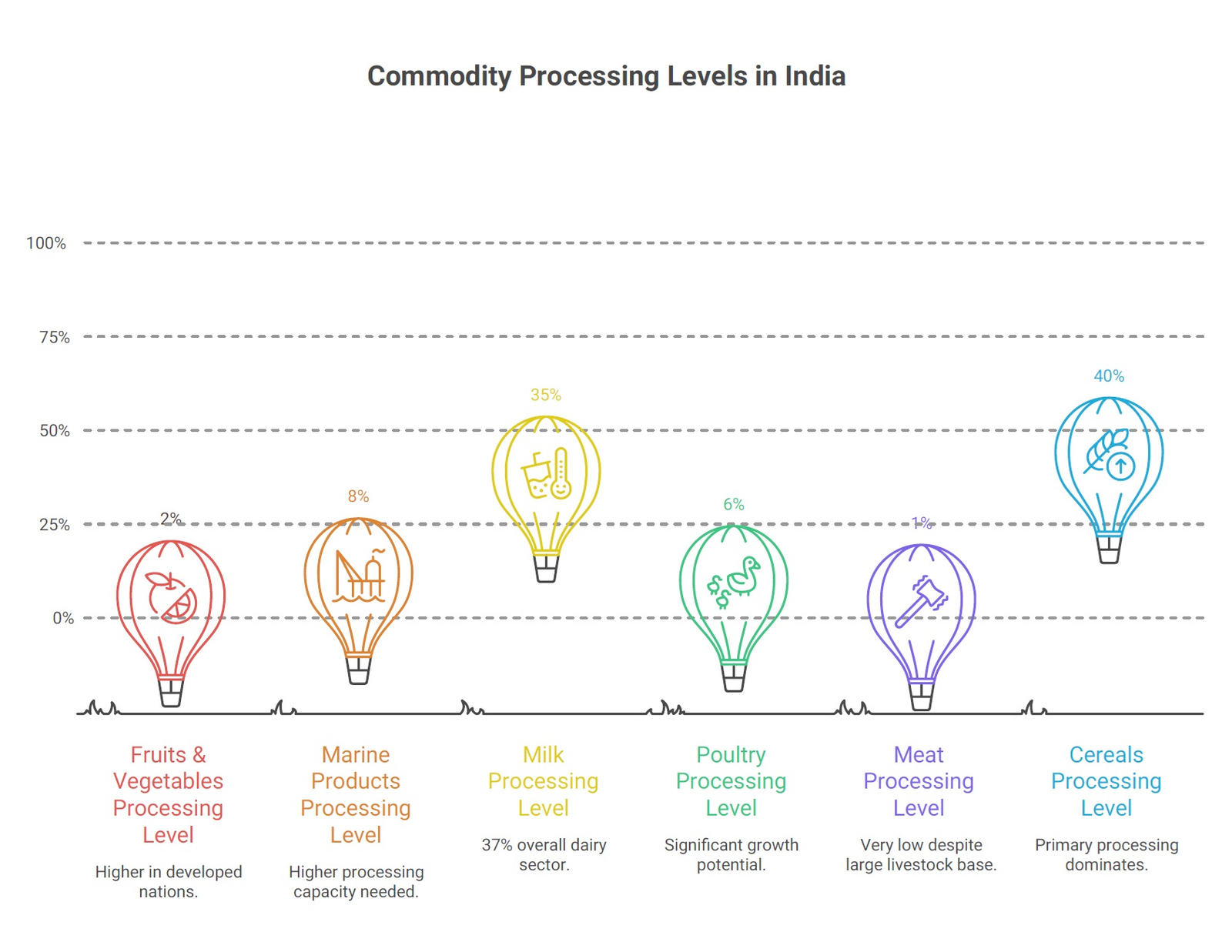
Despite India’s large production base, the processing levels remain significantly low:
| Commodity | Processing Level | Global Benchmark |
|---|---|---|
| Fruits & Vegetables | 2% | Higher in developed nations |
| Marine Products | 8% | Higher processing capacity needed |
| Milk | 35% | 37% overall dairy sector |
| Poultry | 6% | Significant growth potential |
| Meat | 1% | Very low despite large livestock base |
| Cereals | 40% of total processing | Primary processing dominates |
Key Challenge: More than 75% of the food processing industry remains in the unorganized sector
IV. MAJOR SEGMENTS OF FOOD PROCESSING INDUSTRY
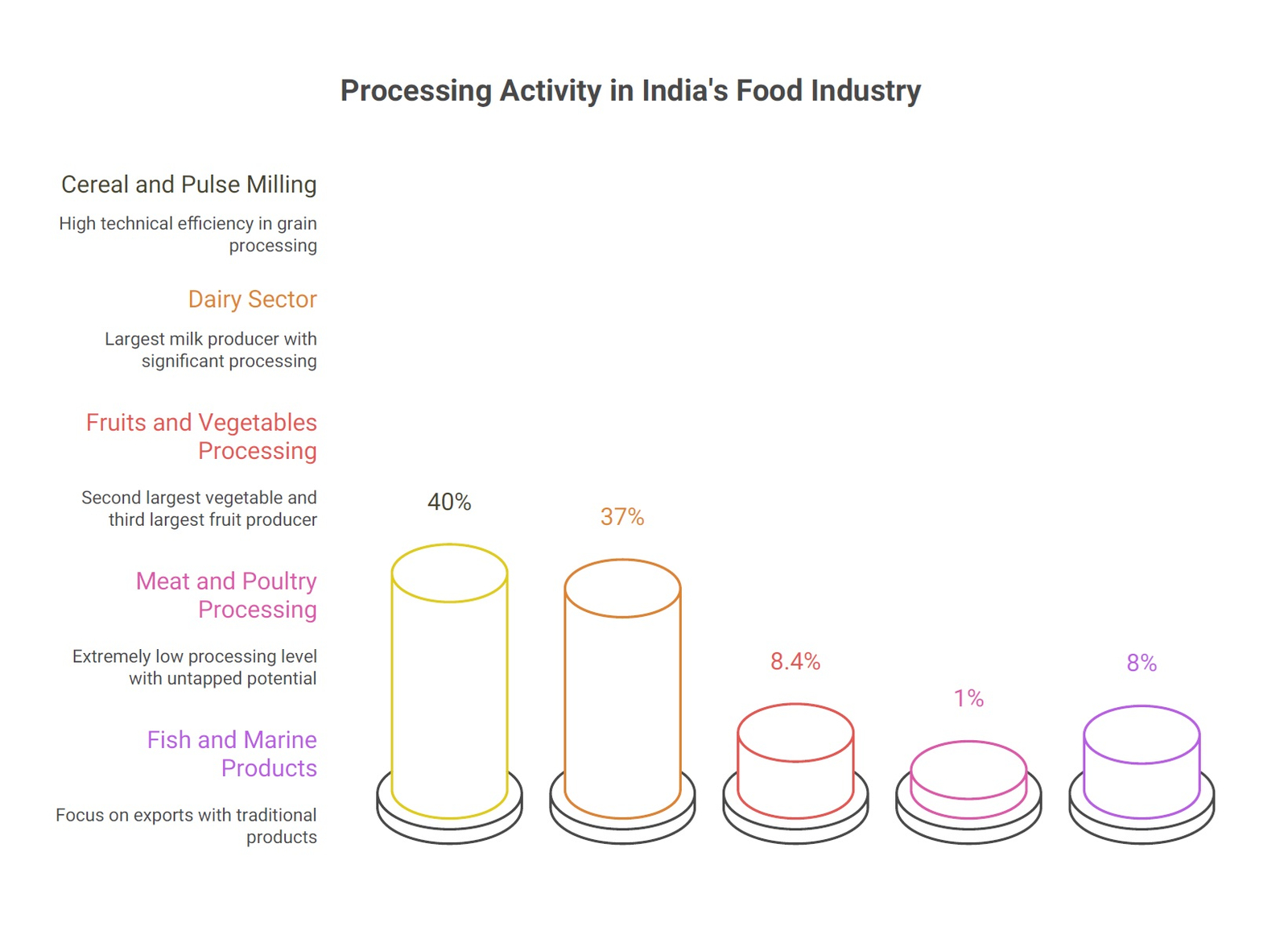
A. Cereal and Pulse Milling (Primary Processing)
Accounts for approximately 40% of total processing activity
Includes rice, sugar, edible oil, and flour mills
Grain processing with high technical efficiency
B. Dairy Sector (Largest Segment)
India is the world’s largest milk producer
37% of dairy yield is processed (largest proportion among all segments)
Organized sector processes approximately 15% of total milk production
Major products: milk powders, yogurt, cheese, butter, ghee
C. Fruits and Vegetables Processing
India is 2nd largest producer of vegetables and 3rd largest of fruits globally
Accounts for 8.4% of world’s food and vegetable yield
Processing techniques: canning, dehydration, pickling, bottling, freezing
Major products: juices, jams, pickles, dried fruits, frozen vegetables
D. Meat and Poultry Processing
India has largest livestock population globally (50% of world’s buffaloes)
Processing level extremely low: only 1% of total meat production converted to value-added products
Significant untapped potential in this segment
Major products: meat products, poultry items, processed meat
E. Fish and Marine Products
Current processing: 8% of production
Focus on exports to global markets
Traditional products: salted fish, dried fish, fishmeal
F. Other Segments
Beverages (coffee, tea, cocoa, soft drinks)
Bakery products (bread, biscuits)
Confectioneries and chocolates
Edible oils and fats
Breakfast cereals and fortified foods
Plant-based meat alternatives (emerging market)
V. LOCATIONAL FACTORS AND REGIONAL DISTRIBUTION
A. Factors Determining Location
1. Proximity to Raw Materials:
Industries processing bulk, low-value commodities (cereals, oilseeds) locate near production areas
Weight loss in processing (e.g., cotton ginning) makes raw material area location economical
2. Proximity to Markets:
Perishable products (bakery items, dairy products) require location close to consumer markets
Small processing units more market-sensitive than large ones
Large market centers offer better labour supply and lower distribution costs
3. Climate and Environmental Factors:
North-Western India advantages:
Cooler climates suitable for preserving food products
Lower humidity compared to peninsular and eastern India
Better conditions for storage infrastructure
Environmental regulations and waste handling capacity
4. Economic Factors:
Availability of cheap labor: Reduces operating costs significantly
Agricultural economy: Abundant raw materials at lower costs
Cost of production: 40% lower production costs in India compared to global averages
5. Infrastructure and Connectivity:
Road and rail connectivity for transportation
Proximity to ports for export-oriented industries
Water availability and management
B. Regional Distribution of Food Processing Industries
Southern Region – Leading Hub:
Houses the highest number of registered food processing factories
Andhra Pradesh: Approximately 14.3% of registered factories
Tamil Nadu: Significant concentration of food processing units
Telangana: Emerging as major processing hub
South region accounts for largest output share in food processing
North-Western Region – Primary Hub:
Punjab and Haryana: Historic centers for grain processing and dairy
Rajasthan: Growing agro-processing cluster
Uttar Pradesh: Major contributor to food processing capacity
State-wise Output Share (2023):
Madhya Pradesh: 22% (Pulses)
Maharashtra: 16.9% (Pulses)
Rajasthan: 13% (Pulses)
Uttar Pradesh: 12.3% (Pulses)
Gujarat: 7.7% (Pulses)
VI. UPSTREAM REQUIREMENTS (Pre-Processing Stage)
A. Raw Material Accessibility
Primary Requirement:
Easy availability of raw materials at lower costs
Established linkages with agricultural sectors
Access to diverse crop varieties for different processing needs
B. Modern Extraction and Processing Techniques
Adoption of advanced processing technologies
Implementation of modern machinery and equipment
Research and development for improved processing methods
C. Farmer Linkages
Importance:
Direct connection between farmers and processing units
Ensures sustainability and continuous raw material supply
Improves farmer income and incentivizes cultivation
Government Initiatives:
E-NAM (Electronic National Agriculture Market): Connects farmers directly with buyers
Farmer Producer Organizations (FPOs): Reduce dependency on middlemen
MSP (Minimum Support Price): Government support to farmers
D. Raw Material Storage Facilities
Critical Infrastructure:
Storage facilities for grains, meat, fish, and other commodities
Cold storage capacity for perishable items
Silos and warehousing infrastructure
Current Challenge:
Additional cold storage capacity needed: 3.5 million MT deficit exists
Under PMKSY’s Integrated Cold Chain Scheme: 268 out of 376 approved projects operationalized
Cold storage capacity created: 8.38 lakh MT (as of December 2022)
E. Quality Testing Facilities
Modern laboratories for food quality analysis
Standardization testing infrastructure
Certification capabilities for export standards
F. Transportation Infrastructure
Refrigerated vehicles for perishable transport
Road and rail networks connecting production to processing centers
Specialized refrigerated wagons for temperature-controlled transport
Adequate logistics and distribution networks
G. Workforce Development
Skilled and semi-skilled labor availability
Training and capacity building programs
Employment opportunities in rural areas
VII. DOWNSTREAM REQUIREMENTS (Post-Processing Stage)
A. Processing and Manufacturing
Key Functions:
Conversion of raw agricultural produce into processed food products
Maintenance of hygiene and quality standards during processing
Implementation of automation and advanced processing techniques
B. Storage and Warehousing
Infrastructure Components:
Modern cold storage and warehouse facilities to prevent spoilage
Inventory management systems to track stock levels
Reduction of wastage through proper storage management
Multiple-temperature controlled storage for diverse products
C. Packaging and Processing Equipment
High-quality packaging materials to maintain product integrity
Integrated Quick Freezing (IQF) and blast freezing technologies
Packing facilities for product preparation
Food preservation and modification technologies
D. Distribution and Retail Network
Supply Chain Coverage:
Efficient distribution to wholesalers and retailers
Supermarket and e-commerce platform access
Last-mile delivery to enhance consumer satisfaction
Growth Areas:
Online delivery platforms: BigBasket, Swiggy, Zomato
Organized retail expansion: Growing penetration in tier-2 and tier-3 cities
Direct-to-consumer models reducing middlemen
E. Quality Control and Regulatory Compliance
Standards and Certifications:
Adherence to FSSAI (Food Safety and Standards Authority of India) guidelines
Quality checks and certifications for international standards
Regular audits and inspections
FSSAI Inspection Framework (2025):
Grading system: A+ (Exemplar, 90+ marks), A (Satisfactory, 80-89 marks), B (Needs Improvement, 50-79 marks)
Assessment of hygiene, sanitation, staff hygiene, temperature control
Critical requirements marked with asterisks for non-negotiable compliance
VIII. SUPPLY CHAIN MANAGEMENT IN FOOD PROCESSING
A. Components of Food Supply Chain
1. Primary Stage – Farmer to Middleman:
Farmers produce agricultural commodities
Traditional middlemen connect farmers to processors
MSP policies influence farmer decisions
2. Processing Stage:
Raw material procurement and quality checking
Processing using appropriate techniques
Quality assurance and packaging
3. Storage and Distribution:
Warehousing and inventory management
Temperature-controlled transportation
Distribution to retailers and wholesalers
4. Retail to Consumer:
Final product reaching consumer through organized retail and e-commerce
Direct-to-consumer models gaining momentum
B. Key Challenges in SCM
Infrastructure Deficits:
Fragmented agricultural supply chain: Small-scale farmers lack direct market linkages
Poor cold storage infrastructure: Limited facilities result in spoilage of perishables
Inadequate transportation: Lack of refrigerated trucks and poor road connectivity
Operational Challenges:
Regulatory bottlenecks: Complex compliance processes hinder smooth operations
High logistics costs: Rising fuel prices and inefficient networks increase distribution costs
Limited technology adoption: Many SMEs do not use advanced SCM technologies
Inadequate pest control: Infestation and pathogens cause storage losses
C. Post-Harvest Losses – A Critical SCM Issue
Scale of Problem:
India loses Rs 1.53 trillion (USD 18.5 billion) annually from post-harvest losses
10-15% of overall food production lost to poor handling
Cereals loss: 4.44% (compared to China’s 2.22%)
Transit losses: 0.22% during distribution (2021-22)
Determinants of Loss:
Lack of proper storage facilities and cooling systems
Inappropriate packaging leading to physical damage and pest exposure
Limited market access resulting in delayed sales
Poor handling practices throughout supply chain
Inadequate knowledge and management capacity
D. Technology Integration in SCM
Emerging Solutions:
Blockchain: Enhanced traceability and transparency in supply chains
IoT (Internet of Things): Real-time monitoring of product conditions
AI and Analytics: Optimizing logistics routes and reducing costs
Automated warehousing: Improving inventory management and reducing errors
Digital supply chains: Farm-to-fork integration and reduced middlemen
E. Government Initiatives for SCM Improvement
1. Pradhan Mantri Kisan SAMPADA Yojana (PMKSY):
Outlay: Rs 10,900 crore (2021-27)
Components:
Mega Food Parks
Integrated cold chain and value addition infrastructure
Creation/expansion of food processing capacities
Infrastructure for agro-processing clusters
Food safety and quality assurance
Operation Greens scheme
Impact: Approved 41 Mega Food Parks, 353 cold chain projects, 63 agro-processing clusters
2. Integrated Cold Chain and Value Addition Infrastructure:
Grant-in-Aid: 35% for storage infrastructure (50% for NE/Himalayan states)
Components: Pre-cooling, sorting, grading, multi-temperature cold storage, IQF, blast freezing
Eligible Products: Horticulture, non-horticulture, fish/marine, dairy, meat, poultry
3. Operation Greens:
Focuses on Tomato, Onion, Potato (TOP) value chains
Provides subsidy on transportation and storage
As of 2022: 52 projects approved for value chain development
4. PM Formalisation of Micro Food Processing Enterprises (PMFME):
Supported close to 2 lakh micro enterprises over five years
Credit-linked subsidies and infrastructure creation
Transforms small enterprises into medium-sized operations
5. Production Linked Incentive (PLI) Scheme for Food Processing:
Budget: Rs 10,900 crore (2021-22 to 2026-27)
Target Products: RTC/RTE foods, millet-based products, processed fruits & vegetables, marine products
Investment Catalyzed: Rs 7,000 crore
Employment Generated: 2.5 lakh+ jobs (with 41 lakh tonnes capacity created)
Benefited Farmers: 9 lakh farmers
Project Support: 1,600+ projects funded across 213 locations
6. PLI Scheme for Millet-Based Products:
Outlay: Rs 800 crore (launched 2022-23)
Promotes sustainable and nutritious food alternatives
Utilizes FY 2022-23 savings from PLISFPI
IX. MEGA FOOD PARKS SCHEME
A. Objectives
Establish direct linkage from farm to processing to consumer markets
Increase processing of perishables from 6% to 20%
Increase India’s share in global food trade by 3% (by 2015)
Create modern infrastructure for food processing along the value chain
B. Scheme Highlights
Government Grant: Up to Rs 50 crores per food park to a consortium
Processing Units Expected: 30-35 units per park
Collective Investment: Minimum Rs 250 crores from consortium companies
Expected Turnover: Rs 400-500 crores per park
Employment Generation: 30,000 jobs per operational park; 5,000 directly
Farmer Connections: Each MFP expected to connect with 25,000 farmers
Quality Labs: Established at each food park
C. Operational Status
Total Approved: 42 Mega Food Parks sanctioned across India
Operational Parks (as of 2024):
Multiple parks now functional providing integrated processing infrastructure
Examples: Srini Mega Food Park (Chittoor, AP), Godavari Aqua Park (West Godavari, AP), North East Mega Food Park (Assam)
Major Operational Parks by State:
| State | Location | Focus |
|---|---|---|
| Andhra Pradesh | Chittoor, Bhimavaram, West Godavari | Dairy, Aqua processing |
| Assam | Nalbari | Diverse processing |
| Gujarat | Surat | Agricultural processing |
| Himachal Pradesh | Una | Horticultural products |
| Karnataka | Tumkur, Mandya | Integrated food processing |
| Maharashtra | Aurangabad, Satara | Multi-product processing |
| Odisha | Rayagada, Khurda | Marine and agro products |
| Punjab | Fazilka, Kapurthala | International standards |
| Rajasthan | Ajmer | Regional production |
| Telangana | Nizamabad, Khammam | Smart agro-processing |
| Uttarakhand | Haridwar, Udham Singh Nagar | Himalayan products |
| West Bengal | Jangipur | Regional specialties |
X. CHALLENGES IN FOOD PROCESSING SECTOR
A. Low Processing Levels
Only 2% of fruits and vegetables processed (vs. requirement of 20%)
Only 8% of marine products processed
Only 6% of poultry products processed
Only 1% of total meat converted to value-added products
Vast untapped potential in food processing
B. Post-Harvest Losses
Annual loss of Rs 92,651 crore due to inadequate infrastructure
Required investment for improvement: Rs 89,375 crore
Primary causes: poor storage and transportation facilities
C. Unorganized Sector Dominance
More than 75% of industry remains unorganized
Limited access to finance and technology
Lack of standardization and quality compliance
D. Infrastructure Gaps
Cold chain deficit: 3.5 million MT additional capacity needed
Inadequate cold storage facilities causing spoilage
Limited refrigerated transport infrastructure
Poor connectivity in rural production areas
E. Quality and Regulatory Compliance
Stringent FSSAI standards require significant investment
Complex compliance procedures for small and medium enterprises
Frequent regulatory updates requiring continuous adaptation
International certification requirements for exports
F. Export Market Challenges
India holds only 2% of global food export market
Top 5 exporting nations control 34% of global share
Most exports directed to Indian diaspora (limited market diversification)
Need for building global brand recognition
G. Technology and Innovation Gaps
Limited adoption of advanced processing technologies in SMEs
Low investment in R&D relative to global competitors
Digital transformation still in nascent stages
Inadequate focus on value-added products
XI. GOVERNMENT POLICY FRAMEWORK
A. Regulatory Framework
Food Safety and Standards Act (FSSA), 2006:
Enforced by Food Safety and Standards Authority of India (FSSAI)
Covers food product specifications, packaging, labeling, hygiene standards
Stringent contaminant and pesticide residue limits
Certification and Standards:
AGMARK (Agricultural Mark) for agricultural products
ISO standards for quality management
Import certifications with rigorous testing protocols
B. Major Government Initiatives
1. Pradhan Mintri Kisan SAMPADA Yojana (PMKSY):
Umbrella scheme for comprehensive food processing support
Budget: Rs 10,900 crore (2021-27)
2. Production Linked Incentive (PLI) Scheme:
Budget: Rs 10,900 crore
Supports manufacturing and innovation in food processing
3. PM Formalisation of Micro Food Processing (PMFME):
Promotion of unorganized sector formalization
Credit-linked subsidies and infrastructure support
4. Pradhan Mantri Matsya Sampada Yojana (PMSSY):
Investment: Rs 20,050 crore
Focus on fisheries cold chain and post-harvest infrastructure
Target: Enhance fish production to 22 million MT
XII. EXPORT POTENTIAL AND OPPORTUNITIES
A. Current Export Status
Processed food exports: USD 16.2 billion (2024-25)
Growth rate: 11.74% CAGR
Agricultural exports: USD 48.2 billion (FY24)
Global market share: 2% only (significant growth potential)
B. Export Opportunities
1. Value Addition Potential:
Moving from primary commodities to value-added products
Scaling healthy Indian food products (millets, makhana)
GI-tagged products gaining global recognition
Herbal and natural product exports
2. Product Categories:
Spices and condiments
Dairy products
Processed fruits and vegetables
Marine and seafood products
Millet-based products
Chocolate and confectionery
3. Global Market Access:
USA, Netherlands, Germany as major markets
Top 10 global markets account for 53% of imports
Emerging demand for clean-label, protein-rich, gut-friendly foods
C. Competitive Advantages
Cost advantage: 40% lower production costs
Large labor force: Abundant low-cost skilled workforce
Strategic location: Proximity to Asian markets and export-importing regions
Diverse production base: Global competitiveness across multiple segments
XIII. EMPLOYMENT AND RURAL DEVELOPMENT
A. Employment Generation
Direct employment: 1.9 million workers in registered units
Potential employment: 9 million by 2030
PLI Scheme: 2.5 lakh+ jobs created
PMKSY: 13.09 lakh people employed
PMFME: Significant rural employment generation
B. Rural Development Impact
Income Enhancement:
Direct farmer income improvement through value addition
Reduced post-harvest losses increasing farmer returns
Better price realization through farmer linkages
Infrastructure Development:
Establishment of processing units in agricultural areas
Creation of rural infrastructure through mega food parks
Cold chain development in remote regions
Livelihood Opportunities:
Employment in processing, packaging, distribution
Skill development and training opportunities
Entrepreneurship through PMFME and related schemes
XIV. KEY PERFORMANCE INDICATORS (UPSC Mains Context)
| Indicator | Current Value | Significance |
|---|---|---|
| Industry Size | USD 336.4 billion | 6th largest globally |
| Contribution to Manufacturing GDP | 12% | Major economic sector |
| Employment | 1.9 million registered | Significant job provider |
| Processing Level (F&V) | 2% | Indicates huge growth potential |
| Export Value | USD 16.2 billion | Growing export competitiveness |
| AAGR | 7.26% | Strong sector growth |
| Projected Size (2027) | USD 1,274 billion | Doubling from 2022 |
| Post-Harvest Loss | Rs 92,651 crore annually | Critical challenge |
| Cold Storage Deficit | 3.5 million MT | Infrastructure need |
XV. FUTURE PROSPECTS AND RECOMMENDATIONS
A. Growth Drivers
Rising middle-class consumption
Urbanization and changing food preferences
Digital platform growth (e-commerce, online delivery)
Government policy support through multiple schemes
Export demand for value-added products
B. Strategic Recommendations for Growth
1. Infrastructure Development:
Expand cold chain capacity by 3.5 million MT
Improve transportation and logistics networks
Establish agro-processing clusters in production zones
2. Technology Integration:
Promote blockchain, IoT, and AI adoption
Support automation in SMEs
Digital supply chain implementation
3. Export Promotion:
Building global brand recognition
Focus on clean-label and health-conscious products
Diversify export markets beyond diaspora markets
4. Skill Development:
Training programs for workforce upskilling
Formalizing unorganized sector
5. Regulatory Harmonization:
Streamline FSSAI compliance procedures
Align with international food safety standards
XVI. QUICK REVISION POINTS FOR UPSC
Definition: Conversion of raw agricultural products into value-added food items through preservation, packaging, and processing techniques.
Scale: 6th largest globally; 12% of India’s manufacturing GDP; USD 336.4 billion valued.
Significance: Reduces post-harvest losses (15-20%), provides rural employment (1.9 million), generates exports (USD 16.2 billion), ensures food security.
Location Factors: Proximity to raw materials (North-West), markets (urban centers), climate (cool regions), and infrastructure.
Upstream: Raw material accessibility, farmer linkages, cold storage, testing facilities, transport, workforce.
Downstream: Processing, packaging, warehousing, distribution, quality control, retail networks.
Supply Chain: Farm to consumer journey involving sourcing, processing, storage, distribution stages; challenged by fragmented agriculture, poor cold chain, high costs.
Challenges: Low processing levels (2% F&V), 75% unorganized sector, post-harvest losses (Rs 92,651 crore annually), cold chain deficit, regulatory compliance costs.
Government Schemes: PMKSY (Rs 10,900 crore), PLI (generating 2.5 lakh jobs), PMFME (2 lakh enterprises supported), PMSSY (fisheries focus).
Mega Food Parks: 42 sanctioned; provide integrated infrastructure, connect 25,000 farmers per park, generate 30,000 jobs per park.
Export Potential: 2% global share (USD 16.2 billion); opportunity to move to value-added products and diverse markets; 40% cost advantage.
Employment: 1.9 million current; 9 million potential by 2030; significant rural development impact.
UPSC MAINS QUESTIONS
2025 – UPSC Mains
Q1. Elaborate the scope and significance of supply chain management of agricultural commodities in India. (10 Marks, 150 Words)
Q2. Examine the scope of the food processing industries in India. Elaborate the measures taken by the government in the food processing industries for generating employment opportunities. (15 Marks, 250 Words)
2024 – UPSC Mains
Q. What are the major challenges faced by Indian irrigation system in recent times? State the measures taken by the government for efficient irrigation management. (Related to agricultural infrastructure)
2023 – UPSC Mains
Q1. How does e-Technology help farmers in production and marketing of agricultural produce? Explain it. (10 Marks)
Q2. Explain the changes in cropping pattern in India in the context of changes in consumption pattern and marketing conditions. (10 Marks)
Q3. Discuss the significance of essential upstream and downstream requirements in ensuring a robust and sustainable food processing industry. (10 Marks, 150 Words)
2022 – UPSC Mains
Q1. Elaborate the scope and significance of the food processing industry in India. (10 Marks, 150 Words)
Q2. What are the main bottlenecks in the upstream and downstream process of marketing of agricultural products in India? (15 Marks, 250 Words)
2020 – UPSC Mains
Q. What are the challenges and opportunities of the food processing sector in the country? How can income of the farmers be substantially increased by encouraging food processing? (10 Marks, 150 Words)
2019 – UPSC Mains
Q1. How far is Integrated Farming System (IFS) helpful in sustaining agricultural production? (10 Marks)
Q2. What are the reformative steps taken by the Government to make the food grain distribution system more effective? (15 Marks)
Q3. Elaborate the policy taken by the Government of India to meet the challenges of the food processing sector. (15 Marks, 250 Words)
2018 – UPSC Mains
Q1. What do you mean by Minimum Support Price (MSP)? How will MSP rescue the farmers from the low-income trap? (10 Marks)
Q2. Examine the role of supermarkets in supply chain management of fruits, vegetables, and food items. How do they eliminate the number of intermediaries? (10 Marks, 150 Words)
Q3. Assess the role of the National Horticulture Mission (NHM) in boosting the production, productivity, and income of horticulture farms. How far has it succeeded in increasing the income of farmers? (15 Marks, 250 Words)
2017 – UPSC Mains
Q1. Explain various types of revolutions that took place in agriculture after Independence in India. How have these revolutions helped in poverty alleviation and food security in India? (10 Marks)
Q2. What are the reasons for poor acceptance of cost-effective small processing units? How can the food processing unit be helpful to uplift the socio-economic status of poor farmers? (10 Marks, 150 Words)
Q3. How do subsidies affect the cropping pattern, crop diversity, and economy of farmers? What is the significance of crop insurance, minimum support price, and food processing for small and marginal farmers? (15 Marks, 250 Words)
2016 – UPSC Mains
Q. What are the impediments in marketing and supply chain management in developing the food processing industry in India? Can e-commerce help in overcoming these bottlenecks? (12.5 Marks, 250 Words)
2015 – UPSC Mains
Q. What are the impediments in marketing and supply chain management in developing the food processing industry in India? Can e-commerce help in overcoming this bottleneck? (12.5 Marks, 250 Words)
2013 – UPSC Mains
Q. India needs to strengthen measures to promote the pink revolution in food industry for ensuring better nutrition and health. Critically elucidate the statement. (15 Marks, 250 Words)
AGRICULTURE AND FOOD PROCESSING


Discover more from Simplified UPSC
Subscribe to get the latest posts sent to your email.