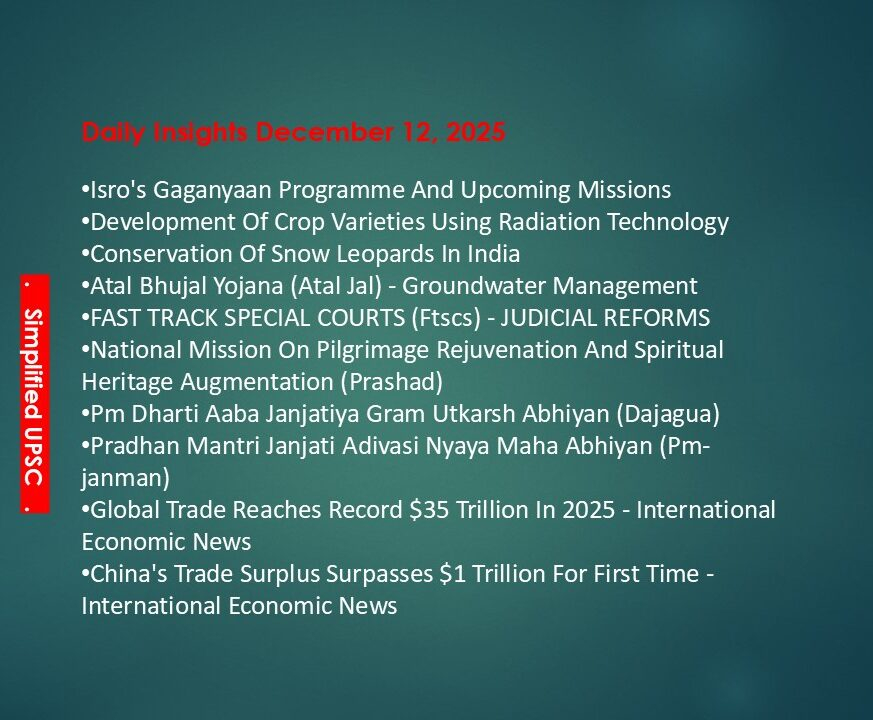
Daily Insights December 12, 2025
Contents
Daily Insights December 12, 2025
1. ISRO’S GAGANYAAN PROGRAMME AND UPCOMING MISSIONS
CONTEXT
India is on the verge of achieving a historic milestone in human spaceflight. The Indian Space Research Organisation (ISRO) has declared 2025 as the “Gaganyaan Year,” marking a pivotal moment in India’s journey towards independent human space exploration capabilities. This programme represents India’s ambitious goal to join the elite group of nations capable of sending humans to space and safely bringing them back.
ABOUT – Key Points
- Mission Timeline: First uncrewed test flight (G1) scheduled for December 2025 with Vyommitra (half-humanoid robot)
- Vyommitra’s Role: Will simulate human responses to microgravity, monitor spacecraft systems, and provide crucial data to enhance safety protocols
- Test Completion: ISRO has completed 7,200 tests; 3,000 tests still pending
- Crewed Mission Target: First human spaceflight planned for Q1 2027
- Uncrewed Missions: Two additional uncrewed missions planned after G1 before crewed flights
- Launch Vehicle: Indigenous PSLV being used; ISRO developing enhanced launch capabilities
- Key Technologies: Life support systems, avionics, navigation, safety protocols being validated
- Budget & Infrastructure: Significant investment in astronaut training and spacecraft development
- International Collaboration: SpaDeX mission successfully demonstrated in-space docking with only half the allocated fuel
- NASA Partnership: NASA-ISRO synthetic aperture radar satellite planned for 2025 launch
- Success Rate: Demonstrates ISRO’s indigenous capability and engineering excellence
- Strategic Importance: Part of India’s vision to be self-reliant in space technology
- Leadership: ISRO Chairman V. Narayanan leading the initiative
Ministry/Department: Department of Space, ISRO
Release Date: Ongoing; Updates expected throughout December 2025
2. DEVELOPMENT OF CROP VARIETIES USING RADIATION TECHNOLOGY
CONTEXT
India has made significant advances in agricultural innovation through atomic energy applications. The Department of Atomic Energy has successfully developed improved crop varieties using radiation-induced mutagenesis and cross-breeding techniques, addressing food security and farmer prosperity objectives.
ABOUT – Key Points
- Total Varieties Developed: 72 improved crop varieties by BARC till date; 71 varieties developed using radiation technologies
- Recent Releases (2020-2025): 23 new varieties released in last 5 years
- Crop Types: Rice (7 varieties), mustard (5), black gram/urad (3), sorghum/jowar (3), groundnut (2), mung bean (1), sesamum/til (1), banana (1), wheat included
- Desirable Traits: High-yield, early maturity, biotic and abiotic stress-tolerant, climate resilience, drought resistance, disease resistance, lodging resistance
- Technology Partner: Bhabha Atomic Research Centre (BARC) – Primary research institution
- Release Process: Official release through Ministry of Agriculture & Farmers Welfare following field trials by ICAR and State Agricultural Universities
- Field Testing: Multiple location trials in different agroclimatic zones before commercial release
- Gazette Notification: All releases officially published through government notifications
- Commercial Cultivation: These varieties now cultivated across India, providing economic benefits to farming community
- Radiation Technique: Radiation-induced mutagenesis combined with cross-breeding methodology
- Food Irradiation: 28 food irradiation facilities established for shelf-life extension
- Export Benefits: Mango shelf-life extended to 35 days; onion and potato to 7.5-8 months for export logistics
- Sustainability: Supports climate-smart agriculture and farmer income doubling objectives
Ministry/Department: Department of Atomic Energy, Ministry of Agriculture & Farmers Welfare
Release Date: November 19, 2025 (PIB)
3. CONSERVATION OF SNOW LEOPARDS IN INDIA
CONTEXT
India’s snow leopard conservation has entered a critical phase with the release of the first comprehensive Snow Leopard Population Assessment Report. This initiative demonstrates India’s commitment to protecting this endangered species and preserving high-altitude ecosystems while engaging local communities in conservation efforts.
ABOUT – Key Points
- Population Assessment: First scientific estimate of 718 snow leopards in India released by Ministry of Environment, Forest & Climate Change
- Global Comparison: Indian population represents one-sixth to one-ninth of global population (estimated 3,000-9,500 globally)
- Geographic Distribution: Found across western Himalayas; approximately 477 snow leopards in Ladakh (highest concentration)
- Conservation Status: IUCN listed as Vulnerable; Schedule-I under Wildlife (Protection) Act 1972; CITES Appendix-I
- Key Habitats: Great Himalayan National Park, Spiti, Lahaul, Ladakh, Kashmir regions; Thajwas Wildlife Sanctuary serves as crucial corridor
- Community Participation: Women-led monitoring teams established; example from Kibber village in Himachal Pradesh with 11-member women’s team
- Himal Sanrakshak Programme: Launched October 2020 to engage local communities in snow leopard protection
- Research Institutions: Wildlife Institute of India, Nature Conservation Foundation leading conservation efforts
- Population Monitoring: Camera trapping methodology; planned every 3-5 years as per Future Directions
- Climate Challenges: Snowfall reduction, glacier melting, habitat fragmentation identified as major threats
- Community Tourism: Community-based tourism providing alternative income source, incentivizing habitat protection
- Landscape Conservation Plan: Himachal Pradesh Forest Department preparing draft management plan integrating scientific research and community participation
- Threat Mitigation: Measures to reduce human-wildlife conflict and promote sustainable livelihoods
Ministry/Department: Ministry of Environment, Forest & Climate Change, Himachal Pradesh Forest Department
Release Date: October 2025 (Report Release)
4. ATAL BHUJAL YOJANA (ATAL JAL) – GROUNDWATER MANAGEMENT
CONTEXT
The Atal Bhujal Yojana represents India’s comprehensive approach to sustainable groundwater management through community participation. Launched on December 25, 2019, under the Jal Jeevan Mission, this scheme addresses critical water-stress challenges in major agricultural states and ensures long-term water security for farming communities.
ABOUT – Key Points
- Launch Date: December 25, 2019 (Atal Bihari Vajpayee’s 95th birth anniversary) under Jal Jeevan Mission
- Target States: 7 designated priority states – Gujarat, Haryana, Karnataka, Madhya Pradesh, Maharashtra, Rajasthan, Uttar Pradesh
- Scheme Duration: 2020-2025 (implementation period)
- Coverage: 78 districts and 8,350 gram panchayats benefited across 1,647 gram panchayats in 36 blocks of 14 districts (as of recent updates)
- Funding: World Bank approved scheme with US$ 719 million (Rs. 6,000 crore) investment
- Beneficiaries: Women, small marginal farmers, agricultural labourers, government agencies, rural populations
- Water-Stressed Areas: Priority given to over-exploited, critical, and semi-critical watershed areas
- Key Interventions: Demand-side management, water security plans at village level, community-led participatory approach
- Supply-Side Measures: Riverbed recharge, rainwater harvesting initiatives, AI-enabled pump controllers
- Recent Performance (Maharashtra): 38 out of 43 talukas and 71 out of 73 watersheds showing improved groundwater extraction rates (2023-2024 comparative analysis)
- Incentive Fund: Rs. 184.24 crore allocation for enhanced groundwater resources management
- Community Behavior Change: Emphasis on water conservation culture at grassroots level
- Double Income Objective: Supports Prime Minister’s farmer income doubling initiative
- Convergence Model: Links with ongoing government schemes for effective implementation
Ministry/Department: Ministry of Jal Shakti (Jal Jeevan Mission)
Release Date: Ongoing; Updates through 2024-25
5. FAST TRACK SPECIAL COURTS (FTSCs) – JUDICIAL REFORMS
CONTEXT
The Fast Track Special Courts Scheme represents a critical initiative under the Nirbhaya Fund to expedite justice delivery in sensitive criminal cases. This centrally sponsored scheme focuses on rapidly clearing the backlog of rape and child sexual abuse cases, ensuring timely justice for victims and deterring future crimes.
ABOUT – Key Points
- Scheme Category: Centrally Sponsored Scheme under Ministry of Law & Justice
- Funding Source: Nirbhaya Fund (dedicated for women’s safety initiatives)
- Scheme Duration: Extended from April 1, 2023 to March 31, 2026 (3 years) by Cabinet approval (November 28, 2023)
- Total Financial Outlay: Rs. 1,952.23 crore (Central Share: Rs. 1,207.24 crore)
- Current Operational Status: 773 FTSCs functional as of August 2025
- POCSO Courts: 400 exclusive POCSO (Protection of Children from Sexual Offences) courts – ePOCSO courts operational
- Geographic Coverage: 29 States/Union Territories
- Case Disposal: 3,44,000+ pending cases disposed till August 2025
- Annual Target: Each FTSC tasked with disposing minimum 165 cases annually
- Case Categories: Primarily rape and child sexual abuse cases under POCSO Act
- Previous Phase: Initial implementation 2019-21 (1 year) with Rs. 767.25 crore; extension 2021-23 with Rs. 1,572.86 crore
- Staffing: One Judicial Officer with 7 support staff per court; Flexi Grant for operational expenses
- Financial Release (2025-26): Rs. 200 crore allocated; Rs. 65.51 crore released to States/UTs as central share
- Fund Distribution: CSS pattern – Central share varies (60:40, 90:10) depending on state category
- Success Indicator: Average disposal time reduced; improved conviction rates in sensitive cases
- Government Commitment: Continuing extension indicates commitment to victim justice and expeditious trials
Ministry/Department: Ministry of Law & Justice, Department of Justice
Release Date: Extended November 28, 2023; Updated August 2025
6. NATIONAL MISSION ON PILGRIMAGE REJUVENATION AND SPIRITUAL HERITAGE AUGMENTATION (PRASHAD)
CONTEXT
The PRASHAD Scheme, launched in 2014-15, represents India’s strategic vision to develop pilgrimage and heritage tourism destinations. This initiative combines spiritual values with sustainable tourism development, promoting India’s rich cultural heritage while generating employment and economic growth in temple towns and pilgrimage centers.
ABOUT – Key Points
- Launch Year: 2014-15 under Ministry of Tourism
- Full Form: Pilgrimage Rejuvenation And Spiritual, Heritage Augmentation Drive
- Primary Objective: Integrated development and enhancement of pilgrimage and heritage tourism sites
- Approach: Planned, prioritized, and sustainable manner of development
- Focus Areas: Infrastructure development, beautification, preservation of religious/spiritual destinations
- Modern Integration: Modern amenities, improved connectivity, sustainable tourism practices
- Amenities Enhancement: Sanitation, security, accessibility improvements for inclusive visitor experience
- Tourism Attractiveness: Positioning pilgrimage as major engine for economic growth and employment
- Heritage Preservation: Focus on heritage structures, local arts, culture, handicrafts, and regional cuisine
- Livelihood Generation: Creating employment through heritage and cultural activities in identified locations
- Infrastructure Gaps: Bridging gaps at pilgrimage destinations and heritage cities
- Beneficiaries: Local communities, pilgrims, tourists, heritage traders, artisans
- Economic Impact: Direct and multiplier effects on local economies and employment generation
- Community Participation: Strengthening mechanism for local involvement in tourism development
- Destination Integration: Creating world-class tourism projects in core tourism footprints
- Success Stories: Multiple pilgrimage sites successfully rejuvenated under the scheme
- Cultural Tourism Engine: Positioned as major driver of religious and spiritual tourism in India
Ministry/Department: Ministry of Tourism, Government of India
Release Date: Launched 2014-15; Ongoing implementation
7. PM DHARTI AABA JANJATIYA GRAM UTKARSH ABHIYAN (DAJAGUA)
CONTEXT
Prime Minister Narendra Modi launched the Dharti Aaba Janjatiya Gram Utkarsh Abhiyan on October 2, 2024, from Hazaribagh, Jharkhand, on Mahatma Gandhi’s birth anniversary. Named after Birsa Munda (Dharti Aaba – Earth Father), this transformative scheme targets comprehensive tribal development through saturated delivery of critical services and infrastructure across tribal-majority villages.
ABOUT – Key Points
- Launch Date: October 2, 2024 (Mahatma Gandhi’s birth anniversary) from Hazaribagh, Jharkhand
- Naming Significance: Named after Birsa Munda, tribal freedom fighter against British rule
- Previous Name: Known as Pradhan Mantri Janjati Unnat Gram Abhiyan (PM-JUGA)
- Total Financial Outlay: Rs. 79,156 crore (Central Share: Rs. 56,333 crore; State Share: Rs. 22,823 crore)
- Geographic Coverage: 63,843 tribal-dominated villages in 549 districts and 2,911 blocks across 30 States/UTs
- Beneficiary Population: More than 5 crore tribal people
- Implementation Duration: 5-year plan
- Key Interventions: 25 specific interventions across critical sectors
- Implementing Ministries: 17 line ministries coordinating implementation
- Convergence Model: Integration with existing government schemes for efficient resource utilization
- Focus Sectors: Social infrastructure, health, education, livelihood development
- Saturation Approach: Ensuring complete coverage of critical gaps in identified villages
- Sustainability: Designed for long-term holistic development of tribal communities
- Targeting: All tribal-majority villages and aspirational blocks included
- Recent Progress: Rs. 10,000 crore worth of projects sanctioned in first 10 months
- Housing Component: 40,000 houses constructed and keys distributed by September 17, 2024
- Financial Disbursement: 1st instalment released to 50,000 beneficiaries during Bhubaneswar event
Ministry/Department: Ministry of Tribal Affairs; Multiple Line Ministries
Release Date: October 2, 2024; Ongoing implementation
8. PRADHAN MANTRI JANJATI ADIVASI NYAYA MAHA ABHIYAN (PM-JANMAN)
CONTEXT
Launched on Janjatiya Gaurav Divas (November 15, 2023), the PM-JANMAN scheme represents a focused initiative to uplift Particularly Vulnerable Tribal Groups (PVTGs). This comprehensive programme provides holistic development interventions addressing housing, healthcare, education, livelihood, and social infrastructure for India’s most marginalized tribal communities.
ABOUT – Key Points
- Launch Date: November 15, 2023 (Janjatiya Gaurav Divas/Janjatiya Day)
- Financial Outlay: Rs. 24,104 crore
- Beneficiary Groups: 75 Particularly Vulnerable Tribal Groups (PVTGs)
- Geographic Scope: 18 States and 1 Union Territory (Andaman & Nicobar Islands)
- Implementation Period: 2023-24 to 2025-26 (3-year coverage)
- Key Interventions: 11 critical development areas
- Implementing Agencies: 9 line Ministries/Departments
- Housing Component: 226,064 pucca houses target; 19,788 completed (as of recent update)
- Healthcare Delivery: 578 Mobile Medical Units (MMUs) deployed for healthcare access
- Water Supply: 290,676 tap water connections installed (Jal Jeevan Mission integration)
- Connectivity: 2,746.17 km of roads constructed for improved accessibility
- Electrification: 123,530 unelectrified households targeted for power connections
- Solar Power Component: 5,067 households sanctioned under New Solar Power Scheme
- Focus Areas: Housing, drinking water, healthcare, education, nutrition, livelihood, electrification
- Quality of Life Improvement: Comprehensive interventions for holistic development
- Community-Centric Approach: Designed around PVTG needs and aspirations
- Regional Examples: Maram tribe in Manipur receiving infrastructure, housing, road connectivity benefits
- Progress Metrics: Measurable interventions with specific targets and timelines
- State Partnership: Collaborative approach with state governments for implementation
Ministry/Department: Ministry of Tribal Affairs; Multiple Line Ministries
Release Date: Launched November 15, 2023; Progress updates May 2025 onwards
9. GLOBAL TRADE REACHES RECORD $35 TRILLION IN 2025 – INTERNATIONAL ECONOMIC NEWS
CONTEXT
Global trade in 2025 is poised to exceed $35 trillion for the first time in recorded history, according to the United Nations Conference on Trade and Development (UNCTAD). This milestone represents a significant recovery in global commerce, driven by strong manufacturing growth, particularly in electronics and technology sectors, amid geopolitical reconfiguration of supply chains.
ABOUT – Key Points
- Historic Milestone: Trade projected to exceed $35 trillion in 2025, up from 2024 levels
- Growth Rate: Global trade growth approximately 7% in 2025 (adding ~$2.2 trillion)
- Goods Trade Growth: Approximately $1.5 trillion increase in goods trade
- Services Trade Growth: Approximately $750 billion increase (nearly 9% growth rate)
- Fourth Quarter Projection: Growth expected at slower pace (0.5% for goods; 2% for services)
- Price Dynamics: Trade good prices expected to decline Q4 2025; volumes driving growth
- East Asia Performance: Strongest regional growth at 9% over last four quarters; intra-regional trade growth at 10%
- Africa Growth: Strong expansion in African trade and south-south commerce
- South-South Trade: Expanding at 8% over last four quarters, showing developing economy resilience
- Manufacturing Dominance: Manufacturing sector remains main engine, growing 10% over four quarters
- Electronics Sector: Leading with 14% growth, driven by AI-related demand
- North America: Exports fell 3% in Q3 but grew 2% over four quarters
- European Trade: Continued growth at slower pace; exports up 2% Q3, 6% over four quarters
- China’s Trade: Trade surplus exceeded $1 trillion for first time; November surplus at $111.68 billion
- Trade Imbalances: Remains elevated; China’s goods surplus about $30 billion higher than previous year
- Friendshoring & Nearshoring: Both indicators rising toward 2021 long-term averages, indicating geopolitical realignment
- Trade Concentration: Growing share of trade through major economies; concentration among largest traders increasing
- 2026 Outlook: UNCTAD expects weaker growth due to slower global activity, rising debt, higher costs
Source: United Nations Conference on Trade and Development (UNCTAD)
Release Date: December 8, 2025
10. CHINA’S TRADE SURPLUS SURPASSES $1 TRILLION FOR FIRST TIME – INTERNATIONAL ECONOMIC NEWS
CONTEXT
China’s cumulative trade surplus has exceeded $1 trillion for the first time, reflecting the country’s response to U.S. protectionist policies under the Trump administration. Chinese manufacturers have strategically redirected exports to alternative markets including Europe, Australia, and Southeast Asia, while establishing production centers in lower-tariff regions to maintain global competitiveness.
ABOUT – Key Points
- Historic Milestone: China’s trade surplus surpassed $1 trillion cumulatively (first 11 months of 2025)
- November Performance: November trade surplus reached $111.68 billion (highest since June 2025)
- Previous Month Comparison: Increased from $90.07 billion in October 2025
- Forecast Variance: Exceeded expectations of $100.2 billion
- US Export Decline: US-bound exports plummeted nearly one-third compared to November 2024
- Strategic Diversification: Export redirection to Europe, Australia, and Southeast Asia
- Supply Chain Restructuring: Chinese firms establishing new production centers in third countries to avoid tariffs
- Tariff Avoidance: Response to anticipated Trump administration tariffs post-November 2024 election
- Market Shift: Moving production to countries with lower tariff barriers to US markets
- Trading Partners: Southeast Asia and European Union becoming primary export destinations
- Global Presence Utilization: Leveraging international presence of Chinese firms for tariff optimization
- Economic Policy: Part of broader diversification strategy away from US market dependency
- Regional Integration: Deepening trade relationships with non-US markets
- Manufacturing Strategy: Shift in global production networks and supply chain configuration
- Competitiveness Maintenance: Ensuring continued profitability and market share despite trade barriers
- Geopolitical Implications: Reflects US-China trade tensions and global supply chain reorientation
Source: Reuters; China General Administration of Customs Data
Release Date: December 7, 2025
11. GLOBAL CLIMATE CRISIS – 2025 TO BE SECOND OR THIRD HOTTEST YEAR ON RECORD
CONTEXT
The European Union’s Copernicus Climate Change Service (C3S) announced on December 9, 2025, that 2025 is poised to be the world’s second or third-warmest year on record. This alarming trend, following 2024’s record-breaking heat, underscores the urgency of climate action as extreme weather events continue to devastate regions globally and the Paris climate targets face increasingly uncertain prospects.
ABOUT – Key Points
- 2025 Temperature Status: Set to rank as second or third-warmest year on record; potentially surpassed only by 2024
- Record Temperature Increase: 2025 approximately 1.4°C above pre-industrial average so far
- Previous Record: 2024 held the record as planet’s hottest year on record
- Decade Trend: Last 10 years identified as the 10 warmest years since records began
- Historic Comparison: C3S records span since 1940; verified against global data from 1850 onwards
- Paris Agreement Targets: Global threshold of 1.5°C warming (limit to prevent worst consequences) increasingly unattainable
- Current Trajectory: World has not technically breached 1.5°C (decades-long average) but pathway closing rapidly
- UN Assessment: 1.5°C goal can no longer realistically be met; faster CO2 emission cuts needed
- Overshooting Risk: Limiting overshooting of 1.5°C threshold requires halving global emissions by 2035
- COP30 Outcomes: Governments failed to agree on substantial new greenhouse gas emission reduction measures
- Extreme Weather Events: Typhoon Kalmaegi (Philippines) – 200+ deaths; Spain wildfire crisis – worst in 3 decades
- Climate Attribution: Scientists confirmed anthropogenic climate change made extreme events more likely
- 2015-2025 Period: Ranking as warmest 11-year period on instrumental record; 2023-2025 the three warmest
- Greenhouse Gas Emissions: Confirmed as primary cause of warming through fossil fuel burning
- Global Emissions Projections: Even with full national climate plan implementation, temperatures headed for 2.3-2.5°C warming
- Emissions Gap: Current policies delivering ~2.8°C warming trajectory; requires 50% cut by 2035 for 1.5°C pathway
Source: European Union’s Copernicus Climate Change Service (C3S); World Meteorological Organisation; UN Environment Programme
Release Date: December 9-10, 2025
12. DEEPAVALI INSCRIBED ON UNESCO’S INTANGIBLE CULTURAL HERITAGE LIST
CONTEXT
Deepavali, India’s festival of lights, was inscribed on December 11, 2025, on the UNESCO Representative List of Intangible Cultural Heritage of Humanity. This historic recognition, announced during the 20th session of UNESCO’s Intergovernmental Committee at the Red Fort in New Delhi, acknowledges Deepavali’s significance as a living heritage that strengthens social bonds, preserves traditional craftsmanship, and promotes values of generosity and well-being.
ABOUT – Key Points
- UNESCO Inscription Date: December 11, 2025
- List Category: UNESCO Representative List of Intangible Cultural Heritage of Humanity
- Announcement Venue: Red Fort, New Delhi during 20th UNESCO Intergovernmental Committee session
- International Recognition: Adoption in presence of delegates from 194 member states
- Festival Significance: Living heritage connecting millions across India and globally
- Social Impact: Strengthens social bonds and community cohesion
- Cultural Preservation: Supports traditional craftsmanship and heritage practices
- Values Reinforcement: Reinforces values of generosity, well-being, and ethical living
- SDG Alignment: Contributes meaningfully to United Nations Sustainable Development Goals
- Participants: Union Minister of Culture Gajendra Singh Shekhawat led Indian delegation
- International Experts: Recognition from UNESCOs global network of international experts
- Prime Minister Statement: PM Modi noted that Deepavali is closely linked to Indian culture and ethos; “soul of our civilisation”
- Global Popularity: UNESCO inscription expected to enhance Deepavali’s global visibility and recognition
- Festival Components: Recognition of potters (diyas), artisans, farmers, sweet-makers, priests, household traditions
- Spiritual Dimension: Acknowledgment of spiritual and cultural dimensions of the festival
- Tourism Potential: Expected to boost pilgrimage and cultural tourism
- Heritage Status: Elevates Deepavali to international status as shared human heritage
Ministry/Department: Ministry of Culture, Government of India
Release Date: December 11, 2025
13. INDIA-OMAN FREE TRADE AGREEMENT – REGIONAL ECONOMIC INTEGRATION
CONTEXT
India and Oman are in final stages of concluding a Comprehensive Economic Partnership Agreement (CEPA), with Prime Minister Narendra Modi and Commerce Minister Piyush Goyal expected to travel to Oman next week (around December 17-18) to sign the historic trade deal. This agreement will strengthen bilateral economic ties, enhance market access, and promote commercial cooperation between the two nations.
ABOUT – Key Points
- Agreement Status: Negotiations completed; final bilateral round held January 13-14, 2025
- Negotiation Timeline: Began November 2023; three complete rounds by March 2024; fifth round January 2025
- Current Status: Final text and market access offers finalized; internal approvals in process
- Expected Signing: December 17-18, 2025 by PM Modi and Commerce Minister Piyush Goyal in Oman
- Delegation Composition: To be confirmed after Union Cabinet approval (largely formality at this stage)
- Cabinet Approval: Process awaiting formal Cabinet notification for signature dates
- Previous Deferment: Cabinet proposal submitted March 2024 but deferred; further renegotiations required
- Commerce Minister Statements: Piyush Goyal confirmed talks in “final stages” (December 11, 2025)
- New Zealand Negotiations: Commerce Minister also negotiating FTA with New Zealand (Todd McClay visiting December 13)
- EU Negotiations: Broad outline of EU FTA finalized after 8-day delegation visit and meetings with EU Commissioner for Trade
- Economic Importance: CEPA expected to enhance bilateral trade and commercial cooperation
- Market Access: Covers both goods and services with specific tariff schedules
- Strategic Partnership: Strengthens India’s Gulf cooperation strategy
- Regional Significance: Part of India’s broader Middle East economic engagement
- Trade Facilitation: Expected to reduce trade barriers and ease business operations
Ministry/Department: Ministry of Commerce & Industry; External Affairs Ministry
Release Date: Announced December 11, 2025; Signing expected December 17-18, 2025
14. INDIGO FLIGHT DISRUPTIONS AND AVIATION REGULATORY INTERVENTION
CONTEXT
India’s largest airline IndiGo faced massive flight disruptions in early December 2025, affecting hundreds of thousands of passengers after failing to adequately plan for new pilot rest regulations. The Directorate General of Civil Aviation (DGCA) launched a major crackdown, deploying nine senior officials to monitor operations and demanding compensation for stranded passengers, while the Delhi High Court intervened to ensure compliance with existing compensation guidelines.
ABOUT – Key Points
- Disruption Period: Early December 2025 onwards
- Cause: Failure to plan for new rules reducing night-time flying and increasing pilot rest periods
- Airlines Affected: IndiGo (India’s largest airline with largest market share)
- Passenger Impact: Hundreds of thousands of passengers stranded; unprecedented operational crisis
- DGCA Response: Deployed 9 senior officials to IndiGo headquarters in Gurugram, Haryana
- Monitoring Focus: Fleet operations, pilot roster, network planning, crew utilization
- CEO Summons: IndiGo CEO Pieter Elbers called for meeting to explain disruptions
- Regulatory Oversight: Officials tasked with monitoring refunds, compensation, flight delays, cancellations
- Inspection Plans: Airport inspections planned within 2-3 days; comprehensive operational status report
- Refund Processing: IndiGo released Rs. 1,158 crore in refunds (as of December 11)
- Delhi High Court Order: Ordered IndiGo to strictly adhere to DGCA compensation guidelines
- DGCA Compensation Rules: Rs. 10,000 for 2-hour delays; Rs. 20,000 for damaged/missing baggage
- PMO Involvement: Prime Minister’s Office held meeting with Civil Aviation Ministry, DGCA, AAI for redressal
- Inquiry Panel: Four-member panel formed to investigate disruption causes
- FIR Against Leadership: DGCA issued notices to CEO Pieter Elbers and COO Isidre Porqueras
- Government Directives: Government mandates passenger-centric concerns, crowd management, baggage handling improvements
- Baggage Crisis: Missing luggage and delayed baggage returns major passenger complaint
Ministry/Department: Directorate General of Civil Aviation (DGCA), Ministry of Civil Aviation
Release Date: December 11-12, 2025
15. STARLINK EXECUTIVE MEETS INDIAN COMMUNICATIONS MINISTER – SPACE INTERNET SERVICES
CONTEXT
Lauren Dreyer, Senior Vice-President for Business Operations of Starlink (SpaceX subsidiary), met with Indian Minister of Communications Jyotiraditya Scindia in December 2025. This represents the third visit by Starlink executives within recent months as the company seeks to commence its satellite internet services in India, having already secured key regulatory approvals from IN-SPAC (Indian Space Promotion and Authorisation Centre).
ABOUT – Key Points
- Executive Visit: Lauren Dreyer (SVP Business Operations) – third visit in recent months
- Meeting Date: December 2025 (Announced via Minister’s X handle)
- Regulatory Status: Starlink obtained clearances from IN-SPAC (Indian Space Promotion & Authorisation Centre)
- Compliance Certification: Demonstrated compliance with law enforcement requirements
- Pricing Information: Monthly residential plan listed at Rs. 8,600 on Starlink website
- Pricing Clarification: Company stated Rs. 8,600 was “dummy price” accidentally posted by website developers
- Service Launch Status: Service authorization pending; regulatory clearances obtained but not yet operational
- Technology: Low Earth Orbit (LEO) satellite technology for broadband internet
- Latency Specification: 20-40 millisecond latency (vs. 600ms for geostationary satellites)
- Bandwidth Advantage: Higher bandwidth compared to traditional satellite internet
- Use Cases: Enables telemedicine, online education, real-time applications in remote areas
- Target Market: Rural and remote regions lacking ground-based infrastructure
- User Equipment: Terminal cost approximately $600 (₹53,168 as of November 17 conversion)
- Affordability Challenge: High upfront and monthly costs challenging for rural populations
- Competition: Operates within India’s satellite internet broadband sector
- Regulatory Framework: Operating under IN-SPAC authorization mechanism
- Strategic Interest: Government interest in bridging digital divide and expanding internet access
Ministry/Department: Ministry of Communications, IN-SPAC (Indian Space Promotion & Authorisation Centre)
Release Date: December 2025
Discover more from Simplified UPSC
Subscribe to get the latest posts sent to your email.