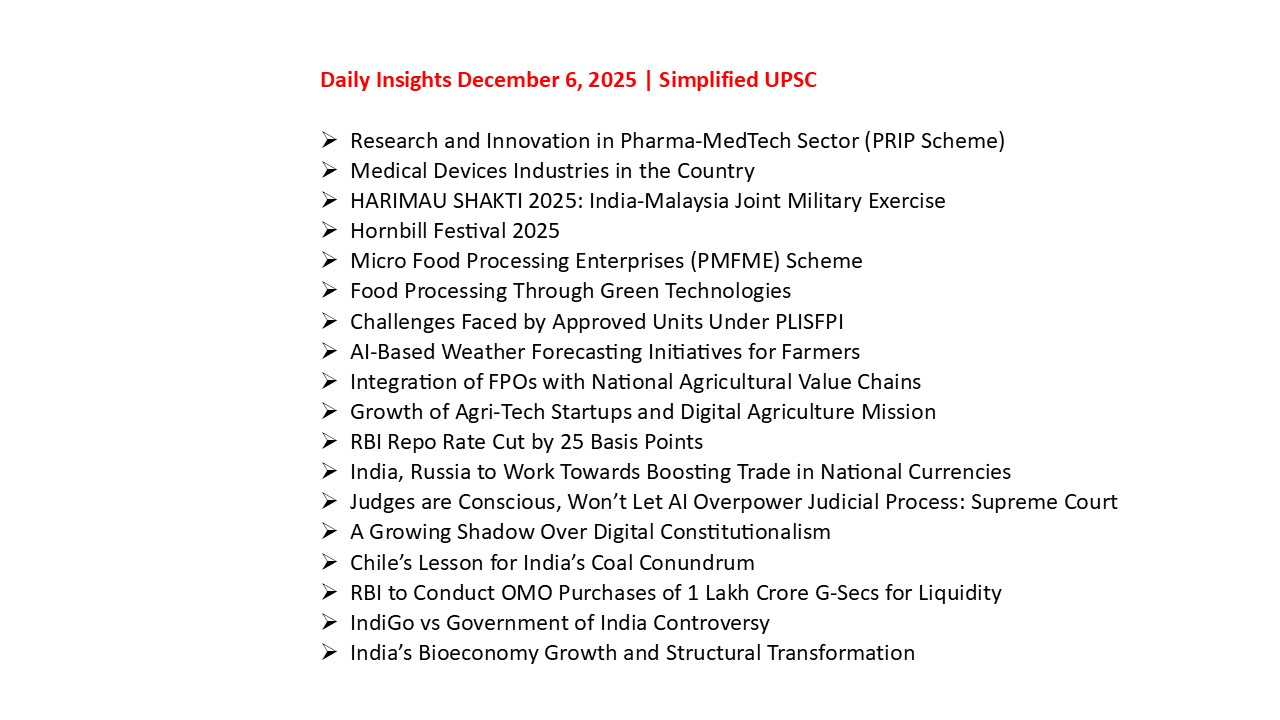
Daily Insights December 6, 2025
Contents
Daily Insights December 6, 2025
Welcome to today’s Daily Insights — your go-to capsule for simplified current affairs, specially curated to help aspirants cut through the noise and focus on what truly matters. In this edition, we bring together the top developments from official PIB releases, insightful reporting and editorials from The Hindu and The Indian Express, and analysis that connects the dots — all in one succinct package.
Whether you’re aiming to stay updated for prelims or deepen your understanding for mains, this compilation is designed to give you clarity. The curated content ensures that essentials — from government notifications and policy announcements to national and international news — are covered comprehensively, helping you build a strong foundation for UPSC preparation.
By combining official data from PIB with the analytical depth of The Hindu and The Indian Express, our Daily Insights offers a balanced, exam-oriented view of the day’s events. It’s not just about what happened — it’s about what you need to know, why it matters, and how it connects with larger themes and syllabus areas.
Stick with us for regular updates, clear context, and reliable summaries to keep your preparation sharp — one day at a time.
PIB RELEASES (December 5, 2025)
1. Research and Innovation in Pharma-MedTech Sector (PRIP Scheme)
Source: Press Information Bureau, Department of Pharmaceuticals
Key 12+ Points:
- Scheme Overview: Promotion of Research and Innovation in Pharma-MedTech Sector (PRIP) is a landmark initiative to transform India’s pharmaceutical and medical device sector into a globally competitive, innovation-driven sector
- Financial Outlay: ₹5,000 crore approved outlay with ₹4,200 crore dedicated for R&D projects, expected to catalyze a pipeline supporting around 300 research and innovation projects
- Innovation Pipeline: Expected to mobilize total R&D investment of approximately ₹11,000 crore in new medicines, complex generics, biosimilars, and novel medical devices
- Eligibility: Open to startups, MSMEs, industries, and academic institutions (only NIPERs among research institutions); preference given to industry-academia collaborations
- Priority Focus Areas: New Chemical Entities (NCE), New Biological Entities (NBE), complex generics, biosimilars, novel medical devices, orphan drugs, antimicrobial resistance (AMR), and strategic priority innovations
- Digital Ecosystem: Pan-India digital Pharma-MedTech innovation exchange platform connects innovators with investors, mentors, government initiatives (Patent Mitra, MedTech Mitra), and global opportunities
- Funding Categories: Early-stage (TRL 1-3 to 5) for startups/MSMEs up to ₹5 crore (100% support up to ₹1 crore, 50% beyond); Later-stage (TRL 4-6 and higher) for industry up to ₹100 crore (35% cost coverage, 50% for strategic areas)
- Geographic Flexibility: Application process does not require startups and industries to declare registration state; eligible across India including innovation hubs and Centers of Excellence
- Job Creation & Competitiveness: Scheme expected to have positive impact on employment generation, industrial competitiveness, and research capacity in pharmaceutical and medical device sectors
- Implementation Timeline: Registration deadline November 3, 2025; Submission deadline November 10, 2025; Two-year implementation period with project outcomes measured against R&D milestones
- Ecosystem Support: Addresses gap between lab-to-market conversion through mentorship, capacity building, regulatory guidance, and access to testing facilities
- No Pharma City Mandate: Scheme does not envision establishment of dedicated pharma cities or biotech clusters; focuses on distributed innovation across states
- NIPERS Eligibility: Among academic institutions, only National Institute of Pharmaceutical Education and Research (NIPERS) institutions are eligible for direct financial assistance
2. Medical Devices Industries in the Country
Source: Press Information Bureau, Department of Pharmaceuticals (India MedTech Expo 2025)
Key 12+ Points:
- Domestic Market Penetration: Indian medical devices share increased dramatically from under 10% to 30% of domestic requirements in the last 5 years, demonstrating significant achievement in self-sufficiency
- High-End Products: Even for Class C advanced invasive products, India now manufactures at 20% market share compared to virtually zero five years ago
- Export Performance: Medical devices exports have jumped to more than $4 billion annually, positioning India as a significant player in global medical device trade
- Cost Competitiveness: Indian manufacturers produce Class-C advanced invasive products at 10-40% cheaper cost than global competitors, providing competitive edge
- Regulatory Growth: Number of medical device manufacturers grew from approximately 400 to more than 4,000 in the last 5 years, reflecting sector’s rapid expansion
- Manufacturing Categories: Various categories ranging from consumables to implantable medical devices are being manufactured across India with improving quality standards
- Global Participation: India MedTech Expo 2025 attracted over 500 domestic companies including MSMEs, startups, and multinational companies; 150+ international buyers from 30+ countries
- Sector Positioning: India positioned as ‘Global MedTech Manufacturing Hub’ emphasizing precision engineering at affordable costs compared to Western counterparts
- Export Potential: Currently only 2% of global medical devices demand is met by Indian exports, indicating enormous untapped potential for export growth
- Quality Standards: Regulator emphasis on raising quality bar to match global standards, essential for scaling export volumes significantly
- Capacity Building Programs: Department of Pharmaceuticals supporting institutes for rolling out both short-term and long-term capacity building courses to develop technically capable workforce
- Sector Partnerships: Strong industry support from associations including AIMED, ADMI, MTAI, AMTZ, AMCHAM, APACMED, ADVAMED, APMEI, ASSOCHAM, CII, FICCI ensuring collaborative ecosystem
- FDI Attraction: Sector attracting significant foreign direct investment due to cost competitiveness, skilled workforce, and regulatory predictability
3. HARIMAU SHAKTI 2025: India-Malaysia Joint Military Exercise
Source: Press Information Bureau, Ministry of Defence
Key 12+ Points:
- Exercise Details: Fifth edition of Joint Military Exercise “Harimau Shakti-2025” commenced at Mahajan Field Firing Range, Rajasthan from December 5-18, 2025
- Participating Forces: Indian contingent represented mainly by DOGRA Regiment troops; Malaysian side represented by troops from 25th Battalion Royal Malaysian Army
- Exercise Mandate: Aimed at jointly rehearsing conduct of sub-conventional operations under Chapter VII of United Nations mandate
- Counter-Terrorism Focus: Scope includes synergizing joint responses during counter-terrorist operations, critical for contemporary security challenges in region
- Tactical Operations: Both sides practice tactical actions including cordon and search missions, destroy operations, heliborne operations, and casualty evacuation during counter-terrorist scenarios
- Helicopter Operations: Rehearsal of drills to secure helipads and undertake casualty evacuation procedures during counter-terrorist operations
- Combat Skills Exchange: Both sides exchange views and practices of joint drills on wide spectrum of combat skills, facilitating mutual learning
- Physical Training: Army Martial Arts Routine, combat reflex shooting, and yoga integrated into exercise curriculum
- Interoperability Enhancement: Focus on achieving enhanced level of interoperability among troops, reducing risk of life and property during peacekeeping operations
- UN Peacekeeping Focus: Emphasis on keeping interests and agenda of UN at forefront during potential peacekeeping operations
- Bilateral Relations: Exercise fosters strong bilateral relations between India and Malaysia, demonstrating defense cooperation
- Best Practices Sharing: Sharing of best practices further enhances level of defense cooperation between Indian Army and Royal Malaysian Army
- Strategic Importance: Exercise reflects India’s commitment to regional security, counter-terrorism cooperation, and deepening bilateral defense ties in Southeast Asia
4. Hornbill Festival 2025
Source: Government of Nagaland, Ministry of Tourism
Key 12+ Points:
- 26th Edition: Hornbill Festival is celebrating its 26th edition in 2025, established in 2000 as annual tourism promotional event
- Festival Dates: Held December 1-10, 2025, as established annually; known as “Festival of Festivals” showcasing cultural diversity
- Venue: Held at Kisama Heritage Village, approximately 12 km south of Kohima capital on NH-29 Kohima-Imphal Road
- Tribal Representation: Features all 18 major tribes of Nagaland showcasing richly colorful culture, tradition, and tribal lifestyle
- International Participation: Six country partners participate (France, Ireland, Switzerland, UK, Malta, Austria) alongside state partner Arunachal Pradesh, expanding global visibility
- Cultural Showcase: Displays art, culture, tribal lifestyle, folk dance, music, foods, farms, attire, and handicrafts providing comprehensive cultural immersion
- Traditional Architecture: Village set up with traditional tribal huts (morungs) from Naga tribes, creating living museum experience
- Economic Impact: Previous year official statistics indicated revenue generation of approximately ₹189 crore from largely unorganized sector, though actual figures likely higher
- Employment Generation: Thousands of temporary jobs created during 10-day event, with significant indirect year-round opportunities in tourism
- Rock Music Competition: Hornbill International Rock Contest represents one of India’s biggest music competitions, attracting performers nationwide
- PAP Relaxation: Protected Area Permit procedures relaxed for foreign tourists during festival; on-arrival facilitation counters established at airports
- Culinary Experience: Showcases traditional Naga cuisine including smoked pork, bamboo shoot delicacies, fermented soybean curries, and traditional rice beers brewed by different tribes
- Sustainability Initiative: Government aims to keep Hornbill venue open throughout year to support sustainable tourism activity beyond festival period
5. Micro Food Processing Enterprises (PMFME) Scheme
Source: Press Information Bureau, Ministry of Food Processing Industries
Key 12+ Points:
- Scheme Duration: Pradhan Mantri Formalisation of Micro Food Processing Enterprises (PMFME) Scheme operational for five years from 2020-21 to 2025-26
- Financial Outlay: ₹10,000 crore total approved outlay for providing financial, technical, and business support
- Primary Objective: Enhance competitiveness of existing individual micro-enterprises in unorganized food processing industry segment and promote formalization
- ODOP Approach: Primarily adopts One District One Product (ODOP) approach to leverage benefits of scale in procurement, common services, and product marketing
- ODOP Selection: Identified by States/UTs based on agriculture production, raw material availability, and product perishability considerations
- Credit-Linked Subsidy: Provides credit-linked capital subsidy at 35% of eligible project cost with maximum ceiling of ₹10 lakh per unit
- Support Categories: Includes support to individual/group category micro enterprises with subsidy covering 35% project cost
- Value Chain Development: Provides framework for value chain development and alignment of support infrastructure
- Backward-Forward Linkages: Strengthens linkages between farmers, processors, and market, creating integrated ecosystem
- Common Facilities: Provides common facilities, incubation centers, training, marketing and branding support to beneficiaries
- Training Support: Offers training under Entrepreneurship Development and Skilling (EDP+) programs and product-specific skilling
- Implementation Scale: Implemented across country creating off-farm employment and increasing farmer income through food processing sector participation
- NIFTEM Support: National Institute of Food Technology Entrepreneurship & Management (NIFTEM-K & NIFTEM-T) provides handholding, mentorship, training, and R&D support
6. Food Processing Through Green Technologies
Source: Press Information Bureau, Ministry of Food Processing Industries
Key 12+ Points:
- Renewable Energy Support: Ministry supports renewable sources (Solar, Biomass, Wind) for food processing projects through PMKSY component schemes
- Financial Ceiling: Maximum permissible cost of ₹35 lakh per project for incorporating renewable/alternate energy technologies in food processing units
- Cold Chain Compliance: Project Implementation Agencies must comply with Ministry of Environment, Forest & Climate Change requirements for Non-ODS refrigerants
- GWP Reduction: Focus on low Global Warming Potential (GWP) refrigerants-based energy efficient cooling systems in cold chain infrastructure
- World Food India Initiative: 4th edition of World Food India 2025 held September 25-28, 2025 with “Sustainability and Net Zero Food Processing” as focus pillar
- Sustainability Pillars: Focused on resource efficiency, waste reduction, energy efficiency, and environmentally friendly packaging solutions
- NIFTEM Packaging Innovation: NIFTEM-Thanjavur developing sustainable packaging through biodegradable plastics and environmental-friendly solutions
- Biopolymer Development: Research into poly lactic acid (PLA), starch-based, and nano fiber alternatives to conventional plastic packaging
- Central Sector Schemes: PMKSY and PLISFPI provide incentives for setting up/expanding food processing infrastructure with green technology focus
- MSMEs Support: Incentivizes eligible entities including startups and MSMEs under schemes with subsidy/incentives components
- Capacity Building: Under PMFME, assistance provided for training of trainers and entrepreneurs in sustainable food processing practices
- Autonomous Institutions: NIFTEM-K (Haryana) and NIFTEM-T (Tamil Nadu) provide handholding, mentorship, training, and R&D support for sustainable practices
- National Priority: Reflects India’s commitment to sustainable development and environmental stewardship in food processing industry
7. Challenges Faced by Approved Units Under PLISFPI
Source: Press Information Bureau, Ministry of Food Processing Industries
Key 12+ Points:
- Scheme Scope: Production Linked Incentive Scheme for Food Processing Industry (PLISFPI) approved March 31, 2021 with ₹10,900 crore budget for 2021-22 to 2026-27
- Units Approved: As of June 2025, 278 food processing units of 170 applicants approved across various scheme categories
- Incentive Released: Total of ₹1,726.60 crore released as incentives till June 2025 demonstrating significant government commitment
- Processing Capacity Addition: Scheme led to addition of 35 lakh MT processing capacity per annum across country
- Employment Generation: Approximately 3.39 lakh direct and indirect employment generated so far under PLISFPI
- Export Performance: Total export of agricultural processed food products increased with CAGR of 13.23% as of 2024-25 with reference to 2019-20
- Implementation Challenges: Ensuring compliance of entire manufacturing chain conducted within India for incentive eligibility
- Component Exclusion: Scheme does not cover floricultural production, limiting scope for certain sectors
- Category-Wise Approvals: Approvals distributed across different categories with regional concentration in Andhra Pradesh (38 units) reflecting state-wise disparities
- Quality & Standard Compliance: Beneficiary units must maintain international quality and safety standards for processed food products
- Export Integration: Units must demonstrate export-led growth orientation as scheme incentivizes global competitiveness
- Incentive Structure: Three components: manufacturing incentive, branding and marketing support, and capacity creation with varying incentive rates
- Monitoring Framework: Regular monitoring of unit performance, capacity utilization, and export achievement to ensure scheme effectiveness
8. AI-Based Weather Forecasting Initiatives for Farmers
Source: Press Information Bureau, Ministry of Agriculture and Farmers’ Welfare
Key 12+ Points:
- Pioneering Initiative: First-of-its-kind targeted dissemination of AI weather forecasts to farmers; Ministry of Agriculture and Farmers’ Welfare positioned as world-leader in AI weather forecasting application
- Farmer Coverage: AI-based monsoon forecasts sent via SMS (m-Kisan) to nearly 3.8 crore farmers across 13 states during Kharif 2025
- Advance Warning: Forecasts provided up to four weeks ahead of rainfall, enabling better agricultural planning compared to traditional methods
- AI Models Used: Blend of two open-access models: Google’s Neural GCM and ECMWF’s Artificial Intelligence Forecasting Systems (AIFS)
- Historical Data Integration: Utilized 125 years of historical rainfall data from India Meteorological Department for model training and validation
- Monsoon Tracking: AI-based forecasts correctly identified 20-day pause in northward monsoon progression mid-season, providing critical updates to farmers
- Weekly Updates: Government sent updated information to farmers every week until continuous rains arrived in respective areas
- Decision Impact: Farmer feedback surveys in Madhya Pradesh and Bihar revealed 31-52% farmers adjusted planting decisions based on forecasts
- Planting Adjustments: Farmers modified land preparation, sowing timing, crop choice, and input selection based on localized forecasts
- Customization: AI models designed forecasts specifically for farmers’ needs with easy-to-understand language and actionable information
- Farmer Engagement: Development Innovation Lab-India and Precision Development worked directly with farmers ensuring message comprehension
- Climate Adaptation: As climate change increases weather variability, forecasts provide farmers critical tool for adaptation and informed decision-making
- Global Recognition: Nobel laureate Michael Kremer acknowledged initiative as “huge achievement” and “model for how to put people first in age of AI”
9. Integration of FPOs with National Agricultural Value Chains
Source: Press Information Bureau, Ministry of Agriculture and Farmers’ Welfare
Key 12+ Points:
- Formation Target: Central Sector Scheme on Formation and Promotion of 10,000 FPOs with all 10,000 FPOs registered across country
- Management Support: ₹18 lakh per FPO provided for 3 years as management cost ensuring institutional sustainability
- Equity Grant: Matching equity grant up to ₹15 lakh provided to ensure financial participation of beneficiary organizations
- Credit Guarantee: Credit guarantee up to ₹2 crore from eligible lending institutions supporting access to formal credit
- Market Linkage Platform: e-NAM Integration – As of October 31, 2025, 4,642 FPOs linked with National Agriculture Market (e-NAM) platform
- Micro-Processing Integration: Credit-linked subsidy sanctioned to 236 FPOs under PM Formalisation of Micro Food Processing Enterprises (PM-FME) Scheme
- Infrastructure Fund Access: 1,590 FPOs availed benefits under Agriculture Infrastructure Fund (AIF) for facility development
- E-Commerce Enablement: E-commerce enablement supported for FPOs to access wider geographies and digital markets
- Credit Guarantee Coverage: 2,583 FPOs obtained collateral-free credit guarantee cover under 10,000 FPO Scheme’s CGF
- Multi-Platform Exposure: FPOs provided exposure to ONDC, e-NAM, and Government e-Marketplace (GEM) for accessing diverse markets
- B2B Linkages: FPOs connected with industries and agri-business organizations through melas/exhibitions for improved market access
- Webinar Support: Weekly webinars conducted for FPOs; webinars organized with industry experts guiding FPOs on business opportunities
- Training & Capacity: Training support provided for input procurement (seeds, fertilizers, pesticides) and mandi licensing for market-ready operations
10. Growth of Agri-Tech Startups and Digital Agriculture Mission
Source: Press Information Bureau, Ministry of Agriculture and Farmers’ Welfare
Key 12+ Points:
- Technology Adoption Focus: Government promoting adoption of emerging technologies including Artificial Intelligence (AI), precision farming, drone technology, and climate-smart agriculture
- Farm Mechanization Program: Scheme aims at ‘reaching the unreached’ by providing farm mechanization benefits to small and marginal farmers, women farmers
- Custom Hiring Centers: Creation of Custom Hiring Centers promoting access to hi-tech and high-value farm equipment without capital investment
- Equipment Distribution: Distribution of various agricultural equipment through government channels enabling technology democratization
- Demonstration & Awareness: Creating awareness among stakeholders through demonstration activities and capacity building programs
- Digital Platform Integration: Digital agriculture mission supporting technology platforms and data-driven decision-making tools
- Startup Ecosystem: Supporting agri-tech startups through incubation, mentorship, and market linkage programs
- Climate-Smart Agriculture: Promoting climate resilient agricultural practices through technology adoption and farmer training
- Drone Technology: Deployment of agricultural drones for crop monitoring, pest management, and input application
- Precision Farming: Precision agriculture techniques including soil moisture sensors, weather-based advisories, and targeted input management
- Data Analytics: Using AI and machine learning for crop prediction, yield optimization, and resource management
- State Implementation: Programs implemented across States/UTs with state-specific focus areas based on agro-climatic conditions
- Farmer Training: Capacity building and demonstration activities ensuring farmers understand and effectively utilize agri-tech solutions
THE HINDU – KEY ARTICLES & EDITORIALS (December 6, 2025)
1. RBI Repo Rate Cut by 25 Basis Points
Key 12+ Points:
- Rate Decision: Reserve Bank of India’s Monetary Policy Committee unanimously reduced policy repo rate by 25 basis points (bps) to 5.25% effective immediately
- Previous Rate: Repo rate cut from 5.50% to 5.25%, marking fourth consecutive cut in easing cycle with cumulative 125 bps reduction since February 2025
- Stance Maintained: Monetary policy stance maintained at “Neutral,” indicating balanced approach supporting growth without pre-committing to extended easing
- GDP Upgrade: RBI upgraded GDP forecast to 7.3% for current fiscal, reflecting robust economic growth trajectory
- Inflation Management: Decision made in context of significant decline in retail inflation in October 2024, creating policy space for rate adjustment
- Rupee Consideration: Rate cut considered in light of rupee depreciation against US dollar, balancing competitiveness with external stability
- Previous Cuts Timeline: June 2025 saw 50 bps cut (6% to 5.50%); August and October 2025 maintained status quo before December cut
- Terminal Rate Projection: Market analysts expect repo rate may reach terminal rate of 5.0% by February 2026, likely last cut in easing cycle
- Liquidity Management: Cut designed to strengthen monetary transmission and improve credit flow to productive sectors of economy
- Short-term Rates: Policy repo rate remains central tool of monetary policy with adjustments expected to affect various long-term interest rates
- Macro Conditions: Decision reflects view that current macroeconomic conditions and outlook have opened policy space for supporting growth
- Global Uncertainties: MPC considered global uncertainties and trade-related concerns while formulating policy response
- Nexus with OMO: Accompanying OMO and dollar-rupee swaps provide durable liquidity injection alongside rate cut, comprehensive liquidity management strategy
2. India, Russia to Work Towards Boosting Trade in National Currencies
Key 12+ Points:
- 23rd India-Russia Annual Summit: Following bilateral summit in Moscow, India and Russia agreed to boost trade using national currencies (Indian Rupee and Russian Ruble)
- Bilateral Settlement Systems: Both sides agreed to continue jointly developing systems of bilateral settlements ensuring uninterrupted maintenance of bilateral trade
- Payment Systems Interoperability: Consultations ongoing on enabling interoperability of national payment systems and financial messaging systems
- Central Bank Digital Currency: Discussions on central bank digital currency platforms to facilitate smoother bilateral transactions
- Trade Target 2030: Revised bilateral trade target of 100 billion dollars by 2030, representing significant increase from current levels
- Key Elements: Both sides emphasized addressing tariff and non-tariff trade barriers, removing logistics bottlenecks, promoting connectivity
- Payment Mechanism Importance: Smooth payment mechanisms identified as key element for achieving revised trade targets
- Multilateral Trade System: India and Russia underlined importance of open, inclusive, transparent, and non-discriminatory multilateral trade system with WTO at core
- Strategic Economic Cooperation: Programme for Development of Strategic Areas of India-Russia Economic Cooperation till 2030 adopted
- Energy Sector Cooperation: Energy sector cooperation highlighted as significant pillar of Special and Privileged Strategic Partnership
- Transport Corridors: Both sides agreed to deepen cooperation in building stable and efficient transport corridors
- International North-South Transport Corridor: Focus on enhancing infrastructure capacity supporting INSTC, Chennai-Vladivostok Corridor, Northern Sea Route
- Investment Projects: Emphasized importance of expeditious resolution of issues related to investment projects in energy sector, addressing investor concerns
3. Judges are Conscious, Won’t Let AI Overpower Judicial Process: Supreme Court
Key 12+ Points:
- Supreme Court Statement: Chief Justice of India assured public that judges are exercising caution regarding AI use in judicial system
- AI Not Overriding: CJI stated “We use it in a very over-conscious manner. We do not want this to overpower our judicial decision-making power”
- Ongoing Petition: Supreme Court hearing plea to curb unregulated use of AI and machine learning within judicial system
- Cautious Implementation: Judiciary adopting measured approach in integrating AI tools, ensuring human judgment remains central to judicial decisions
- Regulatory Framework Development: Court working on establishing appropriate framework for AI use in judicial processes
- Limited Application Areas: AI being used judiciously in specific areas where it can assist without compromising judicial independence
- Decision-Making Authority: Supreme Court maintaining that final judicial decisions remain exclusively within authority of judges and judicial officers
- Public Accountability: Court commitment to maintaining transparency in AI implementation and public trust in judicial process
- Technological Integration: While embracing beneficial AI applications, Court prioritizing protection of fundamental judicial values
- Future Guidelines: Expected development of comprehensive guidelines governing AI use in courts at all levels
- Judicial Independence: Court emphasizing that no technology should compromise independence of judicial decision-making
- Case Management Uses: AI applications primarily in case management, document analysis, and research support functions
- Citizen Safeguards: Court recognizing citizen concerns about AI in judicial process and addressing them through measured regulation
4. A Growing Shadow Over Digital Constitutionalism
Key 12+ Points:
- Digital Age Challenge: As India enters digital era, question arises whether Constitution drafted in 1950 remains adequate for digital realm
- Constitutionalism Concept: Constitutionalism as inner trait of Constitution must evolve as society and technology transform
- Fundamental Rights in Digital Context: Constitution ensured protection of rights and liberties in physical world; digital space presents new challenges
- Separation of Powers Issue: Digital technologies challenge traditional separation of powers between legislative, executive, and judicial branches
- Dispute Resolution Mechanisms: Digital platforms creating new forms of disputes and conflicts requiring new institutional responses
- Data Privacy Concerns: Digital constitutionalism must address emerging data privacy, digital surveillance, and cyber-security threats
- Right to Digital Identity: Need for constitutional recognition of digital identity rights as citizens increasingly operate in digital space
- Online Speech Regulation: Balancing freedom of expression with regulation of digital misinformation and harmful content
- Digital Divide Issues: Constitutional protections must ensure equitable digital access across all socioeconomic strata
- Cross-Border Digital Issues: Digital constitutionalism must address jurisdictional and sovereignty issues arising from borderless nature of digital space
- Amendment & Adaptation: Constitution amended over 100 times but may require specific provisions addressing digital-age challenges
- South Asian Perspective: South Asian constitutions must embrace digital constitutionalism ensuring digital democracy and citizen protections
- Democratic Safeguards: Digital constitutionalism necessary to prevent government abuse of digital technologies and maintain democratic values
5. Chile’s Lesson for India’s Coal Conundrum
Key 12+ Points:
- Energy Transition Challenge: India faces energy transition challenge similar to Chile’s—balancing coal phase-out with energy security
- India’s Coal Dependence: Coal contributes 55% to India’s energy mix and fuels 74% of electricity generation, providing stable, reliable power
- Grid Stability Requirement: Unlike intermittent renewables, coal-fired power plants provide stable, continuous power essential for grid stability
- Chile’s Coal Phase-Out: Chile announced coal phase-out by 2030 with no compensation for sector companies and cancellation of existing PPAs
- Chile’s Energy Crisis: During August (winter in Southern Hemisphere), Chile resorted to diesel generators and restarted decommissioned coal plants to avoid blackouts
- Island Network Problem: Chile’s power grid operates as island network without connections to neighboring countries, limiting ability to import power
- Renewable Intermittency: During winter months, reduced snowmelt and daylight hours make renewables less reliable for baseload power
- Carnot Battery Solution: Germany’s DLR developing “Carnot battery” technology converting coal plants to thermal energy reservoirs using molten salt heated by renewable energy
- Existing Infrastructure Reuse: Carnot batteries preserve existing steam cycle infrastructure (turbines, generators) from old coal plants, reducing investment costs
- Job Preservation: Technology maintains local employment in communities dependent on coal power plants while enabling energy transition
- India’s Coal Reserves: Odisha, Jharkhand, and Chhattisgarh together hold 69% of India’s coal reserves, crucial for economy and local communities
- Energy Security Strategy: India needs dual strategy: responsibly managing coal as transitional flexible power source while aggressively scaling renewables and storage
- Technology Transfer Learning: India can adopt successful transition technologies like Carnot batteries to manage coal phase-out without compromising grid stability
6. RBI to Conduct OMO Purchases of 1 Lakh Crore G-Secs for Liquidity
Key 12+ Points:
- OMO Decision: RBI announced Open Market Operation (OMO) purchases of Government Securities worth ₹1 lakh crore to inject durable liquidity
- Auction Schedule: OMO auctions divided into two tranches of ₹50,000 crore each held on December 11 and December 18, 2025
- Liquidity Injection Strategy: OMO purchases aimed at injecting lasting liquidity into financial system to support credit flow
- Dollar-Rupee Swap: Accompanying 3-year USD/INR buy-sell swap of $5 billion scheduled for December 16, 2025
- Total Liquidity Impact: Combined OMO and swap operations inject approximately ₹1.45 trillion liquidity into banking system
- Purpose Distinction: While OMO aimed at injecting durable liquidity, repo operations manage short-term liquidity alignment with policy rate
- Weighted Average Call Rate: Durable liquidity injection through OMO balances short-term liquidity withdrawal through variable rate reverse repo (VRRR) operations
- Monetary Transmission: Liquidity measures designed to strengthen monetary transmission and facilitate better credit flow to productive sectors
- Long-term Rate Impact: Primary role of OMO is ensuring adequate liquidity rather than directly influencing government securities yields
- Market Stability Support: Operations aim at supporting market stability through adequate durable liquidity provision
- Policy Repo Rate: Policy repo rate at 5.25% remains central tool of monetary policy despite accompanying OMO operations
- Expectations Management: Liquidity injection indicates RBI’s confidence in growth trajectory and manageable inflation outlook
- Financial System Health: Measure reflects RBI’s proactive management of financial system health and credit availability maintenance
INDIAN EXPRESS – KEY ARTICLES (December 6, 2025)
1. IndiGo vs Government of India Controversy
Source: Indian Express News Reports
Key 12+ Points:
- Flight Disruptions: IndiGo airline experienced widespread flight cancellations and operational disruptions in December 2025 affecting millions of passengers
- FDTL Implementation: Phase II of Fatigue and Duty Time Limitations (FDTL) came into effect November 1, 2025 introducing stricter duty-rest rules for pilots
- Duty Restrictions: New rules increased mandatory rest period from 36 to 48 hours per week for pilots—additional 12 hours mandatory weekly rest
- Night Landing Caps: Pilots now restricted to maximum two night-time landings per week, down from previous allowance of six landings
- IndiGo Request: IndiGo requested temporary relaxation of FDTL provisions citing pilot shortage and operational challenges
- DGCA Response: Directorate General of Civil Aviation (DGCA) granted one-time exemptions from certain FDTL rules until February 10, 2026
- Pilot Shortage Claims: IndiGo attributed disruptions to artificial pilot shortage created by rule changes despite having two years to prepare
- Airline Union Concerns: Pilot union alleged IndiGo created artificial crisis to pressure government for regulatory concessions
- Safety vs. Operations: FDTL rules designed scientifically to protect pilot fatigue-related safety; rule relaxation reduces fatigue protections
- Regulatory Parity Issues: Union raised concerns about DGCA appearing non-neutral and granting discriminatory exemptions to single airline
- Passenger Impact: Millions of passengers faced flight delays, cancellations, and helplessness during disruption period
- Alternative Arrangements: Stranded flyers scrambled for alternatives via rail, road transport; airfares skyrocketed amid IndiGo crisis
- Political Response: Congress leader Rahul Gandhi termed situation “fiasco” reflecting cost of government’s “monopoly model” in aviation sector
2. For Putin, a Political Win; For India, a Stable Partner
Source: Indian Express Opinion/Analysis
Key 12+ Points:
- Putin Moscow Visit: Russian President Vladimir Putin visited India in December 2025 with high-profile red-carpet reception signaling strategic partnership
- Geopolitical Context: Visit occurred amid strain in India-US relations following Trump administration’s tariff policies targeting India
- US Tariff Concerns: India faced threat of high trade tariffs and additional 25% penal tariffs on Russian oil purchases, while other countries exempted
- Economic Cooperation 2030: India and Russia signed Economic Vision for 2030 targeting $100 billion bilateral trade
- India’s Strategic Autonomy: Visit demonstrated India’s commitment to strategic autonomy, independent foreign policy pursued regardless of external pressure
- US Relationship Unpredictability: Trump administration’s unpredictable decision-making creating strategic uncertainty regarding US-India partnership stability
- Defence Cooperation Framework: India and US renewed Defence Cooperation Framework for third consecutive 10-year term, maintaining defense ties despite tariff tensions
- Alternative Hedging Strategy: India exploring Russia partnership to diversify defense hardware sources amid US unpredictability
- China’s Perspective: While China may welcome closer India-Russia relations reducing US containment pressure on India, it limits India-Russia partnership
- European Concerns: Europe unhappy about India’s red-carpet welcome to Putin during Ukraine conflict escalation, but recognizes convergence with India on other strategic issues
- Democratic Powers Convergence: European leaders seeing greater convergence with India due to US unreliability and rising China concerns
- South Asian Implications: If Washington downgrades India’s strategic centrality, smaller South Asian states gain leverage—Bangladesh, Sri Lanka, Nepal become alternative partners
- Strategic Recalibration Risk: India’s hedging carries risks; balance-of-power politics may force Washington to recalibrate reliance on India and explore alternative partnerships
INTERNATIONAL & ENVIRONMENTAL NEWS (December 6, 2025)
1. South-East Asia and Sri Lanka Cyclone Crisis
Source: International News Agencies, UN Reports
Key 12+ Points:
- Multi-Cyclone Impact: South-East Asia and Sri Lanka struck by three simultaneous cyclones and exceptionally intense monsoon causing widespread devastation
- Death Toll: Over 900 deaths reported across affected region; Sri Lanka alone recorded 607 deaths from Cyclone Ditwah—worst disaster since 2004 tsunami
- Population Affected: Approximately 11 million individuals impacted by disasters; over 1 million forced to evacuate due to ongoing flooding
- Cyclone Senyar: Rare tropical cyclone formed in Malacca Strait (only second documented cyclone there after Tropical Storm Vamei in 2001)
- Regional Scale: Cyclones and floods affected Indonesia, Thailand, Malaysia, Vietnam, Philippines, and Sri Lanka
- Indonesia Impact: Nearly half of reported deaths occurred in Indonesia (867 deaths), with over 3.3 million affected and 645,000+ displaced
- Sri Lanka Crisis: Cyclone Ditwah caused devastating floods in capital Colombo and low-lying areas; critical blood shortage impacting hospital operations
- Record Rainfall: Hat Yai, Thailand recorded 335mm rainfall in single day (November 21)—heaviest daily rainfall in last 300 years for region
- Climate Extreme: Cyclones at such magnitude rarely observed near equator; unusual phenomenon as local populations unaccustomed to extreme weather
- Economic Damage: Sri Lanka still recovering from 2022 economic crisis; new disaster inflicting significant fresh infrastructure and agricultural damage
- Agricultural Impact: Extensive agricultural devastation across region threatening food security and farmer livelihoods
- Displacement Scale: Millions evacuated from vulnerable areas; refugee camps established to house internally displaced populations
- Climate Change Connection: Extreme weather events becoming more frequent and intense, indicating climate change acceleration and need for disaster preparedness
2. India’s Bioeconomy Growth and Potential
Source: The Hindu, Ministry of Science & Technology, Academic Reports
Key 12+ Points:
- Exponential Growth: India’s bioeconomy expanded 16-fold over past decade—from $10 billion in 2014 to over $165 billion in 2024
- 2047 Target: With right policy reforms, India has potential to reach $1.2-$1.3 trillion bioeconomy by 2047, contributing to Viksit Bharat vision
- Current Status Update: India’s bioeconomy already surpassed USD 130 billion and projected to cross USD 300 billion in coming years
- Global Comparison: China attracted $45 billion in life sciences venture capital (2018-2022)—nearly 10 times more than India, highlighting capital gap
- China Success Model: China’s STAR Market in Shanghai and Biotech Chapter in Hong Kong allowed early-stage biotech firms listing without profitability requirements
- Capital Market Reform: India needs specialized biotech board in stock exchanges allowing capital-efficient listing for emerging biotech companies
- Regulatory Bottlenecks: Lengthy approval timelines for First-in-Human (FIH) trials and fragmented regulatory review processes slow innovation
- CDSCO Capacity Issues: Central Drugs Standard Control Organization lacks scientific capacity for evaluating emerging technologies like mRNA vaccines, gene therapies
- ICMR Empowerment: Proposed reforms suggest ICMR handle clinical trial protocol reviews leveraging research capabilities and ethical framework
- Sector Potential: With reforms, India positioned to become leader in mRNA technology, gene therapy, biosimilars, and biologics
- Employment Impact: Proposed reforms could create millions of high-value biotech jobs and establish India as clinical research hub
- Global Innovation Hub: Reforms could transform India from “pharmacy of world” to “lab of world” contributing significantly to global health innovation
- BRIC Achievements: National institutes under BRIC published 3,190 research papers, commercialized 13 technologies, and mentored 2,578 PhD scholars (3-year period)
Discover more from Simplified UPSC
Subscribe to get the latest posts sent to your email.