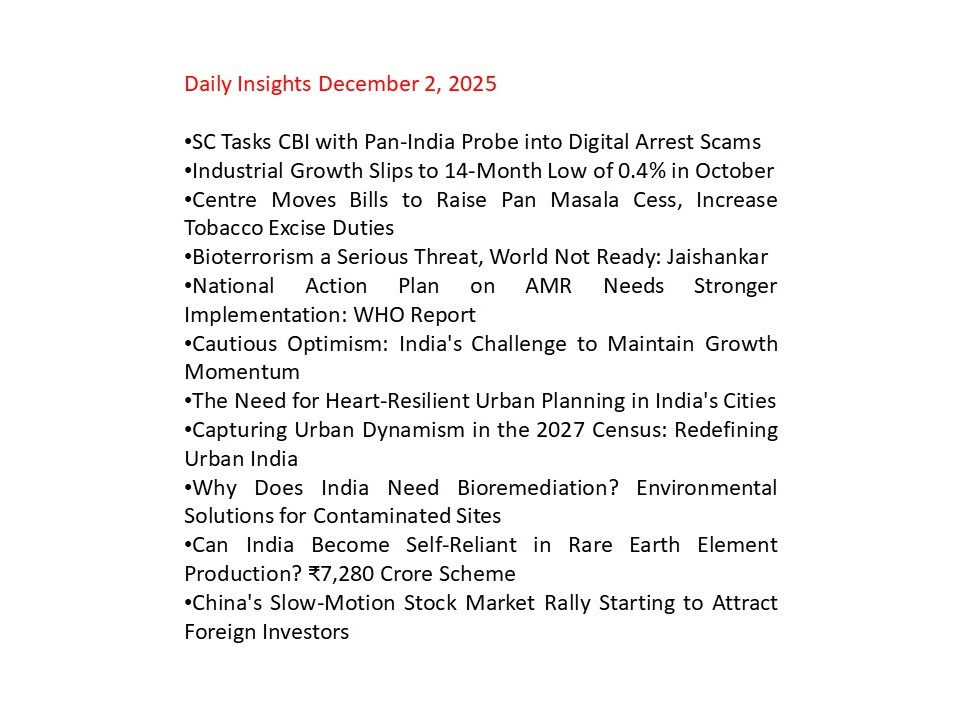
Daily Insights December 2, 2025
Contents
Daily Insights December 2, 2025
1. SC Tasks CBI with Pan-India Probe into Digital Arrest Scams
Key Points:
SC ordered CBI to investigate digital arrest scams across India with sweeping powers and coordination with state police
Digital arrest fraud has defrauded victims of over ₹3,000 crore, predominantly affecting senior citizens
Fraudsters pose as law enforcement/judicial officials via audio-video calls to intimidate and extort money
CBI directed to investigate complicit bank staff colluding with cyber criminals in mule account operations
SC asked RBI to explain why AI/machine learning tools cannot be deployed to identify and freeze suspicious bank accounts
IT intermediaries mandated to provide complete data assistance to CBI for digital arrest case investigations
Department of Telecom instructed to prevent issuance of multiple SIM cards to single entities/individuals to curb misuse
CBI authorized to coordinate with Interpol for targeting cyber-crime hubs operating from offshore jurisdictions
All states and UTs directed to establish and operationalize Cyber-Crime Coordination Centres linked to I4C (MHA)
SC adjourned hearings for two weeks to enable CBI selection of specialized investigation teams
Court expressed shock at scale of digital arrest cases, warning of iron-hand approach
GS Papers 2 (Polity – Judicial Intervention), 3 (Cybersecurity – Crime Prevention)
2. Industrial Growth Slips to 14-Month Low of 0.4% in October
Key Points:
Index of Industrial Production (IIP) growth contracted to 0.4% in October 2025, down from 4.6% in September
Decline marks 14-month low, last recorded in August 2024 when industrial output stalled completely
Manufacturing output rose modestly at 1.8%, while mining sector contracted by 1.8% year-on-year
Electricity generation plummeted 6.9% due to extended rainfall and comfortable temperatures reducing demand
Festive season holidays (Dussehra, Diwali, Chhath) resulted in reduced factory activity and fewer working days
Nine of 23 industry groups recorded positive growth; largest contributions from basic metals and petroleum products
Infrastructure and construction goods emerged strongest segment with 7.1% growth
Capital goods increased 2.4%, intermediate goods grew 0.9%
Consumer durables fell 0.5%, consumer non-durables contracted sharply at 4.4%
Primary goods declined 0.6% as mining weakness persisted
Ministry expects next IIP data for November to release on December 29, 2025
GS Papers 3 (Economy – Industrial Production Indicators), Current Affairs for Policy Analysis
3. Centre Moves Bills to Raise Pan Masala Cess, Increase Tobacco Excise Duties
Key Points:
Finance Minister introduced Central Excise (Amendment) Bill 2025 replacing GST compensation cess on tobacco products
Health Security and National Security Cess Bill 2025 seeks new cess on pan masala manufacturing
GST compensation cess ending in December 2025 after loan repayment completion; replaced with permanent excise duty
Proposed excise duty on cigarettes: ₹5,000-₹11,000 per 1,000 sticks depending on length
60-70% excise duty on unmanufactured tobacco; 100% on nicotine and inhalation products
Overall tax incidence on tobacco and pan masala remains unchanged post-cess expiration at 40% GST + excise
New cess on pan masala aims to generate revenue for public health and national security funding
Government retains fiscal space to increase excise rates while maintaining revenue stability
Bills replace temporary COVID-era compensation mechanism with permanent taxation framework for “sin goods”
TMC member opposed bills citing lack of explicit health warnings in tobacco regulation
No revenue sharing with states from new cess, raising federalism concerns
GS Papers 2 (Governance – Fiscal Policy), 3 (Economics – Taxation)
4. Bioterrorism a Serious Threat, World Not Ready: Jaishankar
Key Points:
EAM S. Jaishankar warned bioterrorism threat is no longer theoretical but an urgent global concern
Biological weapons misuse by non-state actors and terrorist groups represents serious escalating risk
Biological Weapons Convention (BWC), established 50 years ago, lacks modern compliance mechanisms and oversight
BWC missing critical infrastructure: no permanent technical body, no real-time surveillance capabilities, no compliance system
CRISPR and genetic engineering advances enable creation of engineered pathogens more transmissible and treatment-resistant
Potential bio-weapons could target specific populations, making them cheaper and easier to produce
Diseases can cross international borders within hours, making biosecurity a collective global responsibility
Global South faces particular vulnerability due to weak healthcare systems and limited laboratory infrastructure
Jaishankar called for modernized BWC with structured review processes for scientific/technological developments
India proposed comprehensive framework including high-risk agent identification, dual-use research oversight, incident management
Assistance during biological emergencies must be fast, practical, and purely humanitarian
GS Papers 2 (International Relations – Global Security), 3 (Disaster Management – Biosecurity)
5. National Action Plan on AMR Needs Stronger Implementation: WHO Report
Key Points:
National Action Plan on Antimicrobial Resistance (NAP-AMR 2.0) launched for 2025-29 addressing critical gaps
WHO GLASS 2025 report shows one in six laboratory-confirmed bacterial infections resistant to antibiotic treatment
E. coli displays over 60% resistance to ciprofloxacin and 40% to third-generation cephalosporins globally
S. pneumoniae shows 20% resistance to last-resort antibiotics (carbapenems)
S. aureus exhibits 20% methicillin resistance (MRSA) rate indicating serious concern
AMR associated with 4.95 million deaths annually; directly attributed to 1.27 million deaths
India faces higher AMR prevalence than global average, described as “serious and escalating threat”
NAP 2.0 builds on gaps from first plan (2017-2021), includes specific action plans with timelines and budgets
Key strategies: increasing stakeholder ownership, inter-sectoral coordination, enhancing lab capacity, infection control
Private sector engagement strengthened for better AMR surveillance and stewardship programs
Hub-and-Spoke diagnostic model proposed for rural India to tackle blind prescription epidemic
GS Papers 3 (Healthcare – Public Health Crisis), 2 (Governance – Policy Implementation)
6. Cautious Optimism: India’s Challenge to Maintain Growth Momentum
Key Points:
India’s 8.2% growth in Q2 FY2025-26 impressive on standalone basis but faces headwinds maintaining momentum
Foreign institutional investors showing selling pressure amid macro uncertainties and crude oil price increases
Rupee depreciation pressure continues despite positive GDP expectations and strong purchasing activity
FMCG sector gained 0.23%, Healthcare 0.36%, Auto 0.55% showing consumer resilience
Oil & Gas sector declined 0.97%, Telecom 0.91%, Energy 0.64% reflecting sector-specific challenges
Sensex ended marginally down by 13.71 points (0.02%), Nifty down 12.60 points (0.05%)
BSE Mid Cap declined 0.04%, Small Cap 0.13% indicating broader market weakness
Market sentiment slightly pessimistic with 2,128 declining stocks vs. 2,019 advancing stocks
Asia-wide inflation concerns noted with Japan’s core CPI at 2.8% as companies transfer rising costs
Economic growth sustainability requires managing FII flows and currency stability alongside strong fundamentals
Private consumption and GST-driven tax buoyancy remain positive indicators supporting medium-term outlook
GS Papers 3 (Economics – Market Performance & Macro Indicators), Current Affairs – Policy Analysis
7. The Need for Heart-Resilient Urban Planning in India’s Cities
Key Points:
India requires shift from rigid top-down urban planning to flexible human-centered, climate-resilient design thinking
All 100 Smart Cities now have operational Integrated Command Control Centres (ICCCs) using AI and IoT technology
Pradhan Mantri Awas Yojana (PMAY-U) sanctioned 1.18 crore houses integrating sustainability and climate resilience features
Smart Cities Mission pioneering data-driven urban governance transforming service delivery and citizen engagement
Blue-green infrastructure must be embedded directly into master plans rather than treated as add-ons
Urban wetlands, green corridors, permeable surfaces enable climate-resilient drainage and heat mitigation
15-minute access model for inclusive social infrastructure including health, education, care facilities
Community-centric service hubs reduce mobility burdens and enhance social equity in urban planning
India’s rapid urbanization unfolding without coherent design systems, causing unplanned sprawl and environmental stress
Unlike legacy-burdened nations, India can build “first-version” systems for 2050 with climate resilience from outset
ULBs require stronger autonomy and coordination mechanisms for integrated planning and effective service delivery
GS Papers 2 (Governance – Urban Administration), 3 (Environment – Sustainable Urban Development)
8. Capturing Urban Dynamism in the 2027 Census: Redefining Urban India
Key Points:
Registrar General of India retaining 2011 Census urban area definition in 2027 Census for data comparability
Urban definition includes Statutory Towns (officially notified) and Census Towns (5,000+ population criteria)
Census Town criteria: minimum 5,000 population, 400+ persons per sq. km density, 75%+ male workers in non-agriculture
Current binary classification fails to capture complex urbanization spectrum and semi-urban transitions
India’s urbanization rate uncertain, estimates ranging 30-70% depending on definitions, hampering targeted urban planning
Rapid urbanization creates census towns lacking urban governance structures, functioning under outdated rural models
Internal migration data outdated from 2011 Census; actual migration patterns may differ significantly
Most migration intra-district (62%) or inter-district (26%); rural-to-rural largest category (48%), urban-to-urban fastest growing
Cities contribute 60% of India’s GDP while covering only 3% of land, requiring better urbanization understanding
Boundary freeze date set as January 1, 2026; Houselisting in April 2026, Population Enumeration February 2027
First-time caste enumeration approved (April 2024) alongside revised worker classification methodology
GS Papers 1 (Geography – Urbanization), 2 (Governance – Census & Planning), Current Affairs
9. Why Does India Need Bioremediation? Environmental Solutions for Contaminated Sites
Key Points:
Bioremediation uses microbial consortia and biological processes to treat contaminated soil and wastewater sustainably
Industrial effluent contamination, microplastic pollution, and chemical waste require integrated biological treatment approaches
Biofilters with microbial species enable plastic extraction and degradation, offering alternative to traditional disposal
Microbial-based Fenton photosynthetic fuel cells generate bioelectricity while remediating phthalates from wastewater
Polypropylene microplastic biodegradation achieved through natural consortia combining bacteria and microalgae
Hub-and-Spoke diagnostic model for wastewater treatment integrates hub facilities with spoke-connected primary centers
Biochar-based catalyst systems simultaneously treat wastewater and enable resource recovery in microbial desalination cells
Hydrocarbon-degrading bacteria consortia developed for process-based remediation of contaminated sites
Biodegradation of 2,4-dichlorophenol using novel bacterial strains demonstrates emerging contaminant treatment capabilities
Bioaugmentation technologies repair materials combined with electrochemical processes offer comprehensive environmental cleanup
Green biorefinery approaches utilizing enzyme hydrolysis produce nanocellulose from agricultural waste
GS Papers 3 (Environment – Bioremediation & Sustainability), Science & Technology
10. Can India Become Self-Reliant in Rare Earth Element Production? ₹7,280 Crore Scheme
Key Points:
Union Cabinet approved ₹7,280 crore scheme to develop 6,000 MTPA integrated rare earth permanent magnet (REPM) capacity
Scheme aims to challenge China’s 85-90% global dominance in sintered NdFeB magnet production
India currently produces zero meaningful volumes of sintered magnets despite holding 6.27% of global rare earth reserves
REPM demand projected to double by 2030 driven by EV two-wheelers boom and energy-transition technologies
Scheme includes ₹6,450 crore sales-linked incentives for five years and ₹750 crore capital subsidy
Seven-year validity from award date includes two-year gestation period and five-year incentive disbursal period
Five beneficiaries selected via global competitive bidding, each eligible for up to 1,200 MTPA capacity
Full value chain integration required: rare earth oxides to metals to alloys to finished REPMs
India imported 53,000+ metric tonnes of rare earth magnets in FY2024-25, indicating massive import dependence
China banned export of seven critical rare earth elements (April 2025): samarium, gadolinium, terbium, dysprosium, lutetium, scandium, yttrium
National Critical Mineral Mission launched: Geological Survey undertaking 1,200 exploration projects between FY25-FY31
GS Papers 3 (Economy – Manufacturing & Self-Reliance), 2 (International Relations – Resource Security)
11. China’s Slow-Motion Stock Market Rally Starting to Attract Foreign Investors
Key Points:
China’s CSI300 blue-chip index up 16% year-to-date, matching S&P 500 performance despite trade friction
Hong Kong’s Hang Seng risen 30%, setting course for biggest annual gain since 2017
Fund managers holding volatile tech stocks and picking industrial stocks, betting on resilience of two-year rally
Foreign investors beginning gradual return to China after viewing 2025 market results and stabilizing valuations
Record HK$1.38 trillion (₹177 billion equivalent) poured into Hong Kong capital markets recently
Chinese stock recovery defied Sino-American trade tensions through state support and improved corporate governance
AI-linked stocks surged following DeepSeek chatbot’s impressive release boosting market confidence
Foreign holdings in China reached 3.5 trillion Yuan by end September 2025, still below 3.9 trillion Yuan peak (2021)
Morgan Stanley strategist predicts foreign investor return only at “beginning stages of gradual process”
Shanghai Stock Exchange opened stock option market to foreign investors for hedging purposes
Distinction emerging between “old China” (exporters/developers facing headwinds) and “new China” (AI/Biotech growth sectors)
GS Papers 3 (International Economics – Global Markets), Current Affairs – Trade & FDI
12. Yemen’s Worsening Food Security Crisis: Decade-Long Humanitarian Catastrophe
Key Points:
Yemen facing its worst food security crisis after a decade of severe multifaceted humanitarian emergency
Record-level hunger experienced as economic collapse, widespread violence, and service breakdown intensify
Humanitarian agencies increasingly challenged providing lifesaving care amid escalating displacement and suffering
Widespread civilian displacement resulted from violence involving various Middle Eastern state and non-state actors
Essential services collapsed including healthcare, water systems, sanitation infrastructure vital for survival
Economic decline forced increased reliance on remittances as self-sufficiency completely slipped from reach
Conflict between Saudi-led coalition and Houthis created protracted displacement crisis affecting millions
Healthcare system degradation worsens disease transmission risks amid food insecurity complications
Water system failures creating public health emergency compounding hunger and malnutrition crises
Humanitarian access restrictions limiting aid delivery to affected populations
International attention inadequate relative to scale and severity of unfolding humanitarian catastrophe
GS Papers 2 (International Relations – Geopolitics), 3 (Disaster Management – Humanitarian Crisis)
Discover more from Simplified UPSC
Subscribe to get the latest posts sent to your email.