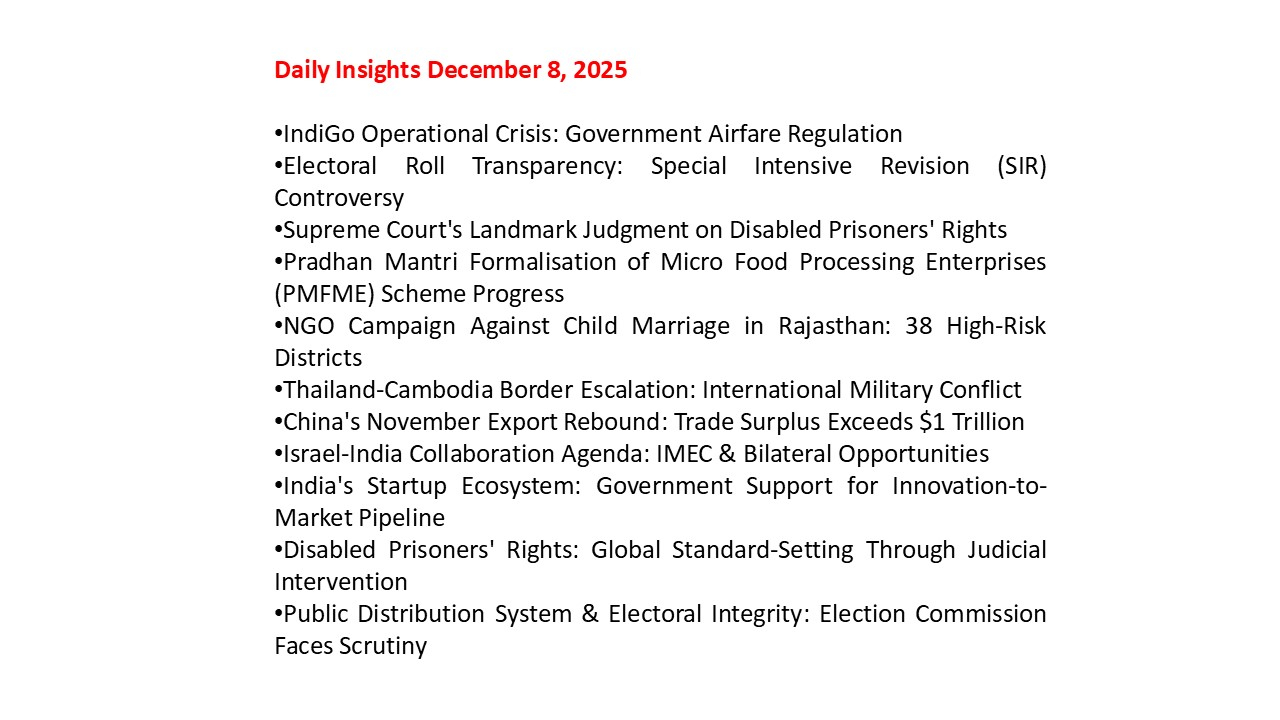
Daily Insights December 8, 2025
Contents
Daily Insights December 8, 2025
1. IndiGo Operational Crisis: Government Airfare Regulation
Source: Ministry of Civil Aviation Press Release
Relevance: GS-II | Governance & Consumer Rights; GS-III | Infrastructure & Service Delivery
Key Points:
IndiGo, operating 60% of domestic aviation capacity, faced massive disruption cancelling ~2,100 flights (2/3 of daily operations) during peak wedding season
Government invoked emergency powers to impose fare caps: ₹7,500 (500km), ₹12,000 (1,000km), ₹15,000 (1,500km), ₹18,000 (2,000km+)
Refund deadline: 8 PM, December 7; Baggage return within 48 hours mandatory
IndiGo exempt from new Flying Duty Time Limitation (FDTL) norms till February 10, 2026 (pilot fatigue safety regulations)
Zero rescheduling/cancellation charges between December 5-15
75+ special trains (East Coast: 6 trains; Western: 7 trains) mobilized for stranded passengers
DGCA issued show-cause notice to CEO Pieter Elbers; potential regulatory penalties pending
Root cause: Non-compliance with new crew duty time regulations requiring extensive aircraft maintenance
Crisis reflects balance between aviation safety (crew fatigue) vs. consumer protection during emergencies
Full operations expected December 10-15; incident marks IndiGo’s worst operational failure in 20-year history
Raises concerns about capacity planning and regulatory preparedness for single-airline dependency
Government intervention demonstrates active crisis management in critical infrastructure sectors
Read More … Indigo vs Government of India
2. Electoral Roll Transparency: Special Intensive Revision (SIR) Controversy
Source: Indian Express Editorial | Election Commission of India
Relevance: GS-II | Constitutional Governance & Electoral Processes; GS-II | Right to Vote
Key Points:
Election Commission launched nationwide Special Intensive Revision (SIR) of electoral rolls across 12 states/UTs (51 crore electors, 321 districts)
Phase-II enrollment extended to December 11; draft roll publication: December 16; final roll: February 14, 2026
Bihar witnessed deletion of ~65 lakh voters, exposing lack of transparency and mass errors in voter deletion process
Supreme Court mandated 5 corrective measures: publication of deleted voters’ lists with deletion reasons
Precedent cited: Kamal Nath judgment—used by EC to justify wide discretion, undermining voter protection principles
Key concern: Process lacks due process—no proper field verification, citizen outreach, or multi-stage scrutiny
Machine-readable electoral rolls absent; data published in inaccessible formats hindering citizen verification
Raison d’être: Concerns over dual-document registration (alleged illegal BD immigrants), but process rushed before major elections
Opacity undermines democratic legitimacy; disenfranchisement labeled “administrative error,” not constitutional violation
Civil society, opposition parties flag: SIR compressed into artificial timeline vs. historical practice (8 prior SIRs till 2003)
Democratic principle: Voting is sacred right; wrongful deletion ≠ administrative error; it silences citizens
Need: EC must pause, implement machine-readable rolls, strengthen due process, engage civil society proactively
3. Supreme Court’s Landmark Judgment on Disabled Prisoners’ Rights
Source: The Hindu | Supreme Court Bench (Justices Vikram Nath, Sandeep Mehta)
Relevance: GS-II | Constitutional Rights & Judicial Activism; GS-II | Rights of Persons with Disabilities
Key Points:
15-page Supreme Court order mandates prison authorities nationwide to end abuse/ill-treatment of disabled inmates under Rights of Persons with Disabilities (RPwD) Act, 2016
All states/UTs directed to revise prison manuals ensuring: (a) assistive devices for mobility, (b) specialized medical care, (c) enhanced visitation rights
Inclusive education facilities mandatory; no inmate denied education due to disability
Petitioner: Sathyan Naravoor case featuring Prof. G. Saibaba (paralyzed; died from harsh imprisonment) and Stan Swamy (Parkinson’s; denied sipper cup)
Core principle: Disabled prisoners suffer dual punishment (crime + discrimination)—violates constitutional equality
Judgment signifies judicial law-making: Full protection under 2016 Act; recognition of prison as State institution with duty of care
Historical context: Disabled rights overlooked in carceral system; this order closes legislative-judicial gap
Implementation mechanism: Prison officials face penalties under RPwD Act; structural changes required (infrastructure, training, compliance)
Dignity clause: Disabled prisoners perform daily tasks without compromising prison security
Expanded legal protections: Assimilates disabled prisoners into general disabled persons’ rights framework
Positive outcome: Addresses systemic neglect (lack of mobility aids, medication access, communication tools)
Challenges ahead: Compliance monitoring, budget allocation, institutional resistance; depends on state-level implementation
4. Government Implements Stricter Excise Taxation on Pan Masala
Source: PIB | Ministry of Finance | Health Security and National Security Cess Bill, 2025
Relevance: GS-III | Taxation & Fiscal Policy; GS-II | Public Health; GS-III | MSMEs
Key Points:
New statutory framework: Health Security and National Security Cess Bill, 2025—capacity-based excise cess on specific machinery/processes
Initial focus: Pan masala; extensible to other notified goods (gutkha, tobacco products)
Mechanism: Tax on manufacturing capacity rather than quantity; bypasses under-reporting evasion common in high-margin products
Fiscal objective: Create predictable, rule-based revenue stream for national security and public health expenditure
Abatement rule: Prorated reduction for shutdowns ≥15 continuous days; prevents liability during genuine downtime
Fund flow: Cess proceeds → Consolidated Fund of India (CFI); earmarked for national security & public health systems
Government powers: Increase cess up to 2× in public interest; notify additional goods; set compliance procedures
Anti-evasion strategy: Capacity-based levy effective against semi-automatic/hybrid machinery manipulation
Public health rationale: Corrective taxation on harmful products; sin goods fund health infrastructure
Administrative framework: Structured levy, assessment, monitoring, enforcement, and multi-tier appeals; transparency enhanced
Fiscal federalism: Cess stays in CFI (not divisible pool)—strengthens Union fiscal space without disrupting state revenues
Implementation: Ensures compliance, audit, and accountability across manufacturing units; reduces informal evasion pathways
5. Pradhan Mantri Formalisation of Micro Food Processing Enterprises (PMFME) Scheme Progress
Source: PIB | Ministry of Food Processing Industries | PMFME Update 31 Oct 2025
Relevance: GS-III | MSMEs & Rural Development; GS-II | Governance & Social Inclusion; GS-III | Food Processing
Key Points:
PMFME scheme formalizes unorganized micro units; key metrics as of Oct 31, 2025:
1,62,744 loans sanctioned (credit-linked subsidy); total loan amount: ₹13,234.90 crore
3,65,935 SHG members approved for seed capital (₹40,000 per member; max ₹4 lakh per SHG federation)
101 Common Infrastructure Facilities (CIFs) sanctioned; 76 incubation centres approved
35% credit-linked subsidy for new/upgraded units (max ₹10 lakh); 35% CIF subsidy (cap ₹3 crore)
Women-led SHG empowerment central to scheme; aligns with Lakhpati Didi, NRLM, Aatmanirbhar Bharat
ODOP (One District One Product) integration strengthens local value chains; reduces entry barriers
Convergence: PMFME + PMKSY + PLISFPI = integrated food processing value chain (micro→large)
Green technology push: Solar, biomass, wind incentives (up to ₹35 lakh); mandatory CTO (Water/Air) compliance
Sustainable packaging: Biopolymers, starch nanofibers, low-waste systems boost export competitiveness
Challenges: Slow on-ground CIF utilization; fragmented value chains; limited digital literacy; credit access gaps
Significance: Off-farm rural employment generation; income stabilization; reduction in distress migration; formal sector integration
Read More.. PMFME
6. NGO Campaign Against Child Marriage in Rajasthan: 38 High-Risk Districts
Source: The Hindu | Just Rights for Children (JRC) | NFHS-5 Data
Relevance: GS-II | Social Issues & Women Empowerment; GS-II | Constitution & Rights; GS-III | Development Policy
Key Points:
Just Rights for Children (JRC) + 17 partner organizations launched year-long campaign targeting 38 high-risk Rajasthan districts
Objective: End child marriage through community engagement, legal enforcement, panchayat mobilization
JRC prevented 22,480 child marriages in Rajasthan (2024); now focusing on vulnerability hotspots
Rajasthan’s child marriage prevalence (NFHS-5): 25.4% vs. India average 23.3%—worrying regional concentration
Critical districts: Chittorgarh & Bhilwara (>40% rates); 9 districts above 30% (Jhalawar, Tonk, Sawai Madhopur, Bundi, Bharatpur, Karauli, Bikaner, Alwar, Pratapgarh)
Secondary concern: 9 more districts in 23-29.9% range requiring awareness, community leadership, panchayat intervention
Strategy: Village panchayat resources, faith leader engagement, community mobilization, legal deterrence
National context: Union Women & Child Development Ministry’s 100-day campaign (target: end child marriage by 2030)
Alignment: Supports UN SDGs; constitutional mandate (right to education, health, dignity for girls)
Root causes: Poverty, illiteracy, traditional practices, weak enforcement; intersects with gender inequality
Legal framework: Prohibition of Child Marriage Act, 2006; criminal penalties for solemnization, abetment
Implementation: Requires multi-stakeholder coordination (state govt, NGOs, community leaders, law enforcement)
7. Thailand-Cambodia Border Escalation: International Military Conflict
Source: Reuters | CNN | Thai Royal Air Force | Thai Ministry of Foreign Affairs
Relevance: GS-II | International Relations & Regional Geopolitics; GS-I | Geography & Border Issues
Key Points:
December 8, 2025: Thailand launched airstrikes targeting military facilities (ammunition storage, command posts, supply routes) after Cambodian artillery fire
Cambodian forces began shelling ~3 AM local time; RTAF responds claimed targeting “immediate threats” on border
Military escalation context: Both nations accuse each other of ceasefire violation; Trump-backed peace deal framework undermined
Previous clashes: July 2024 (first major conflict since 2011)—16 Thai soldiers, 14 civilians killed; 200,000+ displaced
Disputed territory: Border demarcation unresolved; landmine presence (PMN-2); maritime boundary disagreements
Civilian impact: ~70% border town evacuations; one civilian casualty (pre-existing medical condition)
Military buildup: Heavy artillery repositioning, repositioned units, fire-support capabilities deployed
Ceasefire framework fragile: Both sides claim legitimate self-defense; third-party mediation rejected (US, China, Malaysia)
Strategic context: Spillover risks into ASEAN stability; regional economic disruption
US-Cambodia ties: Trump administration’s Thailand preference vs. Cambodia’s China alignment complicates diplomatic resolution
Regional implication: Threatens Thailand-Cambodia trade, ASEAN cohesion; sets precedent for border disputes
Humanitarian concern: Displacement camps, medical access, cross-border refugee flows; ICRC/UN involvement needed
8. China’s November Export Rebound: Trade Surplus Exceeds $1 Trillion
Source: Reuters | CNBC | China Customs Administration Data
Relevance: GS-III | International Trade & Global Economics; GS-III | Import-Export Policy
Key Points:
China’s November 2025 exports: 5.9% YoY growth (USD $330.3 billion), beating forecast of 3.8%; recovery from Oct 1.1% decline
Cumulative trade surplus (Jan-Nov): $1.076 trillion—21.6% increase YoY; historic record
US exports collapsed: -28.6% YoY (8th consecutive month double-digit decline) despite October trade truce announcement
Pivot strategy: Exports to EU (+15%), ASEAN (+8%), Africa, Latin America surge; geographical diversification
US imports into China: -19% YoY; tariff impact persists despite cease-fire messaging
Front-loading effect: Manufacturing acceleration early-2025 anticipating tariff increases now wearing off
Import performance: +1.9% (below forecast 3%), indicates weak domestic consumption; property sector drag continues
Factory sentiment: PMI contraction (8th consecutive month); export orders remain contractionary
Structural issue: Global over-capacity; Chinese exporters absorbing margin losses to maintain volumes
Forecast: Morgan Stanley predicts China’s 2030 global export share at 16.5% (currently ~15%)
Implications for India: Heightened competition for third-country export markets; Indian manufacturers face pricing pressure
Tariff uncertainty: Announced US tariffs implementation lags; full impact expected 2026; persistent trade instability
9. Goa Nightclub Fire: Tragedy Exposes Safety Regulation Gaps
Source: BBC | Wikipedia | NDTV | Goa Police | Chief Minister Pramod Sawant Statement
Relevance: GS-II | Public Safety & Regulatory Compliance; GS-II | Consumer Protection; GS-III | Infrastructure Safety
Key Points:
December 6, 2025 (11:45 PM): Birch by Romeo Lane nightclub, Arpora, Goa—fire killed 25 people; ~50 injured
Victim breakdown: 20 staff, 4 Delhi tourists (same family), 1 undisclosed; 3 deaths from burns, 22 from asphyxiation
Suspected cause: Gas cylinder explosion (kitchen) or burst firecrackers; fire spread engulfed building within seconds
Occupancy: ~100 people on dance floor; 25 total fatalities across building; staff concentrated in basement (escape trap)
Fire service response: Delayed access (400m+ from venue); narrow pathway over small lake hindered equipment deployment
Recovery: Bodies found near kitchen, staircase, basement—many trapped attempting escape; rescue operations ~2 hours
Arrests: Manager detained; warrant for owner issued; 4 total arrests as of December 7
Safety violations: Over-occupancy, inadequate emergency exits, blocked pathways, no water sprinkler systems
Regulatory failure: No evidence of pre-incident safety audits, fire drills, or proper licensing enforcement
Preventive gaps: Goa lacks stringent nightclub licensing standards; inspections inadequate relative to tourist season demand
Economic context: Goa’s tourism-dependent nightlife economy vs. safety regulation—perennial trade-off
National implication: Incident mirrors 2013 Kolkata fire (German Bakery) safety lapses; demands nationwide venue audit, compliance standards
10. Israel-India Collaboration Agenda: IMEC & Bilateral Opportunities
Source: PIB/Ministry of External Affairs | Reuters | Israeli Foreign Ministry Official Statement
Relevance: GS-II | International Relations & Regional Cooperation; GS-II | Strategic Partnerships
Key Points:
Israeli officials publicly affirmed “very strong” ties with India; “endless opportunities” for strategic collaboration
IMEC (India-Middle East-Europe Economic Corridor) described as “very good initiative” for regional stabilization
IMEC origins: G20 Summit, Delhi (Sept 2023)—transformative connectivity project across three regions
Current signatories: India, Saudi Arabia, EU, UAE, US, and G20 partners; absent: Israel and Jordan (focus for 2026)
IMEC objectives: Enhanced trade, connectivity, sustainability; leverages India-Gulf-European triangular relationship
Strategic context: Positioned as counter-initiative to China’s Belt and Road Initiative (BRI)
Israel’s role: Laying foundational agreements with US, UAE, neighboring states; waiting for final framework before full commitment
Bilateral opportunities: Technology transfer (semiconductors, defence), healthcare innovation, agricultural tech, cyber-security
Regional stabilization: IMEC expected to stabilize tensions, create joint economic interests, reduce geopolitical friction
Palestine-Hamas issue: Israeli officials pushing India to designate Hamas as terrorist organization (India maintains nuanced stance)
Trade synergies: Israeli tech + Indian services + European markets; complementary comparative advantages
Implementation timeline: 2026+ activation pending Jordan-Israel inclusion; phase-wise infrastructure rollout (ports, rail, digital corridors)
11. India’s Startup Ecosystem: Government Support for Innovation-to-Market Pipeline
Source: PIB | Science & Technology Ministry | Dr. Jitendra Singh | IISF 2025
Relevance: GS-III | Science & Technology; GS-III | Economic Growth & Innovation; GS-II | Governance Policy
Key Points:
India now world’s 3rd largest startup ecosystem; 6,000+ deep-tech startups in clean energy, advanced materials sectors
Key enabler: ₹1 Lakh Crore Research, Development & Innovation (RDI) Scheme (approved July 2025; FY26 allocation ₹20,000 crore)
Focus: Private sector R&D investment; first-time capital availability for high-risk, high-impact projects; derisking innovation
Structural platforms: BIRAC (biotech), National Missions, sector-specific programs linking startups→funding→mentorship→industry
Regulatory reform: Deregulation, de-licensing, decriminalization reducing compliance burden; enabling focus on innovation
Patent ecosystem: India’s R&D expenditure doubled (past decade); patents registered 17× increase; reflects institutional support
Success metrics: Chandrayaan-3, indigenous COVID vaccines, biotechnology advances; public-sector R&D spillovers
Talent democratization: STEM education in regional languages; 25,000 Atal Tinkering Labs planned; talent from smaller cities rising
Fellowship scheme: 10,000 PM Research Fellowships (next 5 years) providing grants to young researchers nationwide
Academia-industry-government collaboration: Central to ecosystem; shared responsibility model replacing siloed approach
Global competitiveness: India transitioning from technology adoption to original innovation contributions (life sciences, digital platforms)
2047 vision: Policymakers, scientists, entrepreneurs united toward collective roadmap; “Jai Vigyan, Jai Anusandhan” (Glory to Science & Research)
12. Public Distribution System & Electoral Integrity: Election Commission Faces Scrutiny
Source: Indian Express Editorial | Electoral Commission Data | Election Commission Statement
Relevance: GS-II | Constitutional Governance; GS-II | Electoral Processes & Democracy; GS-I | Polity
Key Points:
Special Intensive Revision (SIR) process reveals structural flaws in Indian electoral roll management
Transparency deficit: Electoral roll data published in inaccessible formats; machine-readable formats absent
Bihar scenario: 65 lakh voters deleted without published deletion reasons; Supreme Court forced EC to disclose reasons/lists
Precedent misuse: Kamal Nath judgment cited repeatedly by EC to justify discretionary roll revisions; undermines voter protection jurisprudence
Democratic principle at stake: Democracy functions only through transparent institutions; voters cannot “prove existence” through bureaucratic maze
Scale of error: Phase-II SIR targets 51 crore electors across 321 districts; margin of error affects millions of citizens
Timing concern: Nationwide SIR launched months before crucial 2026 state elections (WB, Assam, TN, Kerala, Puducherry)
Due process gaps: No field verification, citizen outreach, or multi-stage scrutiny before roll revision
EC’s defense challenged: Claims routine administrative clean-up, but opaque process resembles electoral engineering
Reform requirements: Pause SIR; shift to machine-readable, transparent rolls; involve state legal aid, civil society
Constitutional duty: EC must prioritize voter inclusion over exclusion; transparency over administrative convenience
Citizen remedy: Effective publication, appeal mechanisms, proactive EC engagement with potentially affected voters critical
Discover more from Simplified UPSC
Subscribe to get the latest posts sent to your email.