SOUTH AMERICA
Contents
SOUTH AMERICA
Introduction
South America is a continent located almost entirely in the Southern Hemisphere and predominantly in the Western Hemisphere. It forms the southern portion of the American landmass.
Location and Extent
Latitude: 12°N to 55°S
Longitude: 35°W to 81°W
Area: Approximately 17,824,513 sq. km
The continent extends from Point Gallinas in Colombia (approximately 12°N) in the north to Cape Horn in Chile (approximately 56°S) in the south. The geographical coordinates place South America at approximately 14.6048°S, 59.0625°W.
Boundaries
North: Caribbean Sea
East: Atlantic Ocean
West: Pacific Ocean
South: Drake Passage (separating it from Antarctica)
Northwest: Connected to North America by the Isthmus of Panama
Key Geographic Features
The Equator passes through Ecuador, Colombia, and northern Brazil
The Tropic of Capricorn passes through the southern regions of Brazil, Paraguay, Argentina, and Chile
No other continent except Antarctica penetrates as far south, reaching subantarctic latitudes
The continent is compact and roughly triangular in shape, being broad in the north and tapering to Cape Horn in the south
1. Major Physical Divisions
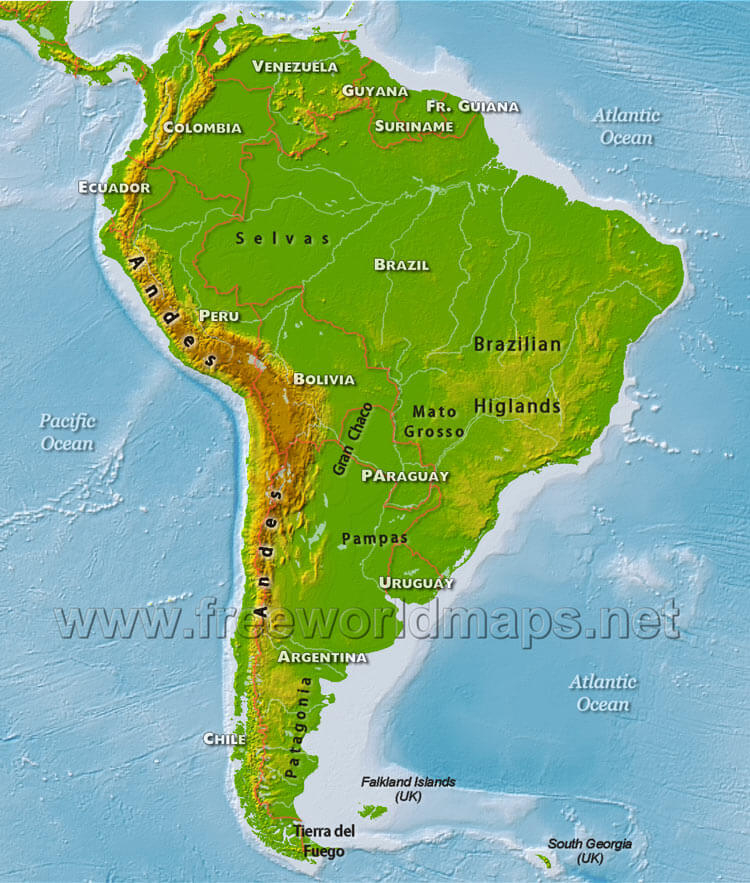
South America’s topography is often likened to a huge bowl owing to its flat interior almost ringed by tall mountains. The continent consists of three main topographic features:
1.1 The Andes Mountains (Western Cordilleras)
The Andes constitute the longest mountain chain in the world, extending approximately 7,000 km (about 5,000 miles) along the entire western edge of the continent
Stretches from Venezuela in the north to southern Chile
The Andes extend through seven countries: Venezuela, Colombia, Ecuador, Peru, Bolivia, Chile, and Argentina
Contains more than 30 peaks reaching at least 20,000 feet (6,000 m) in elevation, many of which are active volcanoes
Mount Aconcagua (6,959 m or 22,831 feet) on the Argentina-Chile border is the highest peak in South America and the highest mountain outside Asia
The Ojos del Salado (6,893 m) is the world’s highest active volcano, located on the Chile-Argentina border
Sub-divisions of the Andes:
Northern Andes: Colombia, Ecuador, and Venezuela (separated into three branches)
Central Andes: Peru and Bolivia (includes the Altiplano plateau)
Southern Andes: Argentina and Chile
Notable Features:
Altiplano: A high plateau (average elevation 3,750 m) between the western and eastern ranges of the Andes in Peru and Bolivia, containing Lake Titicaca and Salar de Uyuni
Contains major valleys such as the Río Magdalena valley
Hosts three of the world’s highest capitals: Bogotá (Colombia), Quito (Ecuador), and La Paz (Bolivia)
1.2 Central Lowlands
The vast interior plains lie east of the Andes and consist of several major basins:
a) Amazon Basin
Covers approximately 7,000,000 sq. km (2,700,000 sq. mi), representing about 35.5% of the South American continent
The largest drainage basin in the world
Contains the Amazon Rainforest, the world’s largest tropical rainforest covering about 6 million sq. km
Extends across eight countries: Bolivia, Brazil, Colombia, Ecuador, Guyana, Peru, Suriname, Venezuela, and French Guiana
Characterized by flat terrain with extensive tropical rainforest
b) Orinoco Basin
The Orinoco River basin covers approximately 1,000,000 sq. km (390,000 sq. mi)
65% in Venezuela and 35% in Colombia
Features vast tropical grasslands called Llanos
The unique Casiquiare Canal provides a natural connection between the Orinoco and Amazon basins
c) Río de la Plata Basin
Includes the drainage systems of the Paraná, Paraguay, and Uruguay rivers
Contains the fertile Pampas grasslands of Argentina and Uruguay
Features the Pantanal, the world’s largest tropical wetland
d) Gran Chaco
A vast plain extending across Paraguay, Bolivia, Argentina, and Brazil
Characterized by dry forests and thorn scrub vegetation
1.3 Eastern Highlands
The eastern highlands consist of two main plateau regions separated by the Amazon River:
a) Guiana Highlands
Extends over 1,000 miles from southern Venezuela across Guyana, Suriname, and French Guiana to northern Brazil
Made up of ancient Precambrian rocks
Characterized by flat-topped mountains (tepuis), deep gorges, and tropical rainforests
Contains Angel Falls (979 m or 3,212 feet), the world’s highest uninterrupted waterfall
Mount Roraima (2,810 m) at the borders of Brazil, Guyana, and Venezuela is the highest peak
b) Brazilian Highlands (Brazilian Plateau)
Comprises more than half of Brazil’s landmass
Average elevation of approximately 1,000 meters (3,300 feet)
Located mainly in the states of Minas Gerais, São Paulo, Goiás, and Mato Grosso
Characterized by low mountains, hilly uplands, tabular plateaus, and steep cliffs along the east coast
Contains the Mato Grosso Plateau and Paraná Plateau
Rich in mineral resources
1.4 Coastal Plains
Pacific Coastal Plain: Very narrow, much narrower than the Atlantic coast
Atlantic Coastal Plain: Broader, especially along Brazil’s eastern coast
Caribbean Coastal Plain: In Colombia and Venezuela
2. Important Rivers
2.1 Amazon River
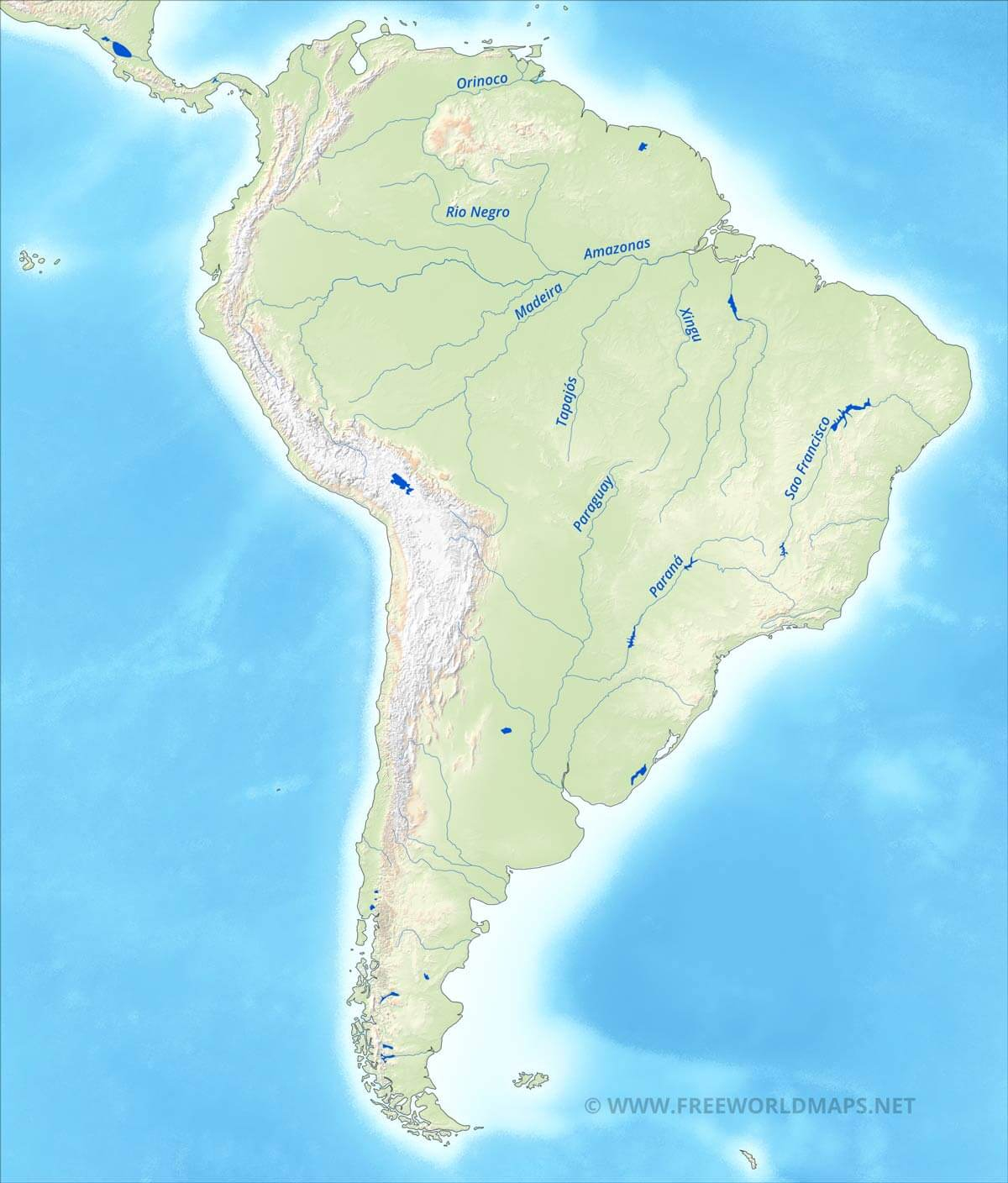
One of the two longest rivers in the world (approximately 6,400 km or 4,000 mi), with ongoing debate about whether it exceeds the Nile
Largest river by discharge volume, accounting for about 20% of all fresh water flowing into the world’s oceans
Originates in the Andes Mountains of Peru (Marañón and Apurímac rivers)
Flows eastward across Brazil and empties into the Atlantic Ocean
The basin supports the world’s largest tropical rainforest ecosystem
2.2 Orinoco River
Length: approximately 2,140 km (1,330 mi)
Fourth largest river by discharge volume (39,000 m³/s at delta)
Rises in the Guiana Highlands of Venezuela
Flows through Venezuela and Colombia before reaching the Atlantic
Major transportation system for eastern and interior Venezuela
2.3 Paraná-Paraguay System
The Paraná River is the second longest river in South America
Forms part of the Río de la Plata drainage system
Flows through Brazil, Paraguay, and Argentina
The Paraguay River is a major tributary
Important for navigation and agriculture in the region
2.4 São Francisco River
Major river in eastern Brazil
Important for irrigation and hydroelectric power
Flows through semi-arid regions of northeastern Brazil
2.5 Magdalena River
Colombia’s principal river
Flows northward through a major valley in the Andes
Important transportation and agricultural corridor
2.6 Uruguay River
Forms part of the border between Argentina, Brazil, and Uruguay
Tributary of the Río de la Plata system
3. Important Lakes
3.1 Lake Titicaca
Located on the border between Peru and Bolivia in the Andes Mountains
Elevation: 3,812 meters (12,507 feet) above sea level
The world’s highest navigable lake (commercially)
Largest lake in South America by volume and second largest by surface area
Surface area: approximately 8,372 sq. km
Contains two sub-basins: Lago Grande (Big Lake) and Lago Pequeño (Little Lake), connected by the Strait of Tiquina
Average depth of 140-443 feet depending on the basin
Contains 41 islands, some inhabited by Quechua and Aymara-speaking communities
More than 3 million years old, classified as one of fewer than 20 “ancient lakes of the world”
3.2 Lake Maracaibo
Located in northwestern Venezuela
With a surface area of 13,512 sq. km (5,217 sq mi), it is the largest lake by surface area in South America
More accurately classified as a semi-enclosed bay or estuary connected to the Gulf of Venezuela by a narrow strait
One of the oldest lakes on Earth, formed 36 million years ago during the uplift of the Andes
Rich in oil and gas resources; Venezuela’s main oil-producing area
Famous for Catatumbo lightning, considered the highest rate of lightning occurrence in the world
Contains brackish water
3.3 Lake Poopó
Located in Bolivia on the Altiplano
Shallow, saline lake subject to significant size variations
Second largest lake in Bolivia
4. Major Deserts
4.1 Atacama Desert
Located along the Pacific coast in northern Chile
Stretches over 1,600 km (1,000 miles) from north to south
Covers an area of approximately 105,000-128,000 sq. km
The driest non-polar desert in the world
Some areas have gone several years without any rainfall
Situated between the Andes Mountains to the east and the Chilean Coast Range to the west, creating a two-sided rain shadow effect
Aridity caused by the cold Humboldt Current and strong Pacific anticyclone
Despite extreme aridity, contains oases, salt flats, active geysers, and high-altitude lagoons
Rich in mineral resources, particularly copper, iodine, lithium, and nitrates
4.2 Patagonian Desert
Located in eastern Patagonia, Argentina
The seventh-largest desert in the world
A cold desert with temperatures rarely exceeding 12°C
Created by the rain shadow effect of the Andes Mountains
Area of approximately 670,000 sq. km
Characterized by semi-arid shrubland and grassland
4.3 La Tatacoa Desert
Located in the Huila Department, Colombia
Situated in a valley between the central and eastern branches of the Colombian Andes
One of the driest areas in Colombia
4.4 Monte Desert
Located in central Argentina
Semi-arid region east of the Andes
Characterized by scrub vegetation
5. Grasslands
5.1 Pampas
Temperate grasslands located in Argentina, Uruguay, and southern Brazil
Known for extremely fertile soil with short, soft, and nutritious grasses
Called the “Granary of South America” due to extensive wheat production
Covers approximately 750,000 sq. km
Supports major cattle ranching and agricultural activities
Humid subtropical climate with moderate rainfall
5.2 Llanos
Tropical grasslands in the Orinoco River basin of Venezuela and Colombia
Seasonally flooded savanna grasslands
Extensive areas flood during the wet season
Support diverse wildlife including capybaras, jaguars, and numerous bird species
5.3 Campos
Tropical grasslands in the Brazilian Highlands
Also called Campos Limpos when referring to clean grasslands without trees
Located primarily in southern Brazil
5.4 Cerrado
Vast tropical savanna in central Brazil, extending into Bolivia and Paraguay
Characterized as shrub savannah with 10-20% shrub cover
Rich biodiversity hotspot
Much of the area now under agricultural development
6. Climate
South America features all major climate zones: tropical, subtropical, temperate, and polar.
6.1 Tropical Climate
The Equator passes through Ecuador, Colombia, and northern Brazil
Equatorial regions experience consistently high temperatures and heavy rainfall throughout the year with no dry season
Average annual temperatures in the Amazon Basin oscillate around 27°C (81°F) with low thermal variation and high rainfall
Tropical rainforest climate dominates the Amazon Basin and Pacific coast of Colombia
6.2 Subtropical Climate
Found in central and southern regions including parts of Argentina, Uruguay, Paraguay, and southern Brazil
Features distinct seasons with hot summers and mild winters
The Pampas region has a humid subtropical climate with moderate rainfall
East-central Brazilian plateau has humid and warm tropical climate
6.3 Temperate Climate
Dominates Uruguay, the Pampas of Argentina, and central Chile
Southern Chile experiences a Mediterranean oceanic climate with temperate summers and cold winters
Winters and summers are milder than in North America due to greater oceanic influence
6.4 Arid and Semi-Arid Climate
Atacama Desert experiences extreme aridity, being the driest place on Earth
Patagonian Plateau forms a rain shadow desert with low rainfall
The Gran Chaco has semi-arid to dry conditions
6.5 Polar/Cold Climate
Tierra del Fuego at the southern tip experiences a subpolar oceanic climate
Cape Horn sees frequent storms, strong winds, and cold temperatures
Barely 7 hours of daylight during June solstice, but almost 18 hours during December solstice
6.6 Highland Climate
The Andes exhibit altitudinal climate zones with temperatures decreasing with elevation
High Andes areas within the tropics have temperate or cold climates despite equatorial location
Altitude plays a crucial role in creating distinct ecosystems at different elevations
Key Climate Influences:
Humboldt (Peru) Current: Cold ocean current flowing northward along the western coast, creating arid conditions in coastal Peru and Chile
Rain shadow effect: The Andes block moisture from both oceans, creating deserts on the leeward side
Amazon Basin: Generates significant rainfall and influences regional climate patterns
7. Natural Vegetation
South America’s natural vegetation closely follows the continent’s climatic zones.
7.1 Selvas (Tropical Rainforest)
Located in the Amazon Basin and other tropical-rainy regions
The largest tropical rainforest in the world covering approximately 6 million sq. km
Called the “Lungs of the World” due to oxygen production
Characterized by dense, multilayered evergreen forest up to 40-50 m tall with emergent trees
Important tree families: Annonaceae, Bombacaceae, Burseraceae, Euphorbiaceae, Leguminosae, Moraceae
Also found along the Pacific coast of Colombia and Ecuador and the Atlantic coast of Brazil
Receives more than 1,000-3,000 mm of rainfall, with some areas receiving over 8,000 mm
7.2 Tropical Savannas
Llanos: Grasslands in the Orinoco basin
Campos: Grasslands in the Brazilian Highlands
Cerrado: Shrub savannah in central Brazil
Characterized by herbaceous vegetation with a dry season greater than 4 months
7.3 Temperate Grasslands
Pampas: Fertile grasslands in Argentina and Uruguay
Short, nutritious grasses ideal for cattle ranching and wheat cultivation
7.4 Tropical Deciduous Forests
Found on the southeastern coast of Brazil
Trees shed leaves during the dry season
7.5 Mixed Forests
Temperate deciduous forests on lower slopes and coniferous forests on higher slopes of the southern Andes
Found on the western side of the Andes in Chile
7.6 Desert and Semi-Desert Vegetation
Atacama Desert: Hardy, drought-resistant plants adapted to extreme aridity
Patagonian Plateau: Scrub vegetation and sparse grassland
Gran Chaco: Dry forests and thorn scrub
7.7 Tundra Vegetation
Tierra del Fuego: Rocky tundra where tree growth is impossible
High Andes: Alpine tundra at high elevations with sparse vegetation
8. Important Straits, Passages, and Capes
8.1 Strait of Magellan
Channel linking the Atlantic and Pacific Oceans
Located between mainland South America (Chile) and Tierra del Fuego island
Length: 350 miles (560 km), width: 2-20 miles (3-32 km)
First navigated by Ferdinand Magellan in 1520
Lies entirely within Chilean territorial waters except its easternmost extremity touched by Argentina
More sheltered than the Drake Passage but has narrow passages, unpredictable winds, and strong tidal currents
Major port: Punta Arenas on the Brunswick Peninsula
8.2 Drake Passage
Body of water between Cape Horn (Chile) and the South Shetland Islands (Antarctica)
Connects the southwestern Atlantic Ocean (Scotia Sea) with the southeastern Pacific Ocean
Extends into the Southern Ocean
Named after Sir Francis Drake, though he never actually sailed these waters
The shortest route from Antarctica to the rest of the world
Open water for hundreds of miles, providing more maneuvering room than other passages
Known for extremely hazardous conditions: strong winds (gale-force), large waves, strong currents, and icebergs
8.3 Beagle Channel
Named after the ship that carried Charles Darwin during his famous voyage
Strait in the Tierra del Fuego archipelago
Shared by Argentina and Chile
Has frequent narrows and unpredictable conditions
8.4 Cape Horn (Cabo de Hornos)
Located on Hornos Island in the Hermite Islands group, Tierra del Fuego archipelago, Chile
The southernmost headland of the Tierra del Fuego archipelago at approximately 55°58’S
Marks the northern boundary of the Drake Passage
Marks where the Atlantic and Pacific Oceans meet
Rising 1,391 feet (424 m) above water
First rounded in 1616 by Dutch navigators Willem Schouten and Jacob Le Maire, named after the Dutch city of Hoorn
Historically a major milestone on the clipper route before the Panama Canal (1914)
Waters are particularly hazardous due to powerful winds, large waves, strong currents, and icebergs
Although not the most southerly point of South America (which is Águila Islet), it is the most significant maritime landmark
8.5 Cape Froward
The southernmost point of mainland South America
Located on the Brunswick Peninsula in Chile
Marks a turning point in the Strait of Magellan
9. Important Islands and Archipelagos
9.1 Tierra del Fuego
Archipelago at the southernmost tip of South America, across the Strait of Magellan
Name means “Land of Fire” in Spanish, named by Ferdinand Magellan in 1520 after seeing fires lit by Indigenous people
Isla Grande de Tierra del Fuego is the largest island in South America with an area of 47,992 sq. km (18,530 sq. mi)
The archipelago is divided between Chile (western two-thirds) and Argentina (eastern portion)
Ushuaia (Argentina) claims to be the world’s southernmost city
Includes Cape Horn and Diego Ramírez Islands
Characterized by rugged landscapes, snow-capped mountains, fjords, and windswept plains
Climate: Subpolar oceanic with cool temperatures year-round, strong winds, and frequent precipitation
Economy based on petroleum extraction (north), tourism, manufacturing, and Antarctic logistics (south)
9.2 Galápagos Islands
Located in the Pacific Ocean, approximately 1,000 km west of Ecuador
Belongs to Ecuador
Volcanic archipelago famous for unique wildlife that inspired Charles Darwin’s theory of evolution
UNESCO World Heritage Site
9.3 Falkland Islands (Islas Malvinas)
Located in the South Atlantic Ocean, approximately 480 km east of Argentina
British Overseas Territory, though claimed by Argentina
Rich cultural history and important for wildlife
9.4 Juan Fernández Islands
Located approximately 670 km (400 miles) west of Chile in the South Pacific Ocean
Administratively part of Chile
Consists of three main islands: Robinson Crusoe, Alejandro Selkirk, and Santa Clara
Robinson Crusoe Island (47.9 sq. km) is closest to the mainland
Alejandro Selkirk Island (49.5 sq. km) is the largest, located 180 km farther west
Cerro de Los Inocentes (1,268 m) on Alejandro Selkirk is the highest point
Famous for being the home of marooned sailor Alexander Selkirk (1704-1709), whose story inspired Daniel Defoe’s Robinson Crusoe
UNESCO Biosphere Reserve
Main settlement: San Juan Bautista at Cumberland Bay
Economy based on lobster fishing and tourism
9.5 Chiloé Island
Second largest island in South America (after Tierra del Fuego)
Located in southern Chile
Known for its distinctive wooden churches and unique culture
9.6 Marajo Island
Located at the mouth of the Amazon River in Brazil
One of the world’s largest river islands
Features seasonal flooding and unique ecosystems
10. Countries and Population
South America comprises 12 independent countries plus French Guiana (an overseas department of France) and the Falkland Islands (British Overseas Territory).
10.1 Countries by Population (2023-2024 estimates)
| Rank | Country | Population | Area (sq. km) | Capital |
|---|---|---|---|---|
| 1 | Brazil | 216.4 million | 8,514,877 | Brasília |
| 2 | Colombia | 52.1 million | 1,138,910 | Bogotá |
| 3 | Argentina | 45.8 million | 2,766,890 | Buenos Aires |
| 4 | Peru | 34.4 million | 1,285,220 | Lima |
| 5 | Venezuela | 28.8 million | 912,050 | Caracas |
| 6 | Chile | 19.6 million | 756,950 | Santiago |
| 7 | Ecuador | 18.2 million | 283,560 | Quito |
| 8 | Bolivia | 12.4 million | 1,098,580 | La Paz/Sucre |
| 9 | Paraguay | 6.9 million | 406,750 | Asunción |
| 10 | Uruguay | 3.4 million | 176,220 | Montevideo |
| 11 | Guyana | 0.8 million | 214,999 | Georgetown |
| 12 | Suriname | 0.6 million | 163,270 | Paramaribo |
10.2 Population Statistics
Total Population: Approximately 438-440 million (2025)
Brazil alone holds nearly 49% of the continent’s population
Average Population Density: Approximately 25 people per sq. km
10.3 Population Density by Country (2021)
| Country | Population Density (people/sq. km) |
|---|---|
| Ecuador | 72 |
| Colombia | 46 |
| Venezuela | 32 |
| Brazil | 26 |
| Chile | 26 |
| Peru | 26 |
| Uruguay | 20 |
| Argentina | 17 |
| Paraguay | 17 |
| Bolivia | 11 |
| Guyana | 4 |
| Suriname | 4 |
10.4 Major Cities
Largest Metropolitan Areas:
São Paulo (Brazil) – 11.9 million
Lima (Peru) – 10.1 million
Bogotá (Colombia) – 7.9 million
Rio de Janeiro (Brazil) – 6.7 million
Santiago (Chile) – 6.3 million
Buenos Aires (Argentina) – 3.1 million (city proper; metropolitan area much larger)
Brasília (Brazil) – 3.0 million
Caracas (Venezuela) – 3.3 million
10.5 Regional Divisions
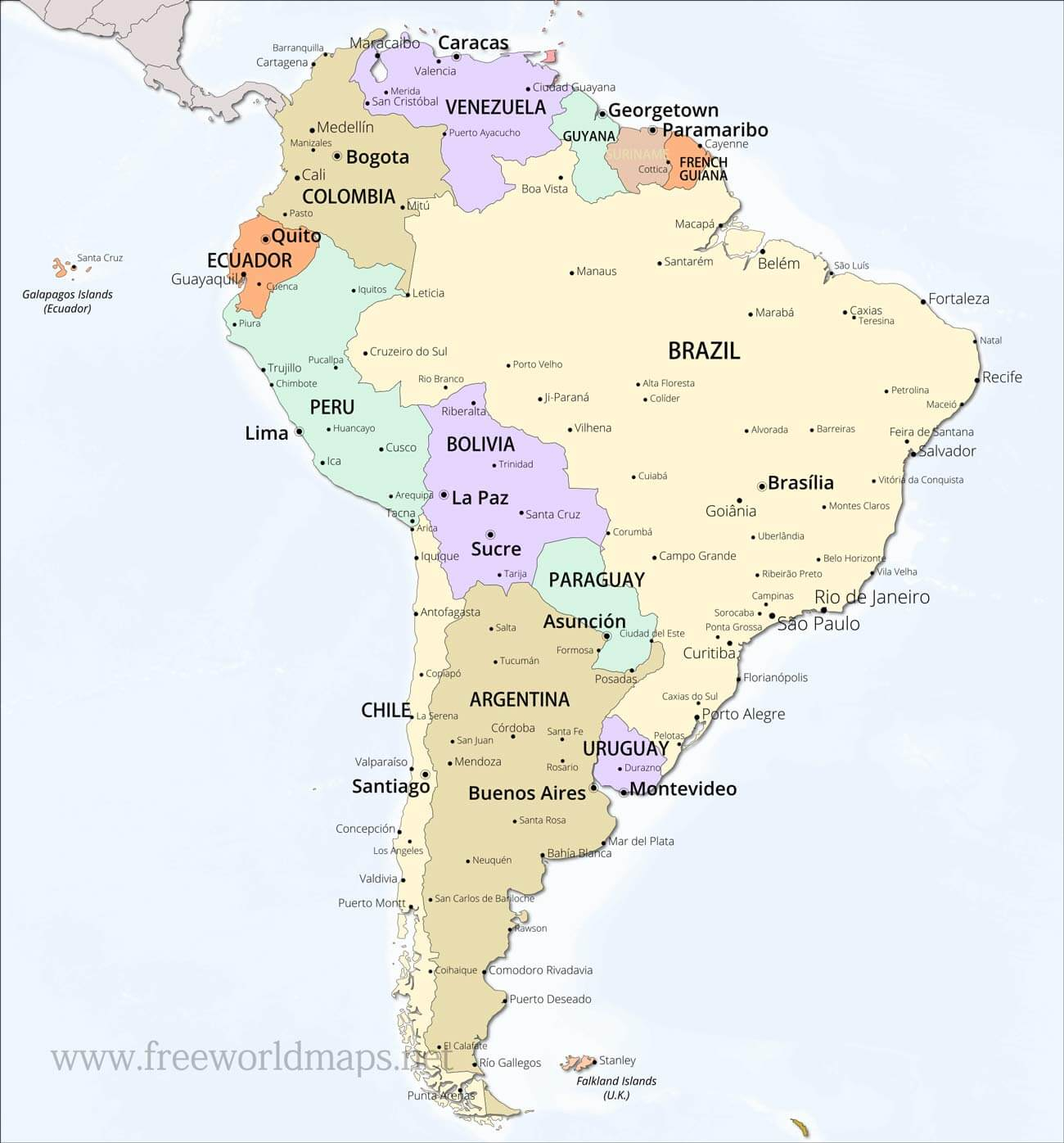
South America can be divided into several cultural and geographic regions:
Northern South America
Venezuela, Colombia, Guyana, Suriname, French Guiana
Characterized by Caribbean influence and tropical climate
Andean Countries
Ecuador, Peru, Bolivia
High indigenous population and Andean culture
Rich mineral resources
Southern Cone
Argentina, Chile, Uruguay (core members)
Sometimes includes Paraguay and southern Brazil
Located mostly south of the Tropic of Capricorn
More moderate climate with European cultural influence
Highest Human Development Index in South America
Member of Mercosur trade bloc
Brazil
Often considered separately due to its size and Portuguese-speaking culture
Dominant economy in the region
11. Agriculture and Natural Resources
11.1 Major Agricultural Crops
Coffee
Brazil is the world’s leading producer and exporter of coffee
Also produced in Colombia, Peru, Ecuador, and other Andean countries
Coffee belt located primarily between the Equator and Tropic of Capricorn
In Brazil, production concentrated in eastern states like São Paulo, Minas Gerais, and Espírito Santo
Soybeans
Brazil and Argentina are among the world’s top producers
Brazil’s soybean exports valued at US$19 billion, representing 10.4% of total exports
Argentina’s soybean exports valued at US$3.23 billion, representing 5.7% of exports
Argentina’s soybean meal exports represent 17.5% of total exports (US$9.96 billion)
Major growing regions: Mato Grosso (Brazil), Pampas (Argentina)
Wheat
Major producers: Argentina, Brazil, Uruguay, Paraguay
Argentina’s La Plata region (Paraná and Uruguay river delta) is the highest wheat-producing region in South America
Brazil’s production concentrated in southern states: Rio Grande do Sul, Paraná, Santa Catarina
The Pampas grasslands are ideal for wheat cultivation
Corn (Maize)
Important crop in Brazil and Argentina
Grown in tropical and subtropical regions
Significant export commodity
Cattle Ranching
Pampas region of Argentina and Uruguay is famous for cattle production
Brazil has large cattle ranching operations, especially in the Pantanal and central regions
Venezuela also has significant cattle ranching in the Llanos
Other Important Crops
Sugar cane: Brazil is a major producer, particularly in São Paulo state
Cotton: Produced in Brazil (northern and eastern states) and Argentina
Rice: Tropical and subtropical regions of Brazil, Argentina, Colombia
Cacao: Amazon region, especially Ecuador
Oranges: Brazil is the world’s largest producer
Bananas: Ecuador, Colombia, Costa Rica (Central America)
Grapes and wine: Chile and Argentina (Mendoza region)
Agricultural Zones
Tierra Templada: Coffee and various fruits thrive
Tierra Fría: Hardy crops and livestock suited for cooler climates
Slash-and-burn agriculture: Practiced in the Guiana Highlands for corn and rice
11.2 Mineral Resources
South America is exceptionally rich in mineral wealth:
Copper
Chile is the world’s leading producer
Also significant production in Peru
Chile leads in copper, iodine, and lithium production
Lithium
Latin America holds 60% of world lithium reserves
Top producers: Bolivia, Argentina, Chile (the “Lithium Triangle”)
Found in salt flats (salares) in the Andes, particularly in Salta, Jujuy, and Catamarca provinces (Argentina)
Argentina has six lithium projects in production
Iron Ore
Brazil is a major exporter
Carajás region produces iron ore transported to Itaqui port via railway
Oil and Natural Gas
Venezuela contains some of the largest proven oil reserves in the world
In 2013, Venezuela was the third-largest exporter of crude oil to the United States
Brazil has significant pre-salt offshore oil fields
Argentina’s Vaca Muerta shale formation contains vast unconventional gas reserves
Ecuador, Peru, Colombia also contribute oil to world markets
Gold
Found in Brazil, Peru, Colombia, and Venezuela
Pascua Lama mine (Argentina-Chile border) produces gold, silver, and copper
Other Minerals
Rare earth elements: Brazil holds approximately one-fifth of world reserves
Nickel: Significant reserves in Brazil
Manganese: Brazil
Lead: Brazil
Diamonds: Brazil
Tin: Bolivia
Silver: Peru, Bolivia, Argentina
Bauxite (Aluminum): Suriname, Venezuela, Brazil
Emeralds: Colombia (world’s leading producer)
11.3 Energy Resources
Hydroelectric power: Brazil has extensive hydroelectric capacity; Amazon region potential
Wind and solar: Growing renewable energy sector, particularly in Brazil, Chile, and Argentina
Coal: Colombia is a significant producer
Natural gas: Argentina’s Vaca Muerta formation is rapidly expanding
Bioenergy: Extensive use in Latin America, particularly Brazil (ethanol from sugarcane)
12. Economy and Trade
12.1 Economic Overview
Brazil is the largest economy in South America in terms of nominal GDP
The region has two major trade blocs: Mercosur (Southern Common Market) and the Andean Community
Mercosur members: Argentina, Brazil, Paraguay, Uruguay, and Venezuela (suspended)
Latin America’s primary energy mix is dominated by fossil fuels (70%), below the global average of 80%
12.2 Trade Performance (2024)
South America’s product exports grew by 4% in 2024
Export volumes increased by 5% while prices dropped by 1%
Agricultural exports increased by 11%, with soybeans, corn, and wheat showing the largest growth
Import volumes increased by 4% while prices decreased by 2%, resulting in a 2% increase in import values
Export growth from Latin America and the Caribbean: 4.1%, driven by South America
12.3 Major Exports
Agricultural products: Soybeans, coffee, wheat, corn, beef, sugar, oranges
Minerals and metals: Copper, iron ore, lithium, gold, silver
Energy: Oil, natural gas, coal
Manufactured goods: Automobiles, machinery, chemicals
12.4 Trade Partners
Asia receives 20.1% of Latin American and Caribbean exports (2017), with China being a major destination
United States: Major trading partner, particularly for oil from Venezuela and agricultural products
European Union: Traditional trading partner due to historical ties
Intra-regional trade: Growing through Mercosur and other agreements
12.5 Major Industries
Mining and extraction: Copper, lithium, iron ore, oil and gas
Agriculture and food processing: Coffee, soybeans, beef, sugar
Manufacturing: Particularly in Brazil, Argentina, and Chile
Services: Tourism, finance, logistics
Fishing: Important in Peru, Chile (anchovy, tuna)
12.6 Major Ports
South America’s ports are critical for international maritime trade:
Port of Santos (Brazil) – Among the busiest in Latin America; exports soybeans, sugar, coffee, manufactured goods
Port of Itaqui (Brazil) – Largest and busiest port, handling 146 million tonnes annually; specialized terminals for iron ore
Port of Tubarão (Brazil) – Major iron ore exporter
Port of Callao (Peru) – Main port serving Lima
Port of Chancay (Peru) – Newest major port (opened late 2024), designed for ultra-large vessels up to 24,000 TEUs
Port of San Antonio (Chile) – 8th largest throughput in Latin America (2019), handling 1.71 million TEU
Port of Cartagena (Colombia) – Major Caribbean port
Port of Buenos Aires (Argentina) – Primary port for Argentina’s exports
12.7 Infrastructure Challenges
Ports require significant investment to accommodate larger vessels (13,000+ TEU capacity)
Infrastructure gap affects transport, energy, telecommunications, water, and sanitation sectors
Roads and railways connecting hinterlands to ports need improvement
13. Ocean Currents
13.1 Humboldt Current (Peru Current)
A cold, low-salinity ocean current flowing northward along the western coast of South America
Extends from southern Chile to northern Peru
Named after German naturalist Alexander von Humboldt, though discovered by José de Acosta 250 years earlier
Extends 500-1,000 km (310-620 mi) offshore
Creates a significant cooling influence on the climate of Chile, Peru, and Ecuador
Largely responsible for the aridity of the Atacama Desert in northern Chile and coastal Peru
Marine air is cooled, preventing precipitation but producing clouds and fog
Supports upwelling of nutrient-rich waters, making it one of the world’s most productive fishing grounds
Upwelling occurs year-round off Peru, but only in spring and summer along Chile
13.2 Brazil Current
Warm ocean current flowing southward along the eastern coast of Brazil
Part of the South Atlantic Gyre
Moderates temperatures along Brazil’s coast
13.3 Falkland Current
Cold current flowing northward along the coast of Argentina
Meets the Brazil Current, creating rich fishing grounds
14. Waterfalls
14.1 Angel Falls (Kerepakupai Merú)
Located in Canaima National Park, Bolívar State, Venezuela
The world’s highest uninterrupted waterfall
Total height: 979 meters (3,212 feet), with the main plunge of 807 m and additional cascades below
Width at base: 500 feet (150 meters)
Leaps from Auyán-Tepuí (Devils Mountain), a flat-topped plateau in the Guiana Highlands
Average water flow: approximately 33,000 gallons (125,000 liters) per second during the rainy season
Named after James Angel, an American aviator who crash-landed his plane nearby in 1937
Indigenous name: Kerepakupai Merú or Parecupá Merú
Best viewed from the air due to dense jungle surroundings
UNESCO World Heritage Site (as part of Canaima National Park)
14.2 Iguazu Falls
Located on the border between Brazil and Argentina
One of the largest waterfall systems in the world
System of approximately 275 individual falls
14.3 Kaieteur Falls
Located in Guyana
Single-drop waterfall with 226 m height
One of the most powerful waterfalls in the world by volume
15. Wildlife and Biodiversity
South America is one of the most biodiverse regions on Earth:
Amazonian Species
Jaguars, pumas, tapirs, capybaras, anacondas, caimans
Over 1,300 bird species including macaws, toucans, harpy eagles
Pink river dolphins
Thousands of fish species including piranhas and arapaima
Andean Species
Llamas, alpacas, vicuñas, guanacos
Spectacled bears, mountain tapirs
Andean condors (largest flying bird)
Chinchillas
Patagonian Species
Guanacos, Patagonian maras
Pumas, Andean foxes
Darwin’s rheas
Marine Species
Penguins (Humboldt, Magellanic)
Sea lions, fur seals
Whales (humpback, southern right, orcas)
Albatrosses
Galápagos Species
Giant tortoises, marine iguanas
Blue-footed boobies, frigatebirds
Galápagos penguins
Conclusion
South America is a continent of remarkable diversity, featuring the world’s longest mountain range (Andes), largest rainforest (Amazon), highest waterfall (Angel Falls), and driest desert (Atacama). With a population exceeding 438 million people distributed across 12 independent nations, the continent exhibits enormous variation in climate, topography, culture, and economic development.
The continent’s geography creates unique ecological zones from tropical rainforests to subpolar tundra, supporting extraordinary biodiversity. Rich in natural resources including minerals (copper, lithium, iron ore), energy (oil, gas), and agricultural products (soybeans, coffee, beef), South America plays a vital role in global commodity markets.
Major physical features include the Andes Mountains stretching 7,000 km along the western edge, the vast Amazon Basin covering 7 million sq. km in the interior, and the Eastern Highlands comprising the Guiana and Brazilian plateaus. The continent is bounded by the Pacific Ocean to the west, Atlantic Ocean to the east, and connected to North America by the narrow Isthmus of Panama.
South America’s strategic location, abundant resources, and growing economies position it as an increasingly important region in the 21st-century global economy, despite ongoing challenges in infrastructure development and sustainable resource management.


Discover more from Simplified UPSC
Subscribe to get the latest posts sent to your email.