Vakataka Dynasty
Contents
Vakataka Dynasty: History, Rulers, Administration, and Cultural Legacy
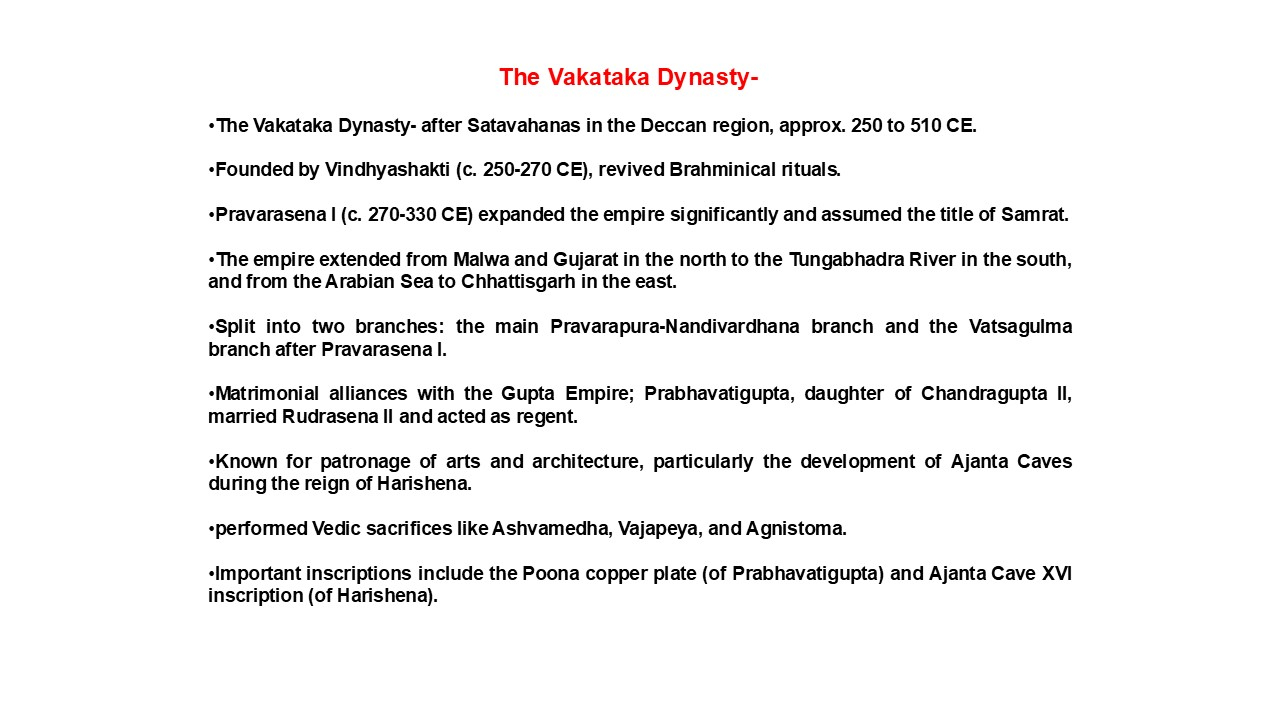
The Vakataka Dynasty ruled the Deccan region between the 3rd and 5th centuries CE.
The dynasty was founded by Vindhyashakti.
The Vakatakas were contemporaries and allies of the Gupta Empire.
Pravarasena I was the most powerful Vakataka ruler.
Pravarasena I performed Vedic sacrifices like Ashvamedha.
The dynasty had two main branches: Nandivardhana and Vatsagulma.
Rudrasena II married a Gupta princess, strengthening political ties.
Harishena was the greatest ruler of the Vatsagulma branch.
The Ajanta Caves flourished under Vakataka patronage.
Vakatakas were major patrons of Buddhist art and architecture.
Sanskrit was the official language of Vakataka inscriptions.
The dynasty followed a monarchical form of administration.
Vakatakas supported Brahmanical Hinduism while also patronizing Buddhism.
Land grants to Brahmins indicate early feudal tendencies.
Their rule helped connect North Indian Gupta culture with the Deccan.
The decline of the Vakatakas led to the rise of later Deccan powers.
Introduction
The Vakataka dynasty was one of the most significant political powers in ancient India, ruling the Deccan region from approximately 250 CE to 510 CE. Emerging as successors to the declining Satavahana empire, the Vakatakas established a centralized administrative structure and became contemporary rivals and allies of the powerful Gupta empire in northern India. The dynasty is remembered not merely for its political achievements but for its extraordinary cultural and artistic patronage, most notably exemplified by the magnificent Ajanta Caves, which represent the zenith of ancient Indian rock-cut architecture and painting.
The Vakatakas were Brahmins of the Vishnuvriddha gotra who ruled over vast territories spanning from Malwa and Gujarat in the north to the Tungabhadra River in the south, and from the Arabian Sea in the west to Chhattisgarh in the east. Their reign marks a transitional phase in Indian history where Brahmanical Hinduism gradually reasserted itself while maintaining tolerance for Buddhism and other faiths. The dynasty ultimately disappeared in the early sixth century, but their administrative models, artistic innovations, and literary contributions influenced subsequent dynasties including the Chalukyas, Rastrakutas, and later medieval powers of the Deccan.
Origin and Early Rulers
Vindhyashakti (c. 250–270 CE)
Vindhyashakti, a Brahmin chieftain whose lineage prior to dynasty establishment remains obscure, founded the Vakataka dynasty around 250 CE. He likely ruled from Purika, a settlement in present-day Vidarbha region. Though limited historical records exist regarding his reign, Vindhyashakti established the foundational structure of Vakataka power during a period when multiple minor dynasties competed for supremacy following the collapse of the Satavahana empire and the declining influence of the Western Kshatrapas. His reign laid the groundwork for territorial consolidation that would characterize his successors.
Pravarasena I (c. 270–330 CE)
The true architect of Vakataka greatness was Pravarasena I, son of Vindhyashakti. He earned the title “Samrat” (sovereign ruler) and established the Vakataka empire as a major political force in the Deccan. Pravarasena I expanded his territory substantially from the initial nucleus in Berar, extending his authority southward into Vidarbha and adjoining regions. With his capital established at Kanchanaka (modern Nachna) in Madhya Pradesh, he significantly enlarged the empire’s geographical reach.
Pravarasena I was a devout follower of Brahmanical traditions and performed several major Vedic sacrifices including Ashvamedha (horse sacrifice) and Vajapeya (drink of strength sacrifice), thereby establishing Brahmanical legitimacy for his rule. These ritual performances served dual purposes: they reinforced religious authority and demonstrated the state’s wealth and power through elaborate ceremonies. His reign marked a turning point when the Vakataka dynasty transformed from a regional power into a major imperial entity that would rival contemporary dynasties.
Gautamiputra (c. 330–350 CE)
The successor to Pravarasena I, Gautamiputra strengthened dynastic consolidation through strategic matrimonial alliances. He married the daughter of Bhavanaga, a Naga king of central India, creating a powerful alliance that expanded Vakataka influence. Through a combination of military campaigns and diplomatic marriages, Gautamiputra extended the empire from Bundelkhand in the north to Hyderabad in the south. He performed ashvamedha and vajapeya sacrifices to celebrate his victories, following the pattern established by his predecessor and demonstrating continuity in religious patronage and political assertion.
Territorial Division and the Two Branches
Following Pravarasena I’s death, the Vakataka empire underwent significant political transformation. The state eventually divided into at least two principal branches, likely through partitioning among his successors. This division, based on political centers, has been labeled by historians as the Nandivardhana-Pravarapura line (also called the main branch) and the Vatsagulma (also called Wasim) branch. Understanding these branches is crucial for comprehending Vakataka political history, as they often functioned as independent entities with distinct policies, though they occasionally reunified under powerful rulers.
The Nandivardhana-Pravarapura Branch
This line, representing continuity with the original Vakataka center, was administered by descendants including Rudrasena I and later significant rulers like Rudrasena II and Pravarasena II. The capital shifted from Kanchanaka to Nandivardhana in Vidarbha, strategically positioned to control central Indian territories.
Rudrasena I maintained the territorial integrity established by earlier rulers and continued the tradition of land grants and Vedic patronage.
Rudrasena II (c. 375–385 CE) became historically significant through his marriage to Prabhavatigupta, daughter of the powerful Gupta emperor Chandragupta II. This matrimonial alliance created profound geopolitical implications, tying Vakataka interests directly to Gupta imperial ambitions.
Prabhavatigupta’s Regency (c. 385–410 CE): Following Rudrasena II’s premature death after only five years of reign, Prabhavatigupta stepped into the power vacuum as regent for her minor sons Divakarasena and Damodarasena (later known as Pravarsena II). Her twenty-year regency proved transformative, bringing Vakataka governance into alignment with Gupta administrative practices and cultural values. She provided crucial support to her father Chandragupta II’s campaigns against the Western Kshatrapas in Gujarat and Kathiawar, leveraging Vakataka geographical position and military resources. This alliance fundamentally altered the course of Indian political history by facilitating the final destruction of Saka power in western India.
Pravarasena II (c. 410–440 CE): One of the most capable rulers of this branch, Pravarasena II founded a new capital at Pravarapura (modern Paunar) in Wardha district. His reign generated the largest corpus of Vakataka inscriptions—approximately twenty copper-plate grants—providing invaluable epigraphic evidence for understanding Vakataka administration, economy, and religious patronage. His inscriptions detailed extensive land grants to Brahmins, temples, and Buddhist institutions, revealing the complex patronage networks that sustained Vakataka power.
Narendrasena (c. 440–460 CE): After Pravarasena II’s death, succession struggles ensued, from which Narendrasena emerged victorious. His reign faced significant military pressure from Nala invaders under Bhavadottavarman. He married Ajihata Bhattarika, daughter of Kadamba king Kakutsavarman, extending diplomatic networks through matrimonial alliances.
Prithvisena II (c. 460–480 CE): The last known ruler of the Nandivardhana branch, Prithvisena II faced repeated invasions from the Nala king Bhavadottavarman and contested claims from Harisena of the Vatsagulma branch. Inscriptional records indicate he rescued “the sunken fortunes of the Vakatakas” twice during his reign, suggesting periods of political crisis and restoration. His rule marked the decline of this branch’s independent power.
The Vatsagulma (Wasim) Branch
Founded by Sarvasena, younger son of Pravarasena I, the Vatsagulma branch controlled territories between the Sahyadri mountain range and Godavari River, with its capital at Vatsagulma (modern Washim) in Maharashtra.
Vindhyashakti II ruled for at least 37 years as early head of this branch, establishing its administrative and cultural foundations.
Pravarasena II (c. 400–415 CE): An important ruler of this branch praised extensively in Cave XVI inscriptions at Ajanta for his excellent, powerful, and liberal governance. Contemporary copper-plate inscriptions lauded his virtues and support for learning and religious institutions.
Devasena: A pleasure-seeking ruler who nevertheless benefited from capable minister Hasthibhoja’s administrative acumen.
Harisena (c. 475–510 CE): The greatest ruler of the Vatsagulma branch and ultimately the last known significant Vakataka monarch. Harisena unified the two Vakataka branches following Prithvisena II’s death, briefly creating a reunified empire at its territorial zenith. His domains extended from Malwa in the north to southern Maharashtra in the south, and from the Bay of Bengal in the east to the Arabian Sea in the west, encompassing Kuntala, Avanti, Kosala, Kalinga, Konkan, and Andhra regions. This territorial extent surpassed even that of Pravarasena I, representing the apex of Vakataka power.
Harisena is immortalized in history as the great patron of Ajanta Cave construction and decoration. His minister Varahadeva commissioned magnificent Buddhist rock-cut monasteries and prayer halls, with inscriptional records mentioning these achievements in glowing terms. The artistic and architectural masterpieces created under his patronage established standards for Deccan art that influenced subsequent dynasties for centuries. Upon Harisena’s death around 510 CE, the Vakataka dynasty rapidly declined, with his successors lacking comparable authority or capability. Within decades, neighboring powers including the Nalas, Kadambas, Kalachuris, and the rising Chalukyas partitioned Vakataka territories.
Vakataka Administration and Polity
The Vakatakas developed a sophisticated administrative system synthesizing elements from earlier Satavahana governance and contemporary Gupta models. Their extensive copper-plate inscriptions provide unprecedented insight into classical Indian administrative structures.
Central Administration
The Vakataka state was organized as a centralized monarchy with the king at its apex. The king held supreme executive, judicial, and military authority while delegating specific functions to subordinate officials. Royal councils (sabhas) advised the monarch on matters of state policy, though limited documentary evidence exists regarding their precise composition or decision-making procedures.
Provincial and District Organization
The empire was divided into territorial units called “Rashtras” or “Rajyas” (kingdoms/provinces), each governed by appointed officials known as “Rajyadhikritas” (governors or provincial officers). These rashtras represented large administrative units corresponding to geographically or historically significant regions. Records mention specific rashtras such as the Pakkana rashtra (referenced in the Belora plates) and the Bhojakata rashtra (mentioned in Chammaka plates), indicating systematic territorial organization.
Provinces were further subdivided into “Vishayas” (districts), which were in turn divided into smaller units called “Aharas” and “Bhogas” or “Bhuktis” (localities). This hierarchical subdivision enabled efficient administration across vast territories and allowed the state to exercise control over diverse populations and geographies.
Revenue Administration
The state appointed a high-ranking official called the “Sarvadhyaksha” (chief accountant or controller of finances) who held responsibility for state revenues and appointed subordinate officers known as “Kulaputras” (literally “sons of families,” perhaps representing officials from established administrative families). These officers maintained law and order and facilitated revenue collection.
Land revenue constituted the primary state income, collected as a percentage of agricultural produce or in monetary terms. The state recognized different categories of land: royal land directly managed by state officials, private land held by individuals, and temple land granted to religious institutions. Revenue assessment was based on land fertility, productivity, and cultivated status, with assessment officials (similar to the Gupta-era Rajukas) conducting periodic surveys.
Military Organization
Military affairs were supervised by high-ranking officers including the “Senapati” (commander-in-chief) and “Dandanayaka” (officer responsible for punishment or coercive forces). The Senapati’s office apparently drafted official charters and decrees, indicating the military’s role in state administration. Different individuals held the Senapati position during different years of a given ruler’s reign, either reflecting positional rotation or simultaneous appointments of multiple individuals with this designation.
Two categories of troops are mentioned in Vakataka grants: “Chhatras” (irregular forces) and “Bhatas” (regular troops or mercenaries). These forces wandered the countryside collecting state revenues and maintaining order, functioning as both tax collectors and law enforcement agents.
Local Administration and Justice
Villages constituted the basic administrative unit. Each village had a “Gramakuta” (headman or village chief) responsible for local order and preliminary dispute resolution. The “Devavarika” or “Dauvarika” functioned as village police head, while “Gandakas” (perhaps equivalent to the Bhatas) served as village law enforcement. The “Rahasika” (confidential officer) attached to the royal court handled sensitive administrative and diplomatic matters.
Land dispute resolution occurred through multiple channels. Village assemblies, continuing traditions from earlier Indian kingdoms, managed local land disputes and often supervised tax collection. These assemblies represented early democratic governance structures, though their composition likely reflected property-owning elite interests rather than universal participation.
Feudatories and Subsidiary Rulers
The Vakataka state incorporated numerous feudatory kings and subsidiary rulers who maintained semi-autonomous authority over their territories while acknowledging Vakataka suzerainty. These feudatories issued their own inscriptions recording land grants and administrative acts, though nominally subordinate to the paramount Vakataka ruler. This feudatory system reflects feudal characteristics emerging in classical Indian governance, whereby loyalty and military support were exchanged for territorial autonomy and revenue privileges.
Vakataka Economy
The Vakataka economy was fundamentally agrarian, with agriculture providing the material basis for state power, cultural patronage, and urban development.
Agricultural Foundation
The overwhelming majority of the population engaged in agricultural production. Major crops included rice, wheat, barley, pulses, sugarcane, cotton, and oilseeds, with cultivation patterns adapted to regional climate and geography. Irrigated agriculture expanded through construction of tanks (artificial ponds), wells, and canal systems, particularly noted in Vidarbha and surrounding regions. The iron plough became increasingly common during the Vakataka period, enhancing agricultural productivity beyond earlier wooden implements.
Land grants to Brahmins and temples frequently involved formerly uncultivated or waste lands. Recipients were expected to develop these lands, undertaking clearance, drainage, and initial cultivation. Over generations, as these grants became hereditary and grantees accumulated resources, vast areas of virgin land transformed into productive agricultural territory. This process effectively expanded the economic base while creating networks of landed interests tied to the state through grants and obligations.
Trade and Commerce
Despite the agrarian foundation, significant trade networks existed and facilitated exchange of goods across the empire and with distant regions. Vakataka merchants engaged in inland trade along established routes connecting major cities and production centers. A merchant named Chandra is mentioned in the Indore plates as purchasing half of a village granted by the king to Brahmins, indicating merchant capital’s growing economic role. Maritime trade through ports on the Arabian Sea coast connected Vakataka territories to international commerce, though records of this trade are limited.
Vakataka grants mention specific taxes on trade and commerce, including “Klipta” (purchase tax or sales tax) and “Upaklipta” (additional minor tax), indicating state revenue derived from market transactions. However, the Gupta and post-Gupta period generally witnessed decline in long-distance trade and commerce compared to earlier periods, likely reflecting reduced security, political fragmentation, and disrupted trade networks.
Land Grants System
The land grant system served as both economic policy and political tool. The state issued grants (called “agrahara” or “brahmadeya” when granted to Brahmins) documented on copper plates or stone inscriptions. These grants typically provided tax-exempt and often hereditary land rights to recipients, usually Brahmins, temples, officials, and occasionally merchants. Recipients gained not merely agricultural rights but also judicial and administrative authority over granted lands and inhabitants.
By the reign of Pravarasena II alone, approximately twenty copper-plate grants were issued, with the entire Vakataka period producing roughly thirty-five documented grants. These grants spread throughout the empire’s territories—Maharashtra, Madhya Pradesh, Chhattisgarh, and northern Karnataka—creating networks of loyal landed interests.
The system served multiple purposes: consolidation of Brahmanical culture and priestly authority, advancement of cultivation and agricultural expansion, compensation of officials and allies without burdening the treasury, and cultivation of religious patronage that reinforced state legitimacy. However, as exempted lands accumulated, the tax-paying base contracted, potentially weakening fiscal capacity and contributing eventually to state fragility.
Vakataka Society, Religion, and Culture
Social Structure
Vakataka society maintained the varna (class) system inherited from earlier Hindu traditions, though evidence suggests the caste structure had not yet rigidified into the rigid hierarchical system that would characterize later medieval society. The Vakatakas themselves were Brahmins, represented by the Vishnuvriddha gotra (family lineage), establishing their ritual and social supremacy.
However, interclass marriages are documented, indicating some social mobility and flexibility. Prabhavatigupta, though records sometimes describe her as wife of a Brahmin prince, apparently entered this marriage from outside Brahmin circles, suggesting cross-varna matrimonial possibilities. Similarly, inscriptions record that Soma, a learned Brahmin of Vallura, married women from both Brahmin and Kshatriya castes without apparent loss of status, suggesting greater social fluidity than later medieval periods would permit.
Merchants, artisans, and agricultural laborers comprised substantial population segments. The existence of merchant references in inscriptions indicates growing merchant class economic importance, though political authority remained concentrated in Brahmin and Kshatriya hands. The forced labor system called “Vishti” required villagers to serve the royal army and administrative officials, representing a significant social obligation and potential hardship for lower-class populations.
Religious Patronage and Syncretism
The Vakatakas were devout Hindus who actively promoted Brahmanical traditions through Vedic sacrifice sponsorship, temple patronage, and land grants to Brahmins. Rulers performed elaborate Vedic rituals including ashvamedha, vajapeya, and other sacrifices to assert authority and demonstrate piety. Yet the dynasty simultaneously maintained remarkable religious tolerance, patronizing Buddhism, Jainism, and variant Hindu traditions including Shaivism and Vaishnavism.
Shaivism (worship of Shiva as supreme deity) emerged as the official state religion during the Vakataka period. Most rulers were devout Shaivites who worshipped Shiva under names including Maheshvara and Mahabhairava. However, epigraphic evidence reveals that Vaishnavite and Buddhist communities also flourished under Vakataka rule, supported by royal ministers, feudatories, and wealthy individuals.
The religious landscape reflected remarkable coexistence and mutual respect. While Brahmanical patronage gradually increased relative to Buddhist support as the dynasty progressed, substantial Buddhist architecture and monasteries continued receiving patronage. Prabhavatigupta’s marriage linked Vakataka Brahmanical traditions with Gupta Vaishnavism, creating periods of syncretistic religious practice. Buddhist viharas (monasteries) and chaityas (prayer halls) were excavated with state or ministerial patronage, suggesting integration of Buddhist devotion within the broader Hindu-dominated political order.
The religious tolerance documented in Vakataka inscriptions contrasts with later periods and reflects pragmatic political wisdom. Diverse religious communities provided distinct sources of loyalty, piety, cultural sophistication, and resources. Patronizing all major traditions simultaneously created constituencies supporting the state across various social groups.
Art and Architecture
The Vakatakas’ greatest legacy rests in their artistic and architectural patronage, most spectacularly embodied in the Ajanta Caves, a UNESCO World Heritage site containing some of India’s finest surviving ancient art.
Ajanta Caves: Located near modern Aurangabad in Maharashtra, the Ajanta site contains rock-cut Buddhist caves (numbered 1-29) excavated across several centuries from the 2nd century BCE to the 6th century CE. The Vakataka period witnessed the most intensive construction and decoration, particularly under Harisena’s patronage. Caves 1, 16, 17, 20, and 26 showcase Vakataka-era artistry at its finest.
The caves contain Buddhist viharas (monastic dwellings) and chaityas (prayer halls) carved directly from living rock. Intricate sculptures adorned these spaces, depicting Buddha, bodhi trees, and elaborate narrative scenes. The murals (paintings) represent the zenith of classical Indian artistic achievement, rendered with delicate brushwork, graceful figures, spiritual depth, and remarkable color preservation. Depicted scenes include Jataka tales (stories of Buddha’s previous lives), events from Buddha’s life, royal court scenes, and symbolic representations of Buddhist teachings.
Harisena’s minister Varahadeva is particularly credited with excavating a magnificent vihara cave at Ajanta in memory of his deceased parents, dedicated to Buddhist monks. The inscriptional praise lavished on Harisena for his liberal patronage and his minister for these artistic achievements indicates how deeply the dynasty valued cultural patronage.
Ellora and Elephanta Caves: While primarily developed in later periods, the Vakatakas contributed to early excavation work at Ellora Caves and left their mark on Elephanta Cave construction, establishing patterns for later dynasties’ work.
Sculptural Traditions: Vakataka sculpture combined indigenous Indian traditions with influences from Gupta and Satavahana styles. Elaborate stone carvings depicting deities, mythological creatures, and narrative scenes adorned temples and caves. The refined aesthetic sensibility and technical mastery evident in these sculptures influenced subsequent Deccan art under the Chalukyas and Rashtrakutas.
Literature and Language
The Vakatakas contributed to Sanskrit literary development during the classical period. Court poets and scholars produced works celebrated for their aesthetic refinement and intellectual depth. Sanskrit remained the primary literary language of official inscriptions, philosophical composition, and courtly literature, continuing earlier traditions while establishing precedents later dynasties would follow.
The development of the “Vakataka script” or “Box-headed script” represents an important paleographic contribution. This script variant, used predominantly in Vakataka copper-plate inscriptions, influenced later scripts and represented refinement in written communication methods.
Vakataka inscriptions themselves constituted significant literary achievements. Composed in high Sanskrit registers by accomplished poets and scholars, these charters employed sophisticated vocabulary, complex grammatical constructions, and elaborate panegyric verses praising rulers and beneficiaries. The copper plates recorded not merely administrative facts but cultural ideals and religious values, functioning as texts asserting royal authority and cosmic legitimacy.
The development of Kannada language and script received modest encouragement during the Vakataka period in southern territories, though Sanskrit maintained primacy. Kannada literature and inscriptional use would expand substantially under later dynasties, but Vakataka-era contributions laid groundwork for southern literary traditions.
Decline and Fall
The Vakataka dynasty’s end remains mysterious, as historical records become sparse regarding the exact circumstances of territorial loss and political collapse. Harisena’s death around 510 CE marked the beginning of rapid decline. No capable successor emerges in historical records; contemporary rulers and feudatories of Nalas, Kadambas, Kalachuris, and other powers apparently moved to exploit perceived Vakataka weakness.
Multiple factors likely contributed to decline: succession disputes following Harisena’s death, military pressure from surrounding kingdoms, fragmentation among feudatory rulers, possible internal administrative breakdown, and erosion of central authority. The exact causes remain debated, but the result was unmistakable. Within several decades, former Vakataka territories were absorbed by neighboring powers. The Chalukyas, who would become the dominant Deccan power by the mid-sixth century, had seized most Vakataka territories by approximately 550 CE.
The dynasty vanished from political significance by the early sixth century, though its cultural and administrative legacies persisted and influenced successor dynasties. The Chalukyas, Rashtrakutas, and later Deccan rulers adopted administrative practices pioneered by the Vakatakas, perpetuated architectural and artistic styles established during their reign, and absorbed Sanskrit literary and philosophical traditions developed under their patronage.
Vakataka Legacy and Historical Significance
The Vakatakas occupy a crucial position in Indian history as a transformative dynasty bridging the classical age of the Guptas with the medieval Deccan kingdoms. Several dimensions of their legacy deserve emphasis:
Administrative Innovation
The Vakataka administrative system synthesized Satavahana and Gupta models while introducing innovations that influenced successor dynasties. Their hierarchical territorial organization, elaborate revenue collection procedures, feudatory incorporation, and bureaucratic specialization established templates subsequent rulers would adopt and adapt. Copper-plate charters as administrative records became standardized practice in later dynasties.
Cultural Patronage
The artistic achievements of the Vakataka period, crystallized in Ajanta’s magnificent caves, represent a pinnacle of classical Indian aesthetic expression. The graceful Buddha figures, exquisite paintings depicting Jataka tales and court scenes, and masterful rock-cut architecture established standards influencing centuries of subsequent Indian art. The Ajanta Caves remain not merely historical artifacts but active sources of artistic inspiration and spiritual significance.
Religious Synthesis
The Vakataka model of religious pluralism—simultaneous state patronage of Hinduism, Buddhism, Jainism, and variant traditions—provided a template for later dynasties managing religiously diverse realms. This pragmatic syncretism contrasts with later periods’ increasing sectarian boundaries and demonstrates classical Indian political wisdom regarding religious tolerance.
Gupta-Deccan Integration
The Prabhavatigupta marriage alliance and resultant Gupta-Vakataka relations represented a crucial historical connection integrating north and south Indian political and cultural spheres. Though eventually competing militarily, both dynasties shared Sanskrit literary traditions, Brahmanical values, and administrative practices, facilitating cultural continuity across the subcontinent during the classical period.
Important Points for UPSC Examination
Chronology: Vakataka dynasty ruled from approximately 250 to 510 CE, contemporary with the later Satavahanas (south) and Guptas (north).
Key Rulers:
Pravarasena I: Founder of imperial power
Prabhavatigupta: Regent of great political importance, daughter of Chandragupta II
Pravarasena II: Most prolific in inscriptional records
Harisena: Greatest ruler, unifier of branches, greatest patron
Major Achievements:
Established sophisticated administration in Deccan
Patronized Ajanta Caves, finest surviving classical art
Maintained religious tolerance while promoting Brahmanical traditions
Strategic alliance with Gupta empire through marriage
Territory: Controlled Deccan from Malwa-Gujarat (north) to Tungabhadra (south), Arabian Sea (west) to Chhattisgarh (east)
Administration: Hierarchical structure with Rashtras → Vishayas → Aharas; sophisticated revenue collection; feudatory incorporation
Economy: Agrarian foundation with expansion through land grants; growing merchant role; limited long-distance trade
Culture: Sanskrit literature; Ajanta Caves masterpieces; religious pluralism; Brahmanical ceremony patronage
Epigraphic Sources: Copper-plate inscriptions (Indore plates, Tirodi plates, etc.) provide detailed information about administration, land grants, and society
Decline: Mysterious end after Harisena’s death; rapid territorial absorption by Nalas, Kadambas, Chalukyas by 550 CE
Legacy: Administrative models, artistic standards, religious tolerance precedent influenced later Deccan dynasties; maintained classical Indian civilization continuity
Quick Revision Facts
| Aspect | Details |
|---|---|
| Period | 250–510 CE |
| Original Capital | Kanchanaka (Pravarasena I); Nandivardhana (early branch); Vatsagulma (later branch) |
| Founder | Vindhyashakti |
| Greatest Ruler | Harisena |
| Territory | Deccan region; Malwa to Tungabhadra; Arabian Sea to Chhattisgarh |
| Religion | Shaivism; also patronized Buddhism, Vaishnavism, Jainism |
| Primary Income | Land revenue (1/4 to 1/6 of produce) |
| Major Contribution | Ajanta Caves—Buddhist rock-cut architecture and painting |
| Administrative Units | Rashtras (provinces) → Vishayas (districts) → Aharas (localities) |
| Key Officials | Rajyadhikritas (governors); Sarvadhyaksha (revenue chief); Senapati (commander) |
| Epigraphic Records | Copper-plate inscriptions; ~35 grants documented; Box-headed script |
| Major Branches | Nandivardhana-Pravarapura branch; Vatsagulma branch |
| Decline Cause | Unknown (after Harisena); rapid territorial loss to Nalas, Kadambas, Chalukyas |
Multiple-Choice Questions for Practice
Question 1: Which Vakataka ruler is credited with founding the capital at Pravarapura?
A) Pravarasena I
B) Pravarasena II
C) Harisena
D) Rudrasena II
Answer: B) Pravarasena II
Explanation: Pravarasena II of the Nandivardhana-Pravarapura branch founded the new capital city of Pravarapura (modern Paunar) in Wardha district. This shift of capital reflected growing administrative complexity and changed strategic priorities.
Question 2: The Ajanta Caves under Vakataka patronage represent masterpieces of which art form?
A) Stone temple construction
B) Rock-cut architecture and Buddhist painting
C) Bronze sculpture
D) Wooden carving
Answer: B) Rock-cut architecture and Buddhist painting
Explanation: The Ajanta Caves, particularly caves excavated and decorated under Harisena’s patronage, showcase exceptional Buddhist rock-cut architecture with monasteries, prayer halls, and chaityas adorned with magnificent murals depicting Jataka tales and Buddhist themes.
Question 3: Which princess’s marriage to Rudrasena II created a strategic alliance between the Vakataka and Gupta empires?
A) Prabhavati Devi
B) Prabhavatigupta
C) Dharini Devi
D) Malini Devi
Answer: B) Prabhavatigupta
Explanation: Prabhavatigupta, daughter of Gupta emperor Chandragupta II, married Rudrasena II of the Vakatakas. After his death, she ruled as regent for twenty years and provided crucial support to her father’s campaigns against the Western Kshatrapas.
Question 5: Which script variant is particularly associated with Vakataka inscriptions?
A) Brahmi script
B) Kharoshthi script
C) Box-headed script (Vakataka script)
D) Pallava script
Answer: C) Box-headed script (Vakataka script)
Explanation: The Vakatakas developed and popularized a distinctive script variant known as the “Box-headed script” or “Vakataka script,” which appears in most of their copper-plate inscriptions and influenced later paleographic development.
Question 6: The last known significant Vakataka ruler who unified both branches was:
A) Pravarasena II
B) Narendrasena
C) Prithvisena II
D) Harisena
Answer: D) Harisena
Explanation: Harisena (c. 475–510 CE), ruler of the Vatsagulma branch, unified both Vakataka branches following Prithvisena II’s death and extended the empire to its territorial zenith before his death marked the beginning of rapid dynastic decline.
Question 7: Vakataka copper-plate grants typically recorded grants of land to which recipients?
A) Only royal family members
B) Brahmins, temples, officials, and merchants
C) Military commanders exclusively
D) Foreign traders only
Answer: B) Brahmins, temples, officials, and merchants
Explanation: Vakataka copper-plate inscriptions document land grants (agraharas or brahmadeyas) primarily to Brahmins and temples, but also to state officials as compensation and occasionally to merchants, creating networks of landed interests tied to the state.
Question 8: Which contemporary power defeated and absorbed most Vakataka territories by approximately 550 CE?
A) Kadamba dynasty
B) Chalukya dynasty
C) Rashtrakuta dynasty
D) Chola dynasty
Answer: B) Chalukya dynasty
Explanation: Following the Vakataka dynasty’s collapse after Harisena’s death, the Chalukya dynasty emerged as the dominant Deccan power and had absorbed most former Vakataka territories by 550 CE, establishing a new era of Deccan political history.
Question 9: What was the primary source of Vakataka state revenue?
A) Trade taxes and customs duties
B) Land revenue (agricultural taxes)
C) Temple donations
D) Merchant guild contributions
Answer: B) Land revenue (agricultural taxes)
Explanation: Land revenue constituted the fundamental state income, typically collected as 1/4 to 1/6 of agricultural produce or in monetary terms. While trade taxes existed (klipta and upaklipta), the agrarian economy’s foundation made agricultural revenue paramount.
Question 10: The Vakataka dynasty’s administrative division into provinces, districts, and localities followed which organizational pattern?
A) Rashtras → Vishayas → Aharas
B) Mandala → Bhoga → Gram
C) Sampad → Samvat → Sambandha
D) Rastra → Kshetra → Padesa
Answer: A) Rashtras → Vishayas → Aharas
Explanation: The Vakataka empire employed a hierarchical territorial organization dividing the state into Rashtras (provinces) governed by Rajyadhikritas (governors), which were further subdivided into Vishayas (districts) and then into Aharas (localities), enabling efficient multi-level administration across vast territories.

Read More: Ancient India Notes
Discover more from Simplified UPSC
Subscribe to get the latest posts sent to your email.