Land Reforms in India
Contents
Analysis of Land Reforms in India:
Introduction
Land reforms in India represent one of the most significant socio-economic transformations in the post-independence era. These reforms emerged as a response to the deeply entrenched feudal agrarian structures inherited from colonial rule, which had created stark inequalities in land ownership and perpetuated the exploitation of cultivators. Rooted in the constitutional mandate for a “socialist republic,” land reforms became the concrete expression of India’s commitment to establishing social justice, equitable resource distribution, and participatory democracy in rural India. This comprehensive analysis examines the philosophical underpinnings, legislative mechanisms, state-wise implementation patterns, and the profound impact of land reforms on India’s socialist democratic character.
I. Philosophical and Constitutional Foundations
A. The Constitutional Mandate for Land Reforms
The Indian Constitution explicitly enshrined the principles underlying land reforms through its constitutional design. Article 39(b) and 39(c) of the Directive Principles of State Policy mandated that the state ensure the equitable distribution of the material resources of the community for the common good and that wealth and means of production are not concentrated in the hands of a few. These provisions formed the ideological foundation for viewing land reforms not merely as economic policy but as a constitutional obligation toward establishing social democracy.
The journey toward prioritizing land reform over property rights demonstrated India’s deliberate socialist orientation. Initially, the Constitution granted fundamental rights to property under Articles 19(1)(f) and Article 31. However, recognizing the tensions between property rights and socio-economic equality, the 44th Constitutional Amendment Act of 1978 demoted property from a fundamental right to a legal right by repealing these articles and introducing Article 300-A. This constitutional recalibration explicitly prioritized redistributive justice over individual property accumulation, reflecting the nation’s commitment to socialist principles.
Most significantly, the Ninth Schedule of the Indian Constitution (introduced by the First Amendment Act 1950) provided constitutional protection to land reform legislation by placing them beyond judicial review. By 1990, more than 250 laws related to land reforms had been added to the Ninth Schedule, shielding them from constitutional challenges on the grounds of violation of property rights. This mechanism demonstrated the Constituent Assembly’s recognition that judicial intervention could derail the transformative agenda of establishing an equitable agrarian society.
B. The Kumarappa Committee and Agrarian Reform Philosophy
Post-independence, the Indian National Congress appointed the Agrarian Reforms Committee under J.C. Kumarappa to comprehensively study agrarian relations and recommend reform measures. This committee’s recommendations formed the blueprint for state legislation on land reforms. The committee’s emphasis on removing feudal intermediaries, redistributing surplus land, and securing tenant rights reflected the Gandhian and Nehruvian vision of transforming India into a more equitable society where land—the primary source of wealth in an agrarian economy—would be equitably distributed among the actual tillers.
II. Objectives of Land Reforms
Land reforms in India pursued multifaceted objectives, reflecting both economic efficiency and social justice imperatives:
Social Justice and Eradication of Feudalism: The primary objective was to eliminate the exploitative feudal system that had persisted for centuries. The reforms aimed to transfer land from intermediaries (zamindars, jagirdars) to the actual cultivators, thereby democratizing land ownership and promoting social equality.
Increased Agricultural Productivity: By securing tenure and conferring ownership to cultivators, the reforms sought to incentivize land development and increase agricultural output. Economic theory suggested that those who directly benefit from land improvements would invest more resources in enhancing productivity.
Poverty Alleviation and Socio-Economic Development: By redistributing land to the landless and providing them with a productive asset, the reforms aimed to lift them out of poverty and improve their socio-economic conditions. Land ownership provided not only economic benefits but also social prestige and bargaining power.
Tenancy Reforms and Protection of Cultivators: The reforms sought to regulate land-landlord relations through:
Fixing fair rents (typically one-fifth to one-fourth of gross produce)
Providing security of tenure by making tenancies non-resumable and permanent
Transferring ownership rights to tenants to eliminate absentee landlordism
Prevention of Land Fragmentation: Through consolidation of landholdings, the reforms aimed to prevent excessive subdivision that reduced productivity and increased agricultural costs.
Realization of Constitutional Mandate: Ultimately, land reforms were instrumental in fulfilling the constitutional promise of establishing a just, equitable, and socialist-oriented social order where wealth and resources would not be concentrated in a few hands.
III. Components and Legislative Framework
A. Abolition of Intermediaries
The abolition of intermediary tenures represented the most transformative component of land reforms. The Zamindari Abolition and Land Reform Act of 1950, enacted in various states, dismantled the zamindari system that had been institutionalized by the British East India Company in 1793. This system had vested ownership rights in native tax collectors (zamindars), reducing actual cultivators to mere “tenants-at-will” with no security of tenure.
Key Provisions of Zamindari Abolition:
Abolition of all rights, title, and interest of zamindars and jagirdars
Transfer of agricultural land to cultivators
Payment of compensation to intermediaries (though at rates below market value)
Creation of systematic land records and demarcation of individual holdings
Relief for peasantry from illegal exactions in cash, kind, and services
Impact: The abolition transferred approximately 63 million hectares of land from zamindars to cultivators, establishing a direct relationship between state and tiller. Around 20 million tenants were brought into this direct relationship with the government, fundamentally restructuring agrarian society.
B. Tenancy Reforms
Recognizing that abolition of intermediaries alone was insufficient, states implemented comprehensive tenancy reforms based on three key guidelines:
1. Rent Regulation: Rent was fixed at one-fifth to one-fourth of gross produce, ensuring fair compensation for landlords while protecting tenants from exploitative rentals. Different states implemented variations—Kerala established uniform fair rent rates throughout the state.
2. Security of Tenure: All tenancies were declared non-resumable and permanent (except in specified circumstances), protecting tenants from arbitrary eviction. This security incentivized tenants to make improvements to land and invest in long-term agricultural practices.
3. Ownership Rights: Where tenancy was abolished, ownership rights were conferred on cultivators, eliminating absentee landlordism and creating a direct farmer-land relationship.
Kerala’s Progressive Approach: The Kerala Land Reforms Act of 1963 became a model for comprehensive tenancy reform. It granted:
Security of tenure to all cultivating tenants
Uniform fair rent throughout the state
Right of cultivating tenants to purchase landlord’s rights
Special protections for “kudikidappukar” (hutment dwellers)
The Kerala Land Reforms Amendment Act of 1969 went further by:
Abolishing both tenancy and landlordism entirely
Vesting government ownership of all leased-out land
Conferring full ownership on cultivating tenants
Giving hutment dwellers the right to purchase homesteads at concessional rates
C. Land Ceiling Laws
To prevent reconcentration of land ownership and promote equitable distribution, two phases of land ceiling legislation were implemented:
Phase I (1960-1972): Initial Ceiling Laws
Ceiling limits were imposed on individual landholdings
However, implementation was hampered by:
Ambiguity regarding whether ceilings applied to families or individuals
Extensive legal challenges and litigation
Land transfers to family members to circumvent ceilings
Inadequate administrative machinery
Phase II (1972 onwards): Revised Ceiling Laws with National Guidelines
The Central Land Reforms Committee (1971) reviewed the ineffectiveness of initial ceiling laws and laid down National Guidelines for Land Ceiling in 1972. These guidelines represented a more rigorous approach:
| Land Type | Ceiling (in acres) |
|---|---|
| Double-cropped perennially irrigated land | 10-18 |
| Single-cropped land | 27 |
| Inferior dry lands | 54 |
Key Features of Revised Ceiling Laws:
Ceilings applied to family units (husband + wife + up to three children) rather than individuals
Compensation for surplus land fixed below market value to ensure affordability for landless beneficiaries
Exemptions from ceiling for religious and charitable institutions were restricted
First priority for land redistribution given to landless agricultural workers, particularly Scheduled Castes and Scheduled Tribes
Surplus land distributed at concessional rates
State-wise Ceiling Variations (Post-1972 Guidelines):
| State | Ceiling (hectares) | State | Ceiling (hectares) |
|---|---|---|---|
| Jammu & Kashmir | 3.60-9.20 | Kerala | 4.86-6.07 |
| West Bengal | 5.00-7.00 | Punjab | 7.00-20.50 |
| Haryana | 7.25-21.85 | Tamil Nadu | 4.86-24.28 |
| Uttar Pradesh | 7.28-28.33 | Rajasthan | 7.28-70.82 |
| Andhra Pradesh | 4.05-21.85 | Maharashtra | 7.28-21.85 |
| Karnataka | 4.05-21.85 | Himachal Pradesh | 4.05-28.33 |
Despite revisions, ceiling law implementation continued to face challenges including legal loopholes, concealed tenancy, and malafide transfers to family members.
D. Land Consolidation
To prevent endless subdivision of agricultural land and improve cultivation efficiency, land consolidation laws were implemented. Punjab and Haryana made consolidation compulsory, while most other states provided for voluntary consolidation upon majority consent of landowners.
Advantages of Consolidation:
Prevented fragmentation of holdings
Reduced time and labor costs for farmers cultivating multiple plots
Decreased irrigation and cultivation expenses
Reduced litigation among farmers
However, progress was largely limited to Punjab, Haryana, and Western Uttar Pradesh, with subsequent fragmentation occurring due to population pressure and inheritance laws.
IV. Related Legislative Acts: A Comprehensive Overview
A. State-Specific Landmark Legislation
1. Uttar Pradesh Zamindari Abolition and Land Reforms Act, 1950
This pioneering legislation established the template for zamindari abolition across India. It comprehensively defined intermediaries, fixed compensation procedures, and created the administrative machinery for land redistribution. The Act demonstrated the possibility of large-scale institutional restructuring despite the political and financial challenges involved.
2. Jammu and Kashmir Big Landed Estates Abolition Act, 1950
Enacted shortly after independence, this Act represents the most radical approach to land reform in India. Unique provisions included:
Abolition without significant compensation: Unlike other states where landlords received compensation, the Act severely limited compensation payments
Direct transfer to tillers: Agricultural land was directly transferred to the actual cultivators
Swift implementation: The administrative efficiency of the J&K government enabled rapid land redistribution—approximately 1.5 million acres were redistributed to tillers
This Act demonstrated that accelerated land reform with limited fiscal burden was institutionally feasible.
3. West Bengal Land Reforms Act, 1955
West Bengal implemented one of the most comprehensive land redistribution programs. Key features included:
Protection of the “Barga” system (sharecropping) with legal recognition
Operation Barga (1978): This landmark initiative registered and secured rights for approximately 1.5 million sharecroppers (“bargadars”), transforming their social and economic position
Land redistribution covering approximately 6 lakh acres between 1967-1970 alone
Protection of “kudikidappukar” (hutment dwellers) from eviction
Remarkably, despite accounting for only 3% of India’s total agricultural land, West Bengal achieved 25% of the nation’s total land redistribution, demonstrating exceptional implementation efficacy.
4. Kerala Land Reforms Act, 1963 and Amendment Act, 1969
As discussed earlier, Kerala implemented the most progressive and comprehensive tenancy abolition in India:
Complete abolition of landlordism
Vesting of government ownership in leased land
Transfer of ownership rights to cultivating tenants
Statutory regulation of “Kudiyirippu” (homestead) ownership
The Kerala Prevention of Eviction Act, 1966 provided additional protections against tenant eviction, demonstrating the government’s commitment to tenant security even beyond statutory provisions.
5. Tamil Nadu Land Reforms Acts (1961, 1970-1972)
Tamil Nadu implemented successive amendments to its ceiling laws:
Initial ceiling of 30 standard acres reduced to 15 acres (1970), then 40 acres (1971), finally 30 acres (1972)
Exemptions for sugarcane and grazing lands were progressively withdrawn
Special provisions for female members holding land (10 standard acres additional ceiling)
Implementation date: March 1, 1972 as the crucial reference date
V. State-Wise Implementation Response and Regional Variations
The implementation of land reforms revealed significant regional variations reflecting differences in political commitment, administrative capacity, and peasant mobilization:
A. Highly Successful States
1. West Bengal
Factors for Success:
Strong communist political leadership committed to radical agrarian transformation
Active grassroots peasant movements providing political mobilization
Efficient administrative machinery
Clear and stringent legislative provisions
Judicial support for tenant rights protection
Decentralized governance through empowered panchayats
Achievements:
Highest land redistribution: 25% of national total
1.5 million sharecroppers secured through Operation Barga
Lowest rural landlessness among marginalized communities
Significant reduction in landlord power
2. Kerala
Factors for Success:
Consistent communist political leadership (E.M.S. Namboodiripad)
Well-articulated land reform strategy
Clear and progressive legislative framework
Active civil society participation
Peasant movements supporting implementation
Robust panchayat system
Achievements:
Complete abolition of landlordism
Transformation of social relations
Creation of relatively egalitarian agricultural society
Elevated living standards for former tenants
3. Jammu and Kashmir
Factors for Success:
Sheikh Abdullah government’s commitment
Radical legislative provisions with minimal compensation
Efficient administrative machinery
Geographic compactness enabling effective monitoring
Achievements:
1.5 million acres transferred to tillers
Significant improvement in peasant conditions
Rapid implementation without prolonged litigation
B. Moderately Successful States
1. Punjab and Haryana
Success primarily in land consolidation rather than redistribution
Achievements:
Compulsory consolidation of holdings
Prevention of fragmentation
Improved agricultural productivity through consolidation
Limitations:
Uneven land distribution outcomes
Green Revolution benefited primarily large farmers
Some structural inequalities persisted
2. Karnataka
Moderate progress in land redistribution
Notable initiative: Bhoomi Project digitizing 20 million land records for 6.7 million landowners in 176 talukas
C. Poorly Implemented States
1. Uttar Pradesh, Bihar, Madhya Pradesh
Factors for Poor Implementation:
Weak political commitment from successive governments
Inadequate administrative machinery
Strong landlord resistance
Legal loopholes enabling evasion (e.g., “personal cultivation” exemptions)
Concealed tenancy prevalence
Inadequate land records
Outcomes:
500,000+ pending land ceiling cases in Andhra Pradesh alone
Malafide transfers to family members
Minimal actual land redistribution
Persistence of feudal relations
2. Rajasthan and Gujarat
Limited land distribution relative to agricultural land area
Strong landlord and merchant farmer resistance
Weaker peasant movements
VI. Critical Provisions and Their Constitutional Significance
A. Ninth Schedule Protections
The placement of land reform legislation in the Ninth Schedule of the Indian Constitution represented a profound constitutional choice. By removing these laws from judicial scrutiny under fundamental rights, the Constitution-makers prioritized transformative social legislation over individual property rights. This mechanism:
Protected land reforms from judicial invalidation
Established the primacy of constitutional directives over fundamental rights
Demonstrated India’s deliberate socialist constitutional orientation
Created legal certainty for implementation
However, this has remained contentious, with arguments that Ninth Schedule protections limit democratic accountability and judicial review.
B. Article 39(b) and 39(c): The Mandate for Equitable Distribution
These Directive Principles established the constitutional obligation that:
Material resources of the community should be distributed to serve the common good
Wealth and means of production should not be concentrated in a few hands
Land reforms became the mechanism through which this constitutional mandate was operationalized in the agrarian context.
C. 44th Amendment Act, 1978: Deprioritizing Property Rights
By removing property from fundamental rights, the Amendment signaled that property rights, while legally protected, would not override legislative efforts at socio-economic redistribution. This constitutional recalibration was essential for legitimizing land reforms against property-owner litigation.
VII. Impact on India’s Socialist Democratic Character
A. Transformation of Social Relations
Land reforms fundamentally transformed rural social relations:
1. Democratization of Land Ownership
Transferred approximately 63 million hectares from intermediaries to cultivators
Created approximately 20 million direct cultivators with state-conferred rights
Reduced landlord economic and political dominance
Empowered rural populations with ownership stakes
2. Reduction of Rural Inequality
Though not eliminating, reforms significantly reduced the Gini coefficient for land distribution in implemented states
States like Kerala and West Bengal achieved relatively equitable land distribution
Prevented further reconcentration of land in an era of population growth
3. Social Mobility and Status Transformation
Former tenants transitioned to landowners, gaining social prestige
Scheduled Castes and Scheduled Tribes benefited from priority distribution provisions
Rural power structures, while not completely dismantled, were significantly weakened
B. Realization of Directive Principles
Land reforms translated abstract constitutional directives into concrete reality:
The promise of equitable resource distribution (Article 39(b)) was partially realized through land redistribution
The prevention of wealth concentration (Article 39(c)) was advanced, particularly in successfully implementing states
The aspiration toward establishing a just social order gained institutional expression
C. Limitations and Challenges to the Socialist Project
Despite aspirations toward socialist transformation, land reforms encountered significant limitations:
1. Implementation Gaps
Weak political commitment in many states
Inadequate administrative machinery
Corruption and manipulation by local officials
Resistance from entrenched interests
2. Persistence of Landlessness
Many landless laborers remained without land despite redistribution programs
Concealed tenancy replaced formal tenancy in many regions
“Reverse tenancy” increased as small holdings became economically unviable with modern agricultural technology
3. Legal Evasion Mechanisms
Malafide transfers to family members to circumvent ceiling laws
“Personal cultivation” exemptions exploited by landlords
Litigation by property owners creating delays and implementation gaps
Benami (proxy) ownership proliferation
4. Incomplete Transformation
Feudal social relations persisted despite institutional changes in some regions
Political power often remained concentrated despite land redistribution
Economic inequality continued due to differential productive capacity and market forces
D. Strengthening Democratic Participation
Land reforms advanced India’s democratic character by:
1. Empowering Rural Populations
Beneficiaries gained stakes in democratic governance
Land ownership enhanced political participation capacity
Rural communities became more assertive in demanding rights and services
2. Validating Constitutional Promise
Demonstrated that the constitution’s socialist promises were not mere rhetoric
Showed state capacity for transformative policy implementation
Built legitimacy for redistributive governance
3. Institutional Innovation
Created mechanisms for participatory implementation through panchayats
Demonstrated possibility of peaceful social transformation through democratic processes
Inspired subsequent redistributive policies
E. Tensions and Contradictions
Land reforms revealed inherent tensions in establishing socialism through democratic, constitutional means:
1. Property Rights vs. Redistributive Justice
Constitutional protection of property rights initially constrained reform potential
Required constitutional amendments (Ninth Schedule additions, 44th Amendment) to prioritize redistributive justice
Created ongoing debates about democratic legitimacy of strong state action
2. Central Directives vs. State Autonomy
Land being a state subject limited central enforcement capacity
States with weak political commitment could circumvent national guidelines
Created federal tensions and uneven implementation
3. Transformation vs. Continuity
Balancing complete institutional transformation with social continuity
Fears of revolutionary upheaval led to gradualist implementation in many states
This gradualism allowed existing power structures to adapt and persist
VIII. Analysis of Bhoodan and Gramdan Movements: Gandhian Alternatives
A. Vinoba Bhave’s Movements: Objectives and Philosophy
![By India Post, Government of India - [1] [2], GODL-India, https://commons.wikimedia.org/w/index.php?curid=74984865](https://upload.wikimedia.org/wikipedia/commons/6/66/Vinoba_Bhave_1983_stamp_of_India.jpg "Land Reforms in India 2")
Acharya Vinoba Bhave launched Bhoodan (Land Gift) Movement in 1951 and subsequently Gramdan (Village Gift) Movement in 1955 as alternatives to state-led land reform. These movements represented a Gandhian approach emphasizing voluntary action, non-violence, and moral regeneration.
Objectives of Bhoodan Movement:
Appeal to landowners to voluntarily donate surplus land to landless peasants
Achieve equitable land distribution through moral persuasion rather than state coercion
Create awareness about landlessness and its destructive social consequences
Provide a non-violent, spiritually rooted alternative to revolutionary movements
Objectives of Gramdan Movement:
Establish village-level collective ownership of land
Promote Gram Swaraj (village self-governance)
Create self-reliant, self-governing village communities
Eliminate class distinctions through collective resource ownership
Promote sustainable agricultural practices through cooperative management
B. Achievements and Limitations
Achievements:
Land Collection: Bhoodan movement collected approximately 4.2 million acres of land
Village Participation: Over 50,000 villages participated in Gramdan movement
Awareness Generation: Significantly raised public consciousness about land inequality
Social Mobilization: Demonstrated possibility of mass social engagement around land issues
Policy Influence: Inspired several state governments to enact land ceiling laws
Limitations:
Scale vs. Need: Collected land represented only about 1% of what was actually needed to address landlessness
Corruption and Misallocation: Collected land often did not reach intended beneficiaries due to local corruption
Idealism vs. Reality: Many donors donated poor-quality or dispute-ridden land
Implementation Failures: Gramdan movement faced significant implementation challenges with collective management proving impractical
Limited Social Transformation: While creating awareness, movements did not fundamentally alter feudal social structures
Resistance to Collectivism: Village populations often resisted collective ownership models, preferring individual holdings
C. Historical Significance
Despite limitations, these movements hold enduring significance:
Demonstrated possibility of engaging landowners in redistributive discourse
Showed that moral and spiritual frameworks could mobilize social action
Provided a model of participatory, decentralized social transformation
Influenced subsequent land reform legislation
Kept land redistribution on the national political agenda
IX. Shortcomings and Challenges in Land Reforms Implementation
Despite the comprehensive legislative framework, land reforms implementation faced formidable challenges:
A. Weak Political Will
Land reforms, being a state subject, depended on state governments’ commitment
Many states lacked strong political will for implementation
Bureaucratic indifference prevailed in numerous instances
Successive governments often deprioritized land reform in development agendas
B. Inadequate Land Records and Administration
Many states failed to maintain accurate and up-to-date land records
Absence of reliable land records hampered identification of surplus land
Weak surveying and settlement machinery in many regions
Delays in record updates enabled evasion of ceiling laws
C. Legal Loopholes and Evasion Mechanisms
Personal Cultivation Exemptions: Landlords claimed unlimited “personal cultivation” areas, particularly in states like Uttar Pradesh, Bihar, and Madras
Benami Transfers: Widespread use of proxy ownership to hold excess land
Family Transfers: Malafide transfers to family members circumvented ceiling laws
Court Litigation: Property owners filed numerous court cases, causing years-long delays
D. Concealed Tenancy
Where tenancy was legally abolished, concealed tenancy practices emerged
Tenants worked land without legal recognition or rights
Landlords evaded regulations while maintaining de facto tenancy arrangements
E. Reverse Tenancy
In areas benefiting from Green Revolution, small holdings became uneconomical
Small farmers increasingly rented out land to large farmers
This reversal created a new form of agricultural dependency
F. Protection of Tribal and Minority Interests
Despite legal prohibitions on tribal land alienation, tribals lost land on a vast scale
Legal loopholes and administrative errors enabled evasion of protective provisions
Minority communities often faced discrimination in land redistribution
G. Gap Between Distribution and Actual Occupancy
Significant gap between redistributed land and actual beneficiary possession
Beneficiaries often lacked resources for productive cultivation
Previous landowners used physical prevention and litigation to obstruct beneficiary possession
H. Fiscal Constraints
High compensation payments to landlords strained state finances
Opportunity cost of resources used for compensation reduced investment in agricultural development
Uneven financial capacity across states affected implementation quality
X. Modern Reform Initiatives and Digital Transformation
Recognizing persistent challenges, recent initiatives have focused on technological modernization:
A. Land Record Digitization
DILRMP (Digital India Land Record Modernisation Programme): Approximately 95% of rural land records have been computerized
Cadastral Mapping: Over 68% of cadastral maps have been digitized nationally
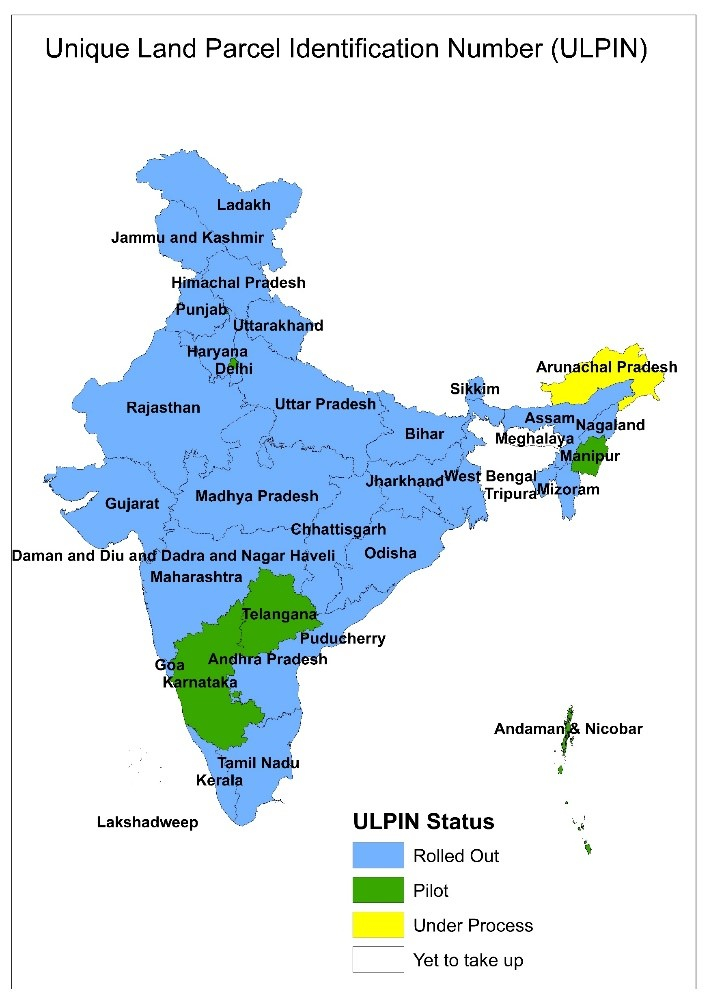
ULPIN (Unique Land Parcel ID/Bhu-Aadhar): Providing unique identifiers for land parcels
Bhoomi Project (Karnataka): Digitized 20 million land records for 6.7 million landowners
B. Digital Solutions for Dispute Resolution
Integration of land records with e-court systems for faster resolution
Mobile apps for accessing land records
Reduced litigation through transparent digital records
C. Model Tenancy Act, 2016
Formalization of lease agreements
Protection for both tenants and landlords
Reduction of dispute prevalence
D. Contemporary Challenges
Digital divide in rural areas limiting adoption
Training requirements for implementation
Need for ongoing land record updates
Ensuring data security and accuracy
XI. Comparative Analysis: Success Factors in Different States
| Factor | Successful States (Kerala, West Bengal, J&K) | Unsuccessful States (UP, Bihar, Rajasthan) |
|---|---|---|
| Political Leadership | Strong ideological commitment | Weak or inconsistent commitment |
| Administrative Capacity | Efficient machinery with trained personnel | Weak administrative structure |
| Peasant Mobilization | Active movements supporting reforms | Limited organized peasant pressure |
| Legislative Clarity | Clear, unambiguous laws | Loopholes and ambiguous provisions |
| Judicial Support | Courts supported beneficiary rights | Courts often favored property owners |
| Civil Society Participation | NGOs and community organizations engaged | Limited civil society involvement |
| Economic Incentives | Cooperative structures and support services | Limited supporting mechanisms |
| Decentralization | Empowered panchayats in implementation | Centralized, often non-responsive administration |
XII. Conclusion: Land Reforms and India’s Socialist Democratic Project
Land reforms in India represent a defining moment in the nation’s post-independence history, embodying the constitutional commitment to establishing a socialist democratic order. These reforms translated abstract constitutional directives into institutional reality, demonstrating the state’s capacity for transformative socio-economic intervention.
Key Achievements:
Institutional Transformation: Successfully dismantled feudal intermediary systems in significant portions of the country
Democratic Participation: Empowered rural populations through land ownership
Constitutional Precedent: Established the primacy of redistributive justice over absolute property rights
Inequity Reduction: Significantly reduced land inequality in successfully implementing states
Awareness and Mobilization: Created national discourse around land rights and social justice
Persistent Challenges:
Implementation Gaps: Significant variations between legislative intent and actual implementation
Incomplete Transformation: Feudal social relations persisted despite institutional changes in many regions
Legal Evasion: Sophisticated mechanisms circumvented reform provisions
Federal Tensions: State autonomy on land matters limited national reform agenda
Historical Significance:
Land reforms represent India’s unique attempt to achieve socialist transformation through democratic, constitutional means. Unlike revolutionary approaches elsewhere, India’s reforms sought to balance transformative social change with constitutional governance, property-owner compensation, and democratic processes. This balance produced uneven results but also demonstrated that significant social transformation is possible within democratic frameworks.
Future Directions:
Contemporary challenges call for:
Strengthening land record systems through digitization
Addressing remaining landlessness through renewed reform initiatives
Updating ceiling laws to reflect contemporary agricultural realities
Combating concealed tenancy through modern monitoring systems
Engaging civil society in implementation oversight
Building on successful state models in underperforming states
Land reforms ultimately affirm India’s foundational commitment to establishing not merely political democracy but social and economic democracy, where wealth and resources—particularly land, the basis of agrarian society—are equitably distributed, enabling all citizens to participate meaningfully in democratic governance and economic life. While implementation has been imperfect, the very attempt represents a remarkable commitment to realizing constitutional promises through democratic processes.
Key Legislative References
Zamindari Abolition and Land Reform Act, 1950 (Various states including UP, Bihar, Bengal)
Jammu and Kashmir Big Landed Estates Abolition Act, 1950
West Bengal Land Reforms Act, 1955
Operation Barga, West Bengal (1978)
Kerala Land Reforms Act, 1963
Kerala Land Reforms Amendment Act, 1969
Kerala Prevention of Eviction Act, 1966
Land Ceiling Acts (1960s-1970s) across states based on national guidelines
Central Land Reforms Committee Guidelines, 1972
Tamil Nadu Land Reforms (Fixation of Ceiling on Land) Acts (1961, 1970-1972)
Model Tenancy Act, 2016
Ninth Schedule of Indian Constitution (Protection of land reform legislation)
44th Constitutional Amendment Act, 1978 (Deprioritization of property as fundamental right)
Article 39(b) and 39(c) – Directive Principles on equitable resource distribution
UPSC-Relevant Points for Examination Preparation
Potential Mains Questions:
“Critically evaluate the impact of land reforms on India’s socialist democratic character. To what extent have they succeeded in achieving the goals enshrined in the Constitution?”
“Compare the implementation of land reforms in Kerala and West Bengal with those in Uttar Pradesh and Bihar. Analyze the factors responsible for differential outcomes.”
“Discuss the role of the Ninth Schedule of the Indian Constitution in protecting land reform legislation. What are the implications for democratic governance and judicial review?”
“How have Bhoodan and Gramdan movements influenced India’s land reform discourse? Evaluate their achievements and limitations.”
“Analyze the tension between property rights and redistributive justice as manifested in India’s land reforms. How has the Constitution evolved on this issue?”
Prelims Questions Format:
Q. Which of the following statements about land reforms in India is/are correct?
(a) Land reforms are exclusively a central government subject
(b) The Zamindari system was abolished completely by 1970 in all states
(c) The 44th Amendment Act removed property from fundamental rights
(d) Land reforms legislation is protected from judicial review through the Ninth Schedule
Answer: (c) only
Key Statistics for Memorization:
63 million hectares transferred from zamindars to cultivators
20 million tenants brought into direct relation with state
4.2 million acres collected under Bhoodan movement
50,000 villages participated in Gramdan movement
1.5 million sharecroppers secured in West Bengal through Operation Barga
25% of India’s total land redistribution occurred in West Bengal (3% of country’s agricultural land)
6 lakh acres redistributed in West Bengal (1967-1970)
1.5 million acres transferred in Jammu and Kashmir
95% of rural land records digitized (current status)
68% cadastral maps digitized nationally
AGRICULTURE AND FOOD PROCESSING


Discover more from Simplified UPSC
Subscribe to get the latest posts sent to your email.