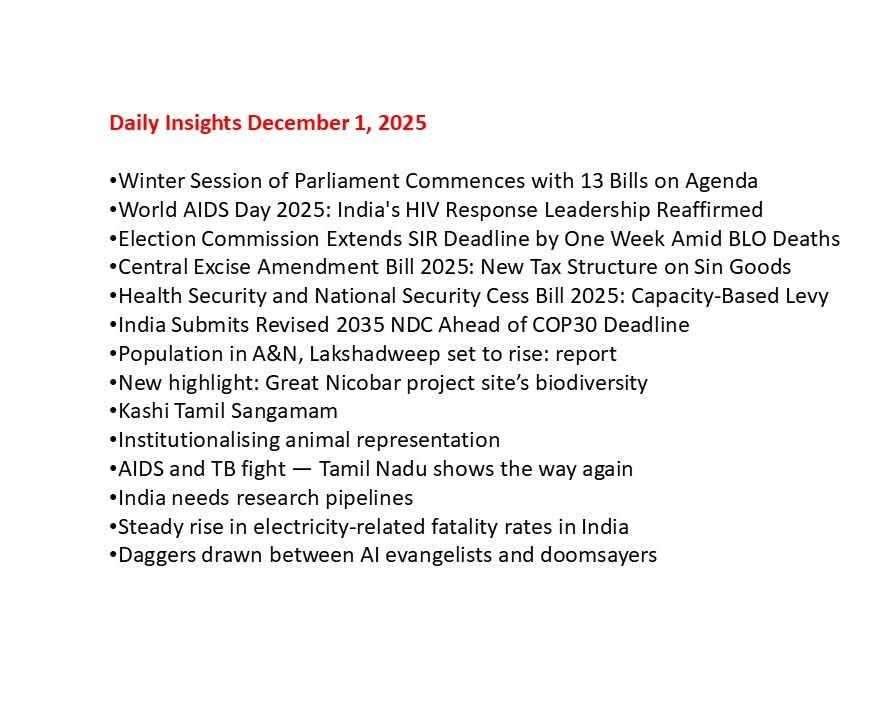
Daily Insights December 1, 2025
Contents
Daily Insights December 1, 2025
1. PARLIAMENT: Winter Session 2025 Commences with 13 Legislative Bills
Source: PIB | https://www.pib.gov.in/PressReleseDetail.aspx?PRID=2196539
Key Points:
Winter Session begins today (December 1) and concludes December 19, 2025 with 15 sittings over 19 days
13 bills listed for legislative business
Major bills include: Central Excise (Amendment) Bill 2025; Health Security and National Security Cess Bill 2025; Insurance Laws (Amendment) Bill 2025; National Highways (Amendment) Bill; Atomic Energy Bill; Corporate Laws (Amendment) Bill; Securities Markets Code Bill 2025; Higher Education Commission of India Bill 2025; Insolvency and Bankruptcy Code (Amendment) Bill 2025
First batch of Supplementary Demands for Grants for 2025-26 to be taken up
All-party meeting held to ensure smooth functioning of both houses
UPSC Relevance: Constitutional procedures, legislative business, government reforms, economic policies
2. HEALTH: India’s HIV Response Leadership Reaffirmed on World AIDS Day 2025
Source: PIB | https://www.pib.gov.in/PressReleseDetailm.aspx?PRID=2196479
Key Points:
National-level observance led by Union Health Minister on December 1, 2025 at Vigyan Bhawan, New Delhi
HIV prevalence declined from 0.33% (2010) to 0.20% (2024) — significantly lower than global average of 0.7%
New HIV infections reduced by 49% since 2010 (from 1.25 lakh to 64,500), surpassing global reduction of 40%
India’s new infections represent only 5% of global total (1.3 million globally in 2024)
NACP Phase-V (2021-26) aims for 80% reduction in annual new infections and AIDS-related mortalities by 2025-26
16.06 lakh PLHIV receiving free ART through 725 ART centers; 12.30 lakh viral load tests conducted (2022-23)
Theme: “Overcoming disruption, transforming the AIDS response”
UPSC Relevance: Public health policy, sustainable development goals, international commitments, health indicators
3. ELECTIONS: Election Commission Extends SIR Deadline Amid BLO Deaths
Source: PIB & Financial Express | https://www.financialexpress.com/india-news/eci-extends-sir-deadline-by-7-days-last-to-fill-form-is-dec-11-final-roll-on-feb-14/
Key Points:
Election Commission extended Special Intensive Revision (SIR) enumeration deadline by 7 days across 12 states/UTs
New enumeration deadline: December 11 (from December 4)
Draft rolls to be published December 16 (from December 9)
Revised schedule implemented following multiple BLO (Booth-Level Officer) deaths allegedly due to work pressure
One-month enumeration phase compressed into unrealistic timeline caused extreme stress and fatalities
TMC delegation highlighted suicide cases and strict timeline issues to Chief Election Commissioner
Exercise involves door-to-door verification and data digitization of voter information
UPSC Relevance: Electoral processes, governance challenges, administrative reform, worker welfare, constitutional bodies
4. TAXATION: Central Excise Amendment Bill 2025 — New Tax Structure on Sin Goods
Source: New Indian Express & PIB | https://www.newindianexpress.com/business/2025/Nov/30/govt-to-replace-compensation-cess-with-central-excise-duty
Key Points:
Finance Minister to introduce Central Excise (Amendment) Bill 2025 in Lok Sabha (today)
Replaces GST Compensation Cess with 70% or higher excise duty on tobacco and related products
Cigarettes to face specific cess of ₹2,700 to ₹11,000 per thousand sticks depending on length
New tax burden protected after compensation cess phase-out
Currently: 28% GST + compensation cess (5–290%); moved to 40% GST slab for sin goods; new structure: 40% GST + 70% cess
Proceeds to Consolidated Fund of India for national security and public health expenditure
Provides government “fiscal space” to maintain historically high tax incidence on tobacco
UPSC Relevance: Fiscal policy, taxation structure, indirect taxes, public finance, sin goods regulation
5. HEALTH & PUBLIC FINANCE: Health Security and National Security Cess Bill 2025
Source: News 18 & New Indian Express | https://www.news18.com/business/economy/govt-to-table-central-excise-amendment-bill-2025-what-it-means-for-tobacco-pan-masala-pr
Key Points:
Health Security-cum-National Security Cess Bill 2025 introduced alongside Central Excise Bill
Imposes new cess on manufacture of pan masala and other specified goods (to be notified later)
Unique feature: Cess linked to production capacity of machinery/processes, not volume of goods manufactured
Proceeds dedicated to: Meeting national security expenditure and public health initiatives
First use of capacity-based levy rather than output-based taxation
Government retains power to notify additional goods under this cess
Represents shift in indirect tax architecture toward public health goals
UPSC Relevance: Public finance, fiscal federalism, social security, health policy, government revenue
6. CLIMATE ACTION: India Submits Revised 2035 NDC Ahead of COP30 Deadline
Source: News on Air & Economic Times | https://www.newsonair.gov.in/india-to-submit-revised-ndc-for-2035-by-december-says-environment-minister-bhupender-yadav/
Key Points:
Environment Minister Bhupender Yadav announced revised NDC for 2035 to be submitted by December 2025
India’s emission intensity declined 36% since 2005 — significant achievement in climate action
Non-fossil fuel energy capacity: 256 GW — more than 50% of total installed capacity, achieving NDC target 5 years ahead of 2030 goal
2 billion+ plants planted under community-led initiative in just 16 months
Nuclear Mission and Green Hydrogen Mission to accelerate net-zero pathway by 2070
First Biennial Transparency Report to be released soon
India called on developed nations to achieve net-zero targets ahead of current timelines
Urged compliance with Paris Agreement principles on technology transfer and climate finance
UPSC Relevance: Climate change mitigation, international environmental agreements, India’s climate commitments, sustainable development, energy transition
7. GEOGRAPHY-ENVIRONMENT: Andaman & Nicobar Islands and Lakshadweep Population to Rise
Source: PIB & Census Data | https://www.gktoday.in/kashi-tamil-sangamam-4-0-is-scheduled-to-begin-on-december-2nd/
Key Points:
Population of A&N projected to increase following development initiatives and improved connectivity
Lakshadweep population (2025): ~68,400 — growth of 6.15% from 2011 census (64,473)
Lakshadweep literacy rate: 91.85% — among India’s highest
Sex ratio: 946 females per 1000 males — above national average
Muslim population dominance: 96.58%
Growth driven by improved governance, developmental projects, and migration
Strategic importance of island territories increasing with focus on maritime security and blue economy
UPSC Relevance: Demography, island development, regional governance, strategic importance, population trends
8. ENVIRONMENT: Great Nicobar Project Site’s Biodiversity Concerns Highlighted
Source: Drishti IAS & Vision IAS | https://www.theindiaforum.in/environment/great-nicobar-island-hurtling-towards-environmental-catastrophe
Key Points:
Great Nicobar Island — UNESCO World Heritage candidate hosting unique biodiversity
Proposed project span: 166 sq km (10% of island’s 910 sq km), including 84 sq km denotified tribal reserves
Biodiversity threat: 200 bird species, including endemic Nicobar megapode; 11 endemic mammals; 32 endemic bird species; 7 endemic reptile species
Forest cover: 85% tropical rainforest — 650 species of angiosperms, ferns, gymnosperms, bryophytes (many endemic)
Galathea Bay — Ramsar wetland and vital nesting site for globally endangered Leatherback Turtle
Tree felling: 9.6-10 million trees projected to be cut for infrastructure development
Seagrass meadows support 750 fish species and 121 threatened marine species including endangered dugongs
Geological risk: Located on megathrust fault line that triggered 2004 Indian Ocean tsunami
UPSC Relevance: Biodiversity conservation, environmental impact assessment, wildlife protection, coastal zone management, indigenous rights, climate resilience
9. CULTURE: Kashi Tamil Sangamam 4.0 — Celebrating Civilisational Links
Source: PIB & Ministry of Education | https://www.gktoday.in/kashi-tamil-sangamam-4-0-is-scheduled-to-begin-on-december-2nd/
Key Points:
Fourth edition begins December 2 in Varanasi (concludes December 15); second phase in Tamil Nadu (December 16-30)
Theme: “Learn Tamil – Tamil Karkalam” — promoting Tamil language learning across India
Delegates: 1,400+ from Tamil Nadu across 7 categories (students, teachers, writers, farmers, professionals, women, spiritual scholars)
Inaugural event: December 2 at Namo Ghat, Varanasi coinciding with Karthigai Deepam festival
Tamil Karkalam initiative: 50 Hindi-knowing Tamil teachers teaching Tamil to 1,500+ children in Varanasi schools
Tamil learning for North: 300 college students from Uttar Pradesh to undergo 15-day Tamil immersion program in Tamil Nadu
Sage Agasthya Vehicle Expedition: Cultural trail from Tenkasi to Kashi (December 2-12), showcasing historical connections
Heritage visits: Kashi Vishwanath Temple, Sarnath, Prayagraj, Ayodhya, ancestral home of Subramania Bharati
Coordinating institutions: IIT Madras, Banaras Hindu University, multiple Union ministries
Alignment: Strengthening “Ek Bharat Shreshtha Bharat” vision
UPSC Relevance: Cultural integration, linguistic preservation, federalism, national integration, heritage tourism, inter-regional cooperation
10. HEALTH: AIDS and TB Fight — Tamil Nadu Shows Leadership Again
Source: The Hindu Editorial & WHO | https://visionias.in/current-affairs/upsc-daily-news-summary/article/2025-11-14/the-hindu/basic-science-biology/global-tb-funding
Key Points:
Tamil Nadu emerging as health leader in combating AIDS and TB — best outcomes among Indian states
TB statistics: India accounts for 1/4th of all TB patients globally; 1.07 crore affected in 2024
Global TB funding gap: Only $5.9 billion reached (target: $22 billion by 2027); research funding only 24% of target
Innovations: 63 diagnostic tests and 29 drugs in development; 18 vaccine candidates in clinical trials
TB treatment success rate (2024): 88% for drug-susceptible TB
Rapid TB testing coverage: 54%; 1.64 lakh receiving drug-resistant TB treatment
High-risk preventive treatment: 53 lakh individuals covered
Social determinants: Undernutrition, HIV, diabetes, smoking, alcohol major risk factors
WHO call: Increased political commitment and domestic investment essential for 2030 elimination goals
UPSC Relevance: Public health indicators, epidemic disease control, state-level governance, health policy, sustainable development goals, international health cooperation
11. SCIENCE & INNOVATION: India Needs Research Pipelines for Breakthrough Technologies
Source: The Hindu Editorial & DST | https://www.pib.gov.in/PressNoteDetails.aspx?NoteId=153470
Key Points:
India’s innovation ranking: 39th globally (Global Innovation Index 2024) — improvement from 79th (2019) on Network Readiness Index
IP filings: 6th position worldwide (as per WIPO 2023)
National Quantum Mission: ₹6,003.65 crore allocated (8-year duration) for quantum technology R&D
Four Thematic Hubs: Quantum Computing (IISc Bangalore), Quantum Communication (IIT Madras), Quantum Sensing & Metrology (IIT Bombay), Quantum Materials & Devices (IIT Delhi)
152 researchers from 43 institutions (31 institutes of national importance, 8 research labs, 1 university, 3 private institutes)
Technology Innovation Hubs (TIHs): 25 established in AI/ML, Robotics, Cyber Security, Data Analytics, Agriculture Technologies, Mining, Advanced Communications, Quantum
Supercomputing infrastructure: 32 Peta Flop capacity; additional 45 Peta Flop planned for 2025
INSPIRE program: Flagship scheme attracting youth to science and research careers
UPSC Relevance: Science and technology policy, research infrastructure, innovation ecosystem, human resource development, institutional frameworks for R&D
12. OCCUPATIONAL HEALTH: Steady Rise in Electricity-Related Fatality Rates in India
Source: NewsLaundry & Polycab Study | https://www.newslaundry.com/2023/08/01/electrocution-kills-12500-a-year-but-indias-power-safety-problem-still-finds-little-media
Key Points:
India’s electrocution fatality rate: ~12,500 annually — highest globally per capita
One lakh deaths over last decade (NCRB data) — approximately 34 deaths daily
Workplace electrocution: ~13 deaths daily; accounts for 40% of workplace fatalities
Factory accidents (2017-2020): Average 3 deaths and 11 injuries daily
Major risk factors: Exposed high-power cables, poor installation and maintenance, waterlogged areas, inadequate inspections
Urban areas particularly vulnerable: Dangerously strung cables near residential areas, sporadic haphazard maintenance
Central Electricity Authority data: Alarming rise in incidents post-monsoon
Infra Safety Initiative: Industry partners launching conclaves to address electrical safety in manufacturing
UPSC Relevance: Occupational safety, public health, infrastructure regulation, labor welfare, risk mitigation, industrial policy
13. TECHNOLOGY & GOVERNANCE: AI Evangelists vs. Doomsayers — Regulatory Dilemma
Source: Indian Express & Vision IAS | https://visionias.in/current-affairs/upsc-daily-news-summary/article/2025-11-10/the-indian-express/science-and-technology/what-govt’s-ai-guidelines
Key Points:
MeitY’s AI Governance Guidelines: Balance between innovation and accountability
Key recommendations: Expand data and computing access; integrate with Digital Public Infrastructure (Aadhaar, UPI); tax rebates for MSMEs
Regulatory approach: Agile, sector-specific using existing laws with targeted amendments
Risk mitigation: India-specific framework with voluntary and techno-legal measures
Accountability: Graded liability regime tied to function/risk level; mandatory grievance redressal
New institutions: AI Governance Group, Technology & Policy Expert Committee, AI Safety Institute
Draft IT Rules amendments: Require social media platforms to verify and label synthetically generated content
Capacity building: AI literacy for citizens, public servants, law enforcement
Concerns: Data privacy risks, inference vulnerabilities, potential foreign AI misuse of user data
Current AI adoption: 93% of Indian organizations now using AI (Zoho study) — mostly strengthening privacy frameworks
UPSC Relevance: Technology regulation, data privacy, governance frameworks, innovation policy, cybersecurity, digital rights
14. INTERNATIONAL RELATIONS: Putin’s India Visit Reshapes Global Diplomacy
Source: Modern Diplomacy | https://moderndiplomacy.eu/2025/11/28/vladimir-putins-2025-india-visit-reshaping-global-diplomacy-and-security/
Key Points:
Putin’s first India visit since Ukraine war outbreak — scheduled for early December 2025
23rd Indo-Russian Annual Summit to deepen collaboration on:
Defence manufacturing
Long-term energy deals
Technology transfers
Alternative payment mechanisms bypassing Western sanctions
Strategic context: India maintaining strong Russia ties despite Ukraine conflict and Western isolation
India’s military dependence: 68-70% imports from Russia — despite stated diversification efforts
Geopolitical implications: India’s “strategic autonomy” criticized as maintaining strategic neutrality while de facto favoring Russia
Trade dynamics: India obtaining cheaper oil, weapons, technology from sanctioned Russia
Broader impact: India enabling Russia’s military objectives, undermining global sanctions regime
Western concerns: India’s approach potentially weakening rules-based international order
UPSC Relevance: International relations, geopolitical neutrality, defense cooperation, sanctions regimes, strategic autonomy, global power dynamics
15. ENVIRONMENT: Arctic Geopolitics — Climate Melt Creates Strategic Flashpoint
Source: Geographical Magazine & Indian Express | https://geographical.co.uk/magazine-previews/out-now-december-2025-issue-geographical and https://indianexpress.com/article/opinion/columns/russia-china-us-donald-trump-greenland-arctic-council-10015600/
Key Points:
Greenland ice sheet melting: 30 million tonnes of ice per hour — contributing ~1mm global sea level rise every 3 years
Arctic exceptionalism withering: Rapidly transforming from peace zone to geopolitical flashpoint
Trump’s Greenland acquisition interest: Strategic/military (Pituffik Space Base monitoring Russia/China), resource competition (rare earth minerals), emerging Arctic shipping routes
Arctic mineral resources: 13% world’s undiscovered oil; 30% untapped natural gas
China’s “Polar Power” ambitions: Self-identified as “near-Arctic state”; Polar Silk Road extending Belt and Road Initiative to Arctic
Russia-China Arctic axis: Joint energy projects (Yamal LNG), shipping route development, geopolitical counter to US/NATO
Arctic Council challenges: Russia-Ukraine war disrupted cooperation; eight permanent members + 13 observers including India
India’s Arctic Policy (2022): Emphasizes climate science, sustainability, international cooperation — but lacks strategic/commercial depth
New trade routes: Northern Sea Route becoming operational 6 months/year, reducing Asia-Europe shipping by 40%
Environmental tipping points: Accelerating Greenland/West Antarctic ice sheet loss; permafrost melt; ecosystem collapse risks
UPSC Relevance: Climate change impacts, geopolitics of resources, Arctic governance, international cooperation, climate tipping points, maritime law, India’s global positioning
Discover more from Simplified UPSC
Subscribe to get the latest posts sent to your email.