IndiGo vs Government of India: The Flight Duty Time Limitations Crisis
Contents
IndiGo vs Government of India: The Flight Duty Time Limitations Crisis
Understanding the Dispute
The IndiGo operational crisis of December 2025 represents a significant confrontation between India’s largest airline and the government’s aviation regulatory framework. This dispute is not a traditional legal case in court but rather a regulatory and operational clash that has exposed fundamental tensions between airline commercial interests and passenger safety regulations. The crisis emerged when the Directorate General of Civil Aviation (DGCA) enforced revised Flight Duty Time Limitation (FDTL) rules that significantly restricted pilot working hours, particularly for night operations.
The Root Cause: FDTL Norms
The core of this dispute lies in the implementation of Phase-II of revised Flight Duty Time Limitations rules, which came into effect on November 1, 2025. These regulations were not arbitrary; they were mandated by the Delhi High Court following a decade-long litigation by pilot associations arguing that Indian FDTL norms were weaker than international standards in the United States and Europe.
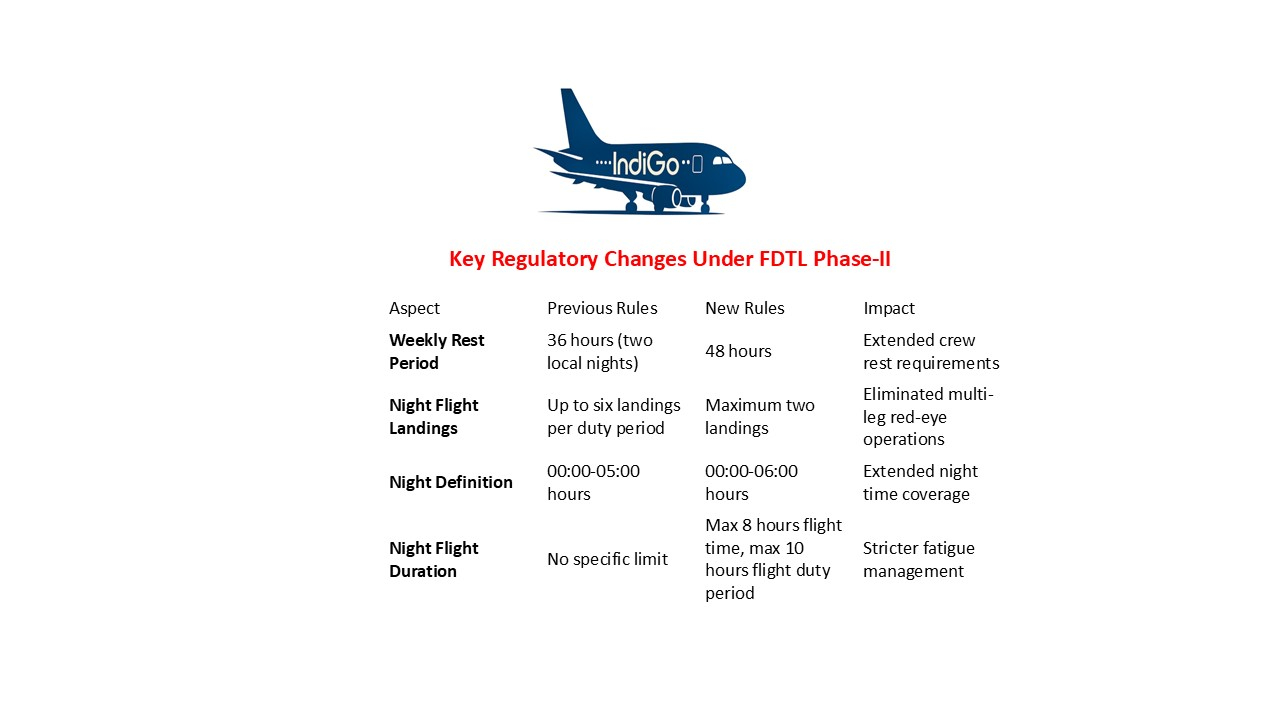
Key Regulatory Changes Under FDTL Phase-II
The revised norms introduced significant operational restrictions for pilot rostering:
| Aspect | Previous Rules | New Rules | Impact |
|---|---|---|---|
| Weekly Rest Period | 36 hours (two local nights) | 48 hours | Extended crew rest requirements |
| Night Flight Landings | Up to six landings per duty period | Maximum two landings | Eliminated multi-leg red-eye operations |
| Night Definition | 00:00-05:00 hours | 00:00-06:00 hours | Extended night time coverage |
| Night Flight Duration | No specific limit | Max 8 hours flight time, max 10 hours flight duty period | Stricter fatigue management |
IndiGo managed the first phase (July 2025) reasonably well, but Phase-II, which curtailed night operations significantly, created a severe capacity crisis.
IndiGo’s Operational Collapse
In early December 2025, the aviation sector witnessed an unprecedented crisis when IndiGo cancelled over 1,000 flights in a single day (December 5)—representing roughly 50% of its daily schedule. This cascaded into a cumulative crisis with the airline cancelling over 1,200 flights throughout the week.
Scale of the Crisis
Peak disruption: Over 1,000 flights cancelled on December 5, 2025
Market impact: Market capitalization wiped out by nearly ₹20,000 crore
Stock decline: 9% fall to ₹5,371 (down from ₹5,900 in previous trading)
Passenger impact: Thousands stranded across major airports (Delhi, Mumbai, Bangalore, Hyderabad)
Fare inflation: Prices on key routes surged past ₹50,000, up from normal rates of ₹8,000-15,000
IndiGo’s Attribution
IndiGo attributed the disruptions to planning lapses and misjudgment during rollout of Phase-II FDTL norms. The airline claimed it was caught unprepared despite having approximately two years’ notice (announced in January 2024, with implementation delayed from June to November 2025).
Pilot Associations’ Allegations: A Counter-Narrative
However, pilot unions—particularly the Airline Pilots’ Association of India (ALPA) and the Federation of Indian Pilots (FIP)—presented a damning counter-narrative that characterizes the crisis as self-inflicted by deliberate mismanagement:
Alleged Corporate Failures:
Hiring freeze: Despite a two-year preparatory window, IndiGo inexplicably maintained a hiring freeze
Pilot retention failures: The airline engaged in cartel-like behavior including pay freezes and non-poaching arrangements
Leave manipulation: Post Phase-II rollout, IndiGo attempted to buy back pilot leave rather than incentivizing retention
Executive compensation vs. employee treatment: While executives received record increments approaching 100% salary increases, pilots faced freezes and reduced leave quotas
Deliberate pressure tactic: FIP alleged the crisis was engineered to pressure DGCA into granting exemptions
The pilots’ unions argued that if IndiGo had invested adequately in crew retention and planning, the transition would have been manageable like other airlines.
Government’s Regulatory Response
The government adopted a multi-layered response strategy that balanced immediate passenger relief with long-term regulatory oversight:
1. Temporary Regulatory Relaxations (Short-term Relief)
On December 4-5, 2025, DGCA granted one-time temporary exemptions to IndiGo’s A320 fleet valid until February 10, 2026:
Exemption from night-duty restrictions (00:00-06:50 hours operations)
Resumption of six night landings per duty period (instead of two)
Withdrawal of weekly rest period substitution restrictions across all airlines
Deployment of 12 DGCA-deputed Flight Operations Inspectors for flying duties for 7-10 days
Redeployment of IndiGo’s own operational inspectors back to flying duties
The DGCA explicitly stated these were “one-time facilitation measures” and repeatedly emphasized that safety requirements remain strictly enforced.
2. Operational Oversight and Monitoring
The government deployed unprecedented real-time monitoring:
24/7 Control Room established by Ministry of Civil Aviation at headquarters
Field inspectors deployed at IndiGo’s operational control centers and major airports
Special mandate for strict monitoring of passenger handling, fare management, and communication protocols
Real-time field inspections at Delhi, Mumbai, Bangalore, and other major airports
3. Passenger Protection Measures
The government mandated airline compliance with passenger care rules:
Automatic full refunds for all cancellations
Cash compensation of ₹5,000-₹20,000 for domestic flights based on delay duration
Hotel accommodation and meals for stranded passengers
Special lounge access for senior citizens and differently-abled passengers
Strict prohibition on arbitrary fare increases during disruptions
Civil Aviation Minister Ram Mohan Naidu issued explicit directions to IndiGo to prevent fare exploitation.
4. Regulatory Investigation and Accountability
The government initiated a high-level four-member committee to probe the crisis:
Committee Members: Sanjay K Bramhane (Joint DG DGCA), Amit Gupta (Deputy DG), Capt. Kapil Manglik, and Capt. Lokesh Rampal
Mandate: Identify causes, assess accountability, review compliance gaps, and recommend corrective measures
Deadline: 15-day report submission
Scope: Examine manpower planning, rostering failures, mitigation measures, and systemic gaps
Minister Ram Mohan Naidu explicitly stated: “Accountability will be fixed. Action will be taken after the inquiry.”
Government’s Stated Approach and Philosophy
The government’s official position, articulated by Civil Aviation Minister Ram Mohan Naidu, reflects a balanced but firm regulatory stance:
Critique of IndiGo’s Management
At a high-level review meeting, Minister Naidu expressed “clear displeasure regarding the manner in which the situation has been handled by the airline” and stressed that “ample preparatory time had been available to ensure a seamless transition.”
This critique centers on IndiGo’s operational readiness, not regulatory validity. The government maintains that airlines had nearly two years to adjust crew planning and rostering.
Safety-First Position
Despite granting temporary exemptions, the government has repeatedly affirmed:
“DGCA’s decision to grant exemptions is being granted solely to facilitate operational stabilisation and in no way amounts to dilution of safety requirements.”
The government’s position suggests that regulatory flexibility in implementation timelines does not compromise the underlying safety principles of FDTL norms.
Passenger Centricity
The government framed its approach as “solely in the interest of passengers, especially senior citizens, students, patients, and others who rely on timely air travel.” This indicates the government prioritized immediate humanitarian relief while maintaining long-term safety enforcement.
Legal and Constitutional Dimensions
The crisis spawned judicial proceedings that add another layer to the dispute:
Public Interest Litigation in Supreme Court
A PIL was filed by the group “IndiGo All Passengers and Another” through advocate Narendra Mishra, seeking:
Constitutional validation of passenger rights under Article 21 (Right to Life and Dignity)
Direction for cessation of arbitrary cancellations
Free alternative travel arrangements (trains, other airlines)
Status report from DGCA on FDTL norms and monitoring mechanisms
Judicial oversight for accountability and restoration of public confidence
The PIL characterizes the crisis as a “humanitarian crisis” and “grave violation of fundamental rights,” arguing that the situation transcended “contractual disputes” to become a matter of national-level public injury.
Political and Ideological Contestation
The crisis became politicized across party lines:
Opposition Perspective:
Congress MP Rahul Gandhi framed the crisis as symptomatic of “government monopoly model” and called for “fair competition” rather than “match-fixing monopolies.” This reflects broader opposition skepticism about government regulatory intervention.
Government Counter-narrative:
The government’s investigation and accountability measures suggest a regulatory approach that acknowledges the legitimate concerns of the pilot associations about IndiGo’s planning failures while maintaining that passenger disruption was preventable with adequate corporate management.
Key Points in Dispute
Regulatory Validity: The FDTL norms themselves are not disputed; they were court-mandated and internationally aligned. The dispute is over implementation methodology and timeline.
Corporate Responsibility: Government and pilots argue IndiGo had adequate notice and resources to prepare. IndiGo argues operational complexity necessitated flexibility.
Safety vs. Operations: Pilots contend that exemptions compromise safety. Government maintains that temporary exemptions do not dilute safety while operational stability is restored.
Market Conduct: The PIL and investigations question whether the disruption was engineered to pressure regulators. This suggests potential competition law implications.
Implications for the Aviation Sector
This dispute establishes several precedents:
Regulatory enforcement authority: DGCA demonstrated willingness to enforce court-mandated safety rules despite industry pushback
Temporary exemption precedent: Future industry crises may reference the February 10, 2026 exemption model
Accountability mechanisms: The inquiry and potential penalties signal that regulatory non-compliance carries consequences
Pilot union empowerment: Pilot associations demonstrated capacity to influence regulatory debates on safety
Conclusion
The IndiGo vs Government of India confrontation is fundamentally about regulatory authority, corporate responsibility, and passenger safety in a rapidly liberalizing aviation sector. The government’s approach emphasizes that regulatory rules exist for passenger and crew safety and that airlines must plan adequate resources, but that implementation flexibility is possible without compromising safety principles. The ongoing inquiry and monitoring suggest the government intends to determine whether this was a genuine operational miscalculation or a deliberate pressure tactic, with accountability measures to follow.
The dispute will likely influence how future aviation regulations are implemented in India, particularly regarding the balance between industry concerns and regulatory enforcement.
Key Takeaway for UPSC Aspirants:
This case illustrates the intersection of regulatory authority (DGCA), constitutional rights (Article 21), competition concerns, and the government’s role in balancing industrial development with consumer protection—all critical themes in the Civil Services syllabus, particularly for Paper II (Governance & Constitution) and Paper III (Social and Economic Policy).
Discover more from Simplified UPSC
Subscribe to get the latest posts sent to your email.