Consumer’s Equilibrium
Contents
Meaning of Consumer and Consumer Behaviour
A consumer is an economic agent who purchases and uses goods and services to satisfy wants within the limits of given income and market prices.
Consumer behaviour studies how a rational consumer decides to spend limited income on different goods and services to maximise satisfaction (utility).
Meaning of Consumer’s Equilibrium
Equilibrium means a position of rest where there is no tendency to change.
A consumer is in equilibrium when they get maximum possible satisfaction from their income at given prices and therefore have no desire to change the existing pattern of consumption.
Thus, consumer’s equilibrium is the situation in which the consumer has allocated income over goods in such a way that total utility is maximised, subject to the budget (income) constraint.
Utility Concepts Used in Equilibrium
Utility: Satisfaction obtained from consuming a good or service.
Total Utility (TU): Total satisfaction from all units consumed.
Marginal Utility (MU): Additional satisfaction from consuming one extra unit of a good.
Law of Diminishing Marginal Utility: As more units of a good are consumed, MU from each additional unit tends to fall.
These ideas are the base for the utility (marginal utility) approach to consumer’s equilibrium.
Consumer’s Equilibrium: Single Commodity (Utility Analysis)
Consider a consumer buying only one good X at price Px.
Equilibrium Condition
Equilibrium is reached when the marginal utility of the last unit (in money terms) equals the price of the good:
MUx = PxIf MUx > Px: each extra unit gives more satisfaction than its price, so the consumer should buy more.
If MUx < Px: each extra unit gives less satisfaction than its price, so the consumer should buy less.
Therefore, the equilibrium quantity of X is that level at which MUx = Px and MU is falling, so that TU is maximised.
Consumer’s Equilibrium: Two Commodities (Law of Equi-Marginal Utility)
Now the consumer spends income on two goods X and Y.
Equilibrium Conditions
Equality of MU per rupee (basic condition):

At this point, the last rupee spent on X and the last rupee spent on Y give the same marginal utility.
Adjustment when not in equilibrium:
If MUx/Px > MUy/Py: consumer gets more utility per rupee from X, so shifts expenditure from Y to X; MUx falls and MUy rises until equality is reached.
If MUx/Px < MUy/Py: consumer shifts expenditure from X to Y; MUy falls and MUx rises until equality is reached.
Full spending of income: Entire income must be spent on X and Y; otherwise the consumer could increase satisfaction by using unspent income.
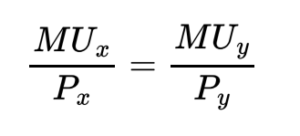
At the combination where these conditions hold, the consumer attains maximum TU and has no incentive to change the combination, so is in equilibrium.
Assumptions of Utility (MU) Analysis
The consumer is rational and aims at maximum satisfaction from given income.
Utility is cardinally measurable (in utils or money), and MU of money is constant.
The Law of Diminishing Marginal Utility holds for every good.
Income of the consumer and prices of goods are given and constant during the analysis.
Goods are homogeneous, divisible, and the consumer’s tastes and preferences remain constant.
Indifference Curve and Budget Line Approach to Consumer’s Equilibrium
Basic Concepts
Indifference Curve (IC): Shows different combinations of two goods that give the same level of satisfaction.
Indifference Map: Family of ICs where curves further from the origin represent higher satisfaction.
Budget Line (Price Line): Shows all combinations of the two goods that the consumer can buy with given income and prices.
Equilibrium Conditions
A consumer is in equilibrium when:
Budget line is tangent to the highest attainable indifference curve.
At the tangency point, the slope of IC (Marginal Rate of Substitution, MRSxy) equals slope of budget line (price ratio Px/Py).

Indifference curve is convex to the origin at the point of tangency (diminishing MRS).
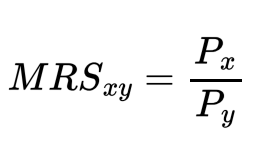
Any other point on the same budget line lies on a lower IC and gives less satisfaction, while points on higher ICs are beyond the budget line and not affordable.
Utility Analysis vs Indifference Curve Analysis (Short Table)


Discover more from Simplified UPSC
Subscribe to get the latest posts sent to your email.

