Demand
Contents
Concept of Demand
In economics, demand = quantity of a good or service that consumers are willing and able to buy at various prices during a given period (not mere desire).
Demand exists only when there is:
Desire for the good
Purchasing power (income/credit)
Willingness to spend that income on the good.
Alfred Marshall: “Amount of a commodity that will be bought at a given price in a given period.” Emphasises price–quantity relation and time period.
Paul Samuelson: “Demand is a schedule of quantities that will be purchased at various prices at a given time.” Forms the basis of demand schedule and demand curve.
Individual vs Market Demand
Individual demand
Quantity of a commodity a single consumer is willing and able to buy at various prices in a given period, ceteris paribus.
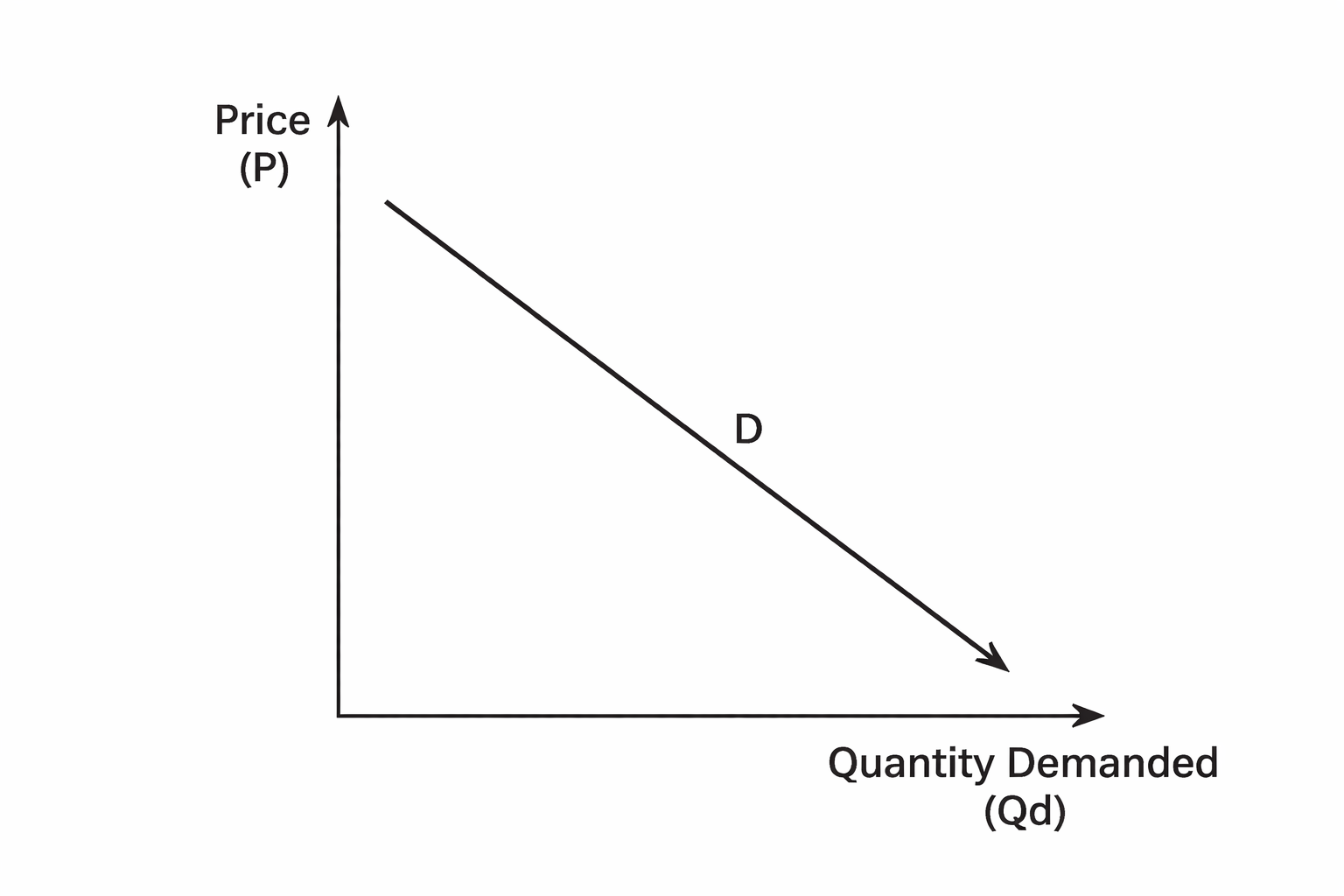
Individual demand curve: shows inverse relation between price and quantity demanded for one consumer; usually downward sloping.
Market demand
Total quantity of a commodity that all consumers in the market are willing and able to buy at various prices in a given period.
Market demand curve: obtained by horizontal summation of all individual demand curves (add quantities at each price).
Demand Function (Individual and Market)
General form
Demand function expresses functional relation between quantity demanded and its determinants:
Qd=f(P,Y,Ps,Pc,T,N,E) where
P = own price, Y = income, Ps= price of substitutes, Pc = price of complements, T = tastes, N = number of consumers, E = expectations.
Individual demand function
Relates quantity demanded by a single consumer to own price and his/her income, tastes, expectations etc., e.g. qi=f(P,Yi,Ps,Pc,Ti,Ei)
Market demand function
Functional relation between market quantity demanded and its determinants; aggregate of individual demand functions, Q=∑qi
Movement vs shift
Change in own price → movement along given demand curve (expansion/contraction of demand).
Change in other determinants (income, tastes etc.) → shift of entire demand curve right (increase) or left (decrease).
Law of Demand
Statement
Other things remaining constant (ceteris paribus), quantity demanded of a commodity varies inversely with its price:
Price ↑ → quantity demanded ↓
Price ↓ → quantity demanded ↑.
Graphical representation
Demand curve: downward sloping from left to right in price–quantity diagram (price on vertical, quantity on horizontal).
Assumptions (ceteris paribus)
Income of consumers remains constant.
Tastes and preferences unchanged.
Prices of related goods (substitutes/complements) constant.
No change in future price expectations.
Size and composition of population constant.
Reasons for downward slope
Substitution effect: When price of a good falls, it becomes relatively cheaper than substitutes; consumers substitute towards it, increasing demand.
Income effect: Fall in price raises real income (purchasing power); consumers can buy more, so quantity demanded increases.
Law of diminishing marginal utility: Additional units give less utility, so consumers are willing to buy more only at lower prices (conceptually consistent though not always explicitly tested).
Exceptions to the Law of Demand
Giffen goods
Special type of inferior goods (staple items making large share of poor consumers’ budget: coarse grains, low‑quality rice etc.).
Price ↑ → real income falls sharply; consumers cut down on costlier foods and buy more of the inferior staple, so quantity demanded rises with price.
Veblen or conspicuous consumption goods
Prestige/luxury goods bought for status: diamonds, designer clothes, high‑end cars etc.
Higher price itself increases snob appeal; some consumers buy more at higher price (Veblen effect).
Necessities of life
Essential goods: basic food items, salt, life‑saving drugs, electricity, water etc.
Demand is almost fixed within a range; even if price rises, quantity demanded does not fall appreciably (very inelastic).
Future price expectations
If consumers expect future price rise, they may buy more now despite rising current prices.
If they expect future price fall, they may postpone purchase, reducing demand even at lower current prices.
Speculative goods
Shares, real estate, other speculative assets: rising price may attract more buyers hoping for capital gains, so demand increases with price.
Ignorance and irrationality
Consumers may be ignorant of ruling price or behave irrationally (fashion, habits, impulse buying), sometimes buying more at higher prices.
Determinants of Demand
Price of the commodity (P)
Core determinant; higher price → lower quantity demanded; lower price → higher quantity demanded (law of demand).
Income of consumers (Y)
Normal goods: income ↑ → demand ↑. Ex. Mobile phones, TVs, laptops
Inferior goods: income ↑ → demand ↓ (consumers shift to superior goods). Ex. Kerosene, low grade grains etc
Prices of related goods
Substitutes (tea–coffee, Pepsi–Coke): price of tea ↑ → demand for coffee ↑ (cross‑price positive).
Complements (car–petrol, printer–ink): price of petrol ↑ → demand for cars ↓ (cross‑price negative).
Tastes, preferences and fashion
Favourable change (trend, advertising, lifestyle) → demand curve shifts right.
Unfavourable change (change in fashion, health concerns) → demand curve shifts left.
Size and composition of population
Larger population → higher market demand for many goods.
Demographic composition (age structure, urbanisation etc.) affects pattern of demand (e.g., more youth → higher demand for education, mobile phones).
Expectations about future prices and incomes
Expected future price rise or income rise → current demand ↑.
Expected future price fall → current demand ↓.
Government policy and taxation
Indirect taxes raise effective price → demand tends to fall.
Subsidies lower effective price → demand tends to rise.
Types of Demand (Conceptual)
Price demand
Demand viewed as a function of own price, holding other factors constant (standard demand curve).
Income demand
Demand as a function of income;
Normal goods: positive relation; inferior goods: negative relation.
Cross demand
Demand for a good as a function of price of related goods (substitutes/complements).
Joint demand
Demand for two or more complementary goods used together (car and fuel, pen and ink); demand for one implies demand for the other.
Composite demand
Demand for a good that has multiple uses (electricity for lighting, heating, industry etc.). Total demand is sum of demands for all uses.
Derived demand
Demand for a factor or intermediate good arising from demand for final goods (e.g., demand for steel derived from demand for cars and construction).
Elasticity of Demand – Concept
Law of demand shows direction of change but not magnitude. Elasticity measures how much quantity responds to changes in determinants.
Elasticity of demand = degree of responsiveness of quantity demanded to change in one determinant (price, income or price of related goods).
Price Elasticity of Demand (PED)
Measures responsiveness of quantity demanded to change in own price.
Defined as:
PED = Percentage change in quantity demanded /Percentage change in price.
Other major types (for syllabus linkage):
Income Elasticity of Demand (YED): response of quantity demanded to change in income.
Cross Elasticity of Demand (XED): response of quantity demanded of one good to change in price of another good (substitute/compliment).
1. Price Elasticity of Demand (PED)
This is the most important type.
Types with Examples
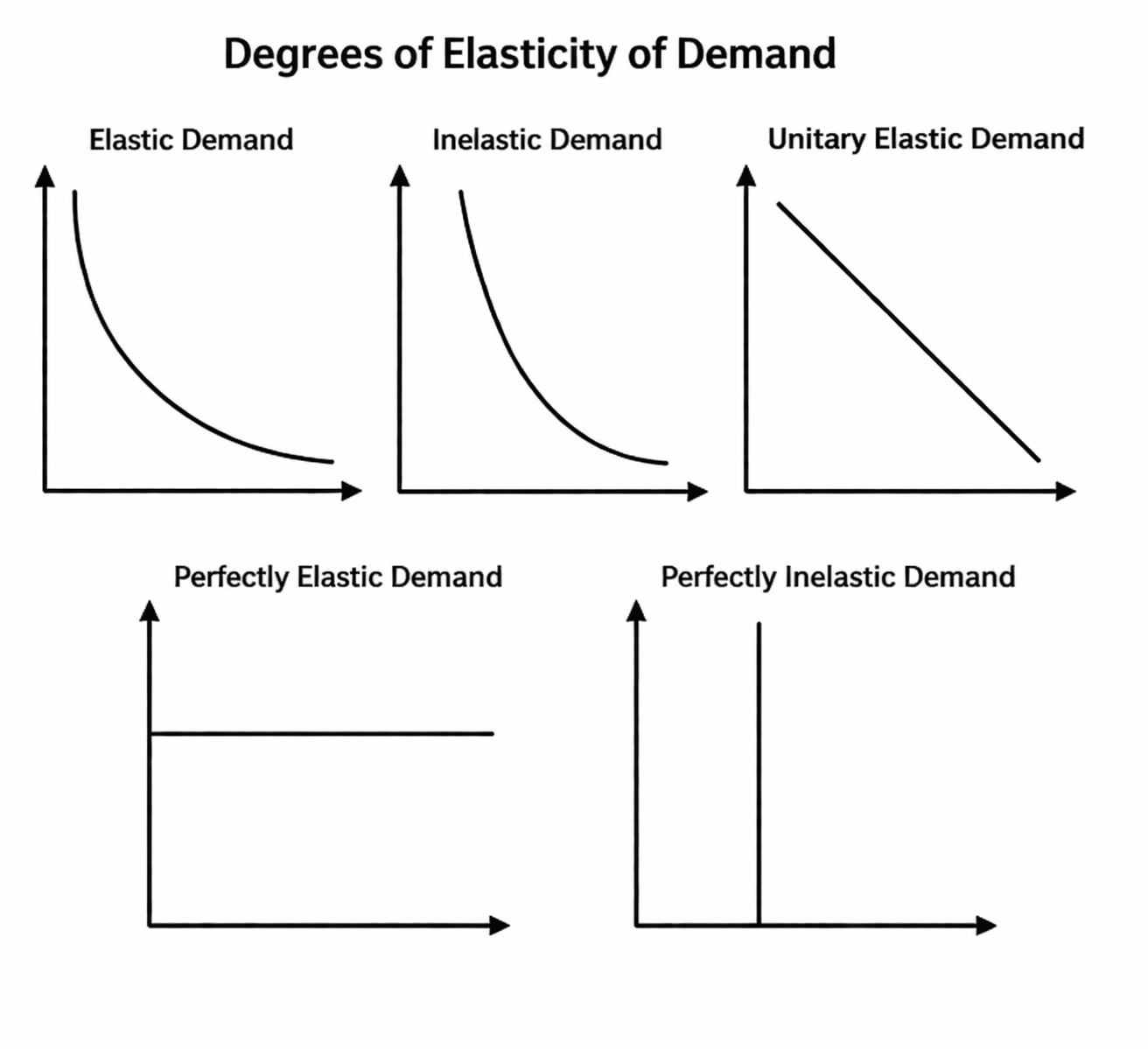
(a) Elastic Demand (PED > 1)
- Quantity changes more than proportionately to price.
- Example: Luxury items like branded shoes
If price drops 10%, demand may increase 25%.
👉 People are sensitive to price changes.
(b) Inelastic Demand (PED < 1)
- Quantity changes less than proportionately to price.
- Example: Petrol or medicines
Even if prices rise, demand doesn’t fall much.
👉 People must buy these goods.
(c) Perfectly Elastic Demand (PED = ∞)
- A tiny price increase leads to zero demand.
- Example: Identical products in perfect competition (like grains in wholesale markets).
(d) Perfectly Inelastic Demand (PED = 0)
- Demand remains constant regardless of price.
- Example: Life-saving drugs (e.g., insulin).
(e) Unitary Elastic Demand (PED = 1)
- Proportionate change in price = change in demand.
- Example: Some household goods in stable conditions.
2. Income Elasticity of Demand (YED)
Types:
- Normal Goods (YED > 0): Demand rises with income
Example: Clothes, electronics - Inferior Goods (YED < 0): Demand falls as income rises
Example: Cheap street food
3. Cross Elasticity of Demand (XED)
Types:
- Substitutes (XED > 0):
Example: Tea and coffee
If tea price rises → coffee demand increases - Complements (XED < 0):
Example: Car and petrol
If petrol price rises → car demand falls
| Type of Demand | Elasticity Value | Explanation | Shape of Curve | Example |
|---|---|---|---|---|
| Elastic Demand | E > 1 | Quantity demanded changes more than proportionately to price change | Flatter curve | Luxury goods (e.g., branded clothes, ACs) |
| Inelastic Demand | 0 < E < 1 | Quantity demanded changes less than proportionately to price change | Steeper curve | Necessities (e.g., salt, petrol) |
| Unitary Elastic Demand | E = 1 | Quantity demanded changes exactly in proportion to price | Rectangular hyperbola | Basic household goods |
| Perfectly Elastic Demand | E = ∞ | Very small price increase → demand becomes zero | Horizontal line | Identical goods in perfect competition |
| Perfectly Inelastic Demand | E = 0 | Quantity demanded does not change at all with price | Vertical line | Life-saving drugs (e.g., insulin) |
Factors Affecting Elasticity
- Availability of substitutes
- Nature of the good (luxury vs necessity)
- Income level
- Time period (long run = more elastic)
- Habit-forming goods (less elastic)
Real-Life Insight
- Companies like Apple keep premium pricing because their customers show inelastic demand (brand loyalty).
- Discount sales in supermarkets work because many goods have elastic demand.
Why Elasticity Matters
- Pricing strategy: Helps firms decide price changes
- Tax policy: Governments tax inelastic goods (like petrol)
- Business forecasting: Predicts revenue changes
Factors Affecting Price Elasticity of Demand
Nature of the commodity
Necessities (salt, staple food, essential medicines) → inelastic demand.
Comforts and luxuries (ACs, jewellery, expensive cars) → more elastic demand.
Availability of close substitutes
More/closer substitutes → easier to switch → demand more elastic.
No close substitutes (e.g., salt) → demand highly inelastic.
Proportion of income spent on the commodity
Small share of income (needles, matchboxes, salt) → price change hardly affects budget → inelastic demand.
Large share (housing, major durables) → consumers react strongly to price change → elastic demand.
Time period
Short run: adjustment difficult, habits fixed → demand more inelastic.
Long run: consumers can adjust habits, find substitutes, change technology → demand becomes more elastic.
Possibility of postponement
Purchases that can be postponed (car, furniture, luxury travel) → elastic demand.
Non‑postponable items (food grains, basic medicines) → inelastic demand.
Habit‑forming nature
Habitual/ addictive goods (cigarettes, alcohol, some beverages) → consumers less responsive to price → relatively inelastic demand.
Range of price and level of income
At very low or very high prices, additional price changes may not induce much quantity response → inelastic.
Very high‑income consumers may not react strongly to price changes for many goods, reducing elasticity.
Read more: INDIAN ECONOMY


Discover more from Simplified UPSC
Subscribe to get the latest posts sent to your email.

