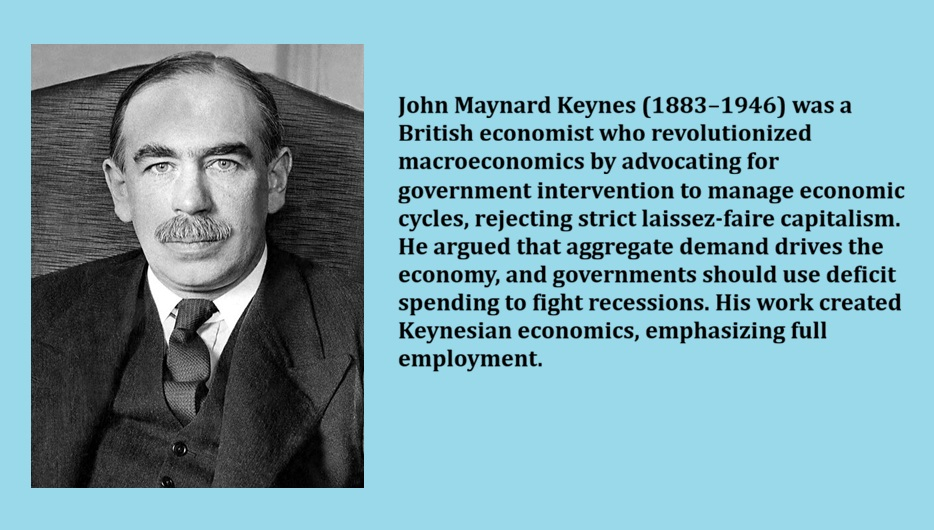
John Keynes — Economic Ideas & Theories
Contents
John Keynes — Economic Ideas & Theories
John Keynes (1883–1946) is widely regarded as the Father of Modern Macroeconomics. His ideas revolutionized how governments understand and manage economies, particularly during crises. Below are his core theories and practical applications.
📚 Books Written by John Keynes
🔑 Core Ideas and Theories
1. Aggregate Demand Theory
Keynes argued that the total demand (spending) in an economy drives output, employment, and income — not supply, as classical economists believed. When aggregate demand falls, businesses produce less, workers are laid off, and the economy enters recession.
Formula concept: AD=C+I+G+(X−M)
Where C = Consumption, I = Investment, G = Government Spending, X = Exports, M = Imports.
Practical Application: During the COVID-19 pandemic (2020), governments worldwide boosted aggregate demand through stimulus checks and unemployment benefits. The IMF reported global fiscal measures exceeded $16 trillion.
2. Rejection of Say’s Law
Classical economists followed Say’s Law — “supply creates its own demand.” Keynes directly challenged this by proving that demand does not automatically arise from production. Markets can get stuck in prolonged unemployment without intervention.
Practical Application: The Great Depression (1929–33), where unemployment hit 25% in the USA and 33% in some countries, validated Keynes’s argument that markets are NOT self-correcting.
3. Role of Government & Fiscal Policy
Keynes advocated for active government intervention through fiscal policy — especially deficit spending during downturns. He believed the government should act as the “spender of last resort” when private investment collapses.
Key tools of fiscal policy:
Government spending on public works (roads, dams, schools)
Tax cuts to increase disposable income of consumers
Deficit budgeting — spending more than revenue during recession
Practical Application: U.S. President Franklin D. Roosevelt’s New Deal (1930s) — massive public works projects that created jobs and revived demand — is the most cited example of Keynesian fiscal policy in action.
4. The Multiplier Effect
Developed with his student Richard Kahn, the Multiplier Effect states that one unit of government spending generates more than one unit of economic activity. When the government spends ₹100, workers earn wages, spend on goods, those sellers spend again — creating a chain of economic activity.
Example: Every ₹1 of government spending can generate ₹1.5 or more in GDP growth, depending on the multiplier coefficient.
Practical Application: India’s infrastructure spending programs (like PM Gati Shakti) are based on this multiplier logic — investment in roads and railways stimulates employment, trade, and consumption simultaneously.
5. Liquidity Preference Theory (Interest Rates)
Keynes explained that people prefer to hold cash (liquidity) rather than invest when uncertainty is high. This preference for liquidity determines interest rates. When liquidity preference is high, interest rates rise, investment falls.
Three motives for holding money:
Transaction motive — for daily needs
Precautionary motive — for emergencies
Speculative motive — to take advantage of future investment opportunities
Practical Application: During recessions, central banks (like the RBI) lower interest rates to reduce the cost of borrowing, making investment attractive over holding idle cash.
6. Investment and the “Animal Spirits”
Keynes introduced the idea of “Animal Spirits” — the psychological and emotional factors (confidence, optimism, fear) that drive business investment decisions. Investment is not purely rational; it is driven by investor sentiment.
Practical Application: Stock market crashes (like 2008 or 2020) are triggered not just by economic fundamentals but by panic and loss of confidence — a Keynesian insight now central to behavioral economics.
7. Wage Rigidity and Unemployment
Keynes argued that wages are sticky downward — workers resist wage cuts even during recessions. This means the labor market does not clear automatically, leading to involuntary unemployment — people willing to work at current wages but unable to find jobs.
Practical Application: This is why governments use minimum wage laws and unemployment insurance — to protect workers when markets fail to provide full employment.
8. Trade Imbalances and Protectionism
Late in his career, Keynes argued that trade deficits weaken economies — when a country imports more than it exports, unemployment rises and GDP slows. Surplus countries impose a “negative externality” on deficit countries by getting richer at their expense.
Practical Application: Keynes proposed taxing surplus countries’ products to correct trade imbalances — a concept visible in today’s trade tariff debates and WTO negotiations.
9. Monetary Policy (Early Views — Later Revised)
In the 1920s, Keynes supported monetarism — stabilizing the price level through interest rate adjustments. He later shifted to emphasizing fiscal policy when he concluded that monetary policy alone is insufficient during deep recessions (the “Liquidity Trap” problem — when interest rates are near zero and monetary stimulus loses effect).
Practical Application: Japan’s “Lost Decade” (1990s) and the 2008 Global Financial Crisis both demonstrated Keynes’s liquidity trap theory — interest rates near zero failed to revive growth, forcing governments to rely on fiscal spending instead.
🧠 Keynesian Economics vs Classical Economics
🌍 Keynes’s Legacy in India (UPSC Relevance)
Keynesian ideas directly influence Indian economic policy:
Five Year Plans relied on government investment to stimulate growth (classic Keynesian fiscal policy)
MGNREGA (rural employment guarantee) is a demand-side stimulus tool rooted in Keynesian thought
Union Budget deficit financing during COVID-19 (2020–21) followed Keynesian prescriptions
RBI’s repo rate cuts during slowdowns reflect liquidity preference theory in practice
Key Quote by Keynes:“In the long run, we are all dead” — arguing that governments must act NOW to fix economic problems rather than waiting for markets to self-correct over decades
⚔️ Criticisms of Keynesian Economics
Keynesian economics, despite its wide influence, has attracted substantial criticism from multiple schools of economic thought — particularly from Monetarists, Austrian School economists, and Supply-Side theorists.
1. Crowding Out Effect
A major criticism is that government borrowing to finance deficit spending raises interest rates, which discourages private sector investment. When the government borrows heavily by issuing bonds, it competes with private firms for the same pool of funds, leaving fewer resources for private investment — a phenomenon called “crowding out”. Milton Friedman and monetarists argued this negates the very stimulus Keynes intended.
2. Stagflation — Failure in the 1970s
The most damaging real-world blow to Keynesian theory came during the 1970s stagflation — a simultaneous occurrence of high inflation + high unemployment. Keynesian theory predicted a trade-off between inflation and unemployment (the Phillips Curve), but stagflation shattered this assumption. This failure forced a rethinking of demand management policies globally.
3. Neglect of Long Run
Keynes focused almost entirely on the short run, dismissing the long run with his famous quote “In the long run, we are all dead”. Critics argue that economic policy must also account for long-term structural issues — such as debt sustainability, capital formation, and productivity growth — which Keynes largely ignored.
4. Assumption of Perfect Competition
Like classical economists, Keynes assumed perfectly competitive markets as the backdrop for his analysis. In reality, markets are dominated by monopolies, oligopolies, and market failures. His models therefore have limited applicability in modern complex economies.
5. Leads to Centrally Planned Economy
Critics, especially Friedrich Hayek (in The Road to Serfdom, 1944), argued that Keynesian intervention implies the government knows better than the market. This gives political authorities dangerous influence over economic decisions, undermining individual freedom and market efficiency. Hayek warned that such thinking could lead to authoritarian economic management.
6. Incomplete Macro Model
Academic critics point out that Keynes’s General Theory is methodologically imprecise — his aggregate demand and supply functions depend only on physical quantities of labour, ignoring wages, fixed capital prices, land rent, and circulation capital. His definitions of voluntary and involuntary unemployment are also criticized as vague and unfinished.
7. Timing Problem (Policy Lags)
Fiscal policy requires time — proposals must be drafted, debated, approved, and implemented. By the time government spending reaches the economy, the recession may already be ending, causing inflationary overheating rather than recovery. This time-lag problem makes Keynesian demand management practically difficult to execute with precision.
8. Neglect of Supply-Side Factors
Keynesian models focus almost entirely on aggregate demand, neglecting supply-side dynamics like debt saturation, supply chain fragilities, and global capital market feedback loops. Supply-side economists (Reaganomics, Thatcherism) argued that tax cuts and deregulation to boost production are more effective long-term solutions than government spending.
9. Multiplier Overestimation
Keynes’s multiplier effect was criticized as theoretically flawed — since government borrows from investors who would have spent that money elsewhere in the private economy, it does not increase the total money stock but merely redirects it. Hence, the multiplier may be significantly smaller than Keynes assumed, especially in open economies where spending leaks abroad through imports.
🔁 Schools That Emerged in Response to Keynes
Bottom Line for UPSC: Keynesian theory remains the foundation of modern macroeconomics and fiscal policy. However, its limitations — especially on inflation control, long-run debt, and supply-side neglect — mean that most modern governments combine Keynesian demand management with monetarist and supply-side tools for balanced economic governance
Read more: INDIAN ECONOMY


Discover more from Simplified UPSC
Subscribe to get the latest posts sent to your email.


