Supply
Contents
Concept of Supply (Economics)
In economics, supply is the quantity of a good or service that producers (firms, sellers, resource owners) are willing and able to offer for sale at different prices during a given period of time.
Supply always involves:
Willingness to sell (producer’s intention).
Ability to sell (availability of output/resources).
A specified price and time period (e.g., 500 units per week at a price of 10 per unit).
Supply may refer to quantity offered at a particular price (point supply) or at various prices (supply schedule/curve).
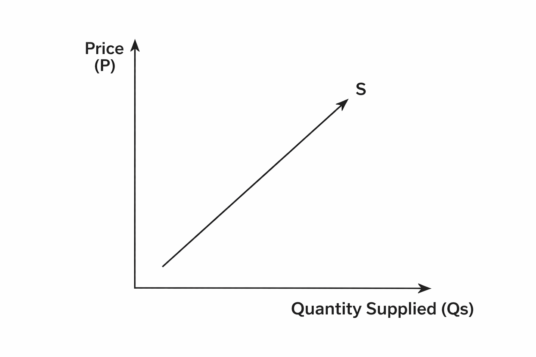
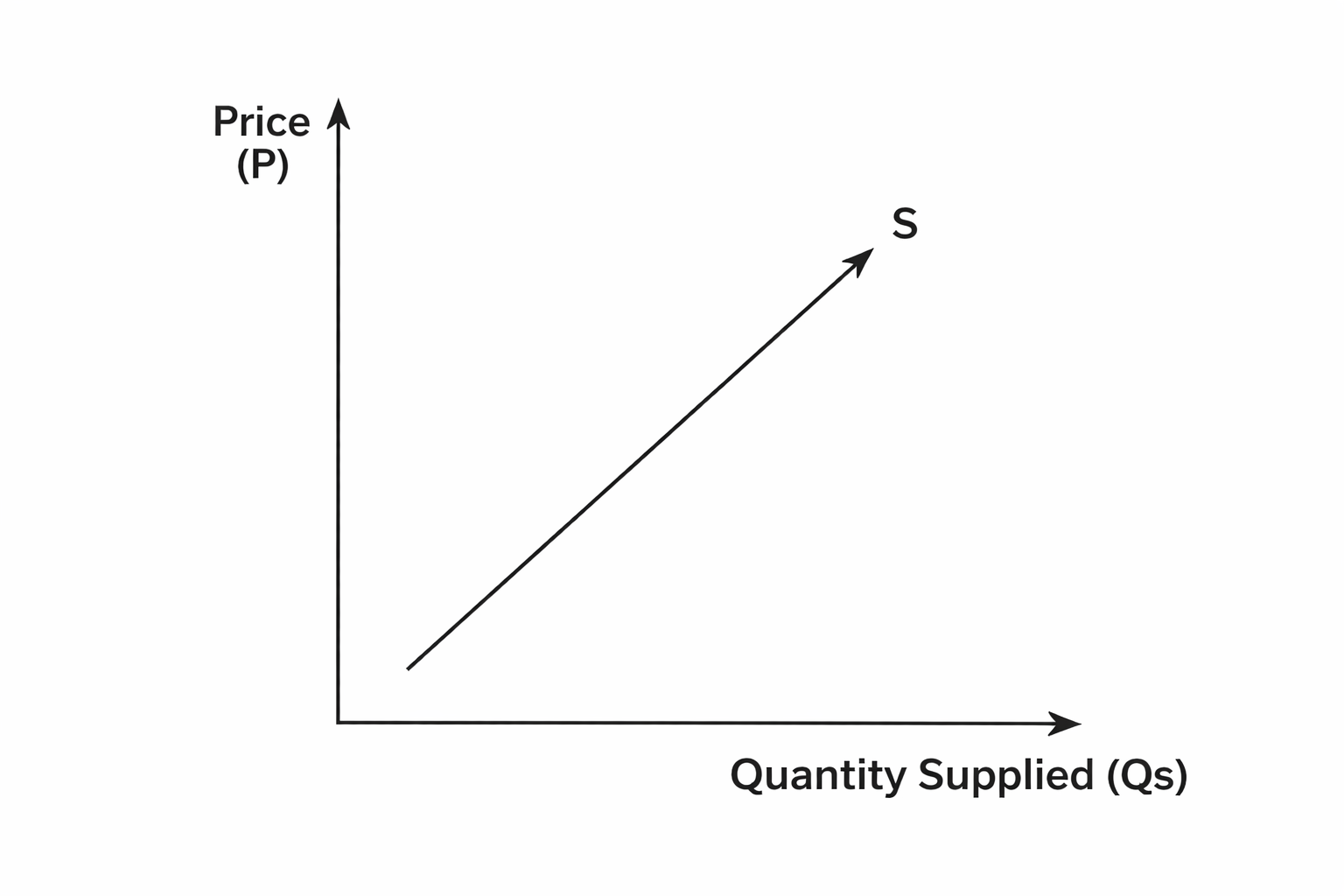
Graphically, supply is represented by an upward‑sloping supply curve in price–quantity space (price on vertical axis, quantity supplied on horizontal axis).
Supply Schedule and Supply Curve
Supply schedule
A table showing different quantities of a commodity that a producer is willing to supply at different prices over a given period.
It reveals the direct relationship between price and quantity supplied: higher prices are associated with larger quantities supplied, other factors being constant.
Can be of two types (for clarity in class notes):
Individual supply schedule: quantity supplied by a single firm at various prices.
Market supply schedule: total quantity supplied by all firms at various prices (horizontal sum of individual supplies).
Supply curve
A graphical representation of the supply schedule, obtained by plotting price–quantity combinations and joining them; it generally slopes upwards from left to right reflecting the law of supply.
Movement along supply curve (extension/contraction of supply) occurs due to change in own price alone.
Shift of supply curve (increase/decrease in supply) occurs when any non‑price determinant (technology, input prices, taxes, etc.) changes.
Law of Supply
Statement
Other things remaining constant (ceteris paribus), quantity supplied of a commodity varies directly with its price:
Price ↑ → quantity supplied ↑
Price ↓ → quantity supplied ↓.
Explanation
Higher prices provide greater profit per unit, encouraging existing firms to expand output and attracting new firms into the industry; conversely lower prices discourage production.
Hence the supply curve slopes upward, showing this positive relationship between price and quantity supplied.
Assumptions (ceteris paribus conditions)
Technology and methods of production remain unchanged.
Cost of production and input prices remain constant.
Prices of related goods do not change.
Government policy (taxes, subsidies, regulations) remains unchanged.
Number of firms in the industry remains constant.
No abnormal natural factors (droughts, disasters).
No speculative expectations about future prices.
Exceptions to the Law of Supply
Future price expectations
If sellers expect higher prices in future, they may withhold stock today, supplying less even at higher current prices; if they expect future price fall, they may sell more now even at lower prices.
Perishable goods
For highly perishable goods (fresh vegetables, eggs, fruits), sellers may offer more at lower prices to avoid spoilage and loss, violating the usual positive price–supply relation.
Rare or fixed‑supply goods
For rare/unique goods (antique paintings, old coins, rare stamps), total supply is fixed; even if price rises sharply, supply cannot increase, so quantity supplied is independent of price.
Agricultural products (short run)
Agricultural output largely depends on natural factors; in bad seasons, supply cannot be increased even at higher prices, and in bumper harvests, farmers may have to sell large quantities despite low prices.
Monopoly/closure situations
In monopoly or business closure situations, a firm may sometimes sell more at low prices (to clear stock) or restrict supply at lower prices for strategic reasons; hence supply may not rise with price in the usual way.
Elasticity of Supply – Concept
Price Elasticity of Supply (PES)
Measures the degree of responsiveness of quantity supplied to changes in the commodity’s own price, other factors remaining constant.
Defined as:
PES = Percentage change in quantity supplied ÷ Percentage change in price.
High PES → quantity supplied reacts strongly to price changes; low PES → quantity supplied reacts weakly.
Importance
Helps firms and policymakers understand how quickly and strongly producers can respond to price incentives.
Relevant for tax policy, buffer stock operations, and analysis of market adjustment to shocks.
Degrees of Elasticity of Supply
(Parallel to demand‑side degrees but on producer side.)
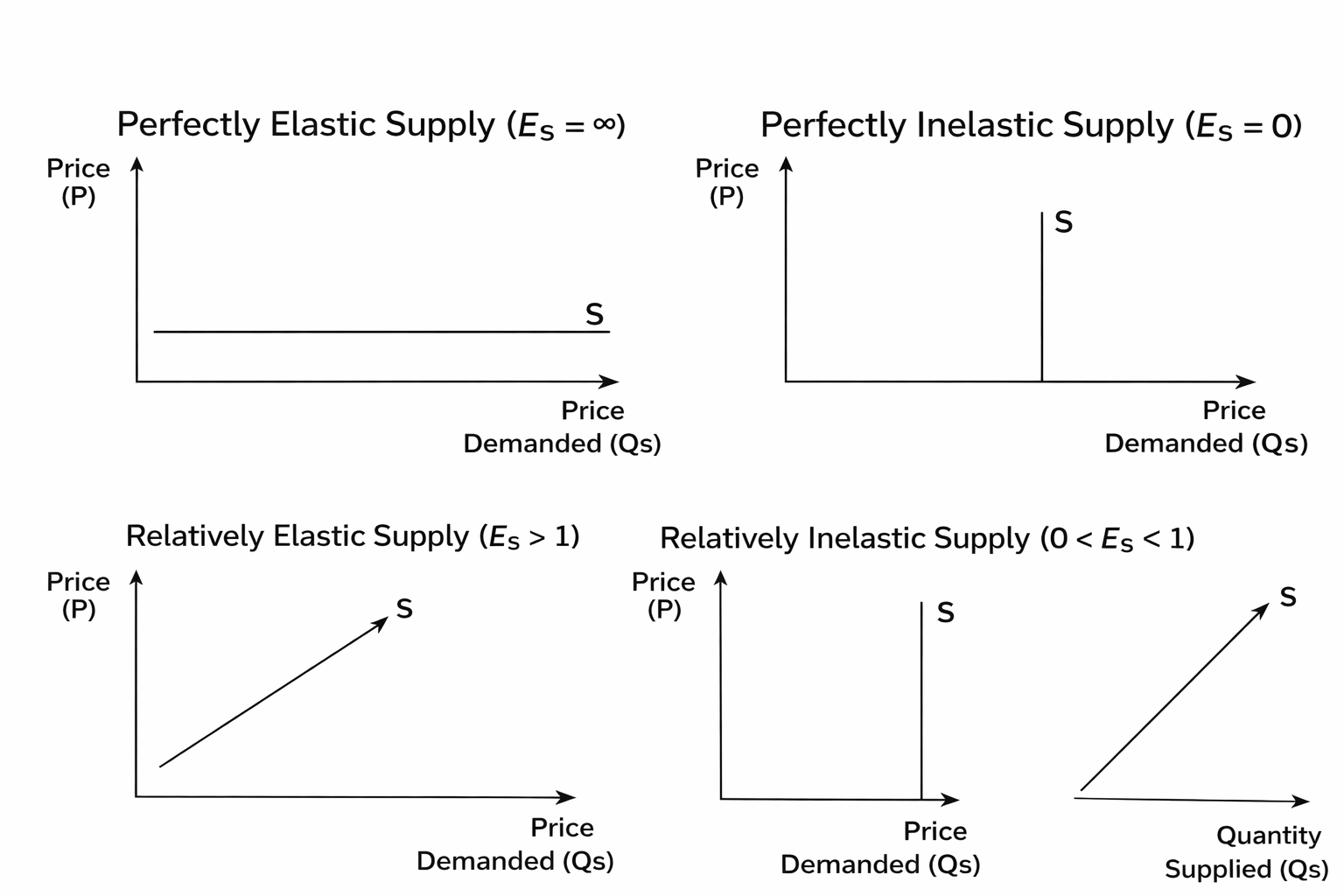
Perfectly elastic supply (Eₛ = ∞)
At a particular price, producers are willing to supply any amount; a very small fall in price causes supply to fall to zero.
Supply curve is a horizontal straight line parallel to the X‑axis.
Perfectly inelastic supply (Eₛ = 0)
Quantity supplied remains constant regardless of price changes; no supply response.
Supply curve is vertical, indicating fixed quantity (e.g., unique works of art, some rare goods).
Relatively elastic supply (Eₛ > 1)
Percentage change in quantity supplied is greater than percentage change in price; producers respond strongly to price changes.
Supply curve is relatively flatter (closer to horizontal).
Relatively inelastic supply (0 < Eₛ < 1)
Percentage change in quantity supplied is less than percentage change in price; producers respond weakly.
Supply curve is relatively steeper (closer to vertical).
Unitary elastic supply (Eₛ = 1)
Percentage change in quantity supplied is exactly equal to percentage change in price.
Supply curve is a straight line passing through the origin; proportionate changes are equal along this line.
Factors Affecting Price Elasticity of Supply (Brief, for completeness)
Time period
Very short run/market period: supply almost fixed → highly inelastic.
Long run: firms can vary capacity, enter/exit → more elastic.
Spare production capacity
If firms have idle capacity, they can easily expand output when price rises → supply more elastic.
Ease of storing the product
Goods that can be stored cheaply and safely (grains, canned goods) have more elastic supply than highly perishable goods.
Ease of factor mobility and production flexibility
If factors (labour, capital, raw materials) can be easily shifted between industries, supply is more elastic.
Length and complexity of production process
Goods requiring long gestation periods or complex processes (ships, heavy machinery) tend to have less elastic supply.
Market Equilibrium (Demand–Supply Interaction)
Meaning of equilibrium
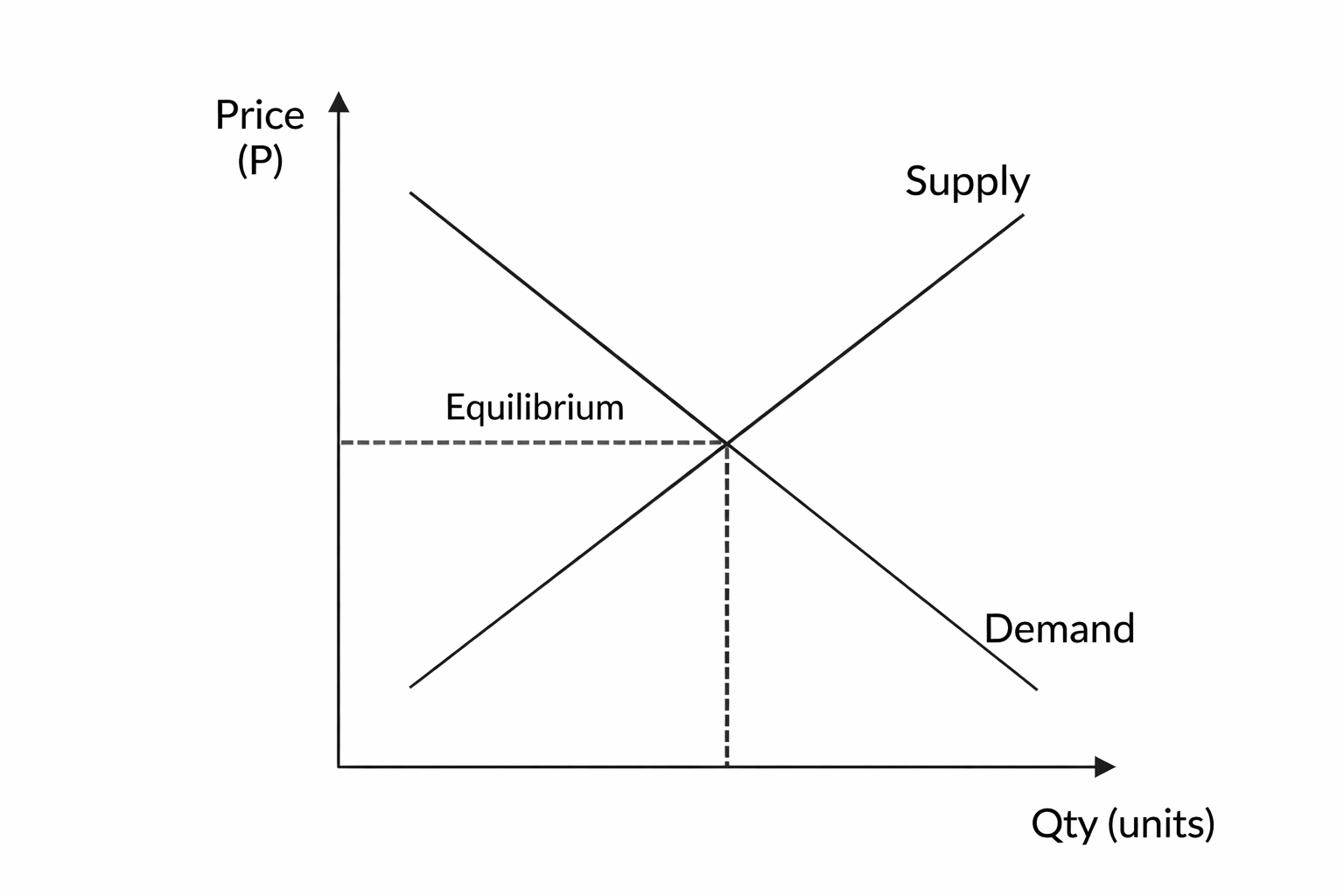
Market equilibrium is the situation where quantity demanded = quantity supplied at a particular price; this price is called the equilibrium price, and the corresponding quantity is the equilibrium quantity.
At equilibrium, there is no tendency for price to change as long as demand and supply conditions remain constant.
Adjustment mechanism
If price is above equilibrium:
Quantity supplied > quantity demanded → excess supply (surplus).
Producers reduce price to clear unsold stock, moving back towards equilibrium.
If price is below equilibrium:
Quantity demanded > quantity supplied → excess demand (shortage).
Consumers bid up price; higher price encourages more supply and reduces demand until equilibrium is restored.
Role of elasticities
The steepness/flatness of demand and supply curves (their elasticities) affects how much quantity and price change when demand or supply shifts.
For example, if supply is very inelastic, a rightward shift of demand raises price sharply but quantity only slightly; if supply is elastic, the same shift raises quantity more and price less.
Read more: INDIAN ECONOMY


Discover more from Simplified UPSC
Subscribe to get the latest posts sent to your email.