Inter‑State Relations
Contents
Inter‑State Relations: UPSC Notes
The smooth functioning of Indian federalism depends not only on Centre–State relations but also on harmonious relations among the states themselves. The Constitution therefore provides several mechanisms to regulate inter‑state comity, coordination, and free movement of people, goods, and ideas.
These include:
Adjudication of inter‑state water disputes
Inter‑State Council and Zonal Councils for coordination
Mutual recognition of public acts, records, and judicial proceedings
Constitutional provisions on freedom of inter‑state trade, commerce, and intercourse (Part XIII, Articles 301–307)
GST has significantly altered the fiscal and trade dynamics of inter‑state relations, turning the earlier fragmented indirect‑tax regime into a more integrated national market.
1. Inter‑State Water Disputes (Articles 262 and related legislation)
Constitutional basis:
Article 262 provides for the adjudication of inter‑state water disputes and empowers Parliament to:
Enact a law to set up tribunals for disputes over use, distribution, and control of waters of inter‑state rivers and river valleys.
Exclude the jurisdiction of the Supreme Court and other courts in respect of such disputes once a tribunal is seized.
Legislation and machinery:
River Boards Act, 1956: Empowers the Central government, on request of concerned states, to set up river boards to advise on regulation and development of inter‑state rivers and river valleys.
Inter‑State Water Disputes Act, 1956:
Central government can set up an ad hoc tribunal when two or more states disagree on waters of an inter‑state river/river valley.
The tribunal’s decision is final and binding; no appeal lies to SC or any other court.
This is meant to replace purely legal adjudication by technical‑cum‑political bodies better suited to public‑interest and public‑utility aspects of water management.
Inter-State Water Dispute Tribunals Set-up So Far
| SI. No. | Name | Set-up in | States Involved |
|---|---|---|---|
| 1 | Krishna Water Disputes Tribunal | 1969 | Maharashtra, Karnataka and Andhra Pradesh |
| 2 | Godavari Water Disputes Tribunal | 1969 | Maharashtra, Karnataka, Andhra Pradesh, Madhya Pradesh and Orissa |
| 3 | Narmada Water Disputes Tribunal | 1969 | Rajasthan, Gujarat, Madhya Pradesh and Maharashtra |
| 4 | Ravi and Beas Water Disputes Tribunal | 1986 | Punjab and Haryana |
| 5 | Cauvery Water Disputes Tribunal | 1990 | Karnataka, Kerala, Tamil Nadu and Puducherry |
| 6 | Second Krishna Water Disputes Tribunal | 2004 | Maharashtra, Karnataka and Andhra Pradesh |
| 7 | Vansadhara Water Disputes Tribunal | 2010 | Odisha and Andhra Pradesh |
| 8 | Mahadayi Water Disputes Tribunal | 2010 | Goa, Karnataka and Maharashtra |
| 9 | Mahanadi Water Disputes Tribunal | 2018 | Odisha and Chhattisgarh |
Rationale: Water disputes involve large‑scale public‑interest issues (irrigation, drinking water, power, environment) that cannot be fully resolved by applying private‑property‑like legal principles; hence, extra‑judicial technical tribunals are preferred.
| Krishna | Godavari | Narmada | Ravi and Beas | Cauvery | Second Krishna | Vansadhara | Mahadayi | Mahanadi |
| 1969 | 1969 | 1969 | 1986 | 1990 | 2004 | 2010 | 2010 | 2018 |
| Maharashtra, Karnataka & Andhra Pradesh | Maharashtra, Karnataka, Andhra Pradesh, Madhya Pradesh & Orissa | Rajasthan, Gujarat, Madhya Pradesh & Maharashtra | Punjab & Haryana | Karnataka, Kerala, Tamil Nadu & Puducherry | Maharashtra, Karnataka & Andhra Pradesh | Odisha & Andhra Pradesh | Goa, Karnataka & Maharashtra | Odisha & Chhattisgarh |
2. Inter‑State Council (Article 263)
Constitutional idea:
Article 263 authorises the President to establish an Inter‑State Council if it appears that public interest would be served by its creation.
The President can define the functions, organisation, and procedure of the Council.
Specified functions under Article 263:
Enquire into and advise upon disputes between states.
Investigate and discuss subjects of common interest between Centre and states or among states.
Make recommendations for better coordination of policy and action on such subjects.
Position vis‑à‑vis judiciary:
The Council’s role is advisory and deliberative, complementing the Article 131 jurisdiction of the Supreme Court in legal disputes between governments.
It can deal with legal and non‑legal issues (policy, administrative, inter‑governmental coordination).
Sarkaria Commission and actual establishment:
The Sarkaria Commission (1983–87) recommended a permanent Inter‑State Council to differentiate it from other bodies under Article 263 and termed it an “Inter‑Governmental Council”.
The Council was actually set up in 1990 under the Janata Dal government led by V. P. Singh.
Composition of Inter‑State Council:
Chairman: Prime Minister
Members: Chief Ministers of all states
Chief Ministers of UTs with legislatures
Administrators of UTs without legislatures
Governors of states under President’s rule
6 Union cabinet ministers (including Home Minister), nominated by the PM
5 additional ministers (Cabinet/Minister of State with independent charge) as permanent invitees
Duties:
Investigate and discuss subjects of common interest between Centre and states or among states.
Make recommendations for better coordination of policy and action.
Deliberate on other matters of general interest referred by the Chairman.
Procedure:
Meets at least three times a year; meetings are in camera and decisions are taken by consensus.
A Standing Committee (created in 1996) under the Union Home Minister (Chair), with 5 Union Cabinet Ministers and 9 Chief Ministers, prepares matters for the full Council.
Inter‑State Council Secretariat (established 1991, headed by a Secretary to Government of India) also acts as secretariat for Zonal Councils since 2011.
3. Full Faith and Credit – Public Acts, Records and Judicial Proceedings
Constitutional basis (Article 261):
Each state’s jurisdiction is territorially limited, so acts and records of one state may not automatically be recognised in another.
“Full Faith and Credit” clause ensures that:
Public acts, records, and judicial proceedings of the Union and every state are given full faith and credit throughout India.
“Public acts” include legislative and executive acts of government.
“Public records” include official books, registers, and records made by public servants in discharge of official duties.
Parliament’s power:
Can lay down mode of proof and effect of such acts, records, and proceedings in other states.
Judicial proceedings:
Final judgments and orders of civil courts anywhere in India are capable of execution anywhere in India, without fresh suit.
This rule does not apply to criminal judgments; courts of one state are not obliged to enforce the penal laws or criminal judgments of another state.
4. Inter‑State Trade and Commerce (Articles 301–307)
Article 301 – Freedom of trade, commerce and intercourse
Declares that trade, commerce and intercourse throughout India shall be free, subject to other provisions in Part XIII.
This freedom covers both inter‑state and intra‑state trade, breaking down internal border barriers and creating a unified national market.
Permitted restrictions (Articles 302–305):
Article 302 – Power of Parliament to impose restrictions in public interest:
Parliament may impose restrictions on freedom of trade, commerce and intercourse between states or within a state in public interest.
However, Parliament cannot ordinarily prefer one state over another or discriminate between states.
Exception: In case of scarcity of goods anywhere in India, differential treatment may be allowed.
Article 303 – Equality of trade movement:
Prohibits Parliament and state legislatures from making laws that discriminate between states or give preference to one state over another, except in cases of scarcity.
Article 304 – Restrictions by states:
Clause (a): State legislatures may impose reasonable restrictions on freedom of trade, commerce and intercourse with or within that state in public interest; but such bills require prior sanction of the President.
Clause (b): States may impose on goods imported from other states/UTs any tax to which similar goods manufactured in that state are subject, thus prohibiting discriminatory taxes.
Article 305 – Saving of existing laws/nationalisation:
Existing laws operative immediately before the commencement of the Constitution and laws providing for monopolies in favour of the Centre or states are saved.
Thus, the Centre or a state can nationalise a trade, business, industry or service (fully or partially).
Article 307 – Appointment of authority:
Parliament may appoint an appropriate authority to give effect to the provisions of Part XIII (Articles 301–304).
It may also vest such authority with necessary powers and duties.
However, no such authority has been appointed so far.
4.1 New Changes due to GST on Inter‑State Trade and Commerce
GST as a structural shift:
The Goods and Services Tax (GST), introduced via the 101st Constitutional Amendment (2016), has fundamentally altered the indirect‑tax regime and inter‑state trade relations.
GST has subsumed multiple central and state taxes (like CST, VAT, entry tax, luxury tax, etc.) into a single integrated tax system, thereby reducing internal trade barriers.
Key features affecting inter‑state trade:
IGST (Integrated GST) is levied on inter‑state supplies of goods and services, while CGST + SGST applies to intra‑state supplies.
Seamless input tax credit (ITC) across states has eliminated the cascading effect of taxes and made multi‑state operations more efficient.
Removal of CST and state entry taxes has reduced delays at state borders and led to fewer check‑posts, speeding up logistics and supply chains.
Impact on freedom under Article 301:
GST has reinforced the spirit of Article 301 by creating a borderless national market for goods and services.
The multiplicity of state‑wise indirect taxes acted as non‑tariff barriers; GST has significantly reduced these barriers, promoting greater economic integration and smoother inter‑state trade.
Fiscal federalism and GST Council:
GST has centralised indirect‑tax policy formulation under the GST Council, where both Centre and states participate (Centre has 1/3rd vote, all states together 2/3rd).
This has fostered cooperative federalism in taxation, but also raised concerns about reduced state autonomy in setting indirect‑tax rates and rules.
States have greater revenue predictability through GST compensation mechanisms (initially) and sharing of GST revenue, but also face revenue volatility and dependence on Centre‑state agreements.
Place of supply and harmonisation:
Under GST, Place of Supply rules clearly distinguish between inter‑state (IGST) and intra‑state (CGST+SGST) supplies, reducing ambiguity and disputes.
This has led to greater uniformity in how trade and commerce are taxed across states, aligning with the constitutional objective of a single economic unit.
5. Zonal Councils (Statutory Bodies under States Reorganisation Act, 1956)
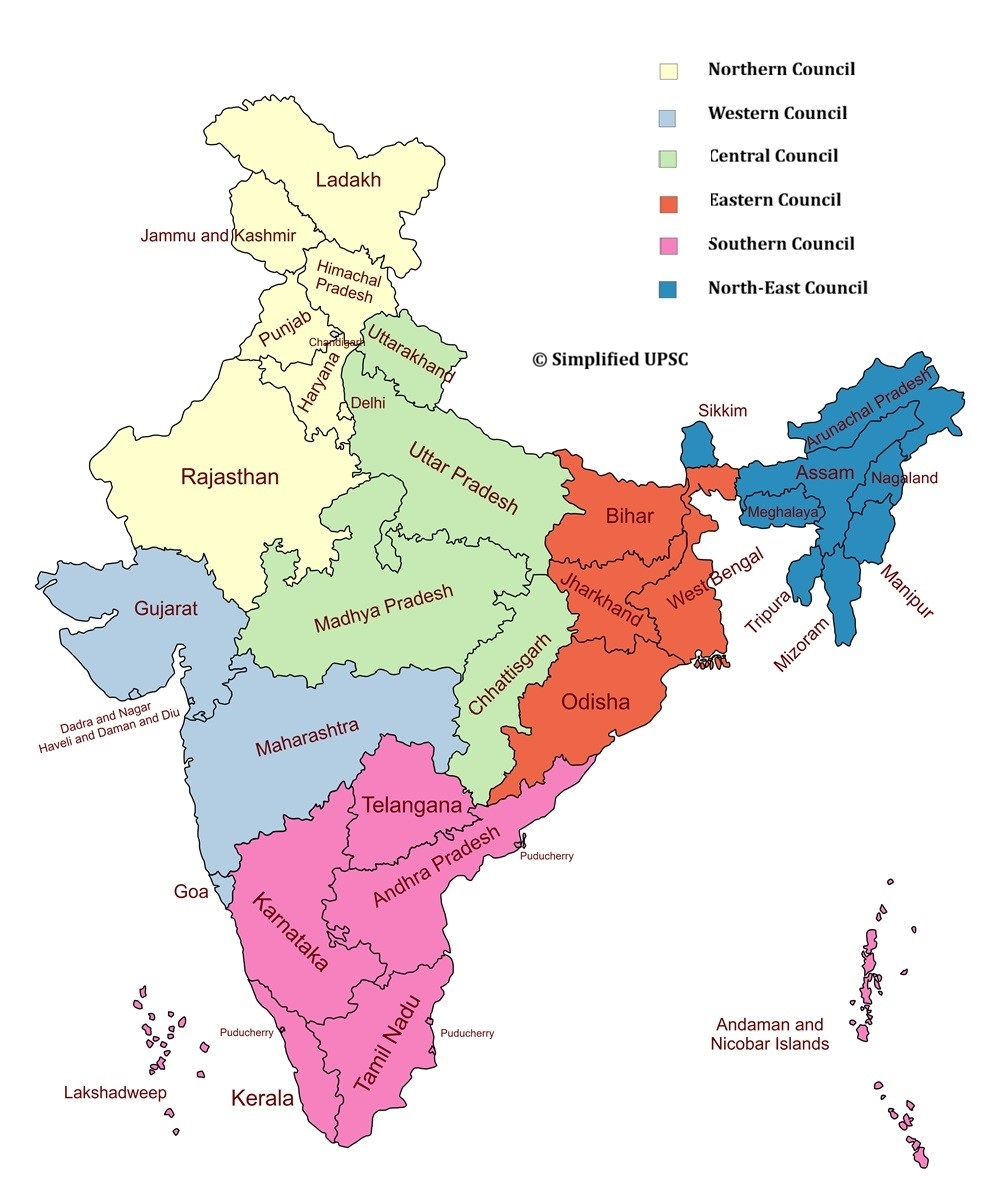
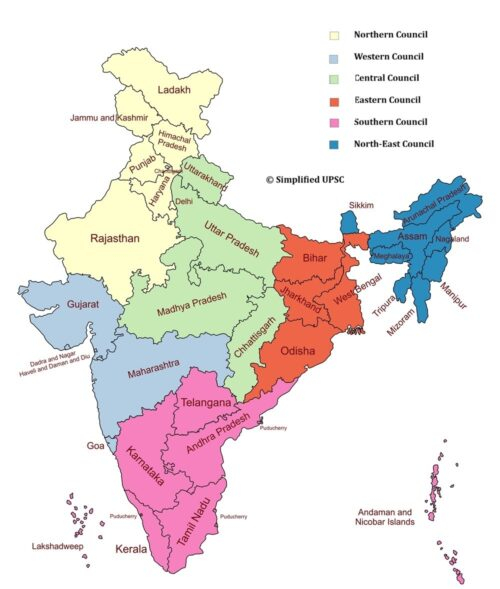
Nature and basis:
Zonal Councils are statutory (not constitutional) bodies created by the States Reorganisation Act, 1956.
They divide India into five zones (Northern, Central, Eastern, Western, Southern) and create one council for each zone.
Composition:
Chairman: Union Home Minister (common to all five councils).
Members: Chief Ministers of all states in the zone.
Two other ministers from each state in the zone.
Administrators of UTs in the zone.
Advisors (non‑voting):
A person nominated by the Planning Commission (now NITI Aayog).
Chief Secretary of each state in the zone.
Development Commissioner of each state.
Vice‑chairman: Each Chief Minister acts as vice‑chairman by rotation for one year.
Objectives and functions:
Promote emotional integration and reduce regionalism, linguism, and excessive state‑consciousness.
Help in removing tensions arising from territorial reorganisation and promote economic advancement.
Enable Centre–states cooperation on:
Economic and social planning
Border disputes
Inter‑state transport
Linguistic minorities
Security and public order
Act as deliberative and advisory bodies (no executive powers).
Zonal Councils at a glance :
Northern Zonal Council: J&K, HP, Haryana, Punjab, Rajasthan, Delhi, Chandigarh; headquarters: New Delhi.
Central Zonal Council: UP, Uttarakhand, Chhattisgarh, MP; HQ: Allahabad.
Eastern Zonal Council: Bihar, Jharkhand, WB, Odisha; HQ: Kolkata.
Western Zonal Council: Gujarat, Maharashtra, Goa, Dadra & Nagar Haveli, Daman & Diu; HQ: Mumbai.
Southern Zonal Council: AP, Karnataka, Tamil Nadu, Kerala, Puducherry; HQ: Chennai.
North‑Eastern Council (Separate Act, 1971):
Members: Assam, Manipur, Mizoram, Arunachal Pradesh, Nagaland, Meghalaya, Tripura, Sikkim.
Functions similar to Zonal Councils, with added emphasis on:
Formulating unified regional plans for common issues.
Reviewing security and public‑order measures taken by member states.


Part I. Constitutional Framework
- Historical Background
- Making of the Constitution
- Salient Features of the Constitution
- Preamble of the Constitution
- Union and its Territory
- Citizenship
- Fundamental Rights
- Directive Principles of State Policy
- Fundamental Duties
- Amendment of the Constitution
- Basic Structure of the Constitution
PART II System of Government
Discover more from Simplified UPSC
Subscribe to get the latest posts sent to your email.